Have you ever wondered whether you should say cuss words or curse words? You are not alone. These two phrases are often used for the same kind of language, but they can carry slightly different feelings and uses. That small difference can make writers stop and think.
Both phrases can describe rude, offensive, or taboo language. In everyday American English, however, cuss words often sounds more casual and conversational. Curse words is also common, but it can sound a little more direct or serious. The best choice depends on your audience, context, and what you want to say.
As an English editor, I often see people treat these phrases as if one is correct and the other is wrong. That is not the case. Both are standard expressions. The real question is which one fits your sentence better. 😊
In this guide, I’ll explain the difference in simple terms. You’ll see examples, common mistakes, grammar rules, usage tips, tables, and FAQs. By the end, choosing between the two should feel easy. ✨ Nor Do I or Neither Do I | Persue vs Pursue | Santa Clause or Santa Claus
🎯 Quick Answer: Cuss Words or Curse Words
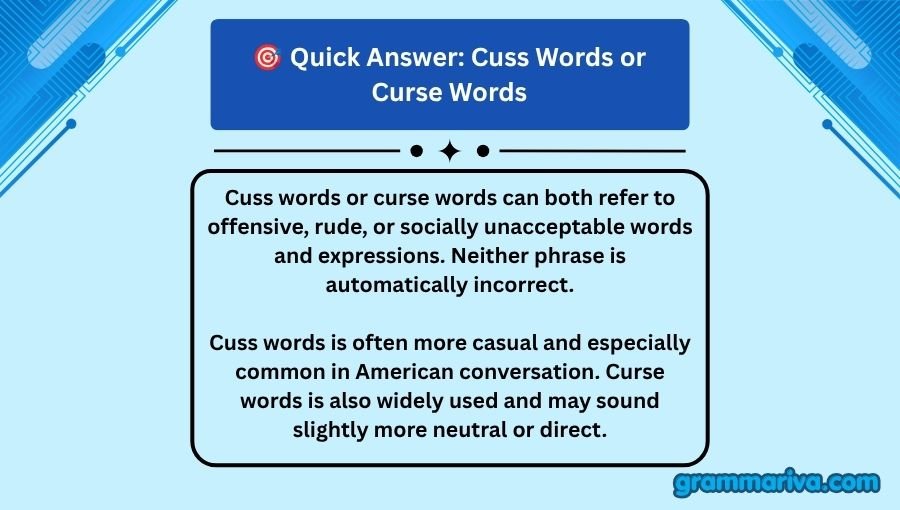
Cuss words or curse words can both refer to offensive, rude, or socially unacceptable words and expressions. Neither phrase is automatically incorrect.
Cuss words is often more casual and especially common in American conversation. Curse words is also widely used and may sound slightly more neutral or direct.
| Phrase | Meaning | Common Feel | Example |
|---|---|---|---|
| Cuss words | Offensive or rude language | Casual | “The movie has a lot of cuss words.” |
| Curse words | Offensive or taboo language | Neutral/direct | “The teacher asked students not to use curse words.” |
| Cussing | The act of using rude language | Casual | “He was cussing after hitting his thumb.” |
| Cursing | The act of using rude language | Neutral/direct | “She apologized for cursing.” |
The key point is simple: both phrases are correct. The difference is mainly one of tone and usage.
Is Cuss Words the Same as Curse Words? 🔍
Yes, in most everyday situations, cuss words and curse words mean nearly the same thing. Both can refer to words that people consider offensive, vulgar, or inappropriate.
The main difference is tone. “Cuss” is a casual American English word. “Curse” has a broader history and can refer to more than offensive language.
For example:
- ✅ “Please don’t use cuss words around the children.”
- ✅ “Please don’t use curse words around the children.”
Both sentences work.
The choice does not change the basic meaning. A speaker might choose “cuss words” because it sounds relaxed. Another speaker might choose “curse words” because it sounds more neutral.
I once edited a school newsletter where the writer used “curse words” in one paragraph and “cuss words” in another. Neither was grammatically wrong. I suggested using one term throughout because consistent wording made the article feel cleaner.
Why Do People Confuse Cuss Words and Curse Words? 🤔
People confuse these expressions because they overlap so closely in meaning. Both can describe language that society considers rude, offensive, or inappropriate.
There is also a spelling and sound connection between the words cuss and curse. They look similar, and both can describe the act of using offensive language.
Another reason is regional usage. American speakers often hear “cuss” in casual speech. Other English varieties may favor “curse” more often.
A simple way to think about it is this:
Cuss sounds more casual.
Curse sounds more neutral or serious.
That is not an absolute rule. Native speakers use both forms in many settings.
A quick memory example
A student once asked me, “Is ‘cuss words’ bad grammar?” I told him that the phrase itself was perfectly acceptable. The issue was not grammar. His problem was that he was writing a formal school essay. In that setting, “offensive language” would have been a better choice.
Cuss Words: Meaning and Correct Use 🗣️
Cuss words is a common informal phrase for words or expressions considered rude, offensive, vulgar, or socially unacceptable.
The word cuss is often associated with casual American English. It can work as a noun or verb depending on the sentence.
As a noun
“Cuss words” refers to the offensive words themselves.
- ✅ “The film contains several cuss words.”
- ❌ “The film contains several cuss word.”
Because the sentence refers to several words, the plural form words is needed.
As a verb
“Cuss” can also mean to use offensive language.
- ✅ “He started to cuss when the computer crashed.”
- ❌ “He started to cuss words when the computer crashed.”
When cuss is used as a verb, you normally do not add “words” after it.
Meaning summary
| Meaning | Word Type | Example Sentence |
|---|---|---|
| Cuss word as offensive language | Noun | “That song contains a cuss word.” |
| Cuss words as several offensive expressions | Plural noun | “The show contains several cuss words.” |
| Cuss as the act of using rude language | Verb | “He began to cuss.” |
💡 Test Tip
Ask yourself whether you are naming the offensive language or describing the action.
If you are naming the language, use cuss word/cuss words.
If you are describing the action, use cuss or cussing.
Curse Words: Meaning and Correct Use ⚠️
Curse words is also a correct phrase for offensive or taboo language.
The word curse can be used as a noun or a verb. Because of that, it has a wider range of meanings than “cuss.”
For example, a person can curse by using offensive language. A person can also curse someone in the sense of wishing harm or bad luck. The context tells you which meaning is intended.
As a noun
- ✅ “The article discusses the use of curse words.”
- ❌ “The article discusses the use of curse word.”
Again, the plural noun needs words when more than one expression is being discussed.
As a verb
- ✅ “He cursed after dropping the box.”
- ❌ “He curse after dropping the box.”
The past-tense form is cursed, not “curse.”
Meaning summary
| Meaning | Word Type | Example Sentence |
|---|---|---|
| Curse word as offensive language | Noun | “The movie contains a curse word.” |
| Curse words as offensive expressions | Plural noun | “Some viewers dislike curse words.” |
| Curse as an action | Verb | “She cursed when she hurt her hand.” |
| Cursed as past tense | Verb | “He cursed after the accident.” |
Cuss Words vs Curse Words at a Glance 📊
The easiest answer is that both expressions are correct, but they differ slightly in tone and range.
| Form | Type | Meaning | Example | Correct/Incorrect |
|---|---|---|---|---|
| Cuss word | Noun | One offensive word | “That is a cuss word.” | ✅ Correct |
| Cuss words | Plural noun | Multiple offensive words | “The show has cuss words.” | ✅ Correct |
| Curse word | Noun | One offensive word | “That is a curse word.” | ✅ Correct |
| Curse words | Plural noun | Multiple offensive words | “The movie contains curse words.” | ✅ Correct |
| Cuss wordses | Incorrect plural | Incorrect form | “The movie has cuss wordses.” | ❌ Incorrect |
There is no grammar rule saying that “cuss words” is wrong while “curse words” is right. Both are accepted expressions.
What Is the Grammar Difference Between Cuss and Curse? 📝
The biggest grammar difference is not between the phrases cuss words and curse words. It is between the individual words cuss and curse.
Both can function as verbs.
- “He cussed.”
- “He cursed.”
Both can describe the use of offensive language.
They can also appear in related forms:
- cuss
- cussed
- cussing
- curse
- cursed
- cursing
One important spelling point is that cursing drops the final “e” from “curse” before adding -ing.
Similarly, cussing uses a double “s.”
The noun phrases follow normal singular and plural rules:
- one cuss word
- two cuss words
- one curse word
- two curse words
Grammar Rules Explanation
Both cuss words and curse words are grammatically valid noun phrases. The first word works as a modifier, while words is the plural noun being described.
The main grammatical issue is number. If you mean one offensive expression, use cuss word or curse word. If you mean more than one, use cuss words or curse words.
The verbs also need normal tense and subject agreement.
- “He cusses.”
- “He cussed.”
- “He is cussing.”
- “He curses.”
- “He cursed.”
- “He is cursing.”
Standard English reference works recognize both “cuss” and “curse” in connection with offensive language. The difference is mostly about style, meaning range, and context.
Correct vs Incorrect at a Glance
| Sentence | Correct/Incorrect | Why |
|---|---|---|
| “That movie has several cuss words.” | ✅ Correct | Plural noun phrase is correct. |
| “That movie has several curse words.” | ✅ Correct | Also a standard plural noun phrase. |
| “He cuss yesterday.” | ❌ Incorrect | The past tense should be “cussed.” |
| “She cursed when she fell.” | ✅ Correct | “Cursed” is the correct past-tense verb. |
| “There were three curse word in the song.” | ❌ Incorrect | “Words” must be plural after “three.” |
How Do You Choose Between Cuss Words and Curse Words? 🎯
Choose cuss words when you want a casual, conversational American English tone. Choose curse words when you want a more neutral or direct expression.
Here is a useful guide:
| Situation | Better Choice | Reason |
|---|---|---|
| Casual conversation | Cuss words | Sounds relaxed |
| Friendly discussion | Cuss words | Informal tone fits |
| General article | Curse words | Clear and neutral |
| Formal writing | Neither if avoidable | “Offensive language” is better |
| Discussion of speech | Either | Both can work |
| School policy | Curse words | Often sounds more neutral |
This does not mean one form is forbidden in a certain setting. It simply means one may sound more natural.
Case Study: Choosing the Right Term at Work 💼
Imagine an employee writing an email about a workplace complaint.
The employee writes:
“There were too many cuss words used during the meeting.”
The sentence is grammatically correct. However, a more professional version would be:
“There was inappropriate language used during the meeting.”
Why?
The goal of a professional email is not simply grammatical correctness. It is also tone. “Cuss words” sounds casual. “Inappropriate language” sounds more suitable for workplace communication.
I once caught myself using “cussing” in an informal note to a coworker. The note was friendly, but when I later turned the message into a formal report, I changed it to “offensive language.” The meaning stayed the same, but the tone became much more appropriate.
What the case teaches
| Version | Grammar | Tone | Best Use |
|---|---|---|---|
| “Cuss words were used.” | Correct | Casual | Conversation |
| “Curse words were used.” | Correct | Neutral | General discussion |
| “Offensive language was used.” | Correct | Professional | Reports |
| “Inappropriate language was used.” | Correct | Formal | Workplace or school |
What Are Common Mistakes With These Terms? ⚠️
Most mistakes happen because people type quickly or treat similar words as interchangeable in every situation.
Here are three common causes:
- Fast typing: People leave out letters or add unnecessary endings.
- Autocorrect: A phone may change a word into something unexpected.
- Lack of knowledge: Writers may assume one phrase is always correct.
Similar grammar confusions
| Confusion | Correct Form | Common Error |
|---|---|---|
| Its / It’s | “Its color” / “It’s cold” | Mixing possession and contraction |
| Your / You’re | “Your book” / “You’re ready” | Mixing possession and contraction |
| Their / There / They’re | “Their car” / “There” / “They’re” | Using the wrong form |
| Cuss / Curse | Both can be correct | Assuming one is always wrong |
| Cussed / Cursing | Depends on tense | Mixing verb forms |
Common wrong spellings and uses
| Wrong Form | What’s Wrong | Correct Form |
|---|---|---|
| Cuss wordes | Incorrect spelling | Cuss words |
| Cuss wordses | Wrong plural | Cuss words |
| Curse wordes | Incorrect spelling | Curse words |
| Curse wordses | Wrong plural | Curse words |
| He cuss yesterday | Wrong verb tense | He cussed yesterday |
| She is curse | Wrong verb form | She is cursing |
Is Cuss More Informal Than Curse? 💬
Yes. Cuss is generally more informal than curse when both refer to offensive language.
That difference is useful when choosing words for different audiences.
Compare:
- “My little brother keeps using cuss words.”
- “The report examines the use of curse words in movies.”
The first sentence sounds like everyday conversation. The second sounds more like general informational writing.
Still, “curse words” is not automatically formal. It is simply a little more neutral.
A good writer should think about the audience before choosing either term.
Usage in Different Contexts 🌎
Both expressions can appear in everyday speech, writing, creative work, and online communication. The best choice depends on the tone.
| Context | Which Term to Use | Example |
|---|---|---|
| Everyday conversation | Cuss words | “He uses too many cuss words.” |
| Professional writing | Neither if avoidable | “The report mentions offensive language.” |
| Creative writing | Either | “The character shouted a curse word.” |
| Social media/texting | Cuss words | “This video has a lot of cuss words.” |
Everyday conversation
“Cuss words” feels very natural in casual American speech.
Professional writing
In formal writing, terms such as offensive language, vulgar language, or profanity may be better.
Creative writing
Writers can choose either expression based on the narrator’s voice.
Social media and texting
Casual terms are common online. “Cuss words” can feel friendly and natural.
When Should You Avoid Both Terms? ✍️
Sometimes the best choice is neither phrase.
If you are writing a formal document, you may want a more neutral expression.
Good alternatives include:
- offensive language
- inappropriate language
- vulgar language
- profanity
- abusive language
- strong language
For example:
- Casual: “The movie has a lot of cuss words.”
- Neutral: “The movie contains a lot of strong language.”
- Formal: “The movie contains frequent offensive language.”
The last two choices may work better in reviews, reports, school documents, or professional content.
Common Phrases With Cuss and Curse 🔤
Both words appear in common expressions. Some are casual, while others are more neutral.
| Phrase | Meaning |
|---|---|
| Cuss words | Offensive or rude words |
| Cuss someone out | Speak angrily to someone using offensive language |
| Cussing | Using offensive language |
| Curse words | Offensive or taboo words |
| Curse at someone | Direct offensive language toward someone |
| Swear words | Another common term for offensive language |
These phrases are not always interchangeable in every sentence. For example, “cuss someone out” is strongly informal, while “use offensive language toward someone” is much more neutral.
What Are the Best Alternatives to Cuss Words or Curse Words? 💡
If you want to sound more professional or avoid repeating the same phrase, several alternatives can work.
| Alternative | Works When | Does Not Work When |
|---|---|---|
| Offensive language | You need a neutral phrase | You want a very casual tone |
| Strong language | Discussing movies, books, or speech | You need to identify a specific type of offense |
| Profanity | Discussing offensive speech directly | Your audience may prefer very simple wording |
| Vulgar language | Describing crude speech | You mean any kind of rude behavior |
| Inappropriate language | Talking about rules or conduct | You need a casual expression |
For many professional settings, offensive language is the safest choice.
Why Does Getting This Difference Right Matter? 🎯
Knowing the difference between casual and neutral wording helps you communicate clearly. The phrases themselves are not difficult, but context matters.
Clarity
Your reader should understand exactly what you mean.
Professionalism
A workplace report should sound different from a text message to a friend.
Digital communication
Online writing is often informal, but public posts can reach many different audiences.
A simple rule I use as an editor is:
The right word is the one that fits both the meaning and the audience.
| Situation | Why Getting It Right Matters |
|---|---|
| Resume | Professional language creates a polished impression |
| Client email | Neutral wording avoids unnecessary informality |
| Published content | Consistent language improves readability |
| Social post | Casual wording may feel more natural |
Does American English Prefer Cuss Words? 🇺🇸
American English commonly uses both cuss words and curse words. “Cuss” has a strongly casual feel and is common in informal American speech.
That does not mean “curse words” is less correct. It simply means the two expressions can signal different tones.
If you are writing for a general American audience, either phrase can work. Your main concern should be context.
For example:
- “Kids should not use cuss words at school.”
- “The study examines the use of curse words in media.”
Both are natural. The first sounds conversational. The second sounds more neutral.
Is Cursing the Same as Cussing? 🗣️
In many situations, yes. Cursing and cussing can both describe using offensive language.
However, curse has meanings that cuss does not always carry.
For example:
“The character cursed the king.”
This could mean the character used offensive language toward the king, but it could also suggest placing a curse on someone, depending on context.
“Cuss” is more strongly tied to informal speech about swearing or using bad language.
| Form | Common Meaning |
|---|---|
| Cussing | Using offensive language |
| Cursing | Using offensive language |
| Cursing someone | Speaking offensively toward someone or, in some contexts, wishing harm |
| Cuss someone out | Insulting or angrily speaking to someone |
How Can You Remember the Difference? 🧠
Use this simple memory trick:
Cuss = casual.
Curse = broader and more neutral.
The first letters can help:
Cuss → Casual
That does not make “curse words” formal. It simply reminds you that “cuss” often sounds more relaxed.
If you are chatting with a friend, “cuss words” feels natural.
If you are writing a general article, “curse words” may feel slightly more neutral.
If you are writing a formal report, consider replacing both with offensive language.
What Should You Use in Formal Writing? 🏢
For formal writing, neither phrase is always the best option. A neutral term often works better.
Consider these choices:
- offensive language
- inappropriate language
- vulgar language
- strong language
- profanity
For example:
❌ “The company policy bans cuss words.”
This is understandable, but it sounds casual.
✅ “The company policy prohibits inappropriate language.”
The second sentence fits a formal policy better.
The key lesson is that grammar and style are different. A sentence can be grammatically correct but still be a poor choice for a particular audience.
Can Cuss Words and Curse Words Be Used Interchangeably? 🔄
Usually, yes. When both phrases refer to offensive language, you can often replace one with the other without changing the basic meaning.
For example:
- “The movie contains several cuss words.”
- “The movie contains several curse words.”
Both sentences communicate the same basic idea.
However, replacement does not always work when curse has another meaning.
For example:
“The witch placed a curse on the village.”
You cannot naturally replace “curse” with “cuss” here.
❌ “The witch placed a cuss on the village.”
That changes the meaning and does not work in standard English.
So remember: the two words overlap when they refer to offensive speech, but “curse” has a wider range of meanings.
Quick Recap Checklist ✅
Use this checklist whenever you are unsure.
| Question | If Yes → Use |
|---|---|
| Am I talking casually about offensive language? | Cuss words |
| Am I using a neutral phrase for offensive language? | Curse words |
| Am I writing a formal report? | Offensive language |
| Am I describing the action casually? | Cussing |
| Am I describing the action neutrally? | Cursing |
| Am I talking about a magical or harmful curse? | Curse |
Practice examples
- “That movie has several ___.”
- Casual: cuss words
- Neutral: curse words
- “He started ___ after dropping his phone.”
- Casual: cussing
- Neutral: cursing
- “The school policy prohibits ___.”
- Best formal choice: offensive language
The more you notice the audience, the easier this choice becomes.
FAQs About Cuss Words vs Curse Words ❓
Are cuss words and curse words the same thing?
Usually, yes. Both phrases can refer to offensive, rude, vulgar, or taboo language. “Cuss words” tends to sound more casual, while “curse words” often sounds more neutral. Neither phrase is grammatically wrong.
Is “cuss words” grammatically correct?
Yes. Cuss words is a grammatically correct plural noun phrase. For one expression, use cuss word. For several expressions, use cuss words.
Is “curse words” grammatically correct?
Yes. Curse words is also a correct plural noun phrase. “Curse word” refers to one offensive expression, while “curse words” refers to more than one.
Which is more common in American English, cuss words or curse words?
Both are used in American English. “Cuss words” often sounds more casual and conversational. “Curse words” can sound slightly more neutral. The best choice depends on the audience and context.
Is cussing the same as cursing?
They can mean the same thing when they describe using offensive language. However, “curse” has other meanings, so cursing can sometimes refer to something beyond simply using rude words.
Should I use cuss words in formal writing?
Usually, no. If you need to discuss offensive language in a formal document, terms such as offensive language, inappropriate language, or profanity may sound more professional.
What is the difference between cuss and curse?
“Cuss” is mainly used informally for using offensive language. “Curse” can also mean using offensive language, but it has additional meanings, including a harmful or magical curse. Context determines the meaning.
Is “cussed” correct English?
Yes. Cussed is a valid past-tense form of the verb cuss. For example, “He cussed after hurting his finger.” It is informal but grammatically correct.
Is “cursing” correct English?
Yes. Cursing is the standard -ing form of curse when the verb means using offensive language. For example, “She was cursing after the computer stopped working.”
What is a more polite term than cuss words?
Good alternatives include offensive language, strong language, inappropriate language, vulgar language, and profanity. The best option depends on how formal your writing needs to be.
Conclusion 🌟
Cuss words or curse words are both correct expressions for offensive or taboo language, so you do not need to worry that one is automatically wrong. The main difference is tone. Cuss words usually sounds more casual, while curse words can sound more neutral. The word curse also has meanings that go beyond offensive speech.
When writing for friends, social media, or casual conversation, cuss words can sound natural. For general writing, curse words is also a clear choice. In formal documents, terms such as offensive language or inappropriate language may be better.
I recommend focusing less on finding one “correct” phrase and more on choosing the phrase that fits your audience. That is the real key to strong English writing. ✨
Remember: correct grammar is only half the job. The best word is the one that fits the context.

Hi, I’m Olivia Carter. I’m an English language editor at Grammariva, and I work on making grammar lessons clear, accurate, and easy to follow. I especially enjoy writing about common grammar mistakes and everyday English.
[…] mistakes, memory tricks, and quick tests. By the end, you will know exactly when to use each word. Cuss Words or Curse Words | Nor Do I or Neither Do I | Persue vs […]