Have you ever typed a word, looked at it twice, and wondered, “Wait, is that spelling right?” persue vs pursue is one of those small spelling traps that can make even careful writers pause. The two forms look almost identical, but only one is a standard English word. The correct spelling is pursue. The spelling persue is incorrect. ❌
I have seen this mistake in school work, emails, social posts, and even polished drafts.
It is easy to make because the sound of pursue can lead your fingers toward the wrong vowels. The good news is that the rule is simple once you see it. 😊
In this guide, I’ll explain the difference in plain English. You’ll learn what pursue means, why persue is wrong, how to remember the spelling, and how to use the correct word in real sentences. By the end, you should be able to spot this mistake quickly and write the word with confidence. Santa Clause or Santa Claus | Invision or Envision | Rancor vs Rancour
🎯 Quick Answer: Is Persue vs Pursue Easy To Remember?
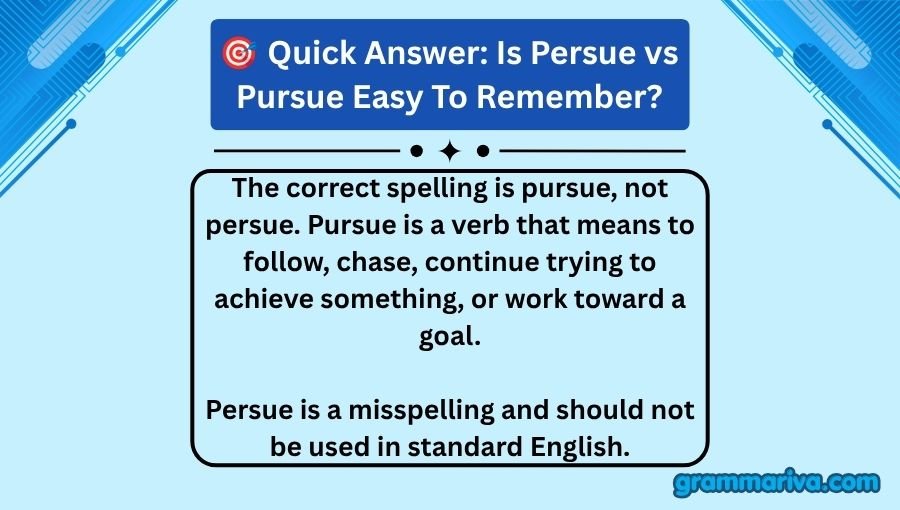
The correct spelling is pursue, not persue. Pursue is a verb that means to follow, chase, continue trying to achieve something, or work toward a goal.
Persue is a misspelling and should not be used in standard English.
| Spelling | Correct? | Meaning | Example |
|---|---|---|---|
| pursue | ✅ Yes | To follow, chase, or work toward something | She wants to pursue a career in medicine. |
| persue | ❌ No | Standard English has no such verb | She wants to persue a career in medicine. |
The easiest rule is this:
Always write “pursue” with “pur” at the beginning.
Is Persue the Same as Pursue?
No. Persue and pursue are not two different English words with different meanings. Pursue is the correct spelling, while persue is a spelling error.
This mistake often happens because English spelling does not always match the way a word sounds. When people hear or say pursue, they may remember the middle sound incorrectly and type persue.
I once reviewed a short school paragraph where a student used persue several times. The student clearly understood the meaning of the word. The problem was only the spelling. Once I pointed out the pur at the start, the mistake disappeared.
Persue: Meaning and Status
Persue is not the standard spelling of the English verb.
You should not use it in essays, resumes, emails, articles, assignments, or professional writing.
For example:
- ❌ I want to persue my dream.
- ✅ I want to pursue my dream.
The meaning the writer wants is clear, but the spelling is still wrong.
Pursue: Meaning and Correct Use
Pursue is a verb. It can describe following someone or something, trying to achieve a goal, or continuing an activity.
For example:
- The police pursued the suspect.
- She decided to pursue her dream.
- He wants to pursue higher education.
- They pursued a new business opportunity.
The exact meaning depends on the sentence, but the spelling stays the same.
🔍 Persue vs Pursue at a Glance
The main difference is spelling. Pursue is correct in standard English, while persue is an incorrect spelling.
| Form | Type | Meaning | Example | Correct/Incorrect |
|---|---|---|---|---|
| pursue | Verb | Follow or chase | The dog pursued the ball. | ✅ Correct |
| pursue | Verb | Work toward a goal | She pursued her dream. | ✅ Correct |
| pursue | Verb | Continue an activity | He pursued his studies. | ✅ Correct |
| persue | Misspelling | No standard meaning | He wants to persue his goal. | ❌ Incorrect |
A useful point is that pursue can be used with both physical and non-physical ideas.
You can pursue a person, a moving object, a career, a goal, an interest, an opportunity, or a dream.
What Does Pursue Mean? 📚
Pursue means to follow or chase something, or to make a serious effort to achieve or obtain something.
It is commonly used in three main ways.
1. Pursue Means “Chase”
The first meaning is physical. If you pursue someone, you follow or chase that person.
Example:
The officer pursued the car down the highway.
Here, pursued means the officer followed or chased the car.
Another example:
The dog pursued the rabbit across the field.
The dog is physically following the rabbit.
2. Pursue Means “Work Toward a Goal”
This is one of the most common modern uses.
Example:
Maya wants to pursue a career in law.
Maya is not physically chasing a career. She is working toward that career.
You can also pursue:
- a dream
- a goal
- an education
- a career
- success
- an opportunity
- a passion
3. Pursue Means “Continue or Take Action”
The word can also describe continuing an activity or course of action.
Example:
The company decided to pursue the project.
This means the company decided to continue working on the project.
| Meaning | Word Type | Example Sentence |
|---|---|---|
| Chase or follow | Verb | The cat pursued the bird. |
| Work toward a goal | Verb | She pursued her dream. |
| Continue an activity | Verb | They pursued the plan. |
💡 Test Tip
When you want to write persue, stop and check the first four letters.
Ask yourself:
Does the word begin with “pur”?
If yes, you are probably on the right track:
p-u-r-s-u-e → pursue
Do not write:
p-e-r-s-u-e → persue ❌
Why Do People Confuse Persue and Pursue?
The confusion in persue vs pursue usually comes from the similar appearance and sound of these two forms.
People confuse these spellings because they look and sound very similar. The difference is only one vowel near the beginning, so the incorrect version can feel natural when typing quickly.
The correct spelling has:
PUR + SUE
The incorrect spelling has:
PER + SUE
The first part is the key.
I remember catching myself typing persue in a quick email years ago. I knew the word, but my fingers followed the sound instead of the spelling. A quick reread caught it before I sent the message.
Common reasons for the mistake include:
- The word is often heard rather than seen.
- The first vowel can be easy to forget.
- Fast typing can cause spelling errors.
- Autocorrect may not always catch a misspelled word.
- Writers may remember the pronunciation but not the spelling.
- Students may never have been taught the correct spelling clearly.
| Reason | How It Causes the Mistake | Simple Fix |
|---|---|---|
| Fast typing | Fingers type the familiar-looking form | Proofread slowly |
| Sound-based spelling | Writer guesses the spelling from pronunciation | Remember PUR |
| Autocorrect | The error may go unnoticed | Use a spell checker and reread |
| Lack of knowledge | Writer has never learned the spelling | Memorize pursue |
| Visual similarity | Both forms look almost identical | Compare the first vowel |
How Do You Spell Pursue Correctly?
When learning persue vs pursue, the most important thing to remember is that the correct spelling is pursue. The correct spelling is:
P-U-R-S-U-E
Break it into two easy parts:
PUR + SUE
This can make the spelling easier to remember.
Correct examples
- ✅ I plan to pursue my goals.
- ✅ She decided to pursue a new career.
- ✅ The team pursued every opportunity.
- ✅ He pursued the runner.
Incorrect examples
- ❌ I plan to persue my goals.
- ❌ She decided to persue a new career.
- ❌ The team persued every opportunity.
- ❌ He persued the runner.
Notice something important: when the verb changes to the past tense, the correct spelling becomes pursued.
It does not become persued.
| Form | Correct Spelling | Example |
|---|---|---|
| Base form | pursue | I want to pursue my goal. |
| Third-person singular | pursues | She pursues her passion. |
| Past tense | pursued | He pursued the opportunity. |
| Present participle | pursuing | They are pursuing success. |
Is Pursue a Verb? 📝
Yes. Pursue is a verb. It describes an action or activity.
For example:
She pursued her goal.
The action is pursued.
The word can appear in several common forms.
Base Form: Pursue
I want to pursue a new career.
Present Form: Pursues
He pursues his interests with passion.
Past Form: Pursued
She pursued her dream for years.
-ing Form: Pursuing
They are pursuing a better solution.
| Form | Example | Use |
|---|---|---|
| pursue | I pursue my goals. | Base form |
| pursues | She pursues her dream. | He/she/it |
| pursued | He pursued the opportunity. | Past |
| pursuing | We are pursuing success. | Continuous action |
These forms all keep the pur spelling.
Can Pursue Be Used for Goals and Dreams?
Yes. Pursue is commonly used with goals, dreams, careers, education, interests, and ambitions.
For example:
She wants to pursue her dream of becoming a writer.
This means she plans to work toward that dream.
Other natural examples include:
- pursue a career
- pursue a goal
- pursue a dream
- pursue an education
- pursue an opportunity
- pursue a passion
- pursue success
- pursue an interest
This use is especially common in professional, academic, and motivational writing.
| Expression | Meaning | Example |
|---|---|---|
| pursue a career | Work toward a career | He wants to pursue a career in design. |
| pursue a goal | Work toward an objective | She pursued her fitness goal. |
| pursue a dream | Try to make a dream happen | They pursued their dream of opening a café. |
| pursue an education | Continue formal learning | She pursued an education abroad. |
| pursue an opportunity | Try to gain an opportunity | We decided to pursue the opportunity. |
Case Study: Using Pursue in Real Life 💼
Imagine that Jordan is applying for a new job.
In the cover letter, Jordan writes:
“I am excited to persue a career with your company.”
The meaning is easy to understand. However, the spelling mistake makes the sentence look less polished.
The corrected sentence is:
“I am excited to pursue a career with your company.”
That one letter can matter in professional writing.
Now imagine a different sentence:
“After graduation, I plan to pursue a career in engineering.”
This is natural, clear, and professional.
The lesson is simple: when you mean “work toward” or “try to achieve,” use pursue.
⚙️ Grammar Rules Explanation
The spelling pursue is the standard English form of the verb. Persue is not the standard spelling.
This is mainly a spelling issue rather than a complex grammar rule. The word must keep its established spelling in all standard uses.
Most major English dictionaries and standard reference sources list pursue as the correct form.
The word can take different grammatical forms, but its spelling pattern remains consistent:
- pursue
- pursues
- pursued
- pursuing
The incorrect spelling persue should not be used in formal or standard English.
Correct vs Incorrect at a Glance
| Sentence | Correct/Incorrect | Why |
|---|---|---|
| She wants to pursue her dream. | ✅ Correct | Pursue is the correct spelling. |
| She wants to persue her dream. | ❌ Incorrect | Persue is a misspelling. |
| He pursued a new opportunity. | ✅ Correct | Pursued is the correct past form. |
| He persued a new opportunity. | ❌ Incorrect | The spelling should begin with pur. |
| They are pursuing their goals. | ✅ Correct | Pursuing is the correct -ing form. |
What Is the Difference Between Pursue and Pursued?
Pursue is the base form, while pursued is the past tense and past participle form.
Compare these sentences:
I want to pursue my goal.
The action is planned or current.
I pursued my goal last year.
The action happened in the past.
The spelling changes because -ed is added, but the beginning stays pur.
| Word | Tense/Form | Example |
|---|---|---|
| pursue | Base form | I will pursue my goal. |
| pursues | Present | She pursues her dream. |
| pursued | Past | He pursued the opportunity. |
| pursuing | -ing form | They are pursuing a solution. |
Common Mistakes ⚠️
One of the most common persue vs pursue mistakes is replacing the “u” with an “e.”
The biggest mistake is replacing pur with per.
Specific spelling mistakes
| Wrong Form | What’s Wrong | Correct Form |
|---|---|---|
| persue | Wrong first vowel | pursue |
| persuing | Incorrect base spelling | pursuing |
| persued | Incorrect past spelling | pursued |
| persues | Incorrect present spelling | pursues |
| peruse | Different word with a different meaning | pursue |
That last row deserves special attention.
Peruse is a real English word. It is not another spelling of pursue. It has a different meaning.
For example:
Please peruse the report before the meeting.
Here, peruse relates to reading or examining something.
So do not confuse:
pursue = follow, chase, or work toward something
peruse = read or examine something
Similar Grammar and Spelling Confusions
| Confusion | Correct Forms | Main Difference |
|---|---|---|
| it’s / its | it’s, its | Contraction vs possession |
| your / you’re | your, you’re | Possession vs “you are” |
| their / there / they’re | their, there, they’re | Possession, place, contraction |
| affect / effect | affect, effect | Usually verb vs noun |
| pursue / persue | pursue | One is correct; one is a misspelling |
I once edited a business document where pursued had been typed as persued several times. The writer had used the wrong spelling consistently. That is a good reminder that repeated errors can look intentional unless you stop and check the word.
Is Peruse the Same as Pursue?
No. Peruse and pursue are different words.
Pursue means to follow, chase, or work toward something.
Peruse means to read or examine something, usually with attention.
Compare:
- ✅ I want to pursue a career in teaching.
- ❌ I want to peruse a career in teaching.
But:
- ✅ Please peruse the attached report.
The context tells you which word you need.
| Word | Meaning | Example |
|---|---|---|
| pursue | Follow or work toward | She wants to pursue her dream. |
| peruse | Read or examine | Please peruse the document. |
This is why spelling matters. A small change in letters can create a completely different word.
How To Remember the Difference 🧠
A simple way to remember persue vs pursue is to focus on the first three letters: pur. The simplest memory trick is:
Pursue starts with PUR.
Think:
PUR + SUE = PURSUE
You can also connect it with the phrase:
“Pursue your purpose.”
Both pursue and purpose begin with pur.
That gives you a quick visual reminder.
Memory Trick
Pursue your purpose.
If you are writing about chasing a goal or working toward a dream, think of purpose and remember the pur beginning.
| Memory Method | Reminder |
|---|---|
| Split the word | PUR + SUE |
| Use a phrase | Pursue your purpose |
| Check the first vowel | Use u, not e |
| Check the meaning | Follow, chase, or work toward |
| Watch past forms | pursued, not persued |
Pursue in Different Contexts 🌎
Understanding persue vs pursue is especially useful when writing for school, work, or social media.
The word pursue works in many types of writing. Its meaning may shift slightly based on context, but the spelling does not change.
Everyday Conversation
You might say:
I want to pursue a healthier lifestyle.
Professional Writing
You might write:
We plan to pursue new business opportunities.
Creative Writing
You might write:
She pursued the fading light through the forest.
Social Media and Texting
You might write:
Keep pursuing your dreams. ✨
The spelling remains pursue in every setting.
| Context | Which Term to Use | Example |
|---|---|---|
| Everyday conversation | pursue | I want to pursue my goals. |
| Professional writing | pursue | We will pursue new opportunities. |
| Creative writing | pursue | He pursued the distant sound. |
| Social media/texting | pursue | Pursue what makes you happy. |
Common Phrases With Pursue
There are several natural phrases that use pursue. These are useful because they show how native English speakers commonly use the verb.
| Phrase | Meaning |
|---|---|
| pursue a dream | Work to make a dream happen |
| pursue a goal | Work toward an objective |
| pursue a career | Work toward a chosen profession |
| pursue an opportunity | Try to gain an opportunity |
| pursue a passion | Spend time working toward something you love |
| pursue success | Work toward achieving success |
For example:
She decided to pursue her passion for photography.
Or:
He is pursuing a career in technology.
These phrases are common in personal, academic, and professional writing.
Synonyms and Alternatives for Pursue 🔄
Several words can sometimes replace pursue, but the best choice depends on the context.
For physical chasing, chase may be more natural.
For goals, work toward is often a clear alternative.
For careers, seek can sometimes work, but it may change the meaning slightly.
| Alternative | Works When | Does Not Work When |
|---|---|---|
| chase | Someone is physically following something | You need a formal career phrase |
| seek | You are trying to find or obtain something | You mean physical pursuit in some contexts |
| follow | You are moving behind or following an idea | You need the stronger sense of actively working toward |
| work toward | You are trying to achieve a goal | You mean physically chasing someone |
| strive for | You are making a strong effort toward a goal | You simply mean following someone |
For example:
She pursued her dream.
You could also say:
She worked toward her dream.
But:
The police pursued the suspect.
is more naturally replaced by:
The police chased the suspect.
The best synonym depends on the exact meaning.
Why Does Correct Spelling Matter? 🎯
Correct spelling helps readers understand your message without distraction. A spelling error may not change the meaning, but it can affect how polished your writing looks.
This is especially true when writing for school, work, clients, or public audiences.
A single spelling mistake rarely ruins an entire message. Still, repeated errors can reduce trust.
A simple principle I use when editing is:
Clear writing shows clear thinking.
That does not mean every informal text must be perfect. Casual messages can contain shortcuts. But important writing deserves a final spelling check.
| Situation | Why Getting It Right Matters |
|---|---|
| Resume | Shows care and attention to detail |
| Client email | Helps create a professional impression |
| Published content | Protects readability and credibility |
| Social post | Makes the message look polished |
Is Pursue Used in Professional Writing?
Yes. Pursue is very common in professional writing.
You may see it in:
- resumes
- cover letters
- business emails
- reports
- company plans
- academic writing
- career advice
- applications
Examples include:
I am eager to pursue a career in marketing.
The company plans to pursue new markets.
She decided to pursue further training.
We should pursue this opportunity carefully.
The word sounds natural in formal writing because it clearly expresses the idea of actively working toward something.
What About Pursuing and Pursued?
Both pursuing and pursued are correct forms of pursue.
Pursuing
Use pursuing when the action is ongoing or connected to a continuous structure.
She is pursuing a degree in biology.
Pursued
Use pursued for a completed past action or in other structures that require the past participle.
He pursued the opportunity last year.
Neither form should be spelled with per.
| Incorrect | Correct | Example |
|---|---|---|
| persuing | pursuing | She is pursuing her goal. |
| persued | pursued | He pursued the job. |
| persues | pursues | She pursues new ideas. |
| persue | pursue | They want to pursue success. |
Does Pursue Have a Special Exception?
There is no common standard-English exception that makes persue correct.
However, peruse is a genuine English word and is worth remembering because it looks similar.
Do not treat peruse as a variation of pursue. They are separate words with separate meanings.
If your sentence means chase, follow, or work toward, use pursue.
If your sentence means read or examine, peruse may be the word you need.
What Is the History of Pursue? 📜
The history of pursue helps explain why its spelling does not simply follow modern pronunciation. The English word developed through older forms connected with the idea of following or continuing after something.
The spelling has become established in modern English as pursue. You do not need to know its full history to spell it correctly, but knowing that the spelling is an established form can help explain why persue is not an accepted alternative.
A simplified history looks like this:
| Period | Form | General Note |
|---|---|---|
| Earlier European forms | Older related forms | Connected with following or going after |
| Middle English | Earlier English forms | The word developed within English usage |
| Later English | pursue | The spelling became more established |
| Modern English | pursue | Standard spelling used today |
The key takeaway is not the history itself. It is the modern spelling:
pursue
Quick Recap Checklist ✅
Use this checklist whenever you are unsure about the spelling.
| Question | If Yes → Use |
|---|---|
| Do you mean “chase”? | pursue |
| Do you mean “work toward a goal”? | pursue |
| Do you mean “follow”? | pursue |
| Are you writing the past form? | pursued |
| Are you writing the -ing form? | pursuing |
| Are you tempted to write “persue”? | Stop and use pursue |
Practice Examples
- She wants to pursue her dream of becoming a chef. ✅
- The company pursued a new business strategy. ✅
- They are pursuing better results. ✅
Remember: This quick checklist makes persue vs pursue easier to remember whenever you are unsure about the spelling.
PUR + SUE = PURSUE
FAQs About Persue vs Pursue
Is “persue” a correct English word?
No. Persue is a misspelling. The correct spelling is pursue.
How do you spell pursue correctly?
Spell it P-U-R-S-U-E. A useful way to remember it is PUR + SUE.
What does pursue mean?
Pursue means to follow or chase someone or something, or to work toward achieving a goal, dream, career, or opportunity.
Why do people spell pursue as persue?
The two spellings look very similar, and the pronunciation can make the first vowel easy to forget. Fast typing, autocorrect, and limited exposure to the written word can also cause the mistake.
Is pursued the past tense of pursue?
Yes. Pursued is the past tense and past participle form of pursue.
Example:
She pursued her dream for years.
Is pursuing spelled with one or two s’s?
Pursuing is spelled with one s after the r and keeps the base spelling of pursue before adding -ing.
Example:
He is pursuing a new career.
Is peruse the same as pursue?
No. They are different words. Pursue means to follow, chase, or work toward something. Peruse means to read or examine something.
Can I say “pursue a career”?
Yes. Pursue a career is a natural and common expression.
Example:
She plans to pursue a career in medicine.
Can I use pursue for a goal?
Yes. You can pursue a goal, pursue a dream, or pursue an ambition.
Example:
Never stop pursuing your goals.
What is the easiest way to remember pursue vs persue?
Remember the phrase “pursue your purpose.” Both words begin with pur. If you see persue, change the e to u.
Conclusion: Persue vs Pursue Made Simple 🎉
Persue vs pursue becomes easy once you remember that pursue is the correct spelling. It begins with pur, not per. Use pursue when you mean to chase, follow, or work toward something. Use pursued for the past form and pursuing for the -ing form.
The biggest trap is how similar the wrong spelling looks. That is why a quick spelling check can help. When you see persue in your draft, pause and remember:
PUR + SUE = PURSUE.
I find this small memory trick much easier than trying to memorize a complicated spelling rule. 😊 Once the pattern becomes familiar, you will spot the error almost instantly.
Good spelling makes your message cleaner, especially in resumes, school assignments, business emails, and published content. So pursue your goals, pursue better writing, and never let persue sneak into your next sentence. ✨
Remember the spelling, trust the meaning, and write with confidence.

Hi, I’m Madison Hayes. I’m an English learning writer at Grammariva, where I work on simple lessons and examples for people who want to improve their grammar and writing. I love turning confusing rules into easy-to-follow explanations.



[…] give you simple tests you can use when writing emails, schoolwork, conversations, and social posts. Persue vs Pursue | Santa Clause or Santa Claus | Invision or […]