Have you ever typed a quick message and stopped at is it to or too early? You are not alone. The words to and too sound alike, but they do very different jobs in English. That makes this small spelling choice surprisingly easy to get wrong. The good news is that the rule is simple once you know what to look for. 😊
If you are asking whether something is happening before the right time, the correct sentence is “Is it too early?” The word too means “more than needed” or “earlier than is suitable” in this pattern. To does not work before early when you mean “earlier than the right time.”
I have taught and edited English for years, and I often see this mistake in texts, emails, comments, and school writing.
In this guide, I will explain the difference in plain English. You will also see examples, memory tricks, common mistakes, practice sentences, and FAQs so you can confidently choose the right word. Mom vs Mum | Spectre or Specter | Damnit or Dammit
🎯 Quick Answer: Is It to or Too Early?
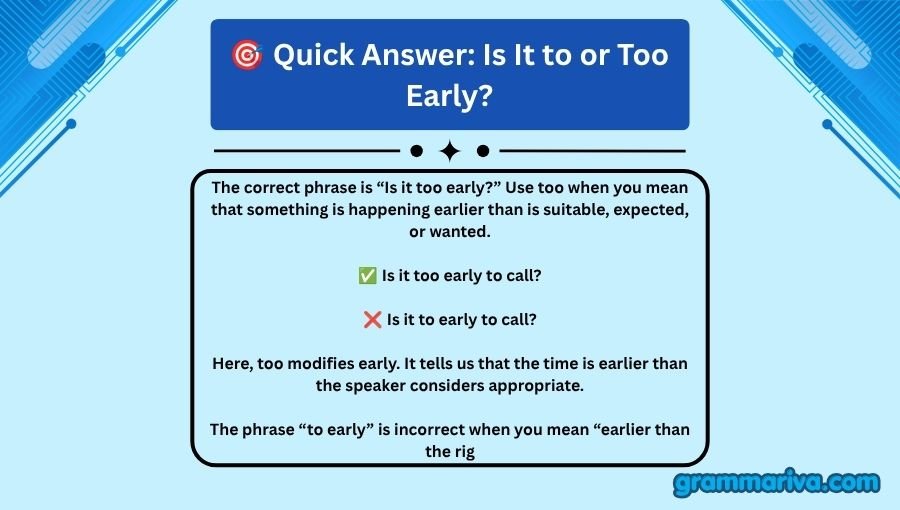
The correct phrase is “Is it too early?” Use too when you mean that something is happening earlier than is suitable, expected, or wanted.
- ✅ Is it too early to call?
- ❌ Is it to early to call?
Here, too modifies early. It tells us that the time is earlier than the speaker considers appropriate.
The phrase “to early” is incorrect when you mean “earlier than the right time.”
🔎 Is “Too Early” the Correct Expression?
Yes. “Too early” is the standard expression when you want to say that something happens before a suitable time.
For example:
- ✅ Is it too early to order dinner?
- ❌ Is it to early to order dinner?
The word too works as an adverb. It changes the strength or degree of the adjective or adverb that follows it.
In too early, the meaning is usually “earlier than is suitable.”
This pattern appears in many everyday sentences:
- It is too early to leave.
- Is it too early to ask?
- You are too early for the meeting.
- We arrived too early.
The spelling to has other jobs. It commonly appears before a verb to form an infinitive, as in to leave, to ask, and to call.
Basic comparison
| Form | Type | Meaning | Example | Correct/Incorrect |
|---|---|---|---|---|
| too early | Adverb + adjective | Earlier than suitable | Is it too early? | ✅ Correct |
| to early | Incorrect combination | No intended standard meaning here | Is it to early? | ❌ Incorrect |
| to leave | Infinitive marker + verb | Shows the infinitive | I want to leave. | ✅ Correct |
| too | Adverb | More than needed or excessively | It is too cold. | ✅ Correct |
💡 Why Do People Confuse “To” and “Too”?
People often search for is it to or too early because the two words sound alike in normal speech.
People confuse to and too because they sound the same in normal speech. When we hear a sentence, we cannot see which spelling the speaker has in mind.
I once caught myself typing “to late” in a quick work message. I knew the rule, but I was typing so fast that my fingers followed the sound instead of the grammar. That tiny error reminded me how easily homophones can slip into digital writing.
The same thing happens with too early.
When someone says:
“Is it too early to call?”
you hear too and to as very similar sounds. Your brain has to use the meaning and sentence structure to choose the spelling.
Here are the most common reasons:
- Fast typing
- Autocorrect
- Speech-to-text tools
- Habit
- Weak knowledge of the difference
- Writing while distracted
- Treating the words as interchangeable
The solution is not to memorize dozens of rules. Learn the job each word does.
📚 “Too Early” vs. “To Early” at a Glance
The difference is simple: too early is correct when too means “more than suitable” or “earlier than suitable.” To early is not the correct form for this meaning.
| Sentence | Correct/Incorrect | Why |
|---|---|---|
| Is it too early to call? | ✅ Correct | Too modifies early. |
| Is it to early to call? | ❌ Incorrect | To cannot replace too here. |
| We arrived too early. | ✅ Correct | The arrival happened earlier than needed. |
| She came to early for the event. | ❌ Incorrect | The intended word is too. |
| It is too early to decide. | ✅ Correct | The decision would be made before the right time. |
A useful way to see the structure is:
too + adjective/adverb
Examples:
- too early
- too late
- too cold
- too expensive
- too quickly
- too slowly
The word to usually does not fill this role.
🧠 Understanding the Basics of “To” and “Too”
The core difference is that to and too are different words with different grammatical functions.
To is commonly used as a preposition or as the marker of an infinitive. Examples include to school, to work, to the store, and to sleep.
Too is commonly used as an adverb. It can mean “also,” or it can show an excessive degree.
For this topic, the second use is the key one.
Compare:
- I want to sleep.
- I am too tired to sleep.
In the first sentence, to comes before the verb sleep.
In the second sentence, too means excessively. The phrase too tired means tired beyond a useful or comfortable level.
The same pattern gives us too early.
| Word | Main Job | Example | Meaning |
|---|---|---|---|
| to | Preposition | Go to school. | Shows direction or relationship |
| to | Infinitive marker | I want to leave. | Introduces a base verb |
| too | Adverb | It is too early. | Earlier than suitable |
| too | Adverb | I want one too. | Also |
| too | Adverb | It is too cold. | More than suitable |
✏️ When Should You Use “Too Early”?
Use too early when something happens before the proper, expected, or desired time.
The word too adds the idea of excess.
Too early for a specific event
Use this structure when an event has a known or expected time.
- ✅ We arrived too early for the concert.
- ❌ We arrived to early for the concert.
The sentence means we arrived before the appropriate time.
Too early to do something
This is one of the most common patterns.
too + adjective/adverb + to + verb
For example:
- ✅ It is too early to leave.
- ✅ It is too early to make a decision.
- ✅ It is too early to celebrate.
- ✅ It is too early to know the result.
Notice something interesting here. Both too and to can appear in the same sentence.
It is too early to leave.
The first word is too because it modifies early.
The second word is to because it introduces the verb leave.
That distinction is extremely useful.
Test Tip 💡
When you see ___ early, ask:
Am I saying “earlier than suitable”?
If yes, choose too.
too early
When you see ___ + base verb, ask whether you need the infinitive marker.
to leave
to call
to ask
This quick test can solve many to or too questions.
| Meaning | Word | Example Sentence |
|---|---|---|
| Earlier than suitable | too | It is too early. |
| Also | too | I want to go too. |
| Direction | to | I went to work. |
| Infinitive | to | I want to work. |
⏰ Is It “Too Early to…” or “To Early to…”?
The correct pattern is too early to + verb.
For example:
- ✅ Is it too early to call her?
- ❌ Is it to early to call her?
The phrase has two separate grammar jobs:
too early = earlier than suitable
to call = infinitive form of the verb
This is why the correct sentence can contain both spellings.
More examples:
- ✅ Is it too early to send the email?
- ✅ Is it too early to talk about the plan?
- ✅ Is it too early to book the hotel?
- ✅ Is it too early to ask for help?
- ❌ Is it to early to send the email?
Sentence breakdown
Take this sentence:
Is it too early to call?
- Is = helping verb
- it = subject
- too = shows excess
- early = describes the timing
- to call = infinitive phrase
The first to does not appear before early. It appears before the verb call.
That is the key difference.
📝 Case Study: A Simple Workplace Example
Imagine that a manager tells an employee that a client may be ready for a proposal next week.
On Monday morning, the employee asks:
“Is it too early to send the proposal?”
That sentence is correct.
The employee is asking whether Monday is earlier than the appropriate time to send the proposal.
I once edited a short workplace email that said, “Is it to early to follow up?” The writer knew exactly what they wanted to say. The only problem was the spelling of too. We changed it to “Is it too early to follow up?”, and the sentence was immediately clear.
This is a good example because the same pattern appears in real work communication.
| Situation | Correct Sentence | Reason |
|---|---|---|
| Calling a client | Is it too early to call? | The call may be premature. |
| Sending an email | Is it too early to send this? | The sender may be ahead of schedule. |
| Making an announcement | Is it too early to announce it? | The timing may be premature. |
| Starting a project | Is it too early to begin? | The start may be ahead of schedule. |
📖 Grammar Rules Explanation
The grammar rule is based on the different functions of to and too.
Too can act as an adverb that shows an excessive degree. In too early, it tells us that the time is earlier than is wanted, expected, or appropriate.
To has different grammatical uses. It can show direction or introduce an infinitive verb. It does not replace too in the phrase too early.
Standard English references and dictionaries agree on these separate uses. The spelling therefore depends on the grammatical role of the word in the sentence.
Consider these examples:
- I went to school.
- I want to study.
- It is too early.
- I am too tired.
The first two use to.
The last two use too.
Correct vs. Incorrect at a Glance
| Sentence | Correct/Incorrect | Why |
|---|---|---|
| Is it too early? | ✅ Correct | Too shows that the time is earlier than suitable. |
| Is it to early? | ❌ Incorrect | To cannot perform this job. |
| It is too early to decide. | ✅ Correct | Too modifies early; to introduces decide. |
| We came too early. | ✅ Correct | The arrival happened before the expected time. |
| We came to early. | ❌ Incorrect | Too is needed before early. |
⚠️ Common Mistakes With “To” and “Too”
The mistake usually happens because the words sound alike.
A writer may know that both words are pronounced similarly but forget that their meanings and grammatical roles differ.
Three common causes are:
Fast typing
When people type quickly, they often write the first spelling that comes to mind.
Autocorrect
Autocorrect can sometimes reinforce the wrong word, especially when a sentence is short.
Lack of knowledge
Some learners simply have not been shown the difference clearly.
The best fix is to connect each spelling to a job.
To often points toward something or introduces a verb.
Too often means “also” or “more than enough.”
Similar grammar confusions
| Confusion | Correct Difference | Example |
|---|---|---|
| to / too | Different grammar roles | It is too early to leave. |
| its / it’s | Possession vs. “it is” | The dog wagged its tail. |
| your / you’re | Possession vs. “you are” | You’re using your phone. |
| their / there / they’re | Possession, place, contraction | They’re over there with their bags. |
| then / than | Time/order vs. comparison | She is taller than me. |
Common wrong forms for this specific phrase
| Wrong Form | What’s Wrong | Correct Form |
|---|---|---|
| to early | To is the wrong word | too early |
| 2 early | Text shorthand is unsuitable for formal writing | too early |
| tooearly | Missing space | too early |
| to-early | Unnecessary hyphen | too early |
| 2 early to call | Number shorthand reduces clarity | too early to call |
| to early to decide | Wrong homophone | too early to decide |
🕰️ Why “Too” Means More Than You May Think
Many learners first learn too as meaning also.
For example:
I want coffee too.
That is correct.
But too has another common use. It can show an excessive amount or degree.
For example:
The coffee is too hot.
This means the coffee is hotter than desired.
The same idea applies to time:
It is too early.
This means the time is earlier than desired or suitable.
So, too early does not simply mean “early.” It means earlier than is appropriate for the situation.
| Expression | Meaning |
|---|---|
| early | Before the expected time |
| too early | Earlier than suitable |
| very early | At a notably early time |
| quite early | Fairly early |
| too late | Later than suitable |
This distinction matters because very early and too early do not mean exactly the same thing.
🌎 “Too Early” in Different Contexts
The phrase too early works naturally in conversation, professional writing, creative writing, and online communication.
The tone may change, but the grammar stays the same.
| Context | Which Term to Use | Example |
|---|---|---|
| Everyday conversation | too early | Is it too early for breakfast? |
| Professional writing | too early | It may be too early to confirm the date. |
| Creative writing | too early | The town woke too early that morning. |
| Social media/texting | too early | Is it too early for Christmas posts? |
Everyday conversation
People often use the phrase when talking about plans.
Is it too early to eat lunch?
Professional writing
The phrase can sound polite and careful.
Would it be too early to discuss the next phase?
Creative writing
Writers can use it to describe timing.
The birds started singing too early.
Social media and texting
Informal messages often shorten sentences.
Too early for coffee? ☕
Even in short posts, too remains the correct spelling.
💬 Common Phrases With “Too Early”
Too early appears in several common sentence patterns. These expressions are useful because they show how the phrase works naturally.
| Phrase | Meaning |
|---|---|
| too early to tell | Not enough time has passed to know the answer |
| too early to say | A conclusion cannot yet be made |
| too early to decide | A decision should wait |
| too early to know | There is not enough information yet |
| too early to celebrate | Success is not certain yet |
| too early in the morning | At an inconveniently early time |
Examples:
- It is too early to tell.
- It is too early to say what will happen.
- It is too early to decide.
- It is too early to know the final result.
These phrases are common in both speech and writing.
🔄 Alternatives to “Too Early”
Sometimes you can replace too early with another expression. The best choice depends on the meaning.
| Alternative | Works When | Does Not Work When |
|---|---|---|
| premature | Something happens before the right time | The setting is very casual |
| ahead of schedule | Something happens before a planned time | There is no schedule |
| before the right time | You want very clear wording | You need a short phrase |
| earlier than expected | Something happens before someone expected | The timing is not about expectations |
| too soon | Something happens before an appropriate time | You specifically need the word early |
For example:
It is too early to decide.
can sometimes become:
It is too soon to decide.
Both can work, but they may have slightly different shades of meaning depending on context.
Too early often focuses on time.
Too soon often focuses on whether enough time has passed.
🎯 How to Remember the Difference
If you are still wondering is it to or too early, remember that too early means earlier than suitable. The easiest memory trick is to give each word a simple job.
Remember “too” with “extra”
Think:
Too = extra
If something is more than wanted or suitable, use too.
- too early
- too late
- too loud
- too expensive
- too difficult
You can also remember that too has an extra o.
Think of the extra o as an extra amount.
too = extra
This is not a complete grammar rule for every use of too, but it is a helpful memory trick for this specific mistake.
Remember “to” before verbs
When to appears before a base verb, it often forms an infinitive.
- to call
- to leave
- to eat
- to sleep
- to decide
So look at:
too early to call
The first word is too because it describes early.
The second is to because it comes before call.
🧪 A Simple Test for “Too Early”
Use this three-step test whenever you are unsure.
Step 1: Look at the word after the blank
If the blank comes directly before early, you almost certainly need:
too early
Step 2: Ask what you mean
Do you mean:
“earlier than suitable”?
If yes, use too.
Step 3: Look for a verb
If to comes before a base verb, it may be correct.
For example:
too early to leave
The first is too.
The second is to.
Practice table
| Sentence | Answer | Explanation |
|---|---|---|
| Is it ___ early? | too | It means earlier than suitable. |
| Is it ___ early to leave? | too | Too modifies early. |
| I want ___ leave. | to | To introduces the verb. |
| We arrived ___ early. | too | The arrival was earlier than suitable. |
| I went ___ the office. | to | To shows direction. |
🗣️ Why “Is It Too Early?” Sounds Natural
The question “Is it too early?” is often used when the speaker wants permission, advice, or reassurance about timing.
It can be followed by an action:
Is it too early to call?
Or it can stand alone:
Is it too early?
The listener understands that the speaker is asking whether the current time is appropriate.
You can use the phrase for many situations:
- Calling someone
- Sending a message
- Asking a question
- Making an announcement
- Buying something
- Making plans
- Celebrating an event
- Talking about a sensitive topic
The phrase is flexible because too expresses the idea of excessive earliness.
📱 “Too Early” in Texts and Social Media
Informal digital writing often has short sentences, but spelling still matters.
For example:
- ✅ Too early for coffee?
- ❌ To early for coffee?
- ✅ Is it too early to post this?
- ❌ Is it to early to post this?
A typo in a text is usually harmless. In a professional email, however, repeated homophone mistakes can make writing look rushed.
If you are writing quickly, pause for one second when you see to or too.
Ask:
Does this mean “also” or “more than suitable”?
If yes, think too.
✍️ Professional Writing and “Too Early”
Professional writing often needs clear timing language.
Suppose you are writing to a client:
Would it be too early to schedule our next meeting?
This sounds natural and polite.
Compare it with:
Would it be to early to schedule our next meeting?
The second version contains a basic word-choice error.
The mistake does not change the intended meaning, but it reduces the polish of the sentence.
Other professional examples include:
- Is it too early to discuss pricing?
- Would it be too early to confirm the date?
- It may be too early to make a final decision.
- It is too early to estimate the total cost.
These sentences show why learning the difference is useful beyond school exercises.
📌 Why Getting “Too Early” Right Matters
Correct spelling helps readers understand your meaning without distractions. The difference may look small, but accurate word choice creates cleaner writing.
| Situation | Why Getting It Right Matters |
|---|---|
| Resume | Shows careful writing |
| Client email | Creates a polished impression |
| Published content | Builds reader trust |
| Social post | Makes the message easier to read |
A useful writing principle is:
Small word choices can make a big difference in clear communication.
You do not need fancy vocabulary to sound professional. You need accurate, clear words.
🧩 Special Cases: “Too” Can Mean “Also”
There is one important point worth remembering.
Too does not always mean “excessively.”
It can also mean also.
For example:
I am coming too.
Here, too means also.
That is different from:
I am too early.
Here, too means earlier than suitable.
The meaning comes from the sentence.
| Sentence | Meaning of “Too” |
|---|---|
| I am too early. | Earlier than suitable |
| It is too cold. | More cold than suitable |
| She talks too loudly. | More loudly than suitable |
| I want to come too. | Also |
| He likes pizza too. | Also |
This is why learning only one translation for too can cause confusion.
✅ Quick Recap Checklist
Use this checklist whenever you are unsure.
| Question | If Yes → Use |
|---|---|
| Does the phrase mean “earlier than suitable”? | too early |
| Does the word mean “also”? | too |
| Does the word show direction? | to |
| Does the word come before a base verb? | Usually to |
| Are you writing “___ early”? | too early |
Practice Examples
- Is it too early to call? ✅
- We arrived too early for the meeting. ✅
- I want to leave early. ✅
Now compare:
- ❌ Is it to early to call?
- ❌ We arrived to early.
- ❌ Is it to soon to decide? when the intended phrase is too soon
The key is to focus on the word’s job, not just its sound.
❓ FAQs About To vs Too
What is correct, “is it to early” or “is it too early”?
“Is it too early?” is correct. Use too because it means that the time is earlier than suitable or expected. “To early” is incorrect for this meaning.
Is it too early to call?
Yes. “Is it too early to call?” is grammatically correct. It asks whether calling now would be earlier than an appropriate or comfortable time.
Why is “to early” wrong?
To does not modify early in this sentence. The word needed is too, which acts as an adverb and shows excessive or unsuitable timing.
What does “too early” mean?
Too early means earlier than is suitable, expected, wanted, or appropriate. For example, “It is too early to decide” means that a decision should probably wait.
Can “too” and “to” appear in the same sentence?
Yes. For example: “It is too early to leave.” The first too modifies early. The second to introduces the verb leave.
What is the difference between “too early” and “very early”?
Too early suggests that the time is earlier than suitable. Very early simply describes a notably early time. Being very early is not necessarily a problem, but being too early usually suggests that the timing is unsuitable.
Is “too early to tell” correct?
Yes. “Too early to tell” is a common and correct expression. It means that there has not been enough time or information to know the answer.
Is “too early in the morning” correct?
Yes. “Too early in the morning” is correct when the morning time is earlier than the speaker considers suitable. For example, “7 a.m. is too early in the morning for me.”
How can I remember “too early”?
Remember too = extra. If something is earlier than wanted or suitable, think too early. The extra o in too can serve as a simple memory clue.
Is “too early” used in formal writing?
Yes. Too early is completely standard in formal, professional, academic, and casual writing. The important point is to use too, not to, when it modifies early.
🏁 Conclusion: Is It to or Too Early?
Is it to or too early has a simple answer: when you mean “earlier than suitable,” write “Is it too early?” 😊
The word too modifies early and shows that the timing is earlier than wanted, expected, or appropriate. The word to has other jobs, such as showing direction or introducing a verb.
Remember the most useful pattern:
too early to + verb
For example:
Is it too early to call?
The first word is too because it describes the timing. The second word is to because it introduces the verb call.
Once you learn this pattern, the choice becomes much easier. When you see early after the blank, think too early. When to comes before a base verb, it may be the infinitive marker.
Good grammar does not have to be complicated. Sometimes one extra letter gives you the clue you need. ✨
Too early is the right choice when the timing is earlier than it should be. Remember that, and you will never have to guess again.

Hi, I’m Ethan Brooks. I’m an English grammar writer at Grammariva, where I work on clear explanations, practical examples, and useful writing tips. I enjoy making difficult grammar topics easier to understand.


[…] the end, you should be able to choose the right form without second-guessing every sentence. Is It to or Too Early | Mom vs Mum | Spectre or […]
[…] can use whenever you are unsure. By the end, the choice should feel easy. 🏡 Dieing vs Dying | Is It to or Too Early | Mom vs […]