If you have ever typed mom vs mum into a search box, you are not alone. These two words mean the same basic thing: a mother. The main difference is not meaning. It is regional usage. In American English, mom is the usual spelling. In British English and several other varieties of English, mum is more common. 🌎
This small spelling difference can cause confusion when you write emails, school assignments, social posts, or messages to family. You may even wonder whether one form is more correct than the other. The answer depends on the kind of English you are using.
As a teacher and editor, I often see writers worry about this choice when there is really no need to panic. Both forms are correct in the right variety of English. ❤️ The key is to know your audience and stay consistent.
In this guide, I will explain the difference between mom and mum, show you when to use each one, and give you simple tests that make the choice much easier. Spectre or Specter | Damnit or Dammit | Apposed vs Opposed
🎯 Quick Answer: Mom vs Mum
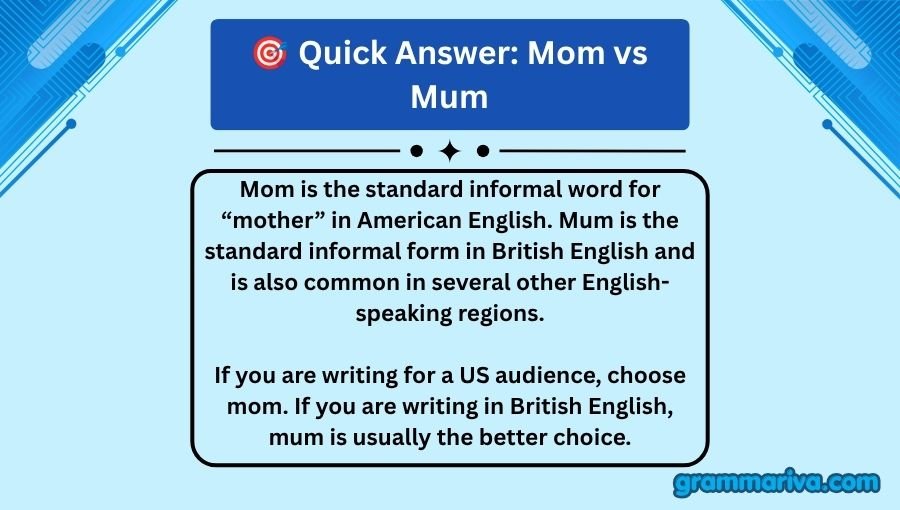
Mom is the standard informal word for “mother” in American English. Mum is the standard informal form in British English and is also common in several other English-speaking regions.
If you are writing for a US audience, choose mom. If you are writing in British English, mum is usually the better choice.
| Word | Main Variety | Meaning | Example |
|---|---|---|---|
| mom | American English | Mother | My mom called me. |
| mum | British English | Mother | My mum called me. |
Both sentences are grammatically correct. The difference is mainly regional spelling and usage.
🔤 Related Word Forms and Close Variants
The words mom and mum have a few related forms. These forms can show possession, address, or a more formal relationship.
| Form | Type | Example |
|---|---|---|
| mom | Noun | My mom is visiting. |
| mom’s | Singular possessive | My mom’s car is outside. |
| moms | Plural noun | The moms met after school. |
| moms’ | Plural possessive | The moms’ meeting starts at six. |
| mum | Noun | My mum lives nearby. |
| mum’s | Singular possessive | My mum’s phone rang. |
| mums | Plural noun | The mums chatted after class. |
| mother | Formal noun | My mother is a doctor. |
The main rule is simple: mom and mum are regional choices, while the apostrophe forms follow normal English grammar.
📚 Understanding the Basics of Mom vs Mum
The core difference between mom and mum is regional English. Mom is used mainly in the United States, while mum is used mainly in British English.
Neither spelling is automatically more correct.
| Form | Type | Meaning | Example | Correct/Incorrect |
|---|---|---|---|---|
| mom | Informal noun | Mother | My mom made dinner. | ✅ Correct in US English |
| mum | Informal noun | Mother | My mum made dinner. | ✅ Correct in British English |
| mother | Formal/common noun | Female parent | My mother made dinner. | ✅ Correct |
| moms | Plural noun | More than one mother | The moms arrived early. | ✅ Correct in US English |
| mums | Plural noun | More than one mother | The mums arrived early. | ✅ Correct in British English |
Think of the difference like color and colour. The words have the same meaning, but different English traditions prefer different spellings.
Is Mom American English
Yes. Mom is the usual informal word for “mother” in American English.
You will commonly see it in US conversations, text messages, school writing, books, movies, advertisements, and social media.
For example:
My mom is picking me up after school.
I bought my mom some flowers.
Mom, can you help me with this?
All three are natural in American English.
Is Mum British English
Yes. Mum is the usual informal form in British English.
For example:
My mum is picking me up after school.
I bought my mum some flowers.
Mum, can you help me with this?
These sentences sound natural to a British English reader.
Does Mom vs Mum Change the Meaning
No. In the usual family sense, mom and mum refer to the same relationship.
The difference is mainly based on the variety of English being used.
That means this is not a case where one word describes one type of mother and the other describes another type. They are simply regional forms.
| Feature | Mom | Mum |
|---|---|---|
| Meaning | Mother | Mother |
| US English | Very common | Unusual |
| British English | Unusual | Very common |
| Informal use | Yes | Yes |
| Formal alternative | Mother | Mother |
💡 Test Tip
Ask yourself one question:
Who is going to read this?
If your audience is mainly American, use mom. If your audience is mainly British, use mum.
If you are writing a US grammar article, for example, mom is normally the best choice.
🧠 Why Do People Confuse Mom and Mum
People confuse these words because they sound similar and have the same basic meaning. The difference becomes noticeable mainly when you write the word down.
Regional English also plays a major role. Someone who learned British English may naturally write mum, while someone who learned American English may automatically write mom.
I once reviewed a short school essay written by a student who had learned English from both American videos and British textbooks. She used mom in one paragraph and mum in another. Her teacher thought she had made a spelling error. The real problem was simply that her writing mixed two varieties of English.
That example shows why consistency matters.
Mom and Mum in Different English Varieties
English is spoken in many countries. Different regions develop their own common vocabulary and spelling habits.
| English Variety | Common Informal Form |
|---|---|
| American English | mom |
| British English | mum |
| Canadian English | mom is common |
| Australian English | mum is common |
| New Zealand English | mum is common |
| General international writing | Depends on target audience |
These patterns are useful guidelines, not strict rules for every individual speaker.
A person from Britain may prefer mom for personal reasons. An American writer may choose mum when writing a British character. Context can change the choice.
🔎 Mom vs Mum at a Glance
Mom and mum have the same basic meaning, but they belong to different regional varieties of English.
| Question | Mom | Mum |
|---|---|---|
| Means mother | Yes | Yes |
| Common in US English | Yes | No |
| Common in UK English | No | Yes |
| Informal | Yes | Yes |
| Appropriate in family conversation | Yes | Yes |
| Appropriate in formal writing | Usually use “mother” | Usually use “mother” |
The best choice depends on your audience, location, and writing style.
✍️ Correct Meanings and Uses
The word can appear in several common situations. The grammar stays simple, but the role of the word can change slightly.
Mom or Mum as a Family Noun
The most common use is as an informal noun for a mother.
My mom works at a hospital.
My mum works at a hospital.
The structure is:
possessive + mom/mum + verb
For example:
My + mom + works at a hospital.
The word mom is the subject noun in the first sentence. In the British version, mum fills the same role.
Mom or Mum When Speaking Directly
You can also use Mom or Mum when speaking directly to your mother.
In this use, the word is often capitalized because it acts like a name.
Mom, where are my keys?
Mum, where are my keys?
The same principle can apply to words such as Dad, Grandma, or Grandpa when they are used as names or forms of direct address.
Possessive Forms
If something belongs to your mother, use the possessive form.
American English:
My mom’s car is new.
British English:
My mum’s car is new.
The apostrophe is important.
mom’s means something belongs to one mom.
moms means more than one mom.
The same difference applies to mum’s and mums.
| Meaning | American English | British English |
|---|---|---|
| One mother | mom | mum |
| One mother’s | mom’s | mum’s |
| More than one mother | moms | mums |
| More than one mother’s | moms’ | mums’ |
📝 Case Study: A Workplace Email
Imagine that an employee is writing a company newsletter for a US audience.
The employee writes:
“We are hosting a special event for employees and their mums.”
The sentence is understandable, but mums may sound out of place in a US-focused publication.
A better US version would be:
“We are hosting a special event for employees and their moms.”
Now imagine the same company is based in London. In that case, mums would fit the expected British style much better.
I once caught a similar issue while editing a short family-themed newsletter. The writer had used American spelling in most of the document but suddenly wrote mum in a headline. Nothing was grammatically broken, but the mixed style made the article feel less polished.
The lesson is simple: match the regional style of the publication.
⚙️ Grammar Rules Explanation
There is no grammar rule that says mom is always correct or mum is always correct. Both are nouns. The difference comes from regional usage.
Standard English references and dictionaries recognize regional differences in vocabulary and spelling. The correct choice depends on the variety of English you are using.
In US English, mom is the normal informal term.
In British English, mum is the normal informal term.
When you need a neutral or formal choice, mother works in both varieties.
Correct vs Incorrect at a Glance
| Sentence | Correct/Incorrect | Why |
|---|---|---|
| My mom lives in Texas. | ✅ Correct | Natural American English |
| My mum lives in London. | ✅ Correct | Natural British English |
| My mom lives in London. | ✅ Correct | Possible, though less typical for British English |
| My mum lives in Texas. | ✅ Correct | Possible, though less typical for American English |
| My moms car is outside. | ❌ Incorrect | The possessive apostrophe is missing |
The last example is a grammar error. The correct form is:
My mom’s car is outside.
The regional difference does not remove normal punctuation rules.
⚠️ Common Mistakes With Mom and Mum
Most mistakes happen for simple reasons. Writers may type quickly, rely on autocorrect, or mix different forms of English.
Why These Errors Happen
- Fast typing: You may type the form you see most often.
- Autocorrect: Your device may suggest a different regional spelling.
- Lack of knowledge: You may not know that both forms are valid.
- Mixed media: Movies, books, websites, and social media may use different varieties.
- Mixed audiences: You may write for readers from several countries.
| Common Confusion | Correct Forms | Main Difference |
|---|---|---|
| it’s / its | it’s, its | Contraction vs possession |
| your / you’re | your, you’re | Possession vs “you are” |
| there / their | there, their | Place vs possession |
| color / colour | color, colour | US vs British spelling |
| mom / mum | mom, mum | Regional family term |
| center / centre | center, centre | US vs British spelling |
Specific Wrong Forms and Uses
| Wrong Form | What’s Wrong | Correct Form |
|---|---|---|
| moms car | Missing possessive apostrophe | mom’s car |
| mums car | Missing possessive apostrophe | mum’s car |
| mom’s | Not wrong by itself | Use for possession |
| mums | Not wrong by itself | Use for plural in British English |
| moms’ | Not wrong by itself | Use for plural possession |
| mum’s | Not wrong by itself | Use for singular possession |
The key is to avoid calling every unfamiliar form “wrong.” Mum is not a misspelling of mom. It is a standard regional form.
🕰️ A Brief History of Mom and Mum
The words mom and mum developed as informal family terms connected to the word for a mother. Their modern spelling differs across English-speaking regions.
The exact history of informal family words can be complex, so it is better not to treat the difference as a simple spelling change from one word into another.
For everyday writing, the useful fact is much simpler: modern English uses different forms in different regions.
| Period | General Form | Note |
|---|---|---|
| Earlier English | mother and related family forms | More formal family vocabulary was common |
| Later English | Informal family terms expanded | Family speech developed shorter forms |
| Modern US English | mom | Standard informal US usage |
| Modern British English | mum | Standard informal UK usage |
| Modern global English | mom and mum | Both remain widely understood |
You do not need to memorize the history to use the words correctly.
🌎 Usage in Different Contexts
The choice in mom vs mum often depends on your target audience and the type of English you are following. The right choice can change based on your audience and purpose.
Everyday Conversation
Use the form that matches the English variety you normally speak.
An American might say:
“My mom is coming over.”
A British speaker might say:
“My mum is coming over.”
Professional Writing
In professional writing, consider your audience.
If the publication uses US English, mom is usually the natural choice.
If it uses British English, choose mum.
For formal documents, mother may be better when the context calls for a more formal tone.
Creative Writing
Creative writers can use either form. The choice can help make a character sound natural.
For example, a British character may say:
“I need to call Mum.”
An American character may say:
“I need to call Mom.”
Social Media and Texting
Social media is flexible. People often use the form that feels natural to them.
However, brand accounts and professional pages should usually follow one style guide.
| Context | Which Term to Use | Example |
|---|---|---|
| US family conversation | mom | My mom is here. |
| UK family conversation | mum | My mum is here. |
| US business article | mom | Tips for new moms |
| UK business article | mum | Tips for new mums |
| Creative writing | Depends on character | “Mom, wait!” |
| Social media | Depends on audience | Love you, Mom! ❤️ |
💬 Common Phrases With Mom and Mum
There are many everyday phrases built around these words. The regional spelling usually stays consistent within the phrase.
| Phrase | Meaning |
|---|---|
| Mom’s house | The house belonging to your mother |
| Mum’s house | The house belonging to your mother |
| Mom and Dad | Informal American family reference |
| Mum and Dad | Informal British family reference |
| Mother and child | More formal or neutral phrase |
| Call your mom | Tell someone to phone their mother |
The phrase Mom and Dad is especially common in American English. Mum and Dad is common in British English.
🔄 Synonyms and Alternatives
You do not always have to use mom or mum. The best alternative depends on the situation.
| Alternative | Works When | Does Not Work When |
|---|---|---|
| mother | Formal or neutral writing | Very casual family speech may sound less personal |
| parent | The mother’s specific identity is not needed | You specifically mean the mother |
| maternal parent | Technical or formal contexts | Casual conversation |
| mom | American informal writing | British style requires consistency |
| mum | British informal writing | US style is required |
Mother is the safest choice when you want a word that works naturally across major English varieties.
However, it can sound more formal than mom or mum in casual conversation.
🎯 Why Getting Mom vs Mum Right Matters
At first glance, the difference may seem tiny. In practice, regional word choice can affect how natural your writing sounds.
Clarity in Communication
Most readers will understand both words. Still, the form that matches their English variety often feels more natural.
Professionalism
Editors, teachers, publishers, and businesses often follow a specific style. Consistency makes your writing look carefully prepared.
Digital Communication
A social media post can reach readers from many countries. Knowing regional differences helps you avoid calling a correct word a spelling mistake.
“Good writing respects both meaning and audience.”
That is a useful rule for almost every regional English question.
| Situation | Why Getting It Right Matters |
|---|---|
| Resume or application | Shows control of writing style |
| Client email | Keeps language consistent |
| Published content | Matches the publication’s English variety |
| Social post | Helps the wording feel natural to the target audience |
🧩 How To Remember the Difference
The easiest memory trick is to connect each form with its main English variety.
Mom = American English
Mum = British English
You can also remember that mum looks like other British spellings you may see in UK writing, while mom is strongly associated with American speech and writing.
Try this quick mental test:
Am I writing for Americans?
If yes, choose mom.
Am I writing for British readers?
If yes, choose mum.
Do I need a formal, widely understood term?
Choose mother.
This three-step test works in most everyday situations.
❓ Is Mom the Same as Mum
Yes. In the usual family sense, mom and mum mean the same thing: a mother.
The main difference is regional usage. Mom is strongly associated with American English, while mum is strongly associated with British English and several other varieties.
🌐 Can You Use Mum in American English
Yes, but it may sound unusual or deliberately British to many American readers.
For example:
My mum is visiting this weekend.
An American reader will almost certainly understand the sentence. However, my mom is visiting this weekend sounds more natural in standard American English.
If you are writing a British character, using mum can be a good choice even inside an American publication.
🇬🇧 Can You Use Mom in British English
Yes, but mum is generally the more natural choice in British English.
A British reader will understand mom, but it may suggest American influence or a character who normally uses American English.
Again, context matters.
✏️ Should You Use Mom or Mum in Formal Writing
For formal writing, mother is often the safest choice when you need a neutral and professional tone.
For example:
My mother attended the meeting.
This sounds more formal than:
My mom attended the meeting.
However, there is nothing grammatically wrong with mom in an informal or conversational document.
The same applies to mum.
📖 Is Mom or Mum More Correct
Neither is universally more correct. When you understand mom vs mum, choosing the right form becomes much easier.
Mom is correct standard usage in American English. Mum is correct standard usage in British English.
Calling one spelling “wrong” without considering regional English would be misleading.
The better question is:
Which form fits my audience and style?
That is the choice a careful writer should make.
📝 Practice Examples
Try choosing the best form before reading the answers.
Example 1
You are writing a US family blog:
My ___ makes the best apple pie.
Answer: mom ✅
Example 2
You are writing a British family story:
My ___ always packs an umbrella.
Answer: mum ✅
Example 3
You need a formal phrase:
My ___ signed the document.
Answer: mother ✅
Example 4
You are writing an American social post:
Happy Mother’s Day to the best ___ ever!
Answer: mom ✅
Example 5
You are writing dialogue for a British character:
“Mum, can you help me?”
Answer: mum ✅
| Practice Sentence | Best Choice | Reason |
|---|---|---|
| My ___ lives in Chicago. | mom | US context |
| My ___ lives in Manchester. | mum | UK context |
| My ___ signed the form. | mother | Formal context |
| I love you, ___. | mom or mum | Depends on regional style |
| “___, where are my shoes?” | Mom or Mum | Direct address depends on variety |
⚠️ When Consistency Matters More Than Choice
Sometimes either word can work. The bigger problem is switching between them without a reason.
For example:
My mom is kind. My mum always helps me.
This is understandable, but it mixes regional forms in the same voice.
A more consistent American version is:
My mom is kind. My mom always helps me.
A consistent British version is:
My mum is kind. My mum always helps me.
If you are intentionally showing different speakers or characters, switching can make sense.
📋 Quick Recap Checklist
Use this checklist whenever you are unsure.
| Question | If Yes → Use |
|---|---|
| Am I writing standard US English? | mom |
| Am I writing standard British English? | mum |
| Am I writing formally? | mother |
| Am I showing an American character’s speech? | mom |
| Am I showing a British character’s speech? | mum |
| Am I showing possession? | mom’s or mum’s |
| Am I talking about several mothers? | moms or mums |
Quick Practice
1. My ___ called this morning.
American English → mom ✅
British English → mum ✅
2. My ___’s birthday is tomorrow.
American English → mom’s ✅
British English → mum’s ✅
3. I spoke to three ___ at the event.
American English → moms ✅
British English → mums ✅
❓ FAQs About Mom vs Mum
Is mom or mum correct
Both are correct. Mom is the usual informal form in American English, while mum is the usual informal form in British English.
What is the difference between mom and mum
The main difference is regional usage. Both words mean “mother” in ordinary family contexts. American English generally prefers mom, while British English generally prefers mum.
Is mom American or British
Mom is primarily associated with American English. It is the standard informal term commonly used in the United States.
Is mum British or American
Mum is primarily associated with British English. It is also common in other English varieties influenced by British usage.
Should Americans say mom or mum
Americans normally say and write mom. Using mum is understandable, but it may sound British or unusual in a typical American context.
Should British people say mum or mom
British English normally uses mum. Mom is understandable but may sound American or less typical in British writing.
Is mum a misspelling of mom
No. Mum is not a misspelling. It is a standard regional form used in British English and other varieties.
Is mom more correct than mum
No. Neither is universally more correct. The correct choice depends on the variety of English being used.
Which word should I use in formal writing, mom or mum
Use mother when you want a more formal and broadly neutral term. In informal writing, choose mom or mum based on your regional audience.
Can I use mom and mum in the same article
You can, but consistency is usually better. If the article follows American English, use mom throughout unless you are discussing the British form or quoting a British speaker. A simple way to remember mom vs mum is to connect each spelling with its main English variety.
🏁 Conclusion
Mom vs mum is a simple regional English difference, not a fight between a correct word and an incorrect one. Mom is the standard informal choice in American English, while mum is the standard informal choice in British English and several other varieties.
When you write, think about your audience first. 🇺🇸 If your content follows US English, choose mom. 🇬🇧 If it follows British English, choose mum. When you want a more formal and broadly neutral word, mother is a reliable choice.
I recommend keeping your choice consistent within the same piece of writing. That small habit makes your work look cleaner and more professional.
Most importantly, do not mark mum as a spelling mistake simply because you use American English. It is a valid regional form.
Once you connect mom with American English and mum with British English, the choice becomes easy.
Remember the audience, choose the regional form, and write with confidence.

Hi, I’m Olivia Carter. I’m an English language editor at Grammariva, and I work on making grammar lessons clear, accurate, and easy to follow. I especially enjoy writing about common grammar mistakes and everyday English.

[…] tricks, common mistakes, practice sentences, and FAQs so you can confidently choose the right word. Mom vs Mum | Spectre or Specter | Damnit or […]
[…] be able to choose the right form without second-guessing every sentence. Is It to or Too Early | Mom vs Mum | Spectre or […]
[…] In this guide, I’ll explain dieing vs dying with clear rules, examples, tables, memory tricks, common mistakes, and FAQs. By the end, you should know exactly which spelling to choose. 🌟 For Who or For Whom | Is It to or Too Early | Mom vs Mum […]