Have you ever typed a word, looked at it, and suddenly wondered, “Wait, is that really how it is spelled?” 😅 continuous vs contious is one of those spelling problems that can make even careful writers pause. The two forms look close, but they do not have the same status in English. One is a standard English word. The other is a common spelling error.
If you have ever written contious instead of continuous, you are not alone. The missing letters are easy to overlook when typing quickly. The good news is that the rule is simple once you see the pattern.
In this guide, I’ll explain the meaning, spelling, grammar, common uses, and memory tricks behind these words. You’ll also see plenty of examples, practical workplace sentences, and quick tests. By the end, you should be able to spot the correct form without stopping to think twice. ✨ Separate vs Seperate | Prescribe vs Proscribe | Whole Day or All Day
🎯 Quick Answer: Continuous vs Contious
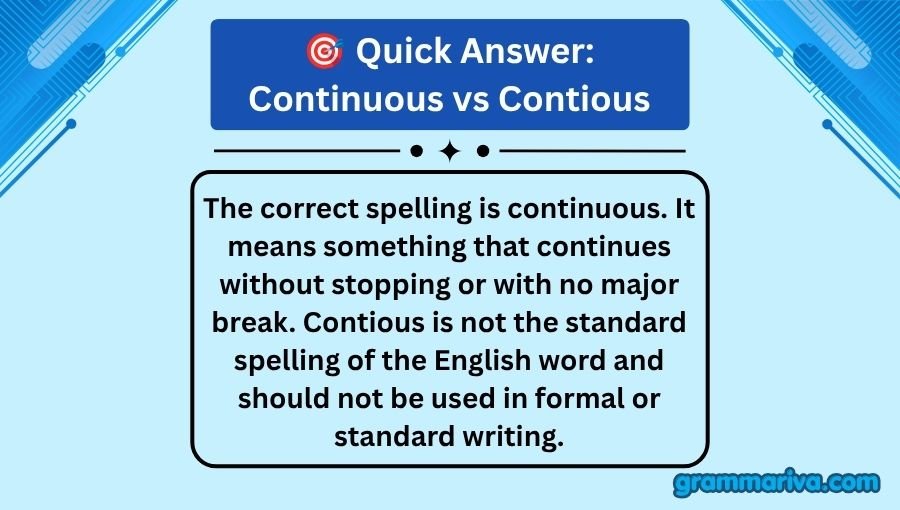
The correct spelling is continuous. It means something that continues without stopping or with no major break. Contious is not the standard spelling of the English word and should not be used in formal or standard writing.
Example:
✅ The machine ran continuously for six hours.
❌ The machine ran contiously for six hours.
The easiest way to remember the difference is to focus on the middle of continuous: contin-u-ous.
📚 Is Continuous the Correct Word?
Yes, continuous is the correct English word. It is an adjective used to describe something that keeps going without interruption or that happens again and again without a clear break.
The spelling contains the letters u and o before the final us sound:
continuous
A common mistake removes the u and produces:
contious ❌
That missing u is the main spelling problem.
What Does Continuous Mean?
Continuous describes something that goes on without stopping or breaking.
For example:
- continuous rain
- continuous noise
- continuous growth
- continuous support
- continuous improvement
- continuous movement
Here are two examples:
✅ The continuous rain flooded several streets.
The rain kept falling without a meaningful break.
❌ The contious rain flooded several streets.
The spelling contious is incorrect.
The word can describe physical things, actions, sounds, events, processes, or ideas.
| Form | Type | Meaning | Example | Correct/Incorrect |
|---|---|---|---|---|
| continuous | Adjective | Continuing without interruption | We had continuous rain. | ✅ Correct |
| contious | Misspelling | Not a standard spelling | We had contious rain. | ❌ Incorrect |
| continuously | Adverb | In a continuous way | The fan ran continuously. | ✅ Correct |
| continuity | Noun | An unbroken connection or flow | The story has continuity. | ✅ Correct |
🔎 What Is the Difference Between Continuous and Contious?
The difference is simple: continuous is a correctly spelled English adjective, while contious is a misspelling.
The two forms can look almost identical at first glance. That is why the error is easy to make.
Compare them:
continuous
contious
The correct word contains “u” after contin.
Think of it like this:
contin + u + ous = continuous
That small u matters.
Continuous as an Adjective
When you need an adjective to describe something that continues without a break, use continuous.
Examples:
✅ The company provides continuous training.
❌ The company provides contious training.
✅ We heard a continuous buzzing sound.
❌ We heard a contious buzzing sound.
The first sentence in each pair uses the correct spelling.
Continuous Can Describe Ongoing Processes
The word is also common when talking about work, learning, improvement, and change.
For example:
- continuous learning
- continuous development
- continuous improvement
- continuous monitoring
- continuous communication
These phrases are common in professional writing.
| Feature | Continuous | Contious |
|---|---|---|
| Standard English word | Yes | No |
| Correct spelling | Yes | No |
| Can be used as an adjective | Yes | No |
| Meaning | Continuing without a break | No standard meaning |
| Suitable for formal writing | Yes | No |
✍️ How Do You Spell Continuous Correctly?
The correct spelling is continuous, with u after contin.
Break the word into a simple visual pattern:
contin + uous
That gives:
continuous
A useful spelling check is to pause after contin. Ask yourself:
“Did I include the u?”
If yes, you probably have the correct spelling.
A Simple Spelling Pattern
Try remembering:
continue → continuous
The words are closely related in form. The base idea is about something continuing.
Compare:
continue
continuous
continuously
continuity
The spelling contin stays visible in all of them.
| Word | Part of Speech | Example |
|---|---|---|
| continue | Verb | Please continue reading. |
| continuous | Adjective | We need continuous support. |
| continuously | Adverb | The system runs continuously. |
| continuity | Noun | The film has good continuity. |
💡 Test Tip
When you are unsure, type continue first in your mind.
If you can remember continue, it becomes easier to remember continuous.
Think:
continue → continu- → continuous
That mental connection can prevent the missing u.
🧠 Why Do People Confuse Continuous and Contious?
People often confuse these spellings because continuous has several vowels close together. When we read quickly, our brains may skip one of them.
The correct spelling is:
c-o-n-t-i-n-u-o-u-s
The incorrect form is:
c-o-n-t-i-o-u-s
Notice what disappeared? The u after n.
I once reviewed a short business report where the writer used “contious” several times. The writer clearly knew the meaning of the word. The problem was simply that the middle u disappeared during typing.
Fast typing is one common reason for this mistake.
Other reasons include:
- typing from memory
- relying on sound instead of spelling
- autocorrect not catching the error
- reading the word too quickly
- not noticing repeated vowel patterns
- confusing the word with other similar spellings
🏢 How Is Continuous Used in Professional Writing?
Continuous is very common in professional English. It can describe work, services, improvement, communication, monitoring, and support.
For example:
✅ Our team provides continuous customer support.
This means the support continues without a significant interruption.
Another example:
✅ Continuous improvement is part of our quality process.
Here, continuous describes ongoing improvement.
In professional writing, spelling errors can affect how polished a document looks. A single typo may not change the meaning, but repeated spelling errors can make a report or email look less careful.
Professional Examples
- The system requires continuous monitoring.
- Our staff receive continuous training.
- The project needs continuous attention.
- Continuous communication helped the team avoid delays.
- The company focuses on continuous improvement.
| Professional Situation | Correct Term | Example |
|---|---|---|
| Customer service | continuous | continuous customer support |
| Training | continuous | continuous employee training |
| Quality | continuous | continuous quality improvement |
| Monitoring | continuous | continuous system monitoring |
| Communication | continuous | continuous communication |
📝 Case Study: A Simple Workplace Example
Imagine that a manager sends this email:
❌ “We need contious communication during the project.”
The meaning is understandable, but the spelling is wrong.
The corrected version is:
✅ “We need continuous communication during the project.”
Now the sentence is clear and professional.
Suppose the manager is asking team members to stay in regular contact throughout the project. Continuous communication fits that idea.
I once caught myself typing a similar spelling mistake while writing quickly. I knew the word perfectly well, but my fingers moved faster than my proofreading. That is why I now give words with repeated vowels a quick second look.
⚙️ Why Is Continuous Correct and Contious Incorrect?
Continuous follows the standard spelling of the word. Contious leaves out a letter and is therefore a spelling error.
Grammar and spelling work together here.
The word continuous functions as an adjective. It modifies a noun.
For example:
continuous music
“Continuous” tells us what kind of music is being described.
continuous rain
“Continuous” tells us that the rain keeps going.
continuous work
“Continuous” tells us that the work continues without a major break.
The form contious cannot perform this role because it is not the standard spelling of the word.
Most standard dictionaries and English reference sources recognize continuous as the correct word. You do not need a special grammar rule to choose between the two. The main issue is spelling.
Correct vs Incorrect at a Glance
| Sentence | Correct/Incorrect | Why |
|---|---|---|
| The machine made a continuous noise. | ✅ Correct | “Continuous” is correctly spelled. |
| The machine made a contious noise. | ❌ Incorrect | The word is missing “u.” |
| We need continuous improvement. | ✅ Correct | The adjective is used correctly. |
| We need contious improvement. | ❌ Incorrect | “Contious” is a misspelling. |
| The rain was continuous all morning. | ✅ Correct | “Continuous” describes ongoing rain. |
⚠️ Common Mistakes With Continuous
The biggest mistake is simply leaving out the u.
But writers can make other errors when they rush.
Mistake 1: Writing Contious
❌ The service was contious.
Correct it to:
✅ The service was continuous.
Mistake 2: Confusing Continuous With Continuously
These words are related, but they have different jobs.
Continuous is an adjective.
Continuously is an adverb.
Compare:
✅ The machine made a continuous sound.
Here, continuous describes “sound.”
✅ The machine ran continuously.
Here, continuously describes how the machine ran.
Mistake 3: Forgetting the Middle U
The most useful visual reminder is:
contin-u-ous
Do not let the middle u disappear.
| Mistake | Why It Happens | Correct Form |
|---|---|---|
| contious | Missing “u” | continuous |
| contiuous | Letters placed incorrectly | continuous |
| continuos | Missing one “u” near the end | continuous |
| continous | Missing “u” | continuous |
| continousely | Misspelled adverb | continuously |
Similar Spelling Confusions
This type of mistake is not unique. English has many pairs where one small spelling change creates an error.
| Confusion | Correct Form | Common Wrong Form |
|---|---|---|
| possessive vs contraction | its | it’s |
| ownership vs contraction | your | you’re |
| place vs contraction | there | they’re |
| advice vs verb | advice | advise |
| effect vs verb | effect | affect |
Fast typing, autocorrect, and limited spelling knowledge can all contribute to these errors.
📖 Continuous vs Contious in Everyday English
In everyday conversation, continuous is used when you want to describe something that keeps going.
You might say:
- “The noise was continuous.”
- “We had continuous rain.”
- “The baby gave us continuous laughs.”
- “There was continuous traffic.”
- “The music played continuously.”
You would not normally use contious in standard English.
Even in casual texts, it is better to use the correct spelling if the word matters to your message.
| Context | Which Term to Use | Example |
|---|---|---|
| Everyday conversation | continuous | The rain was continuous. |
| Professional writing | continuous | We need continuous support. |
| Creative writing | continuous | A continuous stream of light filled the room. |
| Social media/texting | continuous | This playlist gives me continuous good vibes. |
💬 How Does Continuous Work in Different Contexts?
The word continuous can fit many subjects. Its basic meaning stays the same, but the noun around it changes.
Everyday Conversation
We heard continuous noise from outside.
The noise did not stop for a meaningful period.
Professional Writing
The software requires continuous monitoring.
The system needs to be watched on an ongoing basis.
Creative Writing
A continuous stream of water flowed through the valley.
The word helps create a picture of steady movement.
Digital Communication
I need continuous internet access for this job.
The speaker needs access that does not regularly stop.
🔗 Common Phrases With Continuous
There are several common phrases that use continuous naturally. Learning these phrases can also help you remember the spelling.
| Phrase | Meaning |
|---|---|
| continuous improvement | Ongoing effort to make something better |
| continuous learning | Learning that continues over time |
| continuous support | Support that remains available |
| continuous monitoring | Watching something on an ongoing basis |
| continuous communication | Communication that continues throughout a process |
| continuous growth | Growth that keeps happening |
These phrases are especially common in school, business, technology, and workplace writing.
A good spelling trick is to memorize one phrase rather than the word alone.
For example:
continuous improvement
Once that phrase becomes familiar, the spelling of continuous may feel more natural.
🧩 What Are Good Alternatives to Continuous?
Sometimes you can replace continuous with another word. The best choice depends on what you mean.
Possible alternatives include ongoing, constant, uninterrupted, steady, and unbroken.
However, these words are not always exact replacements.
For example, ongoing often means something is still happening, but it does not always mean that there is no interruption.
| Alternative | Works When | Does Not Work When |
|---|---|---|
| ongoing | Something is still happening | You specifically mean no breaks |
| constant | Something stays present or happens very often | The situation is not actually steady |
| uninterrupted | Something happens with no break | You mean general long-term progress |
| steady | Something develops or continues at a stable rate | You mean absolutely no interruption |
| unbroken | Something has no break | The idea is general improvement over time |
Example
Continuous communication and ongoing communication can sometimes express a similar idea.
But they are not always identical.
“Continuous” can suggest an unbroken flow.
“Ongoing” mainly suggests that the activity continues over time.
🎯 Why Getting Continuous Right Matters
Correct spelling helps readers understand your message without distractions. The mistake contious may look small, but repeated spelling errors can reduce the professional feel of a document.
This matters in:
- resumes
- emails
- school assignments
- business reports
- websites
- published articles
- social media posts
A simple rule I tell writers is:
Clear writing starts with words your reader can trust.
You do not need perfect spelling to communicate every idea, but standard spelling makes your writing easier to read.
| Situation | Why Getting It Right Matters |
|---|---|
| Resume | Shows care and attention to detail |
| Client email | Creates a polished impression |
| Published content | Builds reader confidence |
| Social post | Makes the message easier to read |
🧠 How To Remember Continuous vs Contious
The best memory trick is to connect continuous with continue.
Look at these words:
continue
continuous
continuously
continuity
They all keep the continu pattern.
Another trick is to remember:
Continue has a U, and continuous keeps that U.
You can also say the spelling slowly in your head:
con-tin-u-ous
That helps you notice the letter that is often dropped.
When I teach continuous vs contious, I tell students to connect continuous with continue. If they remember the u in “continue,” they are much less likely to drop it in “continuous.”
🧪 Quick Practice: Can You Pick the Correct Form?
Try these before checking the answers.
Practice 1
The company offers ______ support.
A. contious
B. continuous
Answer: B. continuous ✅
Practice 2
We experienced ______ rain throughout the morning.
A. continuous
B. contious
Answer: A. continuous ✅
Practice 3
The system requires ______ monitoring.
A. contious
B. continuous
Answer: B. continuous ✅
Practice 4
Which spelling is correct?
A. continous
B. contious
C. continuous
D. continuos
Answer: C. continuous ✅
| Question | Answer |
|---|---|
| Does the word contain “u” after “contin”? | Yes → Use continuous |
| Are you describing something that continues? | Yes → Use continuous |
| Does the spelling say “contious”? | Yes → Correct it to continuous |
🔄 Continuous vs Contious in Related Word Forms
Knowing related forms can make the main spelling easier.
The base adjective is continuous.
The adverb is continuously.
The noun is continuity.
The verb is continue.
These forms share a clear spelling connection.
| Word | Type | Example Sentence |
|---|---|---|
| continue | Verb | Please continue your work. |
| continuous | Adjective | We need continuous service. |
| continuously | Adverb | The system operates continuously. |
| continuity | Noun | The story needs continuity. |
Notice that the incorrect form contious does not create a standard family of English words.
🌎 Continuous in American English
In US English, continuous is spelled the same way as in standard English generally.
There is no American spelling rule that changes continuous into contious.
So if you are writing:
- an American school paper
- a US business email
- a website article
- a resume
- a report
- an academic assignment
the correct spelling remains:
continuous
This is useful because some English words have regional spelling differences. This one does not create that kind of problem.
🚫 Is Contious Ever Correct?
No. Contious is not a standard alternative spelling of continuous.
It should not be treated as a casual US spelling, British spelling, shortened form, or special grammar variation.
If you see contious in a sentence, the safest correction is:
contious → continuous
The only reason you may encounter contious is that someone has made a spelling mistake or has reproduced a mistake from another source.
📋 Correct and Incorrect Examples
Seeing the difference in real sentences makes the rule easier to remember.
Example Pair 1
✅ The team needs continuous communication.
❌ The team needs contious communication.
Example Pair 2
✅ The machine requires continuous maintenance.
❌ The machine requires contious maintenance.
Example Pair 3
✅ Continuous learning can improve your skills.
❌ Contious learning can improve your skills.
Example Pair 4
✅ The rain was continuous throughout the afternoon.
❌ The rain was contious throughout the afternoon.
Example Pair 5
✅ The software provides continuous monitoring.
❌ The software provides contious monitoring.
The rule does not change from one sentence to another.
Continuous = correct.
Contious = incorrect.
✅ Quick Recap Checklist
Before you finish your sentence, ask yourself these questions.
| Question | If Yes → Use |
|---|---|
| Am I describing something that continues without a break? | continuous |
| Am I using an adjective before a noun? | continuous |
| Did I write “contin-u-ous”? | continuous |
| Did I accidentally write “contious”? | Change it to continuous |
| Am I describing how something happens continuously? | continuously |
Three Final Practice Examples
- The team worked in continuous communication with the client. ✅
- The device recorded data continuously. ✅
- The company focuses on continuous improvement. ✅
Remember the key spelling:
CONTIN-U-OUS
That middle u is the letter people often forget.
❓ FAQs About Continuous vs Contious
What is the correct spelling, continuous or contious?
The correct spelling is continuous. The form contious is a misspelling. Use continuous when describing something that continues without interruption or a meaningful break.
What does continuous mean?
Continuous is an adjective that describes something that keeps going without stopping or breaking. For example, “The continuous rain lasted all morning.”
Is contious a word?
No. Contious is not the standard spelling of an English word. It is usually a misspelling of continuous.
How do you spell continuous correctly?
Spell it c-o-n-t-i-n-u-o-u-s. A useful memory trick is to connect it with continue. Both words contain the important u after “contin.”
Why is continuous often misspelled as contious?
The mistake usually happens because the word contains several vowels close together. Fast typing, quick reading, autocorrect, and memory-based spelling can cause writers to leave out the u.
Is continuously related to continuous?
Yes. Continuously is the adverb form of continuous. For example, “The machine ran continuously.” The adjective is continuous, while the adverb is continuously.
What is the difference between continuous and ongoing?
Both can describe something that continues over time, but continuous can suggest an unbroken flow. Ongoing usually means that something is still happening or in progress.
Is continuous used in professional writing?
Yes. Continuous is common in professional writing. Phrases such as “continuous improvement,” “continuous support,” and “continuous monitoring” are widely useful in workplace communication.
What is an easy way to remember continuous?
Connect it with continue. Think: continue → continu- → continuous. You can also remember the phrase continuous improvement to reinforce the spelling.
Can I use contious in casual texting?
You may see people type it by mistake, but contious is still incorrect. Even in casual communication, continuous is the correct spelling.
🏁 Conclusion: Continuous vs Contious Made Easy
Continuous vs contious becomes much easier once you remember one simple rule: continuous is the correct spelling, and contious is a misspelling. The correct word contains the important u after “contin.”
Use continuous as an adjective when you describe something that keeps going without a break. Use related forms such as continuously when you need an adverb and continuity when you need a noun.
My favorite memory trick is simple: connect continuous with continue. Both keep the u in the middle. 🧠
If you are proofreading an email, article, assignment, or report, take a second look whenever you type this word. A tiny spelling check can make your writing look much more polished. ✨
So remember:
continuous = correct ✅
contious = incorrect ❌
Keep the “u,” keep the word correct.

Hi, I’m Madison Hayes. I’m an English learning writer at Grammariva, where I work on simple lessons and examples for people who want to improve their grammar and writing. I love turning confusing rules into easy-to-follow explanations.
[…] situations. By the end, you should be able to choose the right word without stopping to guess. Continuous vs Contious | Separate vs Seperate | Prescribe vs […]