Some of whom or some of who is a common grammar question because both phrases sound natural when spoken quickly. The problem comes from knowing which form should follow some of when we are talking about people. If you have ever written a sentence like “I met several students, some of who were from Texas,” you may have stopped and wondered if something looked wrong. You were right to pause.
The correct form in standard English is usually some of whom, especially when you are referring to part of a group of people.
I teach grammar by looking at the job a word does in a sentence. That method makes this rule much easier. You do not need to memorize a long list of exceptions. You simply need to check whether the pronoun is doing an action or receiving an action.
In this guide, I’ll explain the rule, show clear examples, cover common mistakes, and give you simple tests you can use when writing. By the end, you should feel confident choosing the right form. ✍️ Tortuous vs Torturous | Continuous vs Contious | Separate vs Seperate
🎯 Quick Answer: Some of Whom or Some of Who
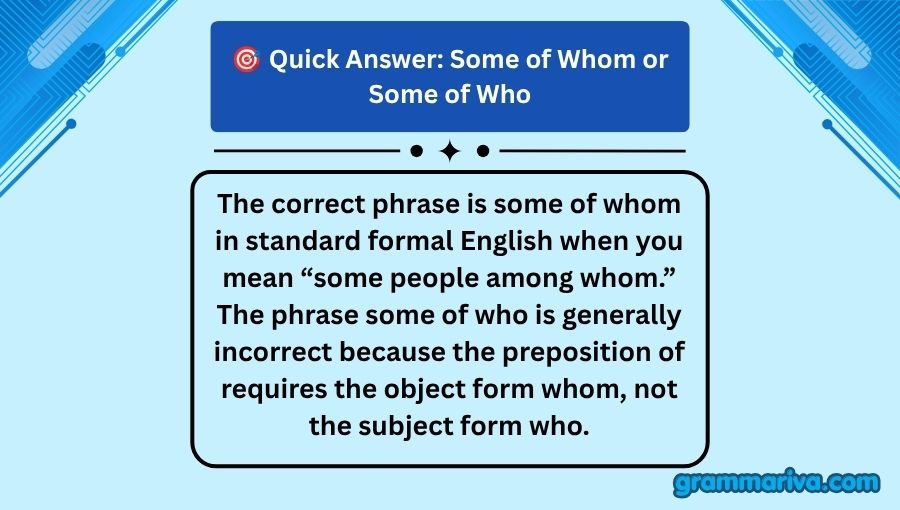
The correct phrase is some of whom in standard formal English when you mean “some people among whom.” The phrase some of who is generally incorrect because the preposition of requires the object form whom, not the subject form who.
Correct: I interviewed ten candidates, some of whom had years of experience.
Incorrect: I interviewed ten candidates, some of who had years of experience. ❌
A quick way to remember it is this: of + whom, not of + who.
What Is the Difference Between Who and Whom?
The main difference is grammatical function. Who is normally used as a subject, while whom is normally used as an object.
| Form | Type | Meaning | Example | Correct/Incorrect |
|---|---|---|---|---|
| who | Subject pronoun | A person doing an action | Who called you? | Correct |
| whom | Object pronoun | A person receiving an action | Whom did you call? | Correct |
| some of whom | Object phrase | Some people among a group | Some of whom arrived early | Correct |
| some of who | Subject form after “of” | Not standard in this construction | Some of who arrived early | Incorrect |
The word of is a preposition. A pronoun that follows it needs to work as an object. That is why whom fits the structure.
Compare these two sentences:
Who called the manager?
Here, who performs the action of calling.
Whom did the manager call?
Here, whom receives the action.
The same basic idea explains some of whom.
Is “Some of Whom” Grammatically Correct? ✅
Yes. Some of whom is grammatically correct and is widely used in formal English. It refers to some people from a group that has already been mentioned. This is why some of whom is a common and useful structure in formal English writing.
For example:
The company hired twelve workers, some of whom had worked in the industry before.
The word whom refers back to twelve workers. The phrase means that some members of that group had previous experience.
Another example:
I invited several friends, some of whom live nearby.
Here, some of whom means “some of my friends.” The phrase adds information about part of the group.
The structure is especially common in relative clauses.
How the Sentence Works
Look at this example:
We met several teachers, some of whom had taught abroad.
The main clause is:
We met several teachers.
The added phrase is:
some of whom had taught abroad.
The phrase some of whom introduces information about part of the group.
The word of connects the partial group to the larger group. The word whom is the object of of.
More Correct Examples
✅ We hired six designers, some of whom had worked for large companies.
❌ We hired six designers, some of who had worked for large companies.
✅ She knows many writers, some of whom have won awards.
❌ She knows many writers, some of who have won awards. This is why some of whom is a common and useful structure in formal English writing.
Why Is “Some of Who” Usually Incorrect?
The phrase some of who is usually incorrect because who is the subject form, while whom is the object form. In the construction some of ___, the pronoun follows the preposition of.
That makes whom the standard choice.
Think of a simpler example:
I spoke with him.
We would not write:
I spoke with he.
Why? Because him is the object form of the pronoun.
The same pattern applies to who and whom:
| Subject Form | Object Form |
|---|---|
| I | me |
| he | him |
| she | her |
| they | them |
| who | whom |
So:
Some of them were late.
becomes:
Some of whom were late.
Not:
Some of who were late.
This is one of the easiest ways to understand the rule.
🎯 How Does “Some of Whom” Work in a Sentence?
Some of whom normally refers back to a previously mentioned group of people. It tells the reader that only part of that group is being described. This makes some of whom a useful structure for connecting a main sentence with extra information about a group.
For example: Writers often use some of whom to give extra information about only part of a larger group.
The professor taught twenty students, some of whom later became doctors.
The larger group is twenty students. The phrase some of whom identifies only part of that group.
The structure often looks like this: Writers often use some of whom to give extra information about only part of a larger group.
Main clause + comma + some of whom + verb + additional information
Examples:
- The school hired new teachers, some of whom had advanced degrees.
- We invited several guests, some of whom arrived early.
- She met many artists, some of whom worked in New York.
- The team signed five players, some of whom were rookies.
Meaning Table
| Meaning | Word Type | Example Sentence |
|---|---|---|
| Part of a group | Pronoun phrase | Some of whom stayed late |
| Part of a group receiving an action | Object pronoun | Some of whom I had already met |
| Part of a previously mentioned group | Relative phrase | Some of whom lived nearby |
The exact meaning changes slightly with the rest of the sentence, but the grammar pattern stays the same.
💡 What Is the Easiest Test for “Who” vs. “Whom”?
The easiest test is to replace who/whom with he/him or they/them.
If he or they works, use who.
If him or them works, use whom.
For example:
Who called?
Replace who with he:
He called.
That works, so who is correct.
Now try:
Whom did you call?
Replace whom with him:
I called him.
That works, so whom is correct.
Now test the phrase:
Some of whom attended the meeting.
Replace whom with them:
Some of them attended the meeting.
That works. Therefore, whom is the correct form.
Test Tip
When you see some of, try replacing the pronoun with them. If the sentence makes sense, whom is usually the right choice.
Is “Some of Whom” Better for Formal Writing?
Yes. Some of whom is especially useful in formal writing because it follows traditional standard grammar rules and makes the relationship between the words clear.
You may see it in:
- Academic writing
- Business reports
- Resumes
- Professional emails
- News writing
- Essays
- Books
- Formal correspondence
For example:
The organization works with several charities, some of whom provide services to local families.
That sentence sounds clear and professional.
In casual conversation, people often avoid whom because modern spoken English frequently favors who. But that does not mean some of who is the standard form after of.
A useful option is to rewrite the sentence if whom feels too formal:
The organization works with several charities. Some of them provide services to local families.
This avoids the issue completely.
📝 Case Study: A Small Mistake in a Work Email
I once edited a workplace email that said:
Our company partners with several schools, some of who offer free training.
The writer had a strong sentence structure but had chosen who automatically. I changed it to:
Our company partners with several schools, some of whom offer free training.
The writer asked why. I showed the them/him test.
“Some of them offer free training” sounds natural. Therefore, the object form whom fits the original structure.
The writer remembered the rule after that because the test was easier than memorizing a grammar chart.
This is a useful lesson. Grammar rules become much easier when you connect them to a simple sentence pattern.
What Is the Grammar Rule Behind “Some of Whom”?
The grammar rule is based on pronoun case. Who is the subject form, and whom is the object form. Because whom follows the preposition of in this construction, some of whom is the standard grammatical form.
Consider:
Some of whom were selected.
The larger group is already named:
The committee interviewed several applicants.
Then:
some of whom were selected
adds information about part of those applicants.
The preposition of creates the relationship between the part and the whole. The pronoun after of takes the object form.
This pattern is not unique to whom.
Compare:
Some of them were selected.
The word them is an object pronoun.
The equivalent relative construction is:
Some of whom were selected.
This is why the grammar works.
Standard English reference works generally recognize the subject/object distinction between who and whom, although everyday speech often uses who in places where traditional formal grammar would use whom.
✅ Correct vs. Incorrect at a Glance
| Sentence | Correct/Incorrect | Why |
|---|---|---|
| I met several people, some of whom were teachers. | Correct | “Whom” follows “of.” |
| I met several people, some of who were teachers. | Incorrect | “Who” is not the standard object form here. |
| She interviewed five candidates, some of whom had experience. | Correct | “Whom” refers to part of the candidates. |
| She interviewed five candidates, some of who had experience. | Incorrect | The phrase needs the object form. |
| We invited ten guests, some of whom stayed late. | Correct | “Whom” follows the preposition “of.” |
⚠️ Why Do People Confuse “Some of Whom” and “Some of Who”?
The confusion happens because who is much more common in everyday speech. Many speakers use who in places where older or more formal grammar would use whom.
There is also a sound issue. When people say the whole sentence quickly, who and whom can feel like tiny details. Writers may choose the form that feels more familiar.
I once caught myself typing some of who in a quick note while editing a long paragraph. I stopped because the phrase sounded slightly off when I read it back. The some of them test immediately gave me the answer.
Here are some common reasons for the mistake:
- Fast typing: Writers often type the more familiar word.
- Autocorrect: Software may not always suggest the form you need.
- Lack of knowledge: Many people never learn the difference between subject and object pronouns.
- Everyday speech: Modern speakers often prefer who because it sounds more natural.
- Overthinking: Some writers know that whom exists but are unsure when to use it.
Similar Grammar Confusions
| Common Confusion | Correct Choice | Simple Reason |
|---|---|---|
| who / whom | Depends on role | Subject vs. object |
| he / him | Depends on role | Subject vs. object |
| they / them | Depends on role | Subject vs. object |
| I / me | Depends on role | Subject vs. object |
| she / her | Depends on role | Subject vs. object |
Specific Mistakes to Avoid
| Wrong Form | What’s Wrong | Correct Form |
|---|---|---|
| some of who | Wrong pronoun case after “of” | some of whom |
| some who whom | Unnecessary extra pronoun | some of whom |
| some of whos | Incorrect spelling | some of whom |
| some of whome | Incorrect spelling | some of whom |
| some of who’s | “Who’s” means “who is” or “who has” | some of whom |
How Can You Remember the Difference?
Use one short rule:
Of + whom.
You can also remember the pair:
who = he/they
whom = him/them
Then test the sentence.
Some of whom arrived early.
Change it mentally:
Some of them arrived early.
That sounds right.
Now:
Some of who arrived early.
Try replacing who with they:
Some of they arrived early.
That sounds wrong. The test tells you that who is not the right form.
This method works well because it focuses on the job of the pronoun instead of its appearance.
Where Is “Some of Whom” Used in Real Writing?
Some of whom works in many types of writing. The structure is common whenever you describe only part of a group.
Everyday Conversation
I have several cousins, some of whom live nearby.
This sounds a little formal in casual speech, but it is grammatically correct.
Professional Writing
We contacted several suppliers, some of whom offered lower prices.
This is a strong choice for reports and business communication.
Creative Writing
She remembered the travelers, some of whom had disappeared years earlier.
The structure can also work naturally in stories.
Social Media and Texting
You may see shorter alternatives online:
Met a bunch of old classmates today. Some of them still live here.
This is often more casual than some of whom.
| Context | Which Term to Use | Example |
|---|---|---|
| Everyday conversation | Some of whom or some of them | Some of them came early. |
| Professional writing | Some of whom | Some of whom had prior experience. |
| Creative writing | Some of whom | Some of whom vanished without a trace. |
| Social media/texting | Some of them | Some of them were there! |
Can “Some of Whom” Be Used Before a Verb?
Yes. Some of whom can be followed by a verb when the phrase introduces information about people in a larger group. This pattern makes some of whom especially useful when you want to describe part of a group without starting a new sentence.
For example:
We invited several speakers, some of whom arrived early.
Here, whom refers to the speakers. The verb arrived describes what some of those speakers did.
Another example:
The school has many graduates, some of whom now work overseas.
The phrase some of whom identifies part of the graduates.
The construction can also appear when the people are connected to an action:
She knows several musicians, some of whom I have met.
Here, I have met them makes the object role clear.
Can “Who” Ever Be Correct in a Similar Sentence?
Yes. Who can be correct when it functions as the subject and does not follow of as an object.
Compare:
The students who arrived early received breakfast.
Here, who is the subject of arrived. The students are doing the action.
Now compare:
The students, some of whom arrived early, received breakfast.
Here, whom follows of.
| Sentence | Pronoun | Role |
|---|---|---|
| The students who arrived early left first. | who | Subject of “arrived” |
| The students, some of whom arrived early, left first. | whom | Object of “of” |
| Who arrived early? | who | Subject |
| Whom did you invite? | whom | Object |
This is the key distinction. The issue is not that who is always wrong. It is that who does not fit the specific some of whom structure.
Is “Some of Whom” More Formal Than “Some of Them”?
Yes. Some of whom often sounds more formal or polished than some of them, especially when it appears in a relative clause.
Compare:
We met several experts, some of whom had worked on the project.
with:
We met several experts. Some of them had worked on the project.
Both are correct. The first combines the ideas into one sentence. The second uses two sentences and sounds more conversational. In formal writing, some of whom is often a clean way to connect related ideas in one sentence.
| Phrase | Style | Example |
|---|---|---|
| some of whom | Formal/standard | Some of whom had experience |
| some of them | Neutral/casual | Some of them had experience |
| who | Subject form | People who had experience |
Choosing between some of whom and some of them is often a style decision. Choosing between some of whom and some of who is a grammar decision.
What Are Some Common Phrases With “Some of Whom”?
There are no major idioms built around some of whom, but the phrase appears in several useful sentence patterns.
| Phrase Pattern | Meaning |
|---|---|
| several people, some of whom | Some people from a larger group |
| many students, some of whom | Part of a student group |
| several employees, some of whom | Part of an employee group |
| many friends, some of whom | Part of a friend group |
| several candidates, some of whom | Part of a candidate group |
Examples:
- The class had several students, some of whom won awards.
- We interviewed many candidates, some of whom had excellent skills.
- She invited several friends, some of whom stayed overnight.
- The company hired several workers, some of whom had previous experience.
What Can You Use Instead of “Some of Whom”?
Sometimes you can replace some of whom with another phrase. The best choice depends on the sentence and the level of formality.
| Alternative | Works When | Does Not Work When |
|---|---|---|
| some of them | You want a simple sentence | You need one relative clause |
| several of them | You want to stress the number | The exact number is unknown |
| a few of them | Only a small number is meant | More than a small group is meant |
| certain people | You want to identify a subset | The original group must stay clear |
| some members of the group | You want extra clarity | The sentence needs a compact structure |
For example:
I met several engineers, some of whom worked remotely.
can become:
I met several engineers. Some of them worked remotely.
Both are correct. The second is often easier for beginners.
Why Does Getting “Some of Whom” Right Matter?
Correct pronoun choice improves clarity. It also makes formal writing look polished and controlled .Using some of whom correctly can make professional and academic sentences clearer and more polished.
| Situation | Why Getting It Right Matters |
|---|---|
| Resume | Shows careful writing |
| Client email | Creates a professional impression |
| Published content | Helps maintain grammar quality |
| Social post | Makes the sentence clear and polished |
A grammar error in a single phrase may not change the meaning, but repeated errors can distract readers.
A useful rule for writers is simple:
Clear grammar helps readers focus on your message instead of your mistakes.
You do not need fancy words to sound professional. You need clear sentence structure and correct word choices.
🧠 How To Remember “Some of Whom” Forever
I recommend remembering three steps.
Step 1: Find “of”
If the phrase contains:
some of ___
stop for a moment.
Step 2: Think of “them”
Ask whether them could fit.
Some of them arrived early.
Yes.
Step 3: Use “whom”
Because whom is the object form that matches them, write:
Some of whom arrived early.
That is the whole trick.
You do not need to spend ten minutes debating the sentence. The substitution test usually solves it in seconds.
❓ Is “Some of Whom” Always the Best Choice?
Not always. It is the correct choice for the grammar structure, but sometimes some of them is clearer or more natural.
For example:
I spoke with several customers, some of whom were upset.
This is polished and concise.
But:
I spoke with several customers. Some of them were upset.
may be easier for a beginner to read.
The choice depends on your audience. Formal writing often favors the compact relative-clause structure. Casual writing may favor shorter sentences.
The important point is that some of who should not be treated as the standard alternative.
What Happens If You Remove “Some of”?
Removing the phrase can help you see the grammar more clearly.
Consider:
I interviewed several applicants, some of whom had experience.
Remove some of:
I interviewed several applicants. They had experience.
The pronoun they works as a subject in the second sentence.
But in the original structure:
some of whom
the pronoun follows of, so the object form is needed.
This shows why who and whom cannot simply be chosen based on what sounds familiar.
❓ Can “Some of Whom” Refer to Women and Men?
Yes. Whom does not identify gender. It can refer to men, women, or a mixed group.
Examples:
The teachers, some of whom were women, attended the event.
The teachers, some of whom were men, attended the event.
The teachers, some of whom were parents, attended the event.
The word whom simply performs the needed grammatical role.
❓ Can “Some of Whom” Be Used With Animals?
Traditionally, whom is associated with people. For animals, writers often use which, that, or another suitable structure depending on context and style.
For example:
The dogs, some of which were rescued, found new homes.
Here, which is natural because the sentence refers to animals.
For people:
The volunteers, some of whom were students, helped clean the park.
So do not automatically replace who with whom whenever you are talking about any living thing. The word needs to fit the type of noun and the grammar.
❓ What If “Whom” Sounds Too Formal?
If whom feels stiff, you can often rewrite the sentence.
Instead of:
I contacted several managers, some of whom were available.
you could write:
I contacted several managers. Some of them were available.
This is perfectly clear and grammatical.
However, if you keep the original relative-clause structure, some of whom remains the standard choice.
❓ Is “Some of Who” Ever Acceptable?
In standard formal English, some of whom is the expected form when whom is the object of of. You may encounter some of who in informal writing or speech, but it should generally be avoided in careful writing.
If you are writing an essay, report, article, professional email, or application, choose some of whom.
❓ Why Does “Whom” Sound Unnatural to Many People?
Modern everyday English often uses who more broadly than traditional formal grammar does. As a result, whom can sound formal or old-fashioned to some speakers.
That does not make whom incorrect. It means that spoken English and formal written English do not always use pronouns in exactly the same way.
When the structure is clear, such as some of whom, using whom is still a strong choice in careful writing.
❓ What Is the Difference Between “Some of Whom” and “Some of Them”?
Some of whom usually forms part of a larger sentence and introduces a relative clause. Some of them usually stands as a separate pronoun phrase.
Compare:
We invited ten guests, some of whom arrived early.
We invited ten guests. Some of them arrived early.
Both sentences are correct. The first is more compact. The second is often more conversational.
❓ How Can I Check “Some of Whom” Quickly?
Use the them test.
If you can say:
some of them
then some of whom is usually the correct relative form.
Example:
Some of them were late.
Therefore:
Some of whom were late.
This is one of the fastest ways to check the construction.
❓ Should I Use “Some of Whom” in Academic Writing?
Yes. Some of whom is a good choice in academic writing when you are referring to part of a group of people.
Example:
The study examined several participants, some of whom had previous experience with the task.
The phrase is clear and grammatically appropriate for formal writing.
❓ Is “Who” Always Wrong After “Of”?
No. The important point is the entire grammar structure. Who can appear near of in a sentence when it has a different grammatical role, but in the specific phrase some of whom, the standard form is whom.
Do not create a rule that says “who can never appear near of.” Instead, check the pronoun’s role.
❓ What Is the Simple Rule for Some of Whom or Some of Who?
Use some of whom when referring to part of a group of people in this relative-clause structure. Avoid some of who in standard formal English.
Remember:
some of whom = correct
some of who = generally incorrect
🔎 Quick Recap Checklist
Use this checklist whenever you are unsure.
| Question | If Yes → Use |
|---|---|
| Does the phrase contain “some of” before the pronoun? | whom |
| Does “them” work in the equivalent sentence? | whom |
| Is the pronoun receiving the action? | whom |
| Is the pronoun the subject doing the action? | who |
| Are you writing formal English? | Prefer the standard form |
Practice Examples
- The team has ten players, some of whom are injured.
- She interviewed several doctors, some of whom worked abroad.
- We invited many neighbors, some of whom brought food.
Try the them test on each one. You will see why whom works.
❓ FAQs About Some of Whom vs Some of Who
Is “some of whom” correct?
Yes. Some of whom is the standard grammatical form when the phrase refers to part of a previously mentioned group of people.
Is “some of who” grammatically correct?
It is generally not considered correct in standard formal English when who follows of in this construction. Use some of whom instead.
Why do we use “whom” after “some of”?
The word whom is the object form of who, and it follows the preposition of. The same idea appears in “some of them.”
Can I say “some of them” instead?
Yes. Some of them is completely correct. It is often simpler and more conversational than some of whom.
What is the easiest way to remember who vs. whom?
Use the he/him or they/them test. If they works, use who. If them works, use whom.
Is “some of whom” formal?
Yes, it can sound more formal than some of them, especially in academic, professional, or polished written English.
Can “some of whom” begin a sentence?
Usually, the phrase refers back to a group already mentioned, so it normally works best after that group has been introduced. A sentence such as “Several students attended. Some of whom stayed late” should instead be written as “Several students attended, some of whom stayed late.”
Can “some of whom” refer to a mixed group?
Yes. Whom can refer to a group that includes people of different genders.
What is the difference between “who” and “whom”?
Who is normally the subject form. Whom is normally the object form. For example, “Who called?” uses who, while “Whom did you call?” uses whom.
Is “some of who” common in casual English?
You may encounter it in informal speech or writing, but it is not the preferred form in careful standard English. For professional or academic writing, use some of whom.
Conclusion
Remember that some of whom is the standard choice when the phrase follows “of” and refers to people.
Some of whom or some of who becomes much easier once you understand the role of the pronoun. In standard English, some of whom is the correct choice when the phrase refers to part of a group of people. The reason is simple: whom is the object form, and it follows the preposition of.
You can remember the rule with one quick comparison: some of them → some of whom. If them works, whom is usually the form you need.
Who is still correct when it acts as the subject. For example, “the students who arrived early” is correct because who performs the action of arriving. The key is not to memorize isolated words. Look at the job each pronoun performs. Once you understand the pattern, using some of whom becomes much easier.
When you are unsure, use the them test. It is fast, clear, and reliable for this construction. With a little practice, choosing some of whom will become automatic. Keep your grammar simple, check the pronoun’s role, and let clarity guide your writing. ✨

Hi, I’m Olivia Carter. I’m an English language editor at Grammariva, and I work on making grammar lessons clear, accurate, and easy to follow. I especially enjoy writing about common grammar mistakes and everyday English.



[…] examples, tables, memory tricks, common mistakes, real-life situations, and practice questions. Some of Whom or Some of Who | Tortuous vs Torturous | Continuous vs […]