Day off vs off day can be confusing because both phrases contain the same two words. Yet they do not mean the same thing. If you have ever said, “I have an off day tomorrow,” when you meant that you do not have to work, you are not alone. I have seen this mix-up often in casual writing, workplace messages, and even student assignments. 😊
The good news is that the difference is simple once you focus on what “off” describes. A day off is a day when you do not have to work, attend school, or follow your usual duties. An off day usually means a day when you are not performing well, do not feel your best, or things are not going as planned.
In this guide, I’ll explain both phrases with clear examples. We’ll look at grammar, everyday speech, work emails, common mistakes, fixed expressions, and useful alternatives. By the end, you should know exactly when to use each phrase. Tear vs Tare | Die vs Dice | Who Else or Whom Else
Quick Answer: Day Off vs Off Day 🎯
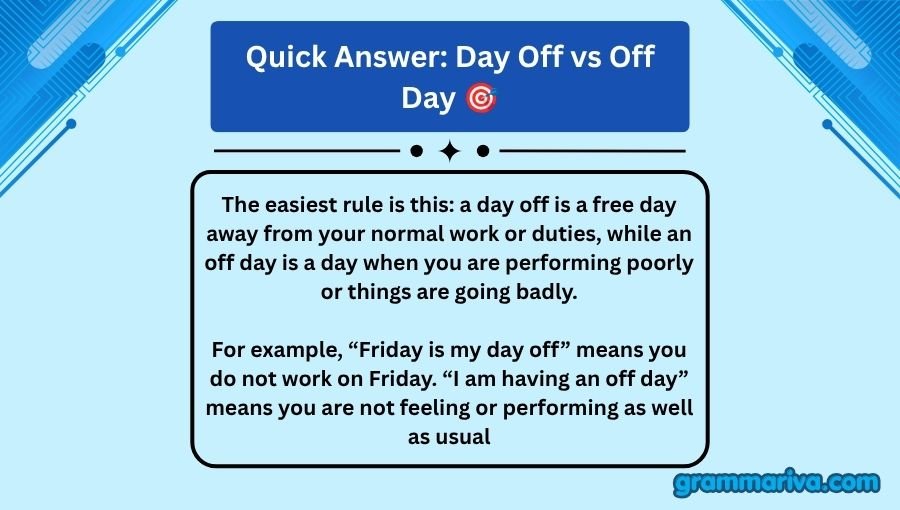
The easiest rule is this: a day off is a free day away from your normal work or duties, while an off day is a day when you are performing poorly or things are going badly.
For example, “Friday is my day off” means you do not work on Friday. “I am having an off day” means you are not feeling or performing as well as usual.
| Phrase | Basic Meaning | Example |
|---|---|---|
| day off | A day away from work or normal duties | I have a day off Friday. |
| off day | A day of poor performance, mood, or results | I am having an off day. |
Is a Day Off the Same as an Off Day? 🤔
No, a day off and an off day are not the same. The first describes time away from normal duties. The second describes a less-than-normal experience or performance.
Think of them this way:
- day off = no work
- off day = not your best day
Example 1
✅ I have a day off tomorrow.
This means the speaker does not have to work tomorrow.
❌ I have an off day tomorrow.
This normally suggests that tomorrow will be a poor or unusual day for the speaker, not that they are free from work.
Example 2
✅ She took a day off after working all week.
She took a break from work.
❌ She took an off day after working all week.
This is not the normal way to express the idea of taking a break from work.
The key is the relationship between the words. In day off, “off” tells us that the day is free from normal duties. In off day, “off” describes the quality of the day or the person’s performance.
Day Off: Meaning and Correct Use 🗓️
A day off is a day when someone does not have to work or perform their normal duties. It can be a planned holiday, a scheduled break, or a day away from work for another reason.
The phrase is especially common in workplaces.
Common examples
✅ I have a day off on Monday.
The person is not scheduled to work Monday.
✅ Can I take a day off next week?
The speaker wants permission to be away from work.
✅ My day off was relaxing.
The speaker had free time away from normal duties.
The phrase can also refer to school or other regular activities.
✅ The students had a day off from school.
Here, “day off” means a break from school.
Sentence breakdown
Consider this sentence:
I have a day off tomorrow.
- I = subject
- have = verb
- a day off = noun phrase
- tomorrow = time expression
The whole phrase a day off acts as a noun.
Useful forms
You may see:
- a day off
- my day off
- your day off
- take a day off
- have a day off
- get a day off
- give someone a day off
- have the day off
| Meaning | Word Type | Example Sentence |
|---|---|---|
| A break from work | Noun phrase | I need a day off. |
| A scheduled free day | Noun phrase | Tuesday is my day off. |
| Permission to stop working | Noun phrase | My manager gave me a day off. |
Test Tip 💡
Ask yourself:
“Am I talking about not working or not doing my normal duties?”
If the answer is yes, day off is probably the phrase you need.
Off Day: Meaning and Correct Use 📉
An off day is a day when someone does not perform as well as usual or does not feel normal. It can describe physical performance, mood, work quality, sports performance, or general luck.
For example:
✅ I am having an off day today.
This means the speaker does not feel or perform normally.
The phrase does not usually mean that the person has no work.
Off day in everyday life
You might say:
✅ I made three mistakes this morning. I am having an off day.
The person is having a bad or unusual day.
You could also say:
✅ Even great athletes have an off day.
The athlete is performing below their normal level.
Off day and feelings
The expression can describe your mood.
✅ Sorry if I seem quiet. I am having an off day.
Here, “off” suggests that the person does not feel like themselves.
Off day and performance
It is also common in sports and work.
✅ The player had an off day and missed several easy shots.
The player performed below their normal standard.
| Meaning | Word Type | Example Sentence |
|---|---|---|
| Poor performance | Noun phrase | The team had an off day. |
| Poor mood | Noun phrase | I am having an off day. |
| Unusually bad results | Noun phrase | The business had an off day. |
Why Do People Confuse Day Off and Off Day? 💭
People confuse these phrases because the same two words appear in a different order. English has many expressions where word order changes meaning.
For example, a day off and an off day look almost identical. The difference is easy to miss when speaking quickly.
I once corrected a short workplace message that said, “I am taking an off day tomorrow.” The writer meant that they were not scheduled to work. Changing it to “I am taking a day off tomorrow” made the meaning immediately clear.
Another reason is that learners may assume off always means “not working.” It can, but not in every expression. In day off, it relates to being away from work or duties. In off day, it describes an unusual or poor day.
Compare these meanings
| Phrase | What “off” tells us | Main idea |
|---|---|---|
| day off | The person is away from normal duties | Free time |
| off day | The day or performance is unusual | Poor or unusual experience |
| take a day off | Stop working for a day | Break |
| have an off day | Perform or feel poorly | Bad day |
Day Off vs Off Day at a Glance 📊
The clearest way to understand the difference is to compare the phrases side by side.
| Form | Type | Meaning | Example | Correct/Incorrect |
|---|---|---|---|---|
| day off | Noun phrase | A break from work or duties | I need a day off. | ✅ Correct |
| off day | Noun phrase | A poor or unusual day | I am having an off day. | ✅ Correct |
| take a day off | Verb phrase | Take time away from work | I will take a day off. | ✅ Correct |
| take an off day | Nonstandard use for a work break | Usually means something different | I will take an off day. | ❌ Incorrect for this meaning |
| have an off day | Verb phrase | Have a poor or unusual day | We had an off day. | ✅ Correct |
The word order matters. Changing the order changes the meaning.
How Do You Use Day Off in a Sentence? ✍️
Use day off when you want to say that someone is free from work, school, or another regular responsibility.
Here are common patterns:
“Have a day off”
✅ I have a day off tomorrow.
This means the person is not working tomorrow.
“Take a day off”
✅ You should take a day off and rest.
This means the person should stop working for a day.
“Get a day off”
✅ I finally get a day off this weekend.
This means the speaker will have a free day.
“Give someone a day off”
✅ The manager gave the employee a day off.
This means the manager allowed the employee to take a free day.
“Have the day off”
✅ I have the day off today.
This is also very natural in American English.
How Do You Use Off Day in a Sentence? 🧠
Use off day when you mean that someone is not feeling well, thinking clearly, performing normally, or getting good results.
Personal mood
✅ I am having an off day.
The speaker feels unusual or not quite like themselves.
Work performance
✅ The editor was having an off day and missed a few errors.
The person’s work was below their usual level.
Sports
✅ The pitcher had an off day.
The pitcher did not perform well.
General results
✅ The restaurant had an off day.
The restaurant did not perform as well as usual.
| Context | Natural Phrase | Example |
|---|---|---|
| Work schedule | day off | Friday is my day off. |
| Rest from work | day off | I need a day off. |
| Poor mood | off day | I am having an off day. |
| Poor sports performance | off day | The team had an off day. |
| Poor work performance | off day | She had an off day at work. |
Can You Say “I Have an Off Day Tomorrow”? 📅
Yes, but the meaning is different from “I have a day off tomorrow.”
“I have an off day tomorrow” can suggest that tomorrow is expected to be a poor or unusual day. It does not naturally communicate that you are free from work.
Compare:
✅ I have a day off tomorrow.
Meaning: I do not work tomorrow.
✅ I might have an off day tomorrow.
Meaning: I might not perform or feel well tomorrow.
The difference is small in appearance but large in meaning.
If you are texting your boss to say that you are not working, use day off.
Day Off vs Off Day in Professional Writing 💼
In professional writing, choosing the right phrase matters because the reader needs to understand your schedule immediately.
Workplace example
Suppose you want to tell your manager that you are unavailable because you are not scheduled to work.
✅ I will be taking a day off on Friday.
This is clear and professional.
❌ I will be taking an off day on Friday.
This may confuse the reader because off day normally describes performance or condition.
A workplace schedule might say:
- Monday: Working
- Tuesday: Working
- Wednesday: Day off
- Thursday: Working
The phrase clearly shows that Wednesday is a scheduled break.
Case Study: A Workplace Message 📧
Imagine that Alex works at a busy office. Alex wants to tell a coworker that Friday is a scheduled break.
Alex writes:
❌ I have an off day on Friday, so I won’t come in.
The message can be understood, but off day is not the best choice.
A clearer version is:
✅ I have a day off on Friday, so I won’t be in the office.
Now the meaning is direct.
Later that same week, Alex makes several mistakes during a presentation. Alex says:
✅ I think I am having an off day today.
This time, off day is exactly right.
The two sentences use similar words but communicate two different ideas.
What Is the Grammar Rule Behind the Difference? 📚
The difference comes mainly from meaning and word order.
In day off, the phrase works as a noun phrase meaning a period when someone is free from regular duties.
In off day, the adjective-like word off modifies “day” and gives the phrase the sense of an unusual, poor, or less successful day.
This is why simply switching the word order does not preserve the meaning.
Standard English usage supports both expressions, but they serve different purposes. Common reference dictionaries and standard English usage guides recognize day off as a term for time away from work or duties and off day as an expression for a poor or unusual day.
Correct vs Incorrect at a Glance
| Sentence | Correct/Incorrect | Why |
|---|---|---|
| I have a day off tomorrow. | ✅ Correct | The speaker is free from work. |
| I am having an off day today. | ✅ Correct | The speaker is not feeling or performing normally. |
| Friday is my off day from work. | ⚠️ Less natural | Day off is clearer for a work break. |
| I took a day off to rest. | ✅ Correct | The speaker stopped working for a day. |
| The player had an off day. | ✅ Correct | The player performed poorly. |
What Are the Most Common Mistakes? ⚠️
The biggest mistake is using off day when you mean day off.
This often happens because people think “off” automatically means “not working.” That is not always true.
Why these mistakes happen
- Fast typing: People write the first phrase that comes to mind.
- Autocorrect: Phones may suggest unexpected wording.
- Lack of knowledge: Learners may not know that word order changes the meaning.
- Speech habits: Casual speech can make the distinction less noticeable.
- Direct translation: A phrase from another language may influence English word order.
I once caught myself typing “off day” in a note when I meant “day off.” I was writing quickly and focused on the word “off.” A quick reread fixed the mistake.
Similar English confusions
| Confusing Forms | Correct Use | Common Problem |
|---|---|---|
| it’s / its | it’s = it is; its = possession | Missing apostrophe |
| your / you’re | your = possession; you’re = you are | Sounding the same |
| their / they’re | their = possession; they’re = they are | Same pronunciation |
| then / than | then = time; than = comparison | Similar spelling |
| day off / off day | free day / poor or unusual day | Same words, different order |
Specific mistakes to avoid
| Wrong Form | What’s Wrong | Correct Form |
|---|---|---|
| an off day from work | Can sound unclear for a scheduled break | a day off from work |
| my off day is Saturday | May be understood but is less clear | my day off is Saturday |
| I am taking an off day | Wrong choice when requesting leave | I am taking a day off |
| She has an off tomorrow | Missing the noun phrase | She has a day off tomorrow |
| I need an off day from my job | Ambiguous for workplace leave | I need a day off from my job |
| He took an off day to rest | Wrong for a planned break | He took a day off to rest |
Does “Off Day” Ever Mean a Day Off From Work? 🔍
In some varieties of English and in informal workplace speech, people may use off day to mean a day when they are not scheduled to work. However, this usage can vary by region, workplace, and speaker.
For clear US English, especially in professional writing, day off is the safer and more standard choice when you mean a break from work.
For example:
✅ Wednesday is my day off.
This is clear to almost everyone.
By contrast:
⚠️ Wednesday is my off day.
Some speakers may understand it as a scheduled break, but others may read it as “Wednesday is a bad day for me.”
When clarity matters, choose day off.
How Are the Two Phrases Used in Different Contexts? 🌎
The right expression depends on what you are describing. Work schedules usually need day off, while feelings and performance usually need off day.
| Context | Which Term to Use | Example |
|---|---|---|
| Everyday conversation | day off for free time | I have a day off tomorrow. |
| Professional writing | day off for leave | I would like to request a day off. |
| Creative writing | Either, depending on meaning | She needed a day off. |
| Social media/texting | Either, depending on meaning | Finally enjoying my day off! |
| Sports | off day for poor performance | The team had an off day. |
| Personal mood | off day | I am having an off day. |
Common Phrases With Day Off and Off Day 💬
Both phrases appear in natural English expressions. The surrounding words often make the intended meaning clear.
| Phrase | Meaning |
|---|---|
| take a day off | Stop working for one day |
| have a day off | Have a free day |
| get a day off | Receive a break from work |
| give someone a day off | Allow someone not to work |
| have the day off | Be free from work that day |
| have an off day | Have a poor or unusual day |
These expressions are useful because they show how native speakers normally build sentences around each phrase.
What Can You Say Instead of Day Off? 🔄
Sometimes another phrase may fit better. The best alternative depends on the situation.
| Alternative | Works When | Does Not Work When |
|---|---|---|
| day of rest | You want to emphasize rest | You need a normal workplace term |
| break | You mean a short or general period of rest | You specifically mean a whole scheduled day |
| leave | You mean authorized time away from work | You are talking about poor performance |
| vacation day | You mean a paid or planned vacation day | The day is not part of vacation |
| free day | You want an informal phrase | Formal workplace policies require “day off” |
For most workplace situations, day off remains the clearest choice.
Why Getting Day Off vs Off Day Right Matters ✨
Correct word choice makes communication easier. It can also prevent awkward misunderstandings.
Imagine telling your manager:
“I need an off day tomorrow.”
Your manager may wonder whether you are asking for time away from work or saying that tomorrow may be difficult for you.
Now compare:
“I need a day off tomorrow.”
There is no confusion.
A simple phrase can make a message much clearer.
“Clear words make simple messages stronger.”
| Situation | Why Getting It Right Matters |
|---|---|
| Resume or application | Shows strong English control |
| Client email | Prevents confusion |
| Workplace message | Makes your schedule clear |
| Social post | Helps readers understand your meaning |
How Can You Remember the Difference? 🧩
Use a simple memory trick:
DAY OFF = OFF WORK
If you are talking about not working, choose day off.
OFF DAY = OFF YOUR USUAL GAME
If you are talking about poor performance, mood, or results, choose off day.
Try this quick test
Ask:
“Is the person free from normal duties?”
- Yes → day off
Ask:
“Is the person having a bad, unusual, or below-normal day?”
- Yes → off day
| Question | If Yes → Use |
|---|---|
| Are you not working? | day off |
| Are you taking leave? | day off |
| Are you free from school? | day off |
| Are you performing poorly? | off day |
| Are you feeling unusual? | off day |
| Are your results worse than normal? | off day |
Practice: Can You Choose the Right Phrase? 📝
Try these before checking the answers.
- I finally have a ___ after six straight workdays.
- I missed an easy shot today. I am having an ___.
- My manager approved my ___ for Friday.
- The team had an ___ during yesterday’s game.
Answers
- day off ✅
- off day ✅
- day off ✅
- off day ✅
The pattern is simple. A break from duties is a day off. Poor performance or an unusual experience is an off day.
Quick Recap Checklist ✅
The main difference can be remembered in a few seconds.
| Question | If Yes → Use |
|---|---|
| Do you mean a free day from work? | day off |
| Are you requesting workplace leave? | day off |
| Are you talking about rest from regular duties? | day off |
| Do you mean poor performance? | off day |
| Do you feel unlike yourself? | off day |
| Did someone perform worse than usual? | off day |
Three final practice examples
I have a day off tomorrow. ✅
I am having an off day today. ✅
The team had an off day yesterday. ✅
FAQs About Day Off vs Off Day ❓
What is the difference between a day off and an off day?
A day off is a day when you are free from work, school, or normal duties. An off day is a day when you are not feeling or performing as well as usual.
Is “day off” correct for work?
Yes. Day off is the natural phrase for a scheduled break from work. For example, “Saturday is my day off” means you are not scheduled to work Saturday.
Is “off day” grammatically correct?
Yes. Off day is grammatically correct when it describes a poor, unusual, or less successful day. For example, “I am having an off day” means you are not feeling or performing normally.
Should I say “I have a day off tomorrow”?
Yes. This is the clearest way to say that you do not have to work tomorrow.
Can I say “I have an off day tomorrow”?
You can, but the meaning may change. It may suggest that tomorrow will be a difficult or unsuccessful day. For a work-free day, I have a day off tomorrow is much clearer.
Is “take an off day” correct?
If you mean taking a break from work, take a day off is the better standard expression. Have an off day is used when someone feels or performs poorly.
What does “I am having an off day” mean?
It means you are not feeling, thinking, or performing as well as you normally do. It can refer to mood, work, sports, or general daily life.
What does “I need a day off” mean?
It means you want or need a day away from work or another regular responsibility. It often suggests that you need rest or personal time.
Which phrase is better in a work email?
Use day off when discussing your work schedule or requesting leave. For example: “I would like to request a day off on Friday.”
Is “off day” common in sports?
Yes. Off day is commonly used when an athlete or team performs below their normal level. For example, “The team had an off day.”
Conclusion 🌟
Day off vs off day becomes easy once you remember what you are describing. Use day off when someone is free from work, school, or regular duties. Use off day when someone is having a poor, unusual, or below-normal day.
If you are talking about your work schedule, say, “I have a day off tomorrow.” If you are talking about poor performance, say, “I am having an off day today.” That small change in word order creates a different meaning.
I recommend using day off in workplace messages whenever you mean scheduled time away from work. It is clear and natural in US English. Save off day for situations involving mood, performance, results, or an unusual experience. 😊
Once you learn this simple rule, you will rarely mix these phrases up again. Free from work? Day off. Not at your best? Off day. Keep that one line in mind, and your word choice will stay clear every time. ✅

Hi, I’m Lucas Bennett. I’m a grammar content specialist at Grammariva. I work on articles covering everyday grammar questions, sentence usage, and writing tips that readers can apply with confidence.


[…] examples, and easy memory tricks. By the end, you should know exactly when to use each word. 😊 Day Off vs Off Day | Tear vs Tare | Die vs […]
[…] should be able to choose the correct form without stopping to think twice. ✨ Marquee vs Marquis | Day Off vs Off Day | Tear vs […]