Confused about die vs dice? You are not alone. These two words look almost the same, but they do not always work the same way in a sentence. If you are talking about a board game, a math problem, or even a piece of equipment, choosing the right form can make your writing clearer. 🎲
The basic rule is simple: die is the traditional singular form for one numbered cube, while dice is the traditional plural form for two or more. For example, you can roll one die, but you can roll two dice. The word die also has other meanings, including a verb meaning to stop living and a noun for a tool used to shape or cut material.
I have seen learners mix these words up because everyday speech often treats “dice” as a singular word. That use is common in casual English, especially in gaming. Still, formal writing usually keeps the traditional distinction. ✍️
This guide explains the difference in plain US English. You will learn when to use each word, how the forms work, which mistakes to avoid, and how to remember the rule. Who Else or Whom Else | Appal vs Appall | Loot vs Lute
🎯 Quick Answer: What Is the Difference Between Die vs Dice?
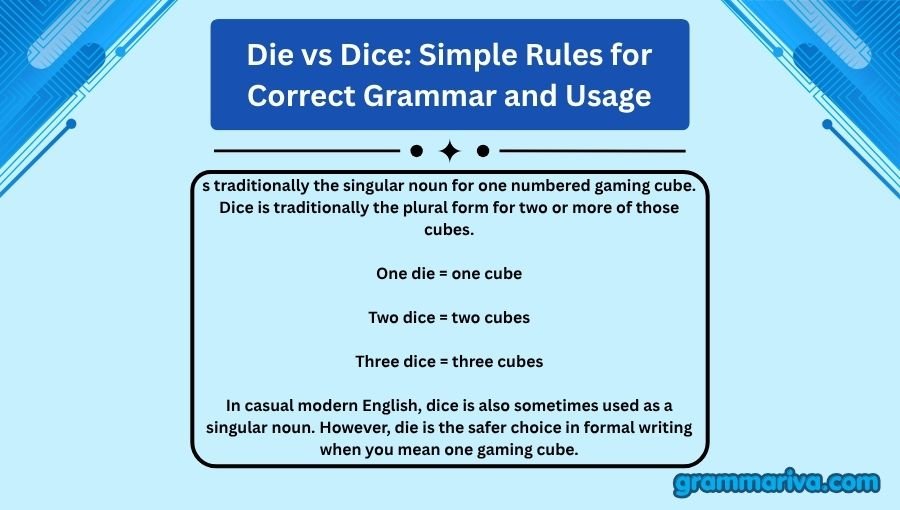
Die is traditionally the singular noun for one numbered gaming cube. Dice is traditionally the plural form for two or more of those cubes.
- One die = one cube
- Two dice = two cubes
- Three dice = three cubes
In casual modern English, dice is also sometimes used as a singular noun. However, die is the safer choice in formal writing when you mean one gaming cube.
| Word | Traditional Number | Example |
|---|---|---|
| Die | Singular | I rolled one die. |
| Dice | Plural | I rolled two dice. |
| Dice | Informal singular use | Roll the dice and see what happens. |
🔤 Related Word Forms and Meanings
The word die has several different uses. This can make it more confusing than it first appears.
When die means a gaming cube, its plural is traditionally dice. But die can also be a verb, and it can be a noun for a tool used in manufacturing.
| Form | Type | Example |
|---|---|---|
| die | Singular noun | One die landed on six. |
| dice | Plural noun | The dice landed on six and four. |
| die | Verb | Plants can die without water. |
| dies | Verb | A flower dies without enough water. |
| died | Past-tense verb | The plant died last week. |
| dying | Present participle | The plant is dying. |
The meaning comes from the sentence. “I rolled a die” refers to a game piece. “The plant may die” uses die as a verb.
📚 Understanding the Basics of Die vs Dice
The core difference in die vs dice is number. Use die for one gaming cube and dice for more than one. The core difference is number. Use die for one gaming cube and dice for more than one.
Think of the pattern like this:
one die → two dice → three dice
This is similar to other irregular plural forms in English. The plural is not made by simply adding -s.
| Form | Type | Meaning | Example | Correct/Incorrect |
|---|---|---|---|---|
| die | Singular noun | One gaming cube | I need one die. | ✅ Correct |
| dice | Plural noun | Two or more gaming cubes | I need two dice. | ✅ Correct |
| dies | Plural gaming noun | Intended as plural of gaming cube | I need two dies. | ❌ Incorrect |
| die | Plural gaming noun | Intended as plural | I need three die. | ❌ Incorrect |
| dice | Informal singular | One gaming cube in casual use | I rolled a dice. | ⚠️ Informal |
When Should You Use Die?
Use die when you mean a single gaming cube.
For example:
I rolled one die and got a five.
The noun is singular because there is only one cube.
You can also use a number directly before it:
She picked up one die from the table.
Another useful test is to replace the noun with “one cube.” If that works, die is probably the right word.
When Should You Use Dice?
Use dice when you mean two or more gaming cubes.
For example:
He rolled two dice.
There are two cubes, so the plural form is needed.
You can also say:
The three dice landed in a row.
The number “three” tells you that the noun must be plural.
| Meaning | Word Type | Example Sentence |
|---|---|---|
| One gaming cube | Singular noun | I rolled one die. |
| More than one gaming cube | Plural noun | I rolled two dice. |
| Stop living | Verb | The plant may die. |
| Tool for shaping material | Noun | The machine uses a die. |
❓ Is Die the Singular Form of Dice?
Yes. In traditional standard English, die is the singular form and dice is the plural form when referring to gaming cubes.
So you would normally write:
She rolled one die.
and:
She rolled two dice.
This rule is easy to remember once you connect the words to numbers.
One = die. More than one = dice.
However, English changes over time. In modern casual speech, especially among gamers, people often use dice as both singular and plural. You may hear someone say, “I rolled a dice.”
That usage is widely understood, but if you are writing a school assignment, article, formal email, or edited publication, one die is the safer choice.
❓ Why Do People Confuse Die and Dice?
People confuse these words because dice is extremely common in everyday speech. Many speakers hear “roll the dice” far more often than “roll the die.”
I once helped edit a short game guide where the writer used “one dice” several times. The meaning was clear, but we changed those examples to “one die” because the guide was written in a formal instructional style.
The confusion also happens because English has many irregular plural forms. Learners may expect a plural noun to end in -s, such as “books” or “cards.”
But die → dice does not follow that pattern.
Why the Mistake Happens
Common causes include:
- Fast typing: People write what they hear or use most often.
- Autocorrect: Software may suggest or leave the familiar word “dice.”
- Lack of knowledge: Learners may never have been taught the traditional singular form.
- Casual speech: Many speakers use “dice” as a singular noun.
- Gaming language: Players often use informal terms without thinking about traditional grammar.
| Similar Confusion | Correct Form | Common Reason for Confusion |
|---|---|---|
| its / it’s | its = possessive; it’s = it is | Sound alike |
| your / you’re | your = possessive; you’re = you are | Sound alike |
| there / their / they’re | Depends on meaning | Similar pronunciation |
| then / than | Depends on meaning | Similar spelling |
| die / dice | die = traditional singular; dice = plural | Irregular plural |
The important point is that die vs dice is not really a spelling problem. It is mainly a number and usage problem.
🧪 Test Tip: How Can You Check Which Word You Need?
Here is a simple test I use when checking a sentence.
First, ask:
How many gaming cubes are there?
If the answer is one, use die.
If the answer is two or more, use dice.
Try these:
I rolled one ___.
“One die” sounds right.
I rolled four ___.
“Four dice” sounds right.
You can also replace the word with cube:
- one cube → one die
- two cubes → two dice
That quick substitution test can help when you are writing quickly.
📝 Case Study: Die vs Dice in a Real Conversation
Imagine a teacher explaining a probability lesson.
The teacher places one gaming cube on the desk and says:
“Today, we will roll one die ten times and record the results.”
That sentence is clear and formal.
Later, the teacher gives each student two cubes:
“Now roll both dice and add the numbers.”
Again, the number controls the form.
I once caught myself typing “one dice” while preparing a classroom example. I had been writing about several dice for a few minutes, so my brain simply carried the plural form into the next sentence. The fix took one second: I changed it to “one die.”
This is a good reminder that even experienced writers can make small mistakes when switching between singular and plural forms.
| Situation | Number | Best Form | Example |
|---|---|---|---|
| A player holds one cube | 1 | die | The player rolls one die. |
| A player holds two cubes | 2 | dice | The player rolls two dice. |
| A teacher describes three cubes | 3 | dice | The teacher has three dice. |
| A player talks casually about one cube | 1 | dice may occur informally | Roll a dice. |
| Formal instructional writing | 1 | die | Roll one die. |
📖 Grammar Rules Explanation
The traditional grammar rule is based on singular and plural number.
Die is the singular noun for one gaming cube. Dice is the plural noun for more than one.
The form dice is not normally made by adding -s to “die.” It is an irregular plural form.
This means:
- one die
- two dice
- several dice
- many dice
It does not mean:
- one dice in formal standard usage
- two dies
- three die
The word die can also function as a verb. In that case, it has nothing to do with gaming cubes.
For example:
The old tree may die.
Here, die means to stop living.
The word can also appear as a noun for a tool used to cut, shape, or form material. That meaning is different again.
Most major English dictionaries recognize the gaming noun die as singular and dice as plural. Modern dictionaries may also record common informal uses, which is why you may see “a dice” in real-world English.
Correct vs Incorrect at a Glance
| Sentence | Correct/Incorrect | Why |
|---|---|---|
| I rolled one die. | ✅ Correct | One cube needs the singular noun. |
| I rolled two dice. | ✅ Correct | Two cubes need the plural noun. |
| She has three dice. | ✅ Correct | Three is plural. |
| He rolled one dice. | ⚠️ Informal | Common in casual English, but “one die” is better formally. |
| We bought two dies for the game. | ❌ Incorrect | “Dies” is not the traditional plural of a gaming die. |
⚠️ Common Mistakes With Die and Dice
Understanding die vs dice can help you avoid simple singular and plural mistakes in formal writing. The most common mistake is using dice after the word “one.”
For example:
❌ I rolled one dice.
The traditional formal version is:
✅ I rolled one die.
Another mistake is creating the plural dies.
❌ We need four dies for the game.
The correct form is:
✅ We need four dice for the game.
A third mistake comes from confusing the gaming noun with the verb die.
The character may die.
Here, “die” is a verb. It does not mean one gaming cube.
Common Wrong Forms
| Wrong Form | What’s Wrong | Correct Form |
|---|---|---|
| one dice | Traditional singular is die | one die |
| two dies | Incorrect plural for gaming cubes | two dice |
| three die | Singular form used with a plural number | three dice |
| a dies | Wrong number and form | a die |
| many die | Singular form used after a plural quantity | many dice |
| one dices | Incorrect noun form | one die |
Why Fast Writing Causes Problems
When people type quickly, they often choose the word they see most often. Since “dice” is common in phrases such as “roll the dice,” it can feel natural even when only one cube is involved.
Autocorrect can also make mistakes harder to notice. If the sentence is understandable, a spelling checker may not flag the problem.
That is why meaning-based proofreading is useful. Do not only ask, “Is the word spelled correctly?”
Ask:
“Does the word match the number?”
🕰️ Word Origin and History
The singular and plural forms have a long history in English, but you do not need detailed historical facts to use them correctly.
The important point for modern writers is that die has traditionally served as the singular form of the gaming noun, while dice serves as the plural.
Over time, everyday English has become more flexible. In some modern settings, especially informal speech, dice can be used as a singular noun. Formal writing still commonly keeps the older singular-plural distinction.
| Stage | Form | General Note |
|---|---|---|
| Older English use | die | Used as a singular noun for one gaming piece. |
| Traditional plural use | dice | Used for more than one. |
| Standard modern formal use | die / dice | The singular-plural distinction remains common. |
| Modern casual use | dice | Sometimes used as singular and plural. |
The safest lesson is simple: formal writing favors one die and two dice.
🌎 Usage in Different Contexts
The right choice can depend slightly on the setting.
In everyday conversation, you may hear both “a die” and “a dice.” In professional or academic writing, the traditional forms are clearer.
| Context | Which Term to Use | Example |
|---|---|---|
| Everyday conversation | die for formal clarity; dice may be casual singular | I rolled one die. |
| Professional writing | die for one; dice for more than one | The test uses two dice. |
| Creative writing | Depends on character and style | She threw the dice across the table. |
| Social media/texting | Dice is often used casually | Roll the dice! 🎲 |
Everyday Conversation
If you are speaking casually, “roll a dice” may be understood immediately. Still, “roll a die” follows the traditional grammar rule.
Professional Writing
Professional writing should favor the clear standard:
The experiment requires one die.
or:
The students will roll two dice.
This removes ambiguity and shows careful control of grammar.
Creative Writing
Creative writers have more freedom. A character may naturally say “a dice” if that reflects real speech.
The narrator can still use “die” in formal narration.
Social Media and Texting
Short digital messages often favor familiar expressions.
Roll the dice and hope for six! 🎲
Here, the exact number of cubes may not matter. The phrase sounds natural and is widely understood.
💬 Common Phrases With Dice
The word dice appears in several familiar expressions. Some are directly connected to games, while others use dice as an image for risk or chance.
| Phrase | Meaning |
|---|---|
| roll the dice | Take a chance or accept uncertainty |
| roll the dice and see | Take a chance and wait for the result |
| loaded dice | A situation designed to produce an unfair result |
| the dice are cast | A decision has been made and cannot easily be reversed |
| throw the dice | Take a chance or make a risky move |
| dice game | A game played with one or more dice |
One especially common phrase is roll the dice. It can describe both an actual game and a risky decision.
For example:
Starting a new business can feel like rolling the dice.
The phrase uses “dice” even though it does not necessarily refer to a physical game.
🔄 Synonyms and Alternatives
Sometimes you can avoid the singular-plural issue by using another phrase. This can be useful when the exact number does not matter.
However, alternatives do not always mean exactly the same thing.
| Alternative | Works When | Does Not Work When |
|---|---|---|
| gaming cube | You need to explain the object clearly | You need natural game language |
| game piece | The exact shape does not matter | You specifically mean a numbered die |
| cube | Shape matters more than game use | The object needs to be identified as a gaming die |
| randomizer | You mean something that produces random results | You are specifically discussing traditional dice |
| numbered cube | You want a clear description | You want a short, natural phrase |
For example, “gaming cube” can explain the object to a new learner. But most players would simply say die or dice.
❓ How Does Die vs Dice Work in Math and Probability?
In math and probability, die is normally used for one gaming cube, while dice refers to multiple cubes.
For example:
What is the probability of rolling a six on one die?
That sentence discusses one cube.
For two cubes:
What is the probability of rolling a total of seven with two dice?
The distinction matters because the number of dice changes the mathematical setup.
| Math Situation | Correct Form | Example |
|---|---|---|
| One cube | die | Roll one die. |
| Two cubes | dice | Roll two dice. |
| Three cubes | dice | Roll three dice. |
| One result from one cube | die | A die has six numbered faces. |
| Results from several cubes | dice | The dice show different numbers. |
❓ Is “A Dice” Grammatically Correct?
In traditional formal English, a die is preferred for one gaming cube.
So:
I need a die.
is the safest formal choice.
You may still encounter:
I need a dice.
This is common in some informal varieties of English, especially in gaming conversations. It is not usually the best choice for formal school, business, or edited writing.
If you want your writing to follow the traditional standard, use die after “a” or “one.”
❓ Is “Two Die” Correct?
No. When you mean two gaming cubes, use two dice.
Correct:
We rolled two dice.
Incorrect:
We rolled two die.
The number “two” tells you that the noun must be plural.
The same rule applies to other quantities:
- four dice
- five dice
- ten dice
- several dice
- many dice
❓ Can Dice Be Singular?
Yes, in modern informal English, dice can be used as a singular noun. This usage is common enough to be understood without trouble.
However, traditional formal English uses die for one gaming cube.
So if you are writing a grammar article, school paper, professional document, or formal explanation, choose:
one die
rather than:
one dice
The choice is less about whether people will understand you and more about which style of English you want to follow.
❓ What Is the Plural of Die?
For the gaming noun, the traditional plural is dice.
Examples:
one die
two dice
six dice
Do not use dies when you mean gaming cubes.
The word dies can exist as a different English form. For example, it can be the third-person singular form of the verb “die”:
A plant dies without water.
So “dies” is a real English word, but it is not the normal plural of a gaming die.
❓ Is Die Only Used for Games?
No. Die has several meanings.
As a verb, it means to stop living:
Plants die without water.
As a noun, it can refer to a tool used for cutting or shaping material.
As a gaming noun, it means one numbered cube:
I rolled a die.
The meaning depends on context.
| Sentence | Meaning of Die |
|---|---|
| I rolled a die. | One gaming cube |
| The plant may die. | Stop living |
| The machine uses a die. | A shaping or cutting tool |
| One die showed six. | One gaming cube |
This is why context is important when reading the word.
🎯 Die vs Dice at a Glance
The easiest rule is still the simplest one:
One die. Two or more dice.
If you remember only one thing from this article, remember that sentence.
| Feature | Die | Dice |
|---|---|---|
| Traditional number | Singular | Plural |
| Gaming meaning | One cube | Two or more cubes |
| Example | Roll one die. | Roll two dice. |
| Formal writing | Preferred for one | Preferred for two or more |
| Informal singular use | Standard | Common in some settings |
| Other meanings | Yes | Mainly plural gaming noun |
🧠 How To Remember the Difference
Use a simple number trick: This simple number trick makes die vs dice much easier to remember when you are writing quickly.
ONE = DIE
MORE = DICE
Say it out loud:
One die. Two dice.
The change from die to dice is easier to remember when you connect each form with a number.
You can also picture a table:
🎲 1 cube = die
🎲🎲 2 cubes = dice
🎲🎲🎲 3 cubes = dice
I personally use this trick when proofreading short grammar examples because it takes less than a second.
Another useful memory clue is that dice already sounds like a group of game cubes. When you see a plural number such as “four,” think dice.
📌 Why Getting Die and Dice Right Matters
Small grammar choices can affect how polished your writing looks.
A sentence such as:
The student rolled one dice.
is easy to understand. But:
The student rolled one die.
follows the traditional standard and sounds more precise in formal writing.
This matters in schoolwork, educational content, publishing, and professional communication.
A short grammar rule can prevent an unnecessary distraction.
Clear writing makes the meaning easier to see.
| Situation | Why Getting It Right Matters |
|---|---|
| Resume or application | Shows attention to language |
| Client email | Keeps communication polished |
| Published content | Supports consistent editing |
| Social post | Makes the message clean and readable |
You do not need complicated grammar to write well. You need the right form in the right place.
🛑 Special Exception: Informal Singular “Dice”
There is one useful exception to remember.
In casual modern English, especially in gaming, dice is sometimes treated as a singular noun.
You might hear:
Roll a dice.
This does not usually confuse listeners. The meaning is clear from context.
Still, formal writing generally benefits from the traditional distinction:
Roll a die.
This is especially true when teaching grammar or writing for readers who expect standard edited English.
So the practical rule is:
Casual speech: “a dice” may appear.
Formal writing: prefer “a die.”
✅ Quick Recap Checklist
Use these questions whenever you are unsure.
| Question | If Yes → Use |
|---|---|
| Are you talking about one gaming cube? | die |
| Are you talking about two or more gaming cubes? | dice |
| Is “die” being used as a verb meaning stop living? | die |
| Are you writing formally about one gaming cube? | die |
| Are you using a common casual gaming expression? | dice may be natural |
Practice Examples
1. I rolled one ___ and got a four.
✅ die
2. The player rolled three ___.
✅ dice
3. We need two ___ for the game.
✅ dice
The pattern is clear once you focus on the number.
❓ FAQs About Die vs Dice
What is the difference between die and dice?
Die is traditionally the singular form for one gaming cube. Dice is traditionally the plural form for two or more gaming cubes.
Is one dice correct?
In formal standard English, one die is preferred. “One dice” is used informally by some speakers, especially in gaming, but it is safer to use one die in formal writing.
Is two dice correct?
Yes. Two dice is the standard plural form.
What is the singular of dice?
The traditional singular form is die. For example, “I rolled one die.”
What is the plural of die?
For the gaming noun, the traditional plural is dice. For example, “I rolled three dice.”
Can I say “a dice”?
You can hear “a dice” in casual modern English, and people generally understand it. However, a die is the traditional and preferred form in formal writing.
Is “dies” the plural of die?
No, not when you mean gaming cubes. The traditional plural is dice. “Dies” can be a verb form, as in “A plant dies without water,” or a noun in other technical contexts.
Why do people say “roll the dice”?
“Roll the dice” is a common expression because it refers to rolling one or more gaming cubes. It can also mean taking a chance or accepting uncertainty.
Should I use die or dice in a school assignment?
Use die for one gaming cube and dice for two or more. This follows the traditional standard and is the safest choice for formal school writing.
Does die have meanings besides a gaming cube?
Yes. Die can be a verb meaning to stop living. It can also be a noun for a tool used to cut or shape material. The context tells you which meaning applies.
🏁 Conclusion
Die vs dice becomes easy once you focus on one question: How many gaming cubes are you talking about? Use die for one and dice for two or more. 🎲
Remember the core pattern:
one die → two dice → three dice
Also remember that die can have other meanings. It can be a verb meaning to stop living, or it can describe a tool used to shape material. Context matters.
You may hear people use “dice” as a singular noun in casual speech. That usage is common enough to recognize. But when you want clean, traditional grammar, one die is the best choice.
The good news is that you do not need to memorize a long grammar rule. Just connect die with one and dice with more than one.
Once that pattern becomes familiar, you can spot the correct form almost instantly.
One die. Two dice. Simple rule, clear writing. ✨

Hi, I’m Olivia Carter. I’m an English language editor at Grammariva, and I work on making grammar lessons clear, accurate, and easy to follow. I especially enjoy writing about common grammar mistakes and everyday English.


[…] end, you should be able to choose the right word without stopping to second-guess yourself. 😊 Die vs Dice | Who Else or Whom Else | Appal vs […]
[…] useful alternatives. By the end, you should know exactly when to use each phrase. Tear vs Tare | Die vs Dice | Who Else or Whom […]