Have you ever typed a sentence with forgo or forego and then stopped to wonder which spelling was right? You are not alone. These two words look almost identical, sound very similar, and are often mixed up even by strong writers. The tricky part is that both words are real English words, but they do not mean exactly the same thing. 😅
When I edit grammar lessons, emails, and blog posts, I often see writers choose the wrong form because they remember only the sound. That can create confusion, especially in formal writing. The good news is that the difference is easier to learn than it first seems.
In this guide, I will explain forgo or forego in plain English. You will learn what each word means, when to use it, how to remember the difference, and how to avoid common spelling mistakes.
By the end, you should feel confident choosing the right word in emails, essays, work documents, and everyday writing. ✍️ City vs Town vs Village | Ingrained or Engrained | Hastle or Hassle
🎯 Quick Answer: Forgo or Forego
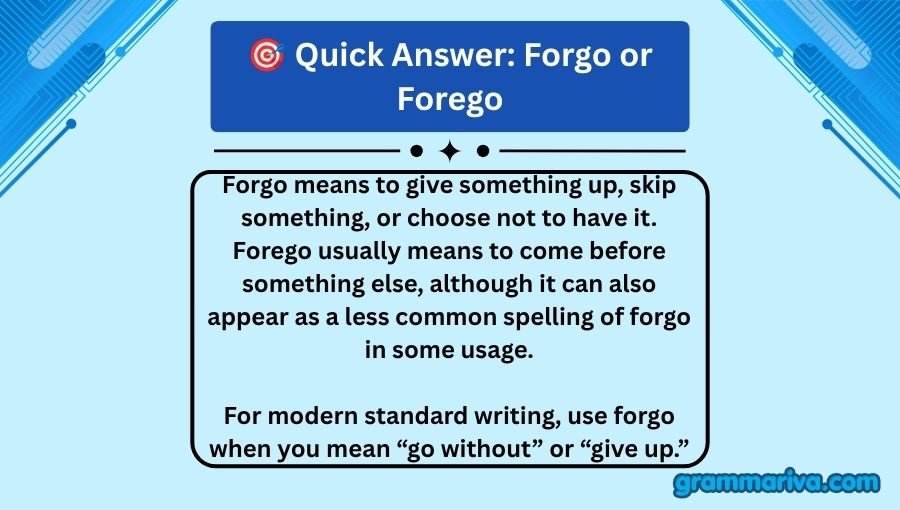
Forgo means to give something up, skip something, or choose not to have it. Forego usually means to come before something else, although it can also appear as a less common spelling of forgo in some usage.
For modern standard writing, use forgo when you mean “go without” or “give up.”
Example:
✅ I decided to forgo dessert after dinner.
❌ I decided to forego dessert after dinner.
The first sentence is the safest choice when you mean that you intentionally skipped dessert.
📚 Related Word Forms of Forgo and Forego
The most useful related form is forwent, which is the past tense of forgo. The past participle is forgone. The word forego has a different usual meaning when it is treated as a separate word.
| Form | Type | Example |
|---|---|---|
| forgo | Verb | I will forgo the extra fee. |
| forwent | Past tense verb | She forwent the opportunity. |
| forgone | Past participle | He has forgone his usual routine. |
| forego | Verb | The introduction will forego the main discussion. |
| foregone | Past participle | The result was considered foregone. |
A key point is that forwent is not spelled forewent. If you mean “gave up” in the past, forwent is the standard form.
🔍 Understanding Forgo or Forego
The core difference is simple: forgo means to go without something, while forego traditionally means to come before something.
Think of the words this way:
- forgo = give up or skip
- forego = come before
The extra e in forego can help remind you of the idea of something being “before” another thing.
| Form | Type | Meaning | Example | Correct/Incorrect |
|---|---|---|---|---|
| forgo | Verb | Give up or skip | I will forgo coffee today. | ✅ Correct |
| forego | Verb | Come before | The opening remarks forego the main presentation. | ✅ Correct |
| forgo | Verb | Come before | The opening remarks forgo the presentation. | ❌ Incorrect for this meaning |
| forego | Verb | Give up | I will forego dessert. | ⚠️ Common but less standard for this meaning |
For most everyday writing, forgo is the word you want when you are talking about choosing not to have or do something.
❓ Is Forgo the Same as Forego?
No. Forgo and forego have different traditional meanings, although modern usage sometimes overlaps.
Forgo means to give something up or do without it. Forego traditionally means to go before something. This distinction is especially useful in careful professional writing.
Forgo means “give up”
Use forgo when someone makes a choice to skip something.
Examples:
✅ I decided to forgo the expensive upgrade.
❌ I decided to forego the expensive upgrade.
Here, the person chooses not to buy the upgrade. Therefore, forgo is the clearest word.
Forego means “come before”
Use forego when something comes before another thing.
For example:
✅ The short introduction will forego the main presentation.
Here, the introduction comes before the main presentation.
That use is less common in everyday speech, but it is still useful to understand.
| Meaning | Word Type | Example Sentence |
|---|---|---|
| Give up something | Verb | We chose to forgo the trip. |
| Skip something | Verb | She decided to forgo lunch. |
| Come before something | Verb | The introduction foregoes the main section. |
❓ Why Do People Confuse Forgo and Forego?
People confuse these words because they are almost identical in spelling and sound. The difference is only one letter, but that letter can change the meaning.
Another reason is that forego has sometimes been used in places where modern writers would choose forgo. That creates mixed examples online and can make the distinction seem less clear.
I once edited a short business report where the writer used forego several times to mean “skip.” The sentences were understandable, but I changed them to forgo because the intended meaning was clearly “do without.” That small edit made the wording more precise.
The mistake often happens because writers remember the phrase by sound instead of meaning.
Three common causes
- Fast typing: You know what you mean and type the first spelling that comes to mind.
- Autocorrect: Your software may not flag either word because both are real words.
- Lack of knowledge: You may never have learned that the two forms can carry different meanings.
🧠 Forgo: Meaning and Correct Use
Forgo means to choose not to have, use, or do something. It often suggests a deliberate decision.
You can forgo:
- food
- money
- comfort
- an opportunity
- a purchase
- a habit
- a benefit
- an activity
Example 1: Food
✅ I decided to forgo dessert.
This means I chose not to eat dessert.
Example 2: Money
✅ We decided to forgo the expensive package.
This means we chose not to buy the expensive package.
Example 3: An activity
✅ She chose to forgo the party.
This means she decided not to attend.
Example 4: A benefit
✅ He was willing to forgo the bonus.
This means he accepted not receiving the bonus.
| Use | Meaning | Example |
|---|---|---|
| Forgo food | Skip it | I will forgo dessert. |
| Forgo a purchase | Not buy it | We will forgo the upgrade. |
| Forgo an event | Not attend | She chose to forgo the party. |
| Forgo a benefit | Give it up | He forwent the bonus. |
❓ When Should You Use Forgo?
Use forgo when the sentence means give up, skip, or do without.
A simple test is to replace the word with “skip.” If the sentence still makes sense, forgo is probably the right choice.
For example:
I decided to forgo breakfast.
Replace forgo with skip:
I decided to skip breakfast.
The meaning stays almost the same. That tells you that forgo works.
💡 Test Tip
Ask yourself:
“Am I choosing to go without something?”
If the answer is yes, choose forgo.
| Sentence | Meaning | Result |
|---|---|---|
| I will forgo the discount. | I will give it up. | ✅ |
| She will forgo lunch. | She will skip it. | ✅ |
| They will forgo the trip. | They will choose not to go. | ✅ |
| The introduction will forgo the main section. | It comes before it. | ❌ |
❓ When Should You Use Forego?
Use forego when you mean that something comes before something else. This meaning is less common than forgo in everyday writing.
The word can be understood as a combination of the idea of before and going. That makes its meaning easier to remember.
For example:
✅ The opening remarks forego the main discussion.
The opening remarks come first.
In ordinary writing, however, you may often find a clearer alternative such as precede or come before.
| Sentence | Intended Meaning | Best Choice |
|---|---|---|
| The introduction comes before the report. | Comes first | Forego can work |
| I skipped breakfast. | Gave up | Forgo |
| She gave up the discount. | Chose not to use | Forgo |
| The opening section comes before the conclusion. | Comes first | Forego can work |
📝 Forgo or Forego in Real-Life Writing
Imagine that a manager sends this email to an employee:
“We have a limited budget this month, so we will forgo the new software upgrade.”
The meaning is clear. The company has decided not to buy the upgrade.
Now imagine this:
“The introduction will forego the main report.”
Here, forego tells the reader that the introduction comes before the main report.
I once caught myself typing forego in a sentence about skipping a meeting. I stopped because the word did not fit the meaning I wanted. I changed it to forgo, and the sentence became clear immediately.
This is why meaning should come before spelling.
| Situation | Best Word | Example |
|---|---|---|
| Skipping lunch | Forgo | I will forgo lunch today. |
| Giving up a purchase | Forgo | We will forgo the upgrade. |
| Coming before another section | Forego | The introduction foregoes the main section. |
| Choosing not to attend | Forgo | She chose to forgo the event. |
⚖️ Forgo vs Forego at a Glance
The easiest distinction is based on meaning. Forgo is about giving something up. Forego is traditionally about coming before something.
| Word | Main Meaning | Example |
|---|---|---|
| forgo | Give up | I will forgo the offer. |
| forgo | Do without | She forwent her usual coffee. |
| forego | Come before | The introduction foregoes the conclusion. |
| forego | Precede | The opening remarks forego the main discussion. |
If you only remember one rule, remember this:
Forgo = give up.
Forego = come before.
❓ Can Forgo Be Used in the Past Tense?
Yes. The past tense of forgo is forwent.
This is one of the most important forms to remember because forgoed is incorrect.
✅ She forwent the opportunity.
❌ She forgoed the opportunity.
The past participle is forgone.
✅ He has forgone the chance to participate.
❌ He has forwent the chance to participate.
| Verb Form | Correct Form | Example |
|---|---|---|
| Present | forgo | I forgo dessert. |
| Past | forwent | I forwent dessert. |
| Past participle | forgone | I have forgone dessert. |
These forms may look unusual, but they follow an irregular pattern similar to other English verbs.
❓ Is “Forego” Ever Correct?
Yes. Forego is a real word and can be correct when it means to come before something.
For example:
✅ The short introduction foregoes the detailed explanation.
However, writers sometimes use forego where they mean “give up.” In that situation, forgo is the clearer modern choice.
The key is not to think that one spelling is always wrong. Both forms exist. The meaning tells you which one fits.
✍️ Grammar Rules Explanation
The grammar rule is based on meaning and verb function. Forgo is a verb meaning to give up, skip, or do without something. Forego is traditionally a verb meaning to precede or come before something.
When the intended meaning is “give up,” standard careful writing generally uses forgo.
For example:
She decided to forgo the opportunity.
The verb describes a deliberate choice not to take the opportunity.
When the intended meaning is “come before,” forego can be used:
The opening statement foregoes the main discussion.
The verb describes what happens first.
Many standard English references recognize the distinction, although actual usage can be less consistent. Because both spellings appear in real writing, the safest approach is to choose based on the meaning you want.
Correct vs Incorrect at a Glance
| Sentence | Correct/Incorrect | Why |
|---|---|---|
| I decided to forgo dessert. | ✅ Correct | It means skip dessert. |
| She forwent the offer. | ✅ Correct | Forwent is the past tense of forgo. |
| He has forgone the benefit. | ✅ Correct | Forgone is the past participle. |
| I decided to forego dessert. | ⚠️ Less clear | Forego is traditionally tied to coming before. |
| She forgoed the opportunity. | ❌ Incorrect | The past form is forwent. |
⚠️ Common Mistakes With Forgo and Forego
The most common error is using forego when the writer means “give up.”
The mistake is understandable because both words look nearly identical. Spell-check tools may not catch it because both spellings can be valid words.
Similar grammar confusions
| Confusion | Correct Meaning |
|---|---|
| its / it’s | Possession / it is |
| your / you’re | Possession / you are |
| their / there / they’re | Possession / place / they are |
| affect / effect | Influence / result |
| forgo / forego | Give up / come before |
A second problem is fast typing. When you write quickly, your brain may focus on sound instead of meaning.
Autocorrect can make the problem worse because it often sees forego as a valid English word and does not change it.
Specific wrong forms
| Wrong Form or Use | What’s Wrong | Correct Form |
|---|---|---|
| forgoed | Incorrect past tense | forwent |
| forewent | Incorrect past tense of forgo | forwent |
| forgoing | Incorrectly formed in some uses | forgoing |
| forgone | Correct only as past participle | forgone |
| forego = always “give up” | Meaning can be unclear | Use forgo for “give up” |
| forgo = always “come before” | Wrong meaning | Use forego when meaning “come before” |
One useful habit is to pause whenever you see the two spellings. Ask what the sentence means before choosing the spelling.
❓ How Can You Remember the Difference?
Use a simple memory trick:
FORGO = FORGET THE EXTRA.
Think of forgo as choosing to go without something.
FOREGO = BEFORE.
The e in forego can remind you of “before.”
Here are three quick examples:
✅ I will forgo coffee.
You are skipping coffee.
✅ She forwent the offer.
She gave up the offer.
✅ The introduction foregoes the main discussion.
The introduction comes before the main discussion.
| Memory Clue | Word | Meaning |
|---|---|---|
| Give up | forgo | Skip or do without |
| Past of give up | forwent | Gave up |
| Past participle | forgone | Given up |
| Before | forego | Come before |
🌎 How Are Forgo and Forego Used in Different Contexts?
The best word depends on what you are trying to say, not how formal the sentence sounds.
| Context | Which Term to Use | Example |
|---|---|---|
| Everyday conversation | Forgo | I will forgo dessert. |
| Professional writing | Forgo | We chose to forgo the extra cost. |
| Creative writing | Either, based on meaning | He chose to forgo comfort. |
| Social media/texting | Forgo | I’m going to forgo the drama. |
In social media, writers may use skip instead of forgo because it sounds more casual.
In professional writing, forgo can sound precise and polished.
❓ What Are Common Phrases With Forgo?
There are several natural phrases built around forgo. Most describe a choice to skip, give up, or do without something.
| Phrase | Meaning |
|---|---|
| forgo the opportunity | Give up a chance |
| forgo the chance | Choose not to take an opportunity |
| forgo the expense | Avoid paying the cost |
| forgo the benefits | Give up advantages |
| forgo the usual routine | Choose not to follow it |
| forgo a purchase | Decide not to buy something |
For example:
✅ She chose to forgo the expense.
This means she decided not to spend the money.
🔄 Synonyms and Alternatives for Forgo
Sometimes another word may sound more natural. The best alternative depends on the sentence.
| Alternative | Works When | Does Not Work When |
|---|---|---|
| skip | You want casual wording | You need a more formal tone |
| give up | You want very clear wording | You want a compact formal verb |
| decline | You reject an offer | You simply skip something |
| avoid | You stay away from something | You deliberately give up a benefit |
| do without | You want a conversational phrase | You need very concise writing |
For example, I chose to skip dessert is more casual than I chose to forgo dessert.
Both communicate the basic idea.
❓ Why Does Getting Forgo or Forego Right Matter?
Choosing the right spelling makes your writing clearer. It also shows that you understand the meaning behind the words you use.
A reader may understand a sentence even when the wrong form appears. But careful word choice reduces confusion and makes your writing look polished.
A simple principle I use when editing is:
“Clear words make clear writing.”
| Situation | Why Getting It Right Matters |
|---|---|
| Resume | Shows careful writing |
| Client email | Reduces possible confusion |
| Published content | Builds reader trust |
| Social post | Keeps the message clear |
This matters even more when a sentence is short. In a short sentence, one word can carry most of the meaning.
❓ Does Context Change Which Word You Should Choose?
Yes. Context determines whether you mean “give up” or “come before.”
Consider these two sentences:
Sentence A:
The company decided to forgo the new equipment.
The company chose not to buy it.
Sentence B:
The opening section foregoes the final discussion.
The opening section comes before the final discussion.
The surrounding words make the intended meaning clear.
| Sentence | Meaning |
|---|---|
| We will forgo the upgrade. | We will not get it. |
| She forwent the invitation. | She gave it up or chose not to accept it. |
| The introduction foregoes the conclusion. | The introduction comes first. |
🧩 How Do Forgo and Forego Work in Longer Sentences?
Long sentences can make these words harder to judge. The solution is to focus on the verb’s direct meaning.
Consider:
Because the team needed to reduce costs, it decided to forgo the optional training program.
The phrase “reduce costs” gives you a clue. The team is choosing not to pay for the training. Therefore, forgo is correct.
Now consider:
The brief opening statement foregoes the detailed explanation that follows.
The statement comes first. Therefore, forego fits the intended meaning.
A simple three-step check
- Find the verb.
- Replace it with “give up” or “come before.”
- Choose the word that keeps the meaning.
| Replacement Test | Result |
|---|---|
| Give up = works | Use forgo |
| Skip = works | Use forgo |
| Do without = works | Use forgo |
| Come before = works | Forego may fit |
| Precede = works | Forego may fit |
📝 Practice Examples for Forgo or Forego
Practice helps make the difference automatic.
Example 1
✅ I decided to forgo the second cup of coffee.
Why? The person chose to skip it.
Example 2
❌ I decided to forego the second cup of coffee.
Why? The intended meaning is “skip,” so forgo is clearer.
Example 3
✅ She forwent the chance to compete.
Why? She gave up the chance.
Example 4
❌ She forgoed the chance to compete.
Why? The past tense is forwent, not forgoed.
Example 5
✅ The opening remarks forego the main discussion.
Why? The remarks come before the discussion.
| Practice Sentence | Answer |
|---|---|
| We decided to ___ the extra cost. | forgo |
| She ___ the invitation last year. | forwent |
| He has ___ his usual routine. | forgone |
| The opening section ___ the conclusion. | foregoes |
| They chose to ___ dessert. | forgo |
🧠 Quick Recap Checklist
Use this checklist whenever you are unsure.
| Question | If Yes → Use |
|---|---|
| Do you mean “give up”? | forgo |
| Do you mean “skip”? | forgo |
| Do you mean “do without”? | forgo |
| Are you talking about the past tense of forgo? | forwent |
| Do you need the past participle of forgo? | forgone |
| Do you mean “come before”? | forego |
Try these
- I decided to ___ the extra fee. → forgo
- She ___ the opportunity last year. → forwent
- The introduction ___ the main section. → foregoes
If you can answer those three, you already understand the main rule.
❓ What Is the Simplest Rule for Forgo or Forego?
The simplest rule is this: use forgo when you mean give up, skip, or do without. Use forego when you mean come before or precede.
For most everyday sentences about choosing not to do something, forgo is the word you want.
FAQs About Forgo vs Forego
❓ What is the difference between forgo and forego?
Forgo means to give up, skip, or do without something. Forego traditionally means to come before or precede something. When you mean “give up,” forgo is the safest standard choice.
❓ Is it forgo or forego when you mean skip?
Use forgo when you mean skip. For example: I decided to forgo dessert.
❓ Is “forego” a correct word?
Yes. Forego is a real word. It is traditionally used to mean come before or precede. It should not automatically be treated as a misspelling of forgo.
❓ What is the past tense of forgo?
The past tense of forgo is forwent. For example: She forwent the opportunity.
❓ Is “forgoed” correct?
No. Forgoed is not the standard past tense of forgo. The correct past form is forwent.
❓ What is the past participle of forgo?
The past participle is forgone. For example: He has forgone the chance to participate.
❓ Can I use forego to mean give up?
You may see forego used that way, especially in varied or older usage. However, for clear modern writing, forgo is the better choice when you mean “give up” or “do without.”
❓ How do I remember forgo vs forego?
Remember forgo = give up and forego = come before. The e in forego can remind you of “before.”
❓ Is forgo formal English?
Yes. Forgo is a standard English verb and works well in professional, academic, and everyday writing. In casual conversation, words such as skip or give up may sound more natural.
❓ Which is correct: “I will forgo” or “I will forego”?
If you mean “I will give up” or “I will skip,” use I will forgo. For example: I will forgo dessert tonight.
🏁 Conclusion
Forgo or forego becomes much easier once you focus on meaning instead of spelling. If you mean give up, skip, or do without, choose forgo. If you mean come before or precede, forego can be the right choice.
Remember the key forms, too. The past tense of forgo is forwent, and the past participle is forgone. Avoid forgoed.
When you are unsure, stop and ask one simple question: “Am I giving something up, or am I talking about something that comes before another thing?” That quick test can solve most cases.
I find that learning words by meaning works much better than memorizing spelling alone. Once the meaning becomes clear, the spelling usually follows. ✨
So the next time you face this common grammar choice, trust the simple rule: forgo means give up, while forego means come before. Keep that distinction in mind, and your writing will be clearer, sharper, and more confident. 📚

Hi, I’m Lucas Bennett. I’m a grammar content specialist at Grammariva. I work on articles covering everyday grammar questions, sentence usage, and writing tips that readers can apply with confidence.

[…] to remember the difference. By the end, you should be able to choose the right word quickly. ✨ Forgo or Forego | City vs Town vs Village | Ingrained or […]
[…] choice is safest for school, work, blogs, and everyday writing. ✍️ Accent vs Ascent vs Assent | Forgo or Forego | City vs Town vs […]
[…] In this guide, I will break down imbed vs embed with clear rules, examples, tables, common mistakes, and easy memory tricks. By the end, you should be able to choose the right form without stopping to second-guess yourself. ✍️ Gluing or Glueing | Accent vs Ascent vs Assent | Forgo or Forego […]