If you have ever stopped while writing a sentence and wondered about comma before or after for example, you are not alone. This small punctuation choice can feel confusing because “for example” can appear in different places in a sentence. Sometimes you need a comma before it. Sometimes you need a comma after it. In other cases, you need commas on both sides.
The good news is that the rule is easier than it first seems. The key is to look at how “for example” works in the sentence. Is it introducing an example at the end? Is it interrupting the main sentence? Or is it starting a new clause? Once you see its job, the punctuation becomes much clearer. 😊
In this guide, I’ll explain comma before or after for example with simple rules, clear examples, tables, common mistakes, and easy memory tricks. By the end, you should feel confident using this phrase in emails, essays, articles, schoolwork, and everyday writing. Imbed vs Embed | Gluing or Glueing | Accent vs Ascent vs Assent
🎯 Quick Answer: Comma Before or After For Example?
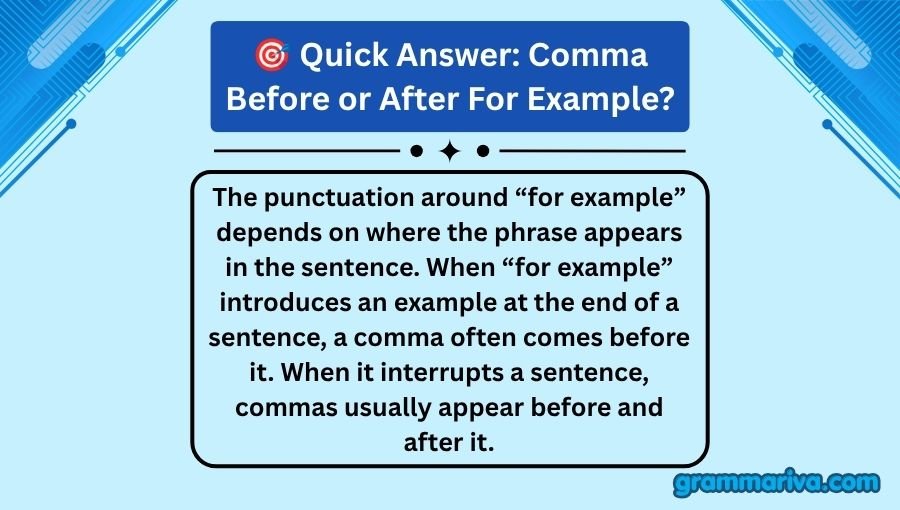
The punctuation around “for example” depends on where the phrase appears in the sentence. When “for example” introduces an example at the end of a sentence, a comma often comes before it. When it interrupts a sentence, commas usually appear before and after it.
Here are the basic patterns:
- At the end: I enjoy outdoor sports, for example.
- Before an example: I enjoy outdoor sports, for example, hiking and cycling.
- In the middle: Some sports, for example, tennis and swimming, are easy to learn.
The exact punctuation depends on the sentence structure, not simply on the phrase itself.
📝 What Does “For Example” Mean?
“For example” is a phrase used to introduce one or more examples that make a statement clearer. It tells the reader that the writer is about to give a specific case that supports the idea.
For instance, consider this sentence:
Many fruits contain vitamin C, for example, oranges and strawberries.
The general idea is “Many fruits contain vitamin C.” The words “oranges and strawberries” give specific examples.
“For example” can appear at the beginning, middle, or end of a sentence. Its position affects the punctuation.
Common positions
| Position | Example | Typical Punctuation |
|---|---|---|
| Beginning | For example, apples contain fiber. | Comma after |
| Middle | Apples, for example, contain fiber. | Commas around phrase |
| End | Some fruits contain fiber, for example. | Comma before, depending on structure |
| Before examples | Try healthy snacks, for example, nuts and fruit. | Often commas around phrase |
The most useful question is not “Does ‘for example’ always need a comma?” It does not. Instead, ask what role the phrase plays in your sentence.
🔍 Understanding Comma Before or After For Example
The easiest way to understand comma before or after for example is to study its position.
When “for example” starts a sentence, place a comma after the phrase.
Correct:
✅ For example, you could take the train.
Incorrect:
❌ For example you could take the train.
When “for example” appears in the middle as an interrupting phrase, place commas around it.
Correct:
✅ Some drinks, for example, tea and coffee, contain caffeine.
Incorrect:
❌ Some drinks for example, tea and coffee contain caffeine.
When “for example” comes at the end, punctuation depends on the sentence. If it simply adds an example to a complete thought, a comma can come before it.
Correct:
✅ You could choose another activity, for example.
The important point is that “for example” does not have one fixed comma rule for every sentence.
Comparison table
| Form | Type | Meaning | Example | Correct/Incorrect |
|---|---|---|---|---|
| For example, | Introductory phrase | Introduces an example | For example, dogs need exercise. | ✅ Correct |
| , for example, | Interrupting phrase | Adds an example inside a sentence | Dogs, for example, need exercise. | ✅ Correct |
| , for example | Ending phrase | Adds an example at the end | Try a fruit, for example. | ✅ Correct |
| for example | No punctuation | Can be correct in some structures | Choose something for example purposes. | ⚠️ Depends |
❓ Should There Be a Comma Before “For Example”?
Yes, a comma often appears before “for example” when the phrase adds an example to a complete statement. However, the comma is not required simply because the words “for example” appear.
Compare these sentences:
✅ Many outdoor activities are relaxing, for example, fishing and hiking.
Here, “for example” introduces specific examples.
Now consider:
✅ Many people enjoy outdoor activities, for example.
Here, the phrase comes at the end and acts as an afterthought.
The sentence structure matters more than the phrase itself.
A simple test
Remove “for example” from the sentence.
If the sentence still works naturally, “for example” may be functioning as an extra phrase that can be separated with commas.
Example:
My brother, for example, loves hiking.
Remove the phrase:
My brother loves hiking.
The sentence is still complete. That is a strong sign that commas are useful around the interruption.
❓ Should There Be a Comma After “For Example”?
Yes, a comma normally follows “for example” when it begins a sentence or introduces an example in the middle of a sentence.
For example:
✅ For example, we could meet after lunch.
The comma helps the reader recognize that the introductory phrase has ended.
The same pattern works inside a sentence:
✅ We could visit a nearby city, for example, Boston.
In this structure, “for example” is inserted into the sentence and is separated by punctuation.
However, do not add a comma after “for example” automatically. The rest of the sentence matters.
Quick examples
| Sentence | Correct? | Reason |
|---|---|---|
| For example, cats need regular care. | ✅ | Introductory phrase |
| We could visit Boston, for example. | ✅ | Ending example |
| We could, for example, visit Boston. | ✅ | Interrupting phrase |
| For example we could visit Boston. | ❌ | Missing comma after introductory phrase |
| We could visit, for example Boston. | ❌ | Missing comma after “for example” in this structure |
💡 When Does “For Example” Need Two Commas?
“For example” needs two commas when it interrupts the main sentence and can be removed without damaging the sentence’s basic meaning.
Look at this example:
Sarah, for example, prefers tea.
The core sentence is:
Sarah prefers tea.
“For example” is extra information. It interrupts the sentence, so commas mark both sides.
Another example:
Some animals, for example, dolphins, are highly social.
The phrase is inserted between the general statement and the specific example.
Test Tip 🧠
Try taking “for example” out.
If the sentence remains grammatically complete, check whether the phrase is acting as an interruption. If it is, commas on both sides are often appropriate.
I once edited a short school essay where a student wrote “My friends for example enjoy soccer.” I simply added the missing commas. The sentence became much easier to read:
My friends, for example, enjoy soccer.
That tiny change made the sentence flow much better.
❓ Can “For Example” Start a Sentence?
Yes. “For example” can begin a sentence, especially when the previous sentence gives a broad idea and the new sentence provides a specific case.
Example:
Many foods are rich in protein. For example, eggs are an easy choice.
The comma comes after “for example” because it is an introductory phrase.
You can also write:
There are many ways to save money. For example, you can cook at home.
This style is common in educational writing because it clearly separates the general idea from the example.
Examples by sentence position
| Position | Example |
|---|---|
| Beginning | For example, you can walk to work. |
| Middle | You can, for example, walk to work. |
| End | You can choose walking, for example. |
| Before a list | Try healthy foods, for example, apples and carrots. |
❓ Is “For Example” Always Set Off by Commas?
No. This is one of the most important points about comma before or after for example.
The phrase does not automatically require commas every time it appears. Punctuation depends on sentence structure and meaning.
Consider:
You can use tools for example purposes.
Here, “for example” is not functioning as an interrupting introductory phrase. The sentence has a different structure.
In normal explanatory writing, however, “for example” is often used to introduce an example. In that role, punctuation is usually needed to make the relationship clear.
Three common patterns
Pattern 1: Beginning
For example, you can start with a small goal.
Pattern 2: Middle
You can, for example, start with a small goal.
Pattern 3: Introducing examples
Start with a small goal, for example, walking for ten minutes.
Learning these three patterns will solve most everyday punctuation questions.
🏢 Case Study: Using “For Example” in a Work Email
Imagine you are writing an email to your manager:
We can reduce the project cost in several ways. For example, we could use a smaller print order.
This is clear and professional.
You could also write:
We can reduce the project cost in several ways, for example, by reducing the print order.
Both sentences work, but they use different structures.
The first uses “for example” to introduce a new sentence. The second keeps the example inside the same sentence.
Workplace comparison
| Situation | Example | Best Feature |
|---|---|---|
| New sentence | For example, we could reduce printing costs. | Very clear |
| Middle position | We could, for example, reduce printing costs. | Natural and flexible |
| Before example | We could reduce costs, for example, by printing fewer pages. | Compact |
| Ending | We could reduce another expense, for example. | Conversational |
For formal business writing, I usually favor the first two patterns because they are easy to scan.
📚 Grammar Rules Explanation
The punctuation around “for example” comes from its role in the sentence. When it introduces an introductory phrase, a comma separates that phrase from the main clause. When it interrupts a sentence, punctuation marks the interruption.
A phrase that provides extra information can often be removed without making the basic sentence incomplete. Commas help show that the phrase is not part of the sentence’s essential grammatical structure.
For example:
Maria, for example, likes jazz.
The core sentence is:
Maria likes jazz.
The inserted phrase “for example” is separated from the main sentence.
At the beginning:
For example, Maria likes jazz.
The comma separates the introductory phrase from the main clause.
At the end:
Maria likes jazz, for example.
The comma helps separate the added phrase from the main statement.
Standard English grammar references generally support punctuation based on sentence structure rather than applying one automatic rule to every occurrence of “for example.”
Correct vs. Incorrect at a Glance
| Sentence | Correct/Incorrect | Why |
|---|---|---|
| For example, I enjoy hiking. | ✅ Correct | Introductory phrase |
| I, for example, enjoy hiking. | ✅ Correct | Phrase interrupts sentence |
| I enjoy hiking, for example. | ✅ Correct | Phrase adds an example at the end |
| For example I enjoy hiking. | ❌ Incorrect | Introductory comma is missing |
| I enjoy, for example hiking. | ❌ Incorrect | Punctuation does not properly separate the phrase |
⚠️ Common Mistakes With “For Example”
People often make punctuation mistakes with “for example” because the phrase feels small. When writing quickly, it is easy to forget the comma.
Three common causes are:
- Fast typing: You know the rule but type too quickly.
- Autocorrect: Software does not always understand sentence structure.
- Lack of knowledge: You may not know that the phrase can have different punctuation patterns.
I once caught myself typing an email sentence like “For example we could move the meeting.” I reread it before sending and noticed the missing comma. The fix took one second, but the final email looked much cleaner.
Similar grammar confusions
| Confusion | Correct Forms | Common Problem |
|---|---|---|
| its / it’s | its, it’s | Possession vs. contraction |
| your / you’re | your, you’re | Possession vs. “you are” |
| their / they’re | their, they’re | Possession vs. “they are” |
| then / than | then, than | Time vs. comparison |
| affect / effect | affect, effect | Different grammatical roles |
| for example punctuation | Based on position | Commas added or removed incorrectly |
Common wrong forms
| Wrong Form | What’s Wrong | Correct Form |
|---|---|---|
| For example I like tea. | Missing introductory comma | For example, I like tea. |
| I, for example like tea. | Missing comma after phrase | I, for example, like tea. |
| I like tea for example, | Awkward ending punctuation | I like tea, for example. |
| I like, for example tea. | Phrase is not properly separated | I like, for example, tea. |
| I like tea, for example tea. | Repeated structure is unclear | I like tea, for example. |
🧩 How to Remember the Comma Rule
You do not need to memorize a long grammar rule. I recommend remembering three simple positions.
1. Beginning = comma after
For example, I could call tomorrow.
2. Middle = comma before and after
I could, for example, call tomorrow.
3. End = comma before when it is an added afterthought
I could call tomorrow, for example.
This three-part pattern is a useful shortcut.
Memory table
| Where “for example” appears | Easy Reminder |
|---|---|
| Beginning | Comma after |
| Middle | Commas around it |
| End | Often comma before |
| Introducing examples | Check the full sentence |
🌎 How Is “For Example” Used in Different Contexts?
“For example” works in almost every type of English writing. The punctuation rules stay largely the same, but the best style can change with the context.
Everyday conversation
In casual speech, people often pause naturally before or after an example.
I like simple meals, for example, pasta and soup.
Professional writing
Clear punctuation is especially useful in emails, reports, and business documents.
We could improve sales, for example, by updating the product page.
Creative writing
Writers may use “for example” to make a description more specific.
The room felt strangely quiet. For example, even the old clock had stopped.
Social media and texting
Casual posts may ignore some punctuation, but correct punctuation still improves clarity.
There are so many places I want to visit. For example, Italy! ✈️
Context table
| Context | Which Form to Use | Example |
|---|---|---|
| Everyday conversation | Any natural position | For example, I love coffee. |
| Professional writing | Clear, structured form | We could, for example, revise the plan. |
| Creative writing | Position based on flow | For example, the room was silent. |
| Social media/texting | Flexible but clear | For example, this café is amazing! |
❓ What Is the Difference Between “For Example” and “For Instance”?
“For example” and “for instance” usually serve the same basic purpose. Both introduce a specific case that supports a general statement.
Compare:
Many pets need daily care. For example, dogs need regular exercise.
Many pets need daily care. For instance, dogs need regular exercise.
The punctuation pattern can be the same.
“For example” is especially common in educational and explanatory writing. “For instance” can sound slightly more formal in some contexts.
Comparison
| Phrase | Main Function | Example |
|---|---|---|
| For example | Introduces an example | For example, cats need care. |
| For instance | Introduces an example | For instance, cats need care. |
| Such as | Introduces examples | Pets such as cats need care. |
| Like | Gives an informal example | Pets like cats need care. |
❓ Can You Use “Such As” Instead of “For Example”?
Sometimes. “Such as” can introduce examples within a sentence, but it does not work exactly like “for example.”
Compare:
I enjoy outdoor sports, such as hiking and cycling.
Here, “such as” directly connects the examples to “outdoor sports.”
You could also say:
I enjoy outdoor sports. For example, I like hiking and cycling.
The meaning is similar, but the grammar is different.
Alternatives table
| Alternative | Works When | Does Not Work When |
|---|---|---|
| For instance | You want to introduce an example | You need a direct noun link |
| Such as | You are listing examples | You need a new introductory sentence |
| Including | You are naming items in a group | You need a full example clause |
| Like | Informal examples | Formal writing needs more precision |
| Namely | You want to identify exact items | You are giving only one possible example |
✍️ Comma Before or After For Example in Academic Writing
Academic writing often uses “for example” to support a claim with evidence or a specific case.
For example:
Many study methods can improve memory. For example, active recall can help students remember information.
You can also keep the phrase inside the sentence:
Active recall, for example, can help students remember information.
Both patterns are useful.
When writing an essay, avoid placing “for example” into every paragraph. Too many examples can make your writing repetitive. Choose the position that creates the clearest connection between your idea and your example.
Academic examples
| Structure | Example |
|---|---|
| New sentence | For example, students can review notes before class. |
| Middle | Students can, for example, review notes before class. |
| Example list | Students can use methods such as flashcards and practice tests. |
| Ending | Students can review notes before class, for example. |
📱 Comma Before or After For Example in Digital Communication
Emails, messages, blog posts, and social media captions often use “for example.”
Digital writing is usually scanned quickly. That makes clear punctuation even more useful.
Compare:
❌ For example you can choose three colors.
The reader has to move through the phrase without a clear pause.
✅ For example, you can choose three colors.
The comma creates a natural break.
In a professional email, this small detail can make your writing look more polished.
❓ Why Do People Confuse Comma Before or After For Example?
People confuse this phrase because it can appear in several positions. The words stay the same, but the punctuation changes.
A writer may remember that “for example” needs a comma but forget whether the comma belongs before or after it.
That leads to sentences like:
❌ For example I enjoy reading.
or:
❌ I, for example enjoy reading.
The solution is to stop treating “for example” as a fixed punctuation unit. Instead, look at its position.
If it begins the sentence, the comma normally comes after it.
If it interrupts the sentence, commas can surround it.
If it appears at the end as an added comment, a comma can come before it.
📝 Common Sentence Patterns to Practice
Practice is one of the fastest ways to learn punctuation.
Pattern 1
For example, we could leave early.
Pattern 2
We could, for example, leave early.
Pattern 3
We could leave early, for example.
Pattern 4
We could choose another option, for example, taking the bus.
Notice how the phrase moves around while the punctuation changes with its position.
Practice table
| Pattern | Example | Punctuation |
|---|---|---|
| Beginning | For example, we could leave. | After |
| Middle | We could, for example, leave. | Both sides |
| End | We could leave, for example. | Before |
| Before specific example | We could take a bus, for example, route 10. | Around phrase |
💼 Why Correct Punctuation Matters
Correct punctuation does more than satisfy a grammar rule. It helps readers understand your meaning without stopping to decode the sentence.
Clarity in communication
A comma can show where an introductory phrase ends and the main thought begins.
Professionalism
Clean punctuation makes emails, reports, resumes, and articles look more polished.
Digital communication
People often skim online content. Clear sentence breaks make information easier to process.
A useful rule I tell writers is:
“Good punctuation should help the reader, not make the reader work.”
Why getting it right matters
| Situation | Why Getting It Right Matters |
|---|---|
| Resume | Shows attention to detail |
| Client email | Makes your message easier to understand |
| Published content | Improves readability |
| Social post | Makes short text clearer |
❓ Does “For Example” Need a Comma in a List?
Often, yes, when “for example” interrupts the sentence and introduces specific examples.
For instance:
You can bring snacks, for example, fruit, nuts, or crackers.
However, writers should pay attention to the exact sentence structure. A comma should not be added simply because a list follows.
A cleaner option may sometimes be:
You can bring snacks such as fruit, nuts, or crackers.
This version removes the need for the interrupting phrase entirely.
❓ Is “For Example” Better at the Beginning or Middle?
Neither position is always better. The best choice depends on what you want to emphasize.
Use the beginning when you want the example to stand out:
For example, regular reading can improve vocabulary.
Use the middle when you want to keep the sentence compact:
Regular reading can, for example, improve vocabulary.
Use the end when the example feels like an afterthought:
Regular reading can improve vocabulary, for example.
For formal writing, the beginning and middle positions are usually easier for readers to follow.
📖 Correct and Incorrect Examples
Here are several examples that show the most common patterns.
Example 1
✅ For example, children can learn through games.
❌ For example children can learn through games.
The introductory comma is missing in the incorrect version.
Example 2
✅ Children, for example, can learn through games.
❌ Children, for example can learn through games.
The second comma is missing in the incorrect version.
Example 3
✅ Children can learn through games, for example.
❌ Children can learn through games for example.
The added phrase needs punctuation in the first version.
Example 4
✅ Children can learn through games, for example, puzzles and memory games.
❌ Children can learn through games, for example puzzles and memory games.
The interrupting phrase is not properly closed.
🧠 Quick Recap Checklist
Use this checklist whenever you are unsure about comma before or after for example.
| Question | If Yes → Use |
|---|---|
| Does “for example” begin the sentence? | Comma after it |
| Does it interrupt the sentence? | Commas around it |
| Does it add an example at the end? | Often a comma before it |
| Does it introduce specific examples? | Check the full sentence structure |
| Can you remove the phrase and keep a complete sentence? | It may be an interrupting phrase |
Try these practice examples
- For example, you could take a taxi.
- You could, for example, take a taxi.
- You could take a taxi, for example.
If you can recognize these three patterns, you have already mastered most common uses.
❓ How Can You Tell Where the Comma Goes?
Look at the location of “for example.”
If it begins the sentence, put the comma after it.
If it appears as an interruption, put commas around it.
If it appears at the end as an added thought, a comma can come before it.
This is much easier than memorizing a separate rule for every sentence.
❓ Is “For Example” Followed by a Comma?
Yes, when it begins a sentence or functions as an introductory phrase, “for example” is normally followed by a comma.
Example:
For example, you can start with one small change.
When it appears in the middle, another comma may follow it:
You can, for example, start with one small change.
The position determines the punctuation.
❓ Can “For Example” Be Used Without a Comma?
Yes, in some sentence structures. “For example” does not automatically require commas every time it appears.
However, when it is used as an introductory phrase or an interrupting phrase, punctuation is normally needed.
Always look at the complete sentence before deciding.
❓ What Is the Easiest Way to Remember the Rule?
Remember this:
Beginning = comma after.
Middle = commas around.
End = often comma before.
For example:
For example, I like tea.
I, for example, like tea.
I like tea, for example.
This simple pattern covers the most common cases.
❓ Is a Comma Needed Before “For Example” in Formal Writing?
Often, yes, when “for example” introduces an additional example or works as an interrupting phrase. Formal writing should follow the structure of the sentence rather than applying a blanket comma rule.
For example:
Several methods can improve focus, for example, taking short breaks.
Or:
Several methods can improve focus. For example, taking short breaks may help.
Both structures can work, depending on the sentence.
❓ Is “For Example” the Same as “For Instance”?
Yes, in most common situations, “for example” and “for instance” introduce examples in very similar ways.
For example:
Some pets need lots of exercise. For example, dogs often need daily walks.
You could replace “for example” with “for instance” without changing the basic meaning.
The punctuation pattern can remain the same.
❓ What Is the Difference Between “For Example” and “Such As”?
“For example” can introduce a complete example or a separate sentence. “Such as” usually connects examples directly to a noun or noun phrase.
Compare:
Some fruits are high in vitamin C. For example, oranges are a good choice.
Some fruits, such as oranges, are high in vitamin C.
Both are correct, but the sentence structures differ.
❓ What Is the Most Common Mistake With “For Example”?
The most common mistake is forgetting the comma after “for example” when it begins a sentence.
Incorrect:
❌ For example you could try walking.
Correct:
✅ For example, you could try walking.
Another common mistake is using only one comma when “for example” interrupts the sentence.
Incorrect:
❌ You could, for example try walking.
Correct:
✅ You could, for example, try walking.
❓ Should “For Example” Be Followed by a Comma in Every Sentence?
No. The phrase should not be treated as if it always requires the same punctuation.
At the beginning, a comma usually follows it.
In the middle, commas can appear on both sides when the phrase is an interruption.
At the end, punctuation depends on how the phrase functions.
The complete sentence should always guide your choice.
❓ What Is the Correct Way to Write “For Example” in an Essay?
A clear option is to use it at the beginning of a sentence:
For example, students can use flashcards to review new vocabulary.
You can also place it in the middle:
Students can, for example, use flashcards to review new vocabulary.
Both are grammatically useful. Choose the form that makes your idea easiest to follow.
❓ Can “For Example” Be Used at the End of a Sentence?
Yes. It can appear at the end when the writer adds an example as an afterthought.
Example:
You could choose a healthier snack, for example.
This construction is possible, though it may sound less direct than introducing the example earlier.
For polished formal writing, a clearer alternative may be:
You could choose a healthier snack, for example, an apple.
Or:
For example, you could choose an apple as a healthier snack.
❓ Does the Comma Change the Meaning of “For Example”?
The comma usually does not change the basic meaning of “for example,” but it can change how the reader understands the sentence structure.
Good punctuation shows whether the phrase is introductory, interrupting, or added at the end.
That makes the sentence easier to read and reduces confusion.
❓ What Should I Do if I Am Still Unsure?
Read the sentence aloud and identify the role of “for example.”
Then try removing the phrase.
If the remaining sentence is complete, the phrase may be extra information that should be separated with commas.
You can also rewrite the sentence. Instead of:
We could, for example, take the train.
you might write:
For example, we could take the train.
A small rewrite can sometimes make punctuation much easier.
❓ Is “For Example” Formal Enough for Professional Writing?
Yes. “For example” is a standard phrase for introducing examples in professional, academic, and general writing.
It works well in:
- Emails
- Reports
- Essays
- Articles
- Presentations
- Business documents
- Educational materials
The key is to use it clearly and avoid repeating it too often.
❓ What Is the Best Alternative to “For Example”?
The best alternative depends on the sentence.
“For instance” is the closest direct replacement.
“Such as” works well when introducing examples directly after a noun.
“Like” can work in casual writing.
“Namely” is useful when you are identifying specific items rather than giving one possible example.
Choose the phrase that matches your sentence structure instead of replacing “for example” automatically.
❓ Can “For Example” Introduce More Than One Example?
Yes. “For example” can introduce one example or several examples.
For example:
Many outdoor activities are fun, for example, hiking, cycling, swimming, and camping.
The phrase can introduce a list.
However, if the list becomes long, rewriting the sentence may improve readability:
Many outdoor activities are fun. Examples include hiking, cycling, swimming, and camping.
This can be cleaner in longer articles or reports.
❓ Should I Use a Comma Before “For Example” in Every Case?
No. Do not add a comma simply because the phrase contains “for example.”
Instead, identify its role.
If it is introducing an example at the beginning, use a comma after it.
If it interrupts a sentence, use commas around it.
If it appears at the end as an added thought, a comma may come before it.
Sentence structure always comes first.
✅ Final Rule to Remember
The easiest way to remember comma before or after for example is to focus on position.
At the beginning, write:
For example, I enjoy hiking.
In the middle, write:
I, for example, enjoy hiking.
At the end, write:
I enjoy hiking, for example.
When “for example” introduces specific examples inside a sentence, punctuation may appear around it:
I enjoy outdoor activities, for example, hiking and cycling.
Do not think of “for example” as a phrase that always gets one fixed punctuation pattern. Its location and role determine the commas.
Once you learn the three main patterns, the choice becomes much easier. I recommend reading your sentence once after writing it and asking one simple question: Is “for example” at the beginning, in the middle, or at the end? That quick check will prevent most punctuation mistakes. 😊
Good punctuation does not need to feel complicated. When you understand the structure, the commas usually make sense on their own. ✨

Hi, I’m Ethan Brooks. I’m an English grammar writer at Grammariva, where I work on clear explanations, practical examples, and useful writing tips. I enjoy making difficult grammar topics easier to understand.
[…] social media. By the end, you should feel much more confident when choosing the right form. 😊 Comma Before or After For Example | Imbed vs Embed | Gluing or […]
[…] right word with confidence. By the end, the difference should feel much easier. 😊 Eaten or Ate | Comma Before or After For Example | Imbed vs […]