Have you ever typed a sentence and stopped because you could not decide between eaten or ate? You are not alone. These two words both come from the verb eat, but they do different jobs in a sentence.
The key is understanding whether you are talking about a completed action in the past or using a form that needs a helping verb. Once you see the pattern, the choice becomes much easier. I teach grammar by looking at the structure of the whole sentence, not just one word.
That makes tricky pairs easier to remember. In this guide, I will show you the difference with simple rules, clear examples, tables, and practical tips.
You will also see how the forms work in everyday speech, emails, school writing, and social media. By the end, you should feel much more confident when choosing the right form. 😊 Comma Before or After For Example | Imbed vs Embed | Gluing or Glueing
Quick Answer: Eaten or Ate? ⚡
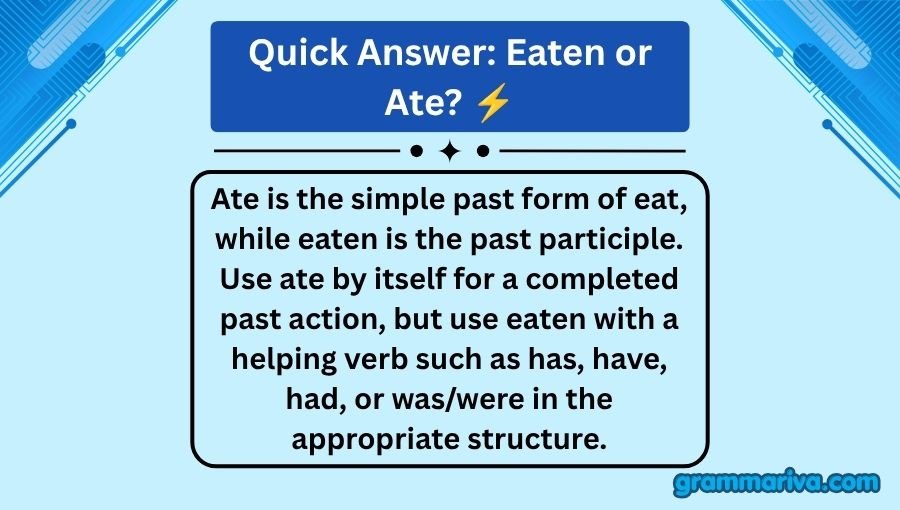
Ate is the simple past form of eat, while eaten is the past participle. Use ate by itself for a completed past action, but use eaten with a helping verb such as has, have, had, or was/were in the appropriate structure.
- I ate breakfast at 8 a.m. ✅
- I have eaten breakfast already. ✅
- I eaten breakfast at 8 a.m. ❌
- I have ate breakfast already. ❌
The fastest rule is simple: ate can stand alone as the main past-tense verb, but eaten usually needs a helping verb.
Is Ate the Past Tense of Eat? 🍽️
Yes. Ate is the simple past tense of eat. We use it when an eating action happened in the past and the sentence does not need a perfect construction.
For example:
I ate pizza last night. ✅
The action happened in the past. The sentence tells us when it happened, so ate is the correct form.
Compare these examples:
| Form | Type | Meaning | Example | Correct/Incorrect |
|---|---|---|---|---|
| eat | Base verb | Present or general action | I eat breakfast early. | ✅ Correct |
| ate | Simple past | An action completed in the past | I ate breakfast early. | ✅ Correct |
| eaten | Past participle | Used with helping verbs | I have eaten breakfast. | ✅ Correct |
| eaten | Past participle alone | Used without the needed helper | I eaten breakfast. | ❌ Incorrect |
A simple way to think about ate is this:
Past action + no perfect helping verb = ate.
When Do You Use Ate?
Use ate when you are describing something that happened in the past.
Examples:
- I ate lunch at noon. ✅
- She ate the last cookie. ✅
- We ate at a new restaurant yesterday. ✅
- They ate before the movie. ✅
Notice that these sentences do not use has, have, or had before the verb.
When Should You Use Eaten Instead? 🥗
Use eaten when the sentence needs the past participle form of eat. This often happens after has, have, or had.
Examples:
- I have eaten already. ✅
- She has eaten lunch. ✅
- We had eaten before they arrived. ✅
You can also see eaten in passive structures.
- The cake was eaten by the children. ✅
- All the cookies were eaten before dinner. ✅
Here is the basic pattern:
have/has/had + eaten
For a passive structure, you may see:
was/were + eaten
| Situation | Word Form | Example |
|---|---|---|
| Simple present | eat | I eat fruit every day. |
| Simple past | ate | I ate fruit yesterday. |
| Present perfect | eaten | I have eaten fruit today. |
| Past perfect | eaten | I had eaten before class. |
| Passive voice | eaten | The fruit was eaten quickly. |
The word eaten does not normally work as the simple past by itself.
So this is wrong:
I eaten breakfast. ❌
The correct sentence is:
I ate breakfast. ✅
Or:
I have eaten breakfast. ✅
Eaten or Ate: The Main Difference 🧠
The main difference is grammatical form. Ate is the simple past form, while eaten is the past participle.
This difference matters because English verb forms work together in specific patterns.
| Word | Verb Form | Common Use | Example |
|---|---|---|---|
| eat | Base form | Present tense, infinitives | I want to eat. |
| ate | Simple past | Finished past action | I ate earlier. |
| eaten | Past participle | Perfect or passive structures | I have eaten already. |
A common mistake is treating eaten as if it were another simple past form.
It is not.
Think of the three main forms as:
eat → ate → eaten
You would not normally say:
Yesterday, I eaten a sandwich. ❌
You would say:
Yesterday, I ate a sandwich. ✅
But you can say:
I have eaten a sandwich. ✅
The helping verb changes the structure.
Why Do People Confuse Eaten and Ate? 🤔
People often confuse these words because both describe an eating action that may have already happened. The difference is not always about the basic meaning. It is about the grammar around the verb.
I once reviewed a student’s short paragraph that said, “I have ate dinner before the guests came.” The student knew that the action was finished. The problem was the verb form after have. Once I changed ate to eaten, the sentence was correct.
There are several reasons this mistake happens:
- Ate sounds natural in many past-tense sentences.
- Eaten is also connected with completed actions.
- Fast typing can cause people to choose the first form that comes to mind.
- Autocorrect may not catch a grammar error.
- Learners may memorize “eat, ate, eaten” without learning when each form is used.
The best solution is to look at the word before the verb.
If you see have, has, or had, check whether you need eaten.
| Sentence Pattern | Correct Form | Example |
|---|---|---|
| I + past action | ate | I ate dinner. |
| She + past action | ate | She ate dinner. |
| I have + completed action | eaten | I have eaten dinner. |
| She has + completed action | eaten | She has eaten dinner. |
| We had + earlier past action | eaten | We had eaten dinner. |
How Can You Tell Which Form Is Correct? 💡
The easiest test is to check for a helping verb.
If there is no helping verb and you are describing a completed past action, ate is usually the right choice.
If have, has, or had comes before the verb, use eaten.
The Quick Test
Ask yourself:
Did I use have, has, or had?
- No → ate may be correct.
- Yes → eaten is usually required.
Compare:
I ate before work. ✅
I have eaten before work. ✅
I had eaten before work. ✅
But:
I have ate before work. ❌
This little test can save you from many mistakes.
Test Tip 🎯
Remove the helping verb and look at the remaining sentence.
If you mean a simple completed action in the past, use ate.
If your sentence is built around have, has, or had, use eaten.
What Does Ate Mean in a Sentence? 📝
Ate tells us that someone performed the action of eating in the past.
It is the simple past form of eat.
For example:
Maria ate breakfast at 7:00.
The sentence describes a finished event. The action happened earlier and is presented as a past event.
Here are several common uses.
A Finished Past Action
I ate breakfast this morning. ✅
A Past Action With a Specific Time
We ate dinner at 6:30. ✅
A Sequence of Past Events
I ate lunch and went back to work. ✅
A Past Event in a Story
He opened the fridge, found some leftovers, and ate them. ✅
| Meaning | Word Type | Example Sentence |
|---|---|---|
| Completed past action | Simple past | I ate breakfast. |
| Past action at a known time | Simple past | She ate at noon. |
| One action in a past sequence | Simple past | We ate and left. |
| Past action in a story | Simple past | He ate the cake. |
What Does Eaten Mean in a Sentence? 🍎
Eaten is the past participle of eat. It is commonly used with helping verbs or in passive structures.
Examples include:
I have eaten already. ✅
She had eaten before the meeting. ✅
The entire cake was eaten. ✅
The word eaten helps create a larger verb structure. By itself, it generally cannot replace ate in a normal simple-past sentence.
Compare:
I ate the sandwich. ✅
I eaten the sandwich. ❌
I have eaten the sandwich. ✅
The third sentence works because have supports the past participle eaten.
Eaten or Ate in Present Perfect and Past Perfect 📚
Perfect tenses are one of the biggest reasons learners need to understand this difference.
The present perfect uses:
has/have + past participle
So:
I have eaten. ✅
She has eaten. ✅
The past perfect uses:
had + past participle
So:
I had eaten before the meeting. ✅
They had eaten before we arrived. ✅
The word ate does not normally follow have, has, or had in standard English.
| Tense | Formula | Correct Example |
|---|---|---|
| Simple past | Subject + ate | I ate lunch. |
| Present perfect | Subject + have/has + eaten | I have eaten lunch. |
| Past perfect | Subject + had + eaten | I had eaten lunch. |
| Passive | Subject + was/were + eaten | The cake was eaten. |
Can You Say “I Have Ate”? ⚠️
No. In standard English, I have ate is incorrect. The correct form is I have eaten.
The reason is simple. Have requires the past participle in this construction, and the past participle of eat is eaten.
Correct:
I have eaten already. ✅
Incorrect:
I have ate already. ❌
This mistake is common because ate is strongly associated with past actions.
But the word after have must fit the verb pattern.
The same idea appears with other irregular verbs:
- I have gone, not “I have went.”
- She has seen, not “She has saw.”
- We have written, not “We have wrote.”
- They have eaten, not “They have ate.”
Learning the pattern helps you avoid mistakes with many irregular verbs.
Can You Say “I Eaten”? 🚫
Usually, no. I eaten is incorrect in standard English because eaten normally needs a helping verb in this type of sentence.
Incorrect:
I eaten breakfast. ❌
Correct:
I ate breakfast. ✅
Or:
I have eaten breakfast. ✅
The form eaten can appear without have in certain passive or participle-based structures, but not as the ordinary simple past verb.
For example:
The cake was eaten. ✅
Here, was supports the structure.
That is why the surrounding words matter.
Case Study: A Simple Workplace Conversation 💼
Imagine that two coworkers are preparing for a meeting.
Alex: “Have you eaten lunch yet?”
Sam: “Yes, I have eaten already.”
Later, Alex talks about what happened earlier.
Alex: “I ate lunch at noon.”
All three sentences are correct.
Why?
“Have you eaten?” uses the present perfect.
“I have eaten already” also uses the present perfect.
“I ate lunch at noon” uses the simple past because the speaker gives a completed past action with a specific time.
I once caught a similar issue while editing a workplace message. The writer had typed, “I have ate before the meeting.” It took only one word to fix, but the correction made the whole email sound much more polished.
| Situation | Correct Sentence | Reason |
|---|---|---|
| Asking about a completed action | Have you eaten? | Present perfect |
| Giving a recent result | I have eaten. | Present perfect |
| Giving a specific past time | I ate at noon. | Simple past |
| Describing an earlier past action | I had eaten before the meeting. | Past perfect |
Grammar Rules for Eaten and Ate
The rule is based on verb form.
Eat is the base form.
Ate is the simple past form.
Eaten is the past participle.
In a normal simple-past sentence, use ate.
She ate dinner.
In a perfect construction, use eaten after the correct helping verb.
She has eaten dinner.
In a passive construction, eaten can follow a form of be.
The dinner was eaten.
Standard English grammar references agree on this basic distinction. The important point is not memorizing a long definition. It is recognizing the sentence pattern.
Correct vs Incorrect at a Glance
| Sentence | Correct/Incorrect | Why |
|---|---|---|
| I ate breakfast. | ✅ Correct | Simple past |
| I have eaten breakfast. | ✅ Correct | Present perfect |
| I had eaten breakfast. | ✅ Correct | Past perfect |
| I have ate breakfast. | ❌ Incorrect | Use the past participle eaten |
| I eaten breakfast. | ❌ Incorrect | A helping verb is missing |
The rule becomes much easier when you focus on the entire verb phrase rather than the single word.
Common Mistakes With These Verb Forms ⚠️
Most mistakes come from choosing a word based on meaning instead of sentence structure.
A writer may think, “The action happened already, so I need ate.” That is not always true. The sentence may require a perfect form.
Other common causes include:
- Fast typing
- Autocorrect
- Weak knowledge of irregular verbs
- Translating directly from another language
- Memorizing forms without learning sentence patterns
- Confusing simple past with past participles
Similar Grammar Confusions
| Confusing Pair | Correct Example | Main Difference |
|---|---|---|
| its / it’s | The dog wagged its tail. | Possession vs contraction |
| your / you’re | You’re ready with your bag. | Contraction vs possession |
| their / they’re | They’re in their car. | Contraction vs possession |
| then / than | Better now than then. | Comparison vs time |
| affect / effect | The change affected the result. | Verb vs noun in common uses |
| ate / eaten | I ate. / I have eaten. | Simple past vs past participle |
Specific Wrong Forms to Avoid
| Wrong Form | What’s Wrong | Correct Form |
|---|---|---|
| I eaten dinner. | Missing helping verb | I ate dinner. |
| I have ate dinner. | Wrong form after have | I have eaten dinner. |
| She has ate lunch. | Wrong past form | She has eaten lunch. |
| We had ate already. | Wrong form after had | We had eaten already. |
| He eaten the cake. | Missing helping verb | He ate the cake. |
| They have ate everything. | Past tense used after have | They have eaten everything. |
How To Remember the Difference 🧩
Use this three-word chain:
eat → ate → eaten
Then attach each form to its job.
Eat = present or base form.
Ate = simple past.
Eaten = past participle.
Try this memory trick:
Yesterday, I ate.
Today, I have eaten.
The word yesterday often points toward simple past.
The phrase have eaten shows the perfect structure.
| Memory Cue | Form | Example |
|---|---|---|
| Every day | eat | I eat fruit every day. |
| Yesterday | ate | I ate fruit yesterday. |
| Already / have | eaten | I have eaten fruit already. |
| Before another past event | eaten | I had eaten before class. |
Eaten or Ate in Different Contexts 🌎
The same grammar rule applies whether you are speaking casually or writing professionally. The context may change, but the verb forms do not.
Everyday Conversation
“I ate already.”
“Have you eaten?”
Both are natural.
Professional Writing
“I ate lunch before the meeting.”
“I have eaten, so I am ready for the meeting.”
Professional writing benefits from clear verb structures.
Creative Writing
Stories often use ate when describing past events.
“She ate the last piece of cake and smiled.”
Perfect forms can also work when the timing between events matters.
Social Media and Texting
Casual posts may use short forms.
“I ate way too much 😂”
“I have eaten enough for three people.”
| Context | Which Term to Use | Example |
|---|---|---|
| Everyday conversation | ate or eaten, depending on structure | I ate already. |
| Professional writing | ate or eaten, depending on structure | I have eaten lunch. |
| Creative writing | ate or eaten, depending on timeline | She ate the cake. |
| Social media/texting | ate or eaten, depending on structure | I ate everything. |
The important point is that casual writing does not change the basic grammar rule.
Common Phrases With Eat, Ate, and Eaten 🍴
There are several common expressions that make these forms easier to recognize.
| Phrase | Meaning |
|---|---|
| Eat out | Have a meal at a restaurant |
| Eat up | Finish all the food |
| Eat too much | Consume more food than needed |
| Eat breakfast | Have the morning meal |
| Have eaten | Completed an eating action |
| Had eaten | Completed an eating action before another past event |
Examples:
We ate out last night. ✅
I have eaten already. ✅
She ate up the whole sandwich. ✅
These phrases do not change the core rule. The form still depends on the sentence structure.
Synonyms and Alternatives for Eat 🍽️
Sometimes you can replace eat with another verb. However, the best choice depends on the exact meaning.
For example, consume is more formal. Dine often suggests having a meal, especially in a restaurant or formal setting. Devour suggests eating something quickly or eagerly.
| Alternative | Works When | Does Not Work When |
|---|---|---|
| consume | You want a formal word | You want a casual tone |
| dine | Talking about having a meal | Talking about every small snack |
| devour | Someone eats eagerly or quickly | The action is slow and calm |
| have a meal | You want a natural phrase | You need a single verb |
You can also change the sentence completely.
Instead of:
I ate lunch.
You could say:
I had lunch.
But if you use have in a different grammatical structure, be careful not to confuse the meaning of have as a main verb with have as a helping verb.
Why Getting the Difference Right Matters 🎯
Choosing the correct form makes your writing clearer. It also helps readers understand when an action happened and how that action connects to another event.
A short sentence can still sound polished when the verb structure is correct.
Clear grammar makes simple ideas easier to trust.
That is especially useful in work, school, and online communication.
| Situation | Why Getting It Right Matters |
|---|---|
| Resume or application | Shows careful writing |
| Client email | Makes your message sound polished |
| Published content | Improves clarity and credibility |
| Social post | Helps readers understand your meaning |
You do not need complicated grammar to sound professional. You need accurate grammar that fits the sentence.
Does the Time Expression Affect the Choice? ⏰
Yes. Time expressions can help you decide between the simple past and perfect forms, although they are not the only factor.
Words such as yesterday, last night, last week, and at noon often work naturally with the simple past.
I ate at noon. ✅
Expressions such as already, yet, ever, and never often appear with the present perfect.
I have eaten already. ✅
However, do not treat these words as absolute rules. The whole sentence matters.
| Time Expression | Common Structure | Example |
|---|---|---|
| yesterday | Simple past | I ate yesterday. |
| last night | Simple past | We ate last night. |
| at noon | Simple past | She ate at noon. |
| already | Present perfect often used | I have eaten already. |
| yet | Present perfect often used | Have you eaten yet? |
| before that | Past perfect may be used | I had eaten before that. |
The safest approach is to look at both the time expression and the verb structure.
Can Ate and Eaten Ever Appear in the Same Sentence? 🔍
Yes. They can appear in the same sentence when they perform different grammatical jobs.
For example:
I ate dinner after I had eaten a small snack earlier. ✅
The first verb describes a simple past action. The second uses the past perfect.
Another example:
She ate the meal after she had eaten an appetizer. ✅
The two forms can work together because the sentence describes different relationships between past actions.
| Sentence | Ate Role | Eaten Role |
|---|---|---|
| I ate after I had eaten a snack. | Main past action | Earlier past action |
| She ate what I had eaten earlier. | Later action | Earlier completed action |
| We ate after they had eaten. | Later action | Earlier action |
This is a good reminder that ate and eaten are not interchangeable. Each one has a specific grammatical role.
Quick Recap Checklist ✅
Use this checklist whenever you are unsure.
| Question | If Yes → Use |
|---|---|
| Is it a simple completed action in the past? | ate |
| Does the sentence use have? | eaten |
| Does the sentence use has? | eaten |
| Does the sentence use had? | eaten |
| Is it passive with was/were? | eaten |
| Are you using the base verb after “to”? | eat |
Practice Examples
- Yesterday, I ___ breakfast at 8.
Answer: ate ✅ - I have ___ breakfast already.
Answer: eaten ✅ - She had ___ before the guests arrived.
Answer: eaten ✅
The more you practice the pattern, the faster the correct form will come to you.
FAQs About Ate vs Eaten ❓
What is the difference between ate and eaten?
Ate is the simple past form of eat. Eaten is the past participle. Use ate for a simple past action and eaten with helping verbs such as have, has, or had, or in passive structures.
Is “I have ate” grammatically correct?
No. I have ate is incorrect in standard English. The correct sentence is I have eaten. The word have requires the past participle in this construction.
Is “I ate” correct?
Yes. I ate is completely correct when you are describing a completed action in the past.
Example:
I ate breakfast at 8 a.m. ✅
Is “I eaten” correct?
No, not as a normal simple sentence. You need the appropriate helping verb.
Correct:
I ate lunch. ✅
I have eaten lunch. ✅
Should I say “I ate already” or “I have eaten already”?
Both can be used, depending on the variety of English and the context. I have eaten already uses the present perfect. I ate already uses the simple past and is common in casual American English.
Is “Have you ate?” correct?
No. The standard form is:
Have you eaten? ✅
After have, use the past participle eaten.
Is “I had ate” correct?
No. The correct form is:
I had eaten. ✅
Had is followed by the past participle in the past perfect.
What is the past tense of eat?
The simple past tense of eat is ate.
Example:
I ate a sandwich yesterday.
The past participle is eaten.
Example:
I have eaten a sandwich.
What is the past participle of eat?
The past participle of eat is eaten.
It is used in perfect constructions and some passive structures.
How can I remember ate vs eaten?
Remember the sequence:
eat → ate → eaten
Then remember the simple rule:
Past action by itself = ate.
Have, has, or had + verb = eaten.
Final Conclusion: Eaten or Ate Made Simple 🎉
Eaten or ate becomes easy once you focus on the verb pattern instead of trying to memorize isolated words. Ate is the simple past form, so use it for a completed past action such as “I ate lunch yesterday.” Eaten is the past participle, so use it with helping verbs such as have, has, and had, as in “I have eaten lunch.” It can also appear in passive structures such as “The cake was eaten.” The best habit is to pause for one second and check the words around the verb. If you are describing a simple past action, ate is usually your answer. If have, has, or had comes before the verb, choose eaten. With a little practice, this irregular verb pair will feel natural. Keep the pattern eat → ate → eaten in mind, and you will have a simple grammar tool you can use in school, work, conversations, and everyday writing. Keep it simple, check the structure, and your grammar will stay on track. ✨

Hi, I’m Lucas Bennett. I’m a grammar content specialist at Grammariva. I work on articles covering everyday grammar questions, sentence usage, and writing tips that readers can apply with confidence.
[…] can choose the right word with confidence. By the end, the difference should feel much easier. 😊 Eaten or Ate | Comma Before or After For Example | Imbed vs […]
[…] common mistakes, and give you easy tests to remember the correct choice. ✨ Spatter or Splatter | Eaten or Ate | Comma Before or After For […]