Proved vs proven can make even careful writers stop and think. Both forms come from the verb prove, and both can be correct. The real question is not whether one word is always right and the other is always wrong. The choice depends on how the word works in a sentence.
For example, you may write, “The scientist has proved the theory,” or “The scientist has proven the theory.” In modern American English, both can be used in many settings. However, proven is especially common before a noun, as in “a proven method.” Proved is also widely used, especially as the past tense and past participle of prove.
I have seen this issue confuse students, editors, and professional writers. The good news is that the rule is much easier than it first looks. 😊 Once you understand the role of each form, you can choose the right one with confidence.
This guide explains the difference, shows real examples, covers common mistakes, and gives you quick tests you can use when writing. Understanding proved vs proven becomes much easier when you focus on the grammatical role of each form. Savor vs Saver | Do Not vs Dont | Beloved vs Loved
🎯 Quick Answer: Which Form Should You Use?
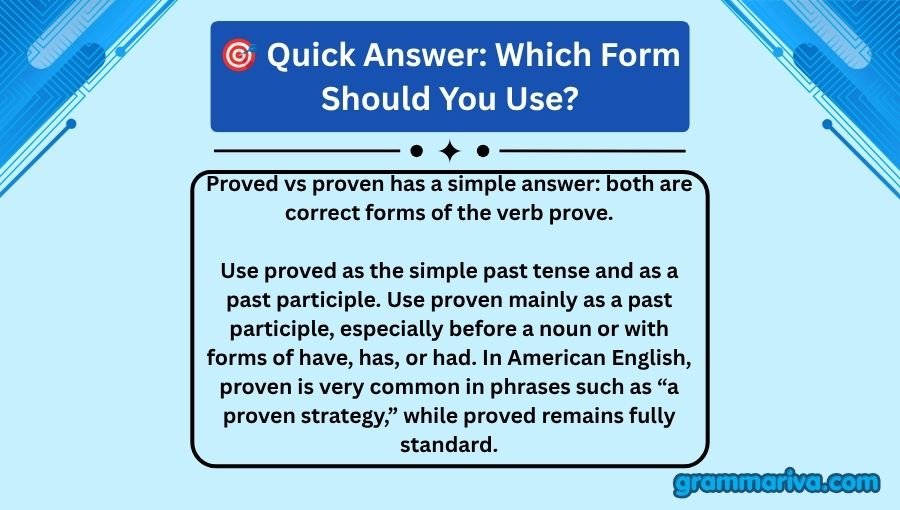
Proved vs proven has a simple answer: both are correct forms of the verb prove.
Use proved as the simple past tense and as a past participle. Use proven mainly as a past participle, especially before a noun or with forms of have, has, or had. In American English, proven is very common in phrases such as “a proven strategy,” while proved remains fully standard.
| Form | Basic Role | Example |
|---|---|---|
| prove | Base verb | We need to prove the claim. |
| proved | Past tense | She proved her point yesterday. |
| proved | Past participle | They have proved the claim. |
| proven | Past participle | They have proven the claim. |
| proven | Adjective-like use | This is a proven method. |
The key point is this: proven is not an incorrect version of proved. It is a standard form with its own common patterns.
🔎 Is Proved the Same as Proven?
Not completely. Proved and proven come from the same verb, but they do not behave in exactly the same way.
Proved can serve as both the simple past form and a past participle. Proven is normally used as a past participle and is also common when the word describes a noun.
Compare these sentences:
- She proved her point during the meeting.
- She has proved her point.
- She has proven her point.
- She used a proven method.
The first sentence uses proved as a simple past verb. The next two use a past participle after has. The last sentence uses proven to describe method.
This difference explains why both forms appear in good writing.
📚 Proved vs Proven at a Glance
The easiest way to understand the pair is to compare their grammatical jobs.
| Form | Type | Meaning | Example | Correct/Incorrect |
|---|---|---|---|---|
| proved | Simple past | Showed something to be true | She proved the claim. | ✅ Correct |
| proved | Past participle | Used with helping verbs | He has proved his point. | ✅ Correct |
| proven | Past participle | Used with helping verbs | He has proven his point. | ✅ Correct |
| proven | Adjective-like form | Shown to work or be true | It is a proven method. | ✅ Correct |
| proven | Simple past | Used alone for a past action | She proven the claim yesterday. | ❌ Incorrect |
The last example is wrong because proven does not normally work as the simple past form by itself.
You would write:
She proved the claim yesterday.
Not:
She proven the claim yesterday.
🧠 What Does Proved Mean?
Proved is the simple past form of prove. It tells us that someone showed something to be true, valid, effective, or correct at a past time.
Examples:
- The lawyer proved his case.
- The experiment proved the theory useful.
- Maya proved that the answer was correct.
- The new system proved reliable.
In each example, the action happened in the past.
Proved as a Past Participle
Proved can also follow helping verbs such as has, have, and had.
Examples:
- The plan has proved successful.
- The results have proved useful.
- The test had proved difficult.
So, if you see proved after a helping verb, that does not make the sentence wrong.
Test Tip 💡
Remove the helping verb and check the sentence.
If you mean a completed action that happened in the past, proved is often the natural choice.
The results proved the theory.
You can also say:
The results have proved the theory.
Both are grammatical.
🧪 What Does Proven Mean?
Proven is a past participle of prove. It is especially common in American English when talking about something that has already been shown to work, succeed, or be true.
Examples include:
- a proven method
- a proven strategy
- a proven solution
- a proven system
- a proven fact
You will also see proven after helping verbs.
Scientists have proven the theory.
The company has proven its ability to adapt.
The form is particularly natural when the focus is on the result rather than the past action itself.
| Meaning | Word Type | Example Sentence |
|---|---|---|
| Showed something was true | Verb | She proved the claim. |
| Demonstrated success | Verb | The plan proved effective. |
| Shown to work | Past participle/adjective-like | It is a proven strategy. |
| Established as true | Past participle | Researchers have proven the result. |
⚖️ When Should You Use Proved Instead of Proven?
Use proved when you need the simple past tense.
The basic pattern is: The key to proved vs proven is understanding whether you are using the simple past or a past participle.
Subject + proved + object/complement
Examples:
The evidence proved his claim.
Her actions proved her loyalty.
The test proved difficult.
You should not replace proved with proven in these simple past structures.
❌ The evidence proven his claim.
✅ The evidence proved his claim.
❌ Her actions proven her loyalty.
✅ Her actions proved her loyalty.
The main clue is that the verb is standing alone as the past-tense action.
🏆 When Is Proven More Natural?
Proven is especially natural when it comes before a noun.
Examples:
We need a proven solution.
He follows a proven process.
This is a proven technique.
The company uses a proven system.
It can also appear with has, have, or had:
The method has proven effective.
The idea has proven useful.
The approach had proven successful.
This is one reason people often notice proven in business, education, science, marketing, and professional writing.
❓Can You Say “Has Proved” and “Has Proven”?
Yes. Both can be grammatically correct.
The choice often depends on style, context, and regional preference.
Compare:
The method has proved effective.
The method has proven effective.
Both sentences can work. In American English, has proven is especially familiar to many readers.
However, you should not assume that proved is wrong simply because proven sounds more familiar.
I once edited a short business report where the writer had changed every instance of proved to proven because they thought proven was the “proper” form. That was unnecessary. Several of the original proved examples were simple past verbs, so changing them actually made some sentences incorrect.
The lesson is simple: check the grammar job first. Do not choose a word just because it looks more formal.
📝 Case Study: A Workplace Example
Imagine that a project manager sends this email after a successful software test:
“The new process proved effective during last week’s trial.”
This sentence is correct. The manager is describing what happened during a completed past event.
Now imagine the manager writes:
“The new process is a proven solution for reducing errors.”
This is also correct. Here, proven describes solution. It tells readers that the solution has already been shown to work.
A third version is:
“The new process has proven effective.”
Again, this is correct. The sentence uses proven as a past participle after has.
| Workplace Situation | Best Choice | Example |
|---|---|---|
| Completed past action | proved | The test proved successful. |
| Description before a noun | proven | We need a proven system. |
| Present perfect | proved or proven | The system has proven effective. |
| Past perfect | proved or proven | The system had proven useful. |
This is why context matters more than memorizing one rigid rule.
📖 Why Are Both Forms Correct?
The verb prove has more than one accepted past participle in modern English. Proved is the regular past form and can also function as a past participle. Proven is another established past participle.
The simple past, however, is normally proved.
Think of the pattern like this:
Present: prove
Simple past: proved
Past participle: proved or proven
That gives you a useful framework:
| Verb Form | Example |
|---|---|
| Present | I prove my point. |
| Simple past | I proved my point. |
| Present perfect | I have proved my point. |
| Present perfect | I have proven my point. |
| Past perfect | I had proved my point. |
| Past perfect | I had proven my point. |
Both participles can work in many perfect constructions. Proven is also very common when it acts like an adjective.
❌ Correct vs Incorrect at a Glance
Here are the patterns I recommend checking first.
| Sentence | Correct/Incorrect | Why |
|---|---|---|
| She proved her point yesterday. | ✅ Correct | Proved is the simple past. |
| She proven her point yesterday. | ❌ Incorrect | Proven does not normally serve as the simple past. |
| The method has proven effective. | ✅ Correct | Proven is a past participle. |
| The method has proved effective. | ✅ Correct | Proved can also be a past participle. |
| We need a proven solution. | ✅ Correct | Proven describes the noun solution. |
⚠️ Why Do People Confuse Proved and Proven?
People confuse these forms because they are both connected to the same verb and both can appear in perfect verb phrases.
There are also several everyday reasons for mistakes:
- Fast typing: Writers often choose the first form that comes to mind.
- Autocorrect: Software may suggest a different form.
- Lack of knowledge: Some writers learn only one version.
- Overcorrection: A writer may believe that one form is always more formal.
- Pattern confusion: Writers may compare prove with other irregular verbs.
For example, people know forms such as:
write → wrote → written
That pattern can make proven feel like the only “special” past participle. But prove is different because proved is also an accepted past participle.
| Similar Confusion | Correct Forms | Common Problem |
|---|---|---|
| it’s / its | it’s = it is, its = possessive | Mixing grammar roles |
| your / you’re | your = possessive, you’re = you are | Sounding alike |
| they’re / their / there | Different meanings | Same pronunciation in some speech |
| affect / effect | Usually different word roles | Similar spelling |
| proved / proven | Both have accepted uses | Choosing by guesswork |
A Quick Personal Example
I once caught myself typing “the test proven useful” in a draft. I was thinking about the phrase “a proven method,” so my brain carried proven into the wrong structure. I changed it to “the test proved useful” and moved on.
That is exactly how these mistakes happen. The writer often knows both words. The problem is choosing the right one in the moment.
🛑 Common Wrong Forms and Uses
Some errors are not spelling mistakes. They are grammar mistakes caused by putting a correct word into the wrong position.
| Wrong Form or Use | What’s Wrong | Correct Form |
|---|---|---|
| She proven it yesterday. | Wrong simple past form | She proved it yesterday. |
| He has prove the point. | Base form follows has incorrectly | He has proved/proven the point. |
| They had prove the claim. | Base form follows had incorrectly | They had proved/proven the claim. |
| A proved method | Possible in some contexts, but less natural for the intended adjective-like meaning | A proven method |
| The results proven the claim. | Proven cannot normally be the simple past here | The results proved the claim. |
| This proven the theory. | Wrong simple past form | This proved the theory. |
Notice that the problem is not always that proven itself is wrong. Sometimes the problem is its grammatical position.
❓Is “Proven” a Past Tense Verb?
No. In standard modern English, proven is normally a past participle, not the simple past tense.
The simple past is proved.
For example:
She proved her point.
Not:
She proven her point.
But after a helping verb, proven can be correct:
She has proven her point.
This small distinction solves many common errors.
❓Is “Proved” a Past Participle?
Yes. Proved can function as a past participle.
For example:
The idea has proved successful.
So the basic verb pattern is:
prove → proved → proved/proven
That is why saying “proven is the past participle” is incomplete. Proved can also be the past participle.
🗣️ How Do You Use Them in Everyday Conversation?
In casual speech, you may hear both forms. Your choice can depend on the exact sentence.
For a simple past action, use proved:
“She proved me wrong.”
For a description, proven is natural:
“That is a proven way to solve it.”
For a perfect construction, either participle may work:
“It has proved useful.”
“It has proven useful.”
| Context | Which Term to Use | Example |
|---|---|---|
| Everyday conversation | proved for simple past | He proved his point. |
| Everyday conversation | proven for descriptions | It’s a proven trick. |
| Professional writing | proved or proven | The study has proven useful. |
| Creative writing | Either, based on sentence | Her courage proved valuable. |
| Social media/texting | Either, based on grammar | A proven favorite! |
💼 How Should You Use Them in Professional Writing?
Professional writing benefits from clear grammatical choices.
When describing a completed action, proved is usually straightforward:
The trial proved successful.
When describing a method, product, or system, proven often sounds natural:
We selected a proven approach.
In business writing, avoid changing every instance of proved to proven simply to sound more polished. Good professional writing is based on accurate grammar, not on choosing the word that looks more impressive.
For example:
“The pilot program proved successful.”
This is clear and professional.
“The company selected a proven strategy.”
This is also clear and professional.
The two forms simply perform different jobs in these sentences.
✨ Proved vs Proven in Creative Writing
Creative writing gives you more freedom, but grammar still matters.
You might write:
Her kindness proved stronger than her fear.
Here, proved describes what became clear through the story.
You could also write:
She trusted a proven method.
Here, proven describes the method.
Writers sometimes prefer proved because it can make an action feel direct:
His actions proved his loyalty.
Proven can create a stronger sense of established fact:
His loyalty was proven over many years.
The best choice depends on what you want the sentence to do.
📱 Can You Use Proven in Social Media Posts?
Yes. Proven is common in short posts, especially when describing a method, tip, product, or idea.
Examples:
“A proven way to stay focused. 🎯”
“This trick has proven useful! ✨”
“Tried it once, and it proved me wrong. 😂”
Social media does not remove grammar rules. A short caption can still use the wrong verb form.
If you write a sentence such as:
“This trick proven everything.”
the issue is grammatical, not stylistic.
A better version is:
“This trick proved everything.”
Or, depending on the intended meaning:
“This trick has proven useful.”
🧩 How Can You Remember the Difference?
A simple way to remember proved vs proven is to look at the word’s role in the sentence.
Use one simple memory rule:
Proved = simple past.
Proven = commonly used as a past participle or adjective-like form.
Try these three questions:
- Is the word the main past-tense verb by itself?
- Is there a helping verb such as has, have, or had?
- Is the word describing a noun?
If the answer to the first question is yes, proved is usually the answer.
If the second or third applies, proven may be the better choice.
Quick Memory Examples
Yesterday, she proved it. ✅
She has proven it. ✅
It is a proven method. ✅
Yesterday, she proven it. ❌
That four-line pattern is worth remembering.
🔄 What Are Good Alternatives to Proved and Proven?
Sometimes you can avoid the choice entirely by changing the sentence.
Useful alternatives include demonstrated, confirmed, showed, and established. However, each has a slightly different meaning.
| Alternative | Works When | Does Not Work When |
|---|---|---|
| showed | You mean made something clear | You need a stronger sense of formal proof |
| demonstrated | You mean clearly showed something | The context is very casual |
| confirmed | You mean verified something | No verification actually happened |
| established | You mean firmly demonstrated or accepted | The action was only a simple observation |
| verified | You mean checked and confirmed accuracy | The idea was demonstrated rather than checked |
For example:
The test proved the system worked.
Could become:
The test demonstrated that the system worked.
But the words are not always exact replacements. Choose based on meaning.
💡 Common Phrases With Proven
Proven appears in several natural phrases, especially when something has already shown that it works or is reliable.
| Phrase | Meaning |
|---|---|
| proven method | A method shown to work |
| proven strategy | A strategy with an established record of success |
| proven solution | A solution already shown to work |
| proven effective | Shown to be effective |
| time-tested and proven | Shown to remain useful over time |
These phrases are especially common in professional, educational, technical, and marketing language.
🧠 Why Does Getting Proved vs Proven Right Matter?
Using proved vs proven correctly helps readers understand exactly what you mean without stopping to question the grammar. Using the right form makes your writing easier to understand. It also shows that you understand how verb forms work.
A small grammar mistake can distract readers. This matters even more in professional writing.
| Situation | Why Getting It Right Matters |
|---|---|
| Resume | Shows attention to detail |
| Client email | Builds trust and clarity |
| Published content | Keeps the writing polished |
| Social post | Makes short messages easier to read |
A useful writing principle is:
Clear grammar lets your idea get the attention, not the mistake.
That is especially true with word pairs that look similar. Readers may understand what you mean, but correct grammar makes the message smoother and more confident.
❓Does American English Prefer Proven?
American English uses proven very often, especially in phrases such as “a proven method” and in perfect constructions such as “has proven effective.”
However, that does not make proved incorrect. American English also regularly uses proved as the simple past and as a past participle.
So, do not treat the choice as a battle between a “correct” word and an “incorrect” word.
The better question is:
What grammatical role does the word have in this sentence?
That question gives you a much more reliable answer.
📋 A Simple Decision Guide
When you are unsure, use this quick process.
Step 1: Check for a past-time action
If the word is the main verb describing something that happened, use proved.
The experiment proved successful.
Step 2: Check for a helping verb
If you have has, have, or had, both proved and proven may be possible depending on the sentence and style.
The experiment has proved successful.
The experiment has proven successful.
Step 3: Check for a noun after the word
If the word directly describes a noun, proven is often the natural choice.
a proven strategy
a proven system
Step 4: Read the whole sentence
Do not decide based on the word alone. Grammar comes from the full sentence.
❓Which Is Correct: “The Method Proved Effective” or “Proven Effective”?
“The method proved effective” is correct when describing what happened or what became clear.
“The method has proven effective” is also correct when using the present perfect.
Compare:
The method proved effective during the trial. ✅
The method has proven effective over several years. ✅
The first focuses on a completed past event. The second connects the past result to the present.
Both are useful. The time and structure decide the choice.
❓Can “Proven” Come Before a Noun?
Yes. This is one of its most common uses.
Examples:
a proven technique
a proven approach
a proven product
a proven solution
In these examples, proven tells readers that the noun has already been shown to work or succeed.
This pattern is easy to remember because proven + noun is extremely common.
❓Is “Proved Method” Wrong?
Not every use of proved before a noun is automatically ungrammatical, but proven method is the normal and natural choice when you mean a method that has been shown to work.
For clear modern writing, I recommend:
a proven method
rather than:
a proved method
The second can appear in specialized or unusual contexts, but it is not the form most readers expect for this meaning.
❓Can You Say “Has Proven” in Formal Writing?
Yes. Has proven is fully suitable for formal writing.
Examples:
The new policy has proven effective.
The treatment has proven successful.
The approach has proven useful.
You do not need to replace has proven with has proved just because the writing is formal.
Both forms can be correct.
❓Which Is Better for a Resume?
Either can be correct, but the exact sentence matters.
For example:
“The new process proved effective in reducing delays.”
This describes a past result.
Or:
“The new process has proven effective in reducing delays.”
This emphasizes an established result that remains relevant.
If you are describing a method or skill:
“Developed a proven process for improving customer support.”
Here, proven naturally describes process.
The strongest resume wording is the version that clearly matches the time and meaning.
❓Why Do People Say “Proven” More Often?
Proven is highly familiar because it appears often in phrases describing successful or reliable things.
You may see:
- proven results
- proven skills
- proven methods
- proven strategies
- proven solutions
Marketing and professional writing also use these patterns often. That high exposure can make proven feel more correct than proved.
But frequency does not change the basic grammar rule.
When you need the simple past, use proved.
❓Is “Proved” More Correct Than “Proven”?
No. Neither is simply “more correct.”
Proved is the standard simple past form and can also be a past participle. Proven is an accepted past participle and is especially common before nouns and in many perfect constructions.
The best choice depends on the sentence.
Think:
She proved it yesterday. ✅
She has proven it already. ✅
It is a proven solution. ✅
This is a case where context matters more than picking a single winner.
❓How Do You Use Proved and Proven in a Sentence?
Use proved as the simple past:
The experiment proved the idea correct.
Use proved or proven as a past participle:
The experiment has proved useful.
The experiment has proven useful.
Use proven as an adjective-like form before a noun:
We need a proven solution.
That covers most everyday cases.
❓What Is the Easiest Way to Tell Them Apart?
Ask whether the word is the main past-tense verb.
If yes, choose proved.
If it follows has, have, or had, proved or proven may work.
If it describes a noun, proven is usually the natural choice.
Here is the shortest version:
Past action = proved.
Past participle or noun description = proven is often used.
❓What Should Students Remember About Proved and Proven?
Students should remember that prove has two commonly accepted participle forms: proved and proven.
The simple past is proved.
The most useful pattern is:
prove → proved → proved/proven
For example:
I prove the point.
I proved the point yesterday.
I have proved the point.
I have proven the point.
It is a proven point or method.
Once students learn that pattern, the confusion becomes much smaller.
🔍 Quick Recap Checklist
Use this checklist before you publish or submit your sentence.
| Question | If Yes → Use |
|---|---|
| Is it the simple past verb? | proved |
| Does it describe a past action by itself? | proved |
| Does it follow has, have, or had? | proved or proven |
| Does it describe a noun? | Usually proven |
| Are you describing an established method or strategy? | Usually proven |
| Are you writing “she proven it yesterday”? | Change it to proved |
Practice Examples
- The new plan proved successful during the test. ✅
- The company has proven its ability to adapt. ✅
- We need a proven strategy before we begin. ✅
Now try the same test without looking at the answers:
- The experiment ___ useful yesterday.
- The experiment has ___ useful.
- We selected a ___ approach.
Answers:
- proved
- proven or proved
- proven
❓How Can You Avoid Future Mistakes?
Do not memorize dozens of isolated sentences. Learn the verb pattern and check the grammar role.
When editing, I recommend reading the sentence aloud. If you hear:
“Yesterday, she proven…”
your ear may catch the problem quickly.
Then check whether the word is:
- a simple past verb
- a past participle
- an adjective-like description
This takes only a few seconds.
You can also replace the word temporarily with showed.
If the sentence needs a simple past verb:
She showed that the claim was true.
Then proved is likely the right form:
She proved that the claim was true.
This is a handy editing trick when you are unsure.
❓Should You Always Choose Proven When in Doubt?
No. That shortcut can create errors.
If the sentence is a simple past construction, proved is the safe choice.
For example:
The evidence proved the claim.
Not:
The evidence proven the claim.
If you are describing a noun:
a proven solution
then proven is the natural choice.
The goal is not to favor one word. The goal is to match the word to its grammatical role.
❓Are Proved and Proven Interchangeable?
They are interchangeable in some past-participle constructions, but not in every grammatical position.
For example:
The plan has proved effective. ✅
The plan has proven effective. ✅
But:
The plan proved effective. ✅
The plan proven effective. ❌
And:
a proven strategy ✅
is the normal choice for the adjective-like use.
So, they overlap, but they are not interchangeable everywhere.
❓Can Both Forms Appear in the Same Article?
Absolutely. In fact, good writing may naturally use both.
For example:
The first test proved difficult. After several changes, the team created a proven process that worked well.
There is no need to force one form throughout an article. Each sentence should use the form that fits its grammar and meaning.
❓What Is the Best Final Rule for Proved vs Proven?
The best rule is simple:
Use proved for the simple past. Use proved or proven as a past participle when the sentence allows both. Use proven commonly when it describes a noun or appears in familiar phrases such as “proven method.”
Once you learn that pattern, most cases become easy.
FAQs About Proved vs Proven
Is “proved” grammatically correct?
Yes. Proved is the standard simple past form of prove and can also be used as a past participle.
Is “proven” grammatically correct?
Yes. Proven is an accepted past participle of prove. It is especially common before nouns and in many perfect verb constructions.
Which is correct, “proved” or “proven”?
Both can be correct. Use proved for the simple past. Use proved or proven in many past-participle constructions, depending on context and style.
Is “She proven it” correct?
No. The simple past form is proved.
Correct:
She proved it. ✅
Incorrect:
She proven it. ❌
Is “has proved” correct?
Yes. Has proved is grammatically correct because proved can function as a past participle.
Example:
The method has proved effective.
Is “has proven” correct?
Yes. Has proven is also correct.
Example:
The method has proven effective.
Both forms are accepted in this type of construction.
Should I write “a proven method” or “a proved method”?
A proven method is the normal and natural choice when you mean a method that has been shown to work.
Is proven the past tense of prove?
No. The simple past is proved. Proven is normally used as a past participle.
Why is proven common in American English?
Proven is widely used in American English, especially in phrases describing established success or reliability, such as “proven strategy,” “proven method,” and “has proven effective.”
Can proved and proven mean the same thing?
Sometimes, especially when they function as past participles. However, they cannot be swapped in every sentence. Proved is required for the normal simple past, while proven is especially common as a past participle and adjective-like form.
Conclusion
The difference between proved vs proven becomes clear when you focus on sentence structure. Proved vs proven is not really a fight between a correct word and an incorrect word. Both forms belong to the verb prove, but they have different patterns of use. Proved is the normal simple past form. Proved can also work as a past participle. Proven is another accepted past participle and is especially common when describing a noun or in phrases such as “has proven effective” and “a proven method.”
When I edit a sentence with these words, I first check the job the word is doing. Is it the main past-tense verb? Then proved is usually right. Is it describing a noun? Proven is often the better choice. Is it following has, have, or had? Both forms may be possible.
The difference between proved vs proven becomes clear when you focus on sentence structure.That small habit can prevent a lot of grammar mistakes. ✨
Remember the easiest pattern: prove → proved → proved/proven. When you focus on the sentence instead of guessing which word sounds more formal, the choice becomes much clearer.
Choose the form that fits the grammar, and your writing will prove itself. ✅

Hi, I’m Olivia Carter. I’m an English language editor at Grammariva, and I work on making grammar lessons clear, accurate, and easy to follow. I especially enjoy writing about common grammar mistakes and everyday English.

[…] needed. By the end, you should feel confident using it in both casual and professional English. Proved vs Proven | Savor vs Saver | Do Not vs […]
[…] By the end, you should be able to choose the right form with confidence. 🌟 Take It or Leave It | Proved vs Proven | Savor vs […]