If you have ever wondered about elegy vs eulogy, you are not alone. These two words are closely linked to death, grief, and remembrance, so it is easy to mix them up. Both can honor someone who has died, but they are not the same thing. One is mainly a type of poem or written work. The other is a speech or piece of writing that praises a person, often at a funeral or memorial service.
I have seen this mix-up many times in writing. The words look and sound related, and both can appear in the same setting. Yet their meanings and uses are different. Once you know what each word does, the difference becomes much easier to remember. 🌿
In this guide, I will explain the difference in simple US English. You will learn when to use each word, see clear examples, review common mistakes, and get quick tests that make the rule stick. By the end, you should feel confident choosing the right word. 😊 Gases or Gasses | Take It or Leave It | Proved vs Proven
🎯 Quick Answer: Elegy vs Eulogy
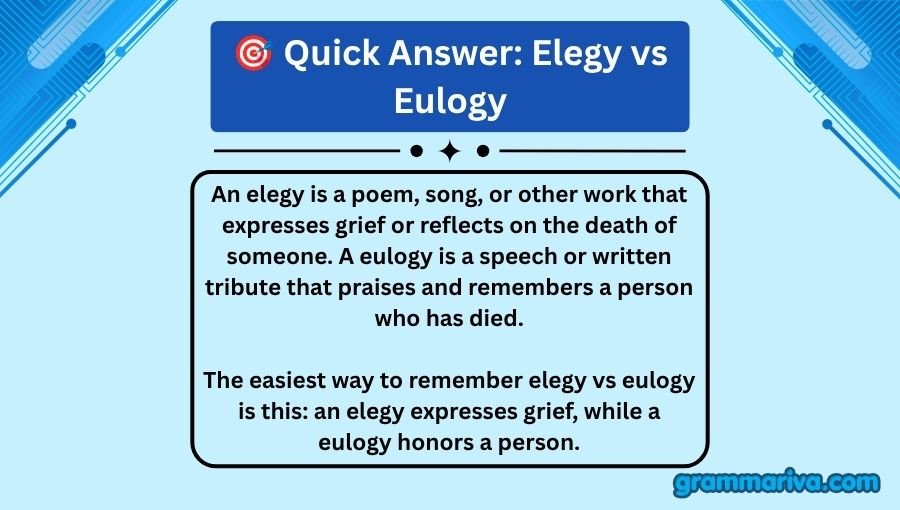
An elegy is a poem, song, or other work that expresses grief or reflects on the death of someone. A eulogy is a speech or written tribute that praises and remembers a person who has died.
The easiest way to remember elegy vs eulogy is this: an elegy expresses grief, while a eulogy honors a person.
| Word | Basic Meaning | Common Form | Typical Setting |
|---|---|---|---|
| Elegy | A work expressing grief or mourning | Poem, song, written piece | Literature or remembrance |
| Eulogy | A speech or tribute honoring someone who died | Speech or written tribute | Funeral or memorial |
📚 Understanding Elegy vs Eulogy
The core difference is simple. An elegy focuses on grief, loss, mourning, or reflection. A eulogy focuses on praise, memories, and honoring a person’s life.
An elegy does not have to be delivered at a funeral. It can be a literary work written after a death. It may also reflect on loss in a broader way.
A eulogy is usually connected to a specific person. It is often delivered by a family member, friend, coworker, religious leader, or another speaker at a funeral or memorial.
Elegy: A Work of Mourning
An elegy is usually a poem or other creative work about loss. It often has a sad or thoughtful tone.
Example:
The poet wrote an elegy after the death of his close friend.
Here, the word describes a creative work that expresses grief.
Eulogy: A Tribute to a Person
A eulogy is a speech or tribute that remembers and praises someone who has died.
Example:
Maria gave a touching eulogy at her father’s funeral.
The focus is on Maria’s spoken tribute and the life of her father.
Comparison at a Glance
| Form | Type | Meaning | Example | Correct/Incorrect |
|---|---|---|---|---|
| Elegy | Noun | A work expressing grief | The poet wrote an elegy for his friend. | ✅ Correct |
| Eulogy | Noun | A tribute praising a person who died | James delivered a eulogy at the funeral. | ✅ Correct |
| Elegy | Noun | A funeral speech | She gave an elegy at the funeral. | ❌ Usually incorrect |
| Eulogy | Noun | A mourning poem | He published a eulogy about his loss. | ❌ Usually incorrect |
| Elegy | Noun | A reflective work about loss | The song became an elegy for the lost generation. | ✅ Correct |
The words can overlap in theme, but their usual forms and purposes are different.
❓ Is an Elegy the Same as a Eulogy
No, an elegy and a eulogy are not the same. An elegy is generally a creative work that expresses sorrow or reflects on loss, while a eulogy is a spoken or written tribute that praises a person who has died.
Think about the main purpose.
- Elegy: grief, mourning, reflection
- Eulogy: praise, memories, tribute
An elegy may be written for a person, but it can also address a broader sense of loss. A eulogy normally centers on a particular person’s life.
A Simple Memory Trick 💡
I use this quick trick when teaching the difference:
Elegy = emotion about loss.
Eulogy = words of praise.
The trick is not a perfect dictionary definition. It is simply a memory aid. It helps you quickly decide which word fits your sentence.
✍️ What Is an Elegy and When Should You Use It
An elegy is a work that deals with grief, death, loss, or mourning. It is most often associated with poetry, but the term can also describe other creative works. Understanding elegy vs eulogy becomes easier when you focus on whether the text mainly expresses grief or honors someone’s life. Understanding elegy vs eulogy becomes easier when you focus on whether the writing expresses grief or honors a person’s life.
You might use elegy when talking about:
- A poem written after someone’s death
- A song that mourns a loss
- A literary work about death
- A creative reflection on grief
- A work that mourns a person, group, place, or lost period
Example 1
✅ Correct: The writer composed an elegy for her late brother.
❌ Incorrect: The writer composed a eulogy for her late brother.
The second sentence is not always impossible, because a written tribute can be called a eulogy in some contexts. But if you specifically mean a poem or literary work expressing grief, elegy is the better choice.
Example 2
✅ Correct: The poem is an elegy for a lost friend.
❌ Incorrect: The poem is a eulogy for a lost friend.
The first sentence clearly tells readers that the poem is a mourning work.
Meaning Summary
| Meaning | Word Type | Example Sentence |
|---|---|---|
| Work expressing grief | Noun | The poem is an elegy for his sister. |
| Literary work about loss | Noun | The novel reads like an elegy for a vanished town. |
| Song or creative work of mourning | Noun | The song became an elegy for those who died. |
💡 Test Tip
Ask yourself:
“Am I talking about a creative work that expresses grief or loss?”
If yes, elegy is probably the right word.
🕊️ What Is a Eulogy and When Should You Use It
A eulogy is a speech or tribute given to honor and remember someone who has died. It commonly includes memories, praise, stories, and statements about the person’s character or impact.
A eulogy can be spoken at:
- A funeral
- A memorial service
- A celebration of life
- A public remembrance
- A private gathering
It can also exist in written form.
Example 1
✅ Correct: Daniel delivered a eulogy for his grandfather.
❌ Incorrect: Daniel delivered an elegy for his grandfather.
If Daniel is giving a speech that praises and remembers his grandfather, eulogy is the natural word.
Example 2
✅ Correct: Her eulogy included several funny stories from college.
❌ Incorrect: Her elegy included several funny stories from college.
The first sentence sounds natural because a eulogy often combines sadness with warm memories.
Meaning Summary
| Meaning | Word Type | Example Sentence |
|---|---|---|
| Funeral tribute | Noun | She gave a eulogy at the memorial. |
| Speech honoring the dead | Noun | His eulogy focused on his kindness. |
| Written tribute | Noun | The newspaper published a eulogy for the respected leader. |
❓ Why Do People Confuse Elegy and Eulogy
People confuse these words because both relate to death, grief, remembrance, and honoring the dead. They can also appear in the same conversation or event.
For example, a person might write an elegy about someone and later hear a eulogy about that same person. The subject is similar, but the form and purpose are different.
I once reviewed a student’s essay where she called a poem a “eulogy.” The poem clearly focused on grief and loss. We changed the word to elegy, and the meaning became much clearer.
The Main Source of Confusion
The confusion often comes from thinking:
“Both words are about someone who died, so they must mean the same thing.”
That is not quite right.
A better approach is to ask what the work is doing.
| Question | Best Choice |
|---|---|
| Is it a poem about grief? | Elegy |
| Is it a funeral speech? | Eulogy |
| Does it mourn a loss? | Elegy |
| Does it praise a person’s life? | Eulogy |
| Is it a creative work about loss? | Elegy |
| Is it a tribute spoken at a memorial? | Eulogy |
📝 Case Study: Choosing the Right Word
Imagine that a community leader named Robert has died.
A local newspaper publishes a thoughtful poem about the sadness of losing him. That poem can be described as an elegy.
At his memorial service, Robert’s daughter gives a ten-minute speech. She talks about his kindness, his work, and funny family memories. That speech is a eulogy.
Both pieces honor Robert. But they do different jobs.
| Situation | Correct Term | Why |
|---|---|---|
| A poem mourning Robert | Elegy | It is a creative work expressing loss |
| A daughter’s funeral speech | Eulogy | It honors and praises Robert |
| A song reflecting on Robert’s death | Elegy | It expresses grief through art |
| A written tribute read at the memorial | Eulogy | It directly honors his life |
| A collection of poems about grief | Elegies | The works focus on mourning |
This is a useful way to understand elegy vs eulogy in real life.
📖 Grammar Rules Explanation
Both elegy and eulogy are nouns. The main issue is not grammar in the narrow sense. It is choosing the noun that matches the meaning and context.
Use elegy when you mean a work that expresses grief or reflects on loss.
Use eulogy when you mean a speech or tribute that honors a person who has died.
The words can sometimes overlap in broader use. A written tribute can have qualities of both. Still, standard English usage keeps a useful distinction between a mourning work and a tribute of praise.
Correct vs Incorrect at a Glance
| Sentence | Correct/Incorrect | Why |
|---|---|---|
| She wrote an elegy after her mother’s death. | ✅ Correct | The work expresses grief. |
| He delivered a eulogy at the funeral. | ✅ Correct | He gave a tribute speech. |
| She delivered an elegy at the funeral. | ❌ Usually incorrect | The context calls for a eulogy if it is a tribute speech. |
| The poet published an elegy about loss. | ✅ Correct | It is a creative work about grief. |
| His eulogy praised his father’s kindness. | ✅ Correct | A eulogy often praises and remembers the person. |
A good writer looks at the purpose and form of the work rather than simply looking at the subject.
⚠️ Common Mistakes With Elegy and Eulogy
The biggest mistake is treating the two words as perfect synonyms. Learning elegy vs eulogy can help writers avoid choosing the wrong word in sensitive conversations about death and remembrance.
They are related, but they have different common uses.
Why These Mistakes Happen
Three common causes are:
- Fast typing: People choose the first similar word that comes to mind.
- Autocorrect: Spell-check tools do not always understand context.
- Lack of knowledge: Writers may know both words but not know the distinction.
I once caught myself typing “eulogy” when I meant a poem of mourning. I stopped and asked one simple question: “Is this a speech honoring someone, or a creative work expressing grief?” That fixed the choice immediately.
Similar Word Confusions
| Confusing Pair | Correct Difference |
|---|---|
| It’s / Its | “It’s” means “it is”; “its” shows possession |
| Your / You’re | “Your” shows possession; “you’re” means “you are” |
| Affect / Effect | “Affect” is usually a verb; “effect” is usually a noun |
| Then / Than | “Then” relates to time; “than” is used for comparison |
| Their / There / They’re | Possession, place, and “they are” |
These pairs show why context matters. Similar-looking words can have very different jobs.
Specific Wrong Forms and Uses
| Wrong Form or Use | What’s Wrong | Correct Form |
|---|---|---|
| A funeral poem called a eulogy | The intended meaning is a mourning poem | Elegy |
| A tribute speech called an elegy | The intended meaning is a tribute | Eulogy |
| Eulagy | Incorrect spelling | Eulogy |
| Elegy speech | May confuse a speech with a literary form | Eulogy, if it is a tribute speech |
| Elegie | Incorrect English spelling | Elegy |
| Eulogy poem | Too broad or unclear if the poem mainly mourns a loss | Elegy |
🕰️ Word History and Meaning Development
The histories of these words help explain why they look and sound somewhat alike, but you do not need to memorize their origins to use them correctly.
Both terms have long been connected with mourning and remembrance in English. Their modern uses developed around different kinds of expression.
An elegy became strongly associated with literary mourning and reflection. A eulogy became closely associated with praise and tribute, especially in connection with someone’s death.
The important point for modern writers is not the exact historical path. It is the difference that remains in everyday English.
| Period | General Development | Main Idea |
|---|---|---|
| Earlier literary use | Mourning works developed as a form of expression | Grief and reflection |
| Later English use | The terms became more clearly associated with different forms | Mourning vs. tribute |
| Modern use | Both remain common in writing and speech | Elegy for mourning work; eulogy for tribute |
| Present-day use | The terms may overlap in broad discussions of remembrance | Context decides the best word |
🌎 Usage in Different Contexts
The right choice can become easier when you consider where the word appears.
Everyday Conversation
Use eulogy when talking about a speech given to honor someone who died.
“Her brother gave a beautiful eulogy.”
Use elegy when discussing a poem, song, or artistic work about loss.
“The song feels like an elegy for his childhood.”
Professional Writing
In journalism, education, and formal writing, context matters. A report about a funeral may mention a eulogy. A literary analysis may discuss an elegy.
Creative Writing
Writers often use elegy when describing a poem, story, song, or artistic work that mourns something lost.
Social Media and Texting
People may use both words loosely online. Still, accurate writing follows the same basic distinction.
| Context | Which Term to Use | Example |
|---|---|---|
| Everyday conversation | Eulogy for a tribute speech | “His eulogy was very moving.” |
| Professional writing | Depends on the form | “The article discusses the poet’s elegy.” |
| Creative writing | Elegy for a mourning work | “She wrote an elegy for the old neighborhood.” |
| Social media/texting | Depends on meaning | “Her eulogy honored his life.” |
💬 Common Phrases With Elegy and Eulogy
Neither word has a huge collection of fixed idioms. However, several natural combinations appear often.
| Phrase | Meaning |
|---|---|
| Write an elegy | Create a mourning or reflective work |
| Compose an elegy | Create an elegy, often a poem |
| An elegy for someone | A mourning work about a person |
| Give a eulogy | Deliver a tribute speech |
| Deliver a eulogy | Present a funeral or memorial tribute |
| A moving eulogy | A touching tribute honoring someone |
These phrases can help you recognize the natural use of each word.
🔄 Synonyms and Alternatives
Sometimes you do not need either word. A simpler phrase may communicate your meaning more clearly.
For example, instead of eulogy, you can often say tribute speech. Instead of elegy, you can say poem about grief if you are speaking to a general audience.
| Alternative | Works When | Does Not Work When |
|---|---|---|
| Tribute | You mean an act of honoring someone | You specifically mean a mourning poem |
| Tribute speech | You mean a spoken eulogy | You mean a literary elegy |
| Memorial poem | You mean a poem remembering someone | You need the traditional literary term |
| Mourning poem | You want a simple description of an elegy | You mean a funeral speech |
| Remembrance speech | You mean a speech honoring someone | You are discussing a creative poem |
Using a simpler phrase can be helpful when your audience may not know the difference between the two terms.
❓ How Can You Remember the Difference Between Elegy and Eulogy
Use the first sound of the words as a memory clue.
Elegy → emotion and expression of loss.
Eulogy → words of praise.
Another easy trick is to picture two scenes.
Picture a poet sitting alone and writing about someone who has died. Think elegy.
Now picture a person standing at a funeral and talking about the wonderful life of the person who died. Think eulogy.
The images make the difference easier to remember.
| If You Picture… | Think… |
|---|---|
| A poet writing about grief | Elegy |
| A poem about someone who died | Elegy |
| A person speaking at a funeral | Eulogy |
| A speech praising someone’s life | Eulogy |
| A song mourning a loss | Elegy |
❓ Can an Elegy Be Written for Someone Who Is Still Alive
Usually, an elegy is connected with death or serious loss, but the idea of an elegy can be broader than a literal funeral tribute. A creative work may use the form to mourn something that has disappeared or is being lost.
For example:
The novel is an elegy for a disappearing way of life.
Here, nobody needs to have died. The word highlights deep loss and reflection.
This broader use is especially common in creative and literary writing.
❓ Can a Eulogy Be Written Instead of Spoken
Yes. A eulogy can exist as a written tribute even if it is not delivered aloud.
For example, a newspaper may publish a tribute to a respected person who died. A family may also prepare a written eulogy for a memorial service.
The key idea is that the piece honors and remembers the person.
❓ Is a Funeral Poem an Elegy or a Eulogy
A funeral poem is usually an elegy if its main purpose is to express grief or reflect on loss.
If the piece is a speech that praises and remembers the person, it is a eulogy.
The format matters, but the purpose matters too.
❓ Which Word Is Better for a Funeral Speech
Eulogy is the better word for a funeral speech that honors the person who died.
For example:
“I was asked to give the eulogy at my uncle’s funeral.”
That sentence clearly identifies a tribute speech.
❓ Can a Song Be an Elegy
Yes. A song can be described as an elegy when it mourns a death or reflects deeply on loss.
For example:
“The song became an elegy for the singer’s late friend.”
This use focuses on the song’s emotional and creative role.
❓ Can a Eulogy Be Sad
Yes. A eulogy can be very sad. It can include grief, tears, and painful memories.
However, its main purpose is usually to honor and remember the person. A eulogy may also contain humor, warmth, gratitude, and personal stories.
❓ What Is the Plural of Elegy
The plural of elegy is elegies.
For example:
The poet wrote several elegies during his career.
The spelling changes from -y to -ies.
❓ What Is the Plural of Eulogy
The plural of eulogy is eulogies.
For example:
The collection contains several eulogies honoring community leaders.
Both words follow the same common plural spelling pattern.
| Singular | Plural | Example |
|---|---|---|
| Elegy | Elegies | The book contains several elegies. |
| Eulogy | Eulogies | The archive contains old eulogies. |
❓ What Is the Difference Between Elegy and Eulogy in Literature
In literature, an elegy is generally a creative work that expresses grief or reflects on death and loss. A eulogy is more directly a tribute that praises a person who has died.
Literary discussions often use elegy because it describes a recognized kind of mourning expression.
⭐ Why Getting Elegy and Eulogy Right Matters
Choosing the correct word improves clarity. It tells readers whether you mean a mourning work or a tribute.
This matters even more in sensitive subjects involving death and grief. A word choice that seems small can change how your sentence feels.
Clear words help people understand not only what you mean, but also what you feel.
| Situation | Why Getting It Right Matters |
|---|---|
| Resume or professional writing | Shows careful word choice |
| Client email | Prevents confusion in sensitive communication |
| Published content | Makes the writing more accurate |
| Social post | Helps readers understand the intended meaning |
Good writing is not about using the biggest words. It is about choosing the right word.
❓ How Do You Choose Between Elegy and Eulogy
Start by asking what you are describing.
If it is a poem, song, or creative work that expresses grief, choose elegy.
If it is a speech or tribute honoring someone who died, choose eulogy.
If you are still unsure, rewrite the sentence using a simple phrase such as “mourning poem” or “tribute speech.” Then see which meaning fits.
| Question | If Yes → Use |
|---|---|
| Is it a mourning poem? | Elegy |
| Is it a creative work about loss? | Elegy |
| Is it a funeral speech? | Eulogy |
| Does it praise someone’s life? | Eulogy |
| Does it mainly express grief? | Elegy |
| Is it a memorial tribute? | Eulogy |
🧠 Practice Examples
1. The poet wrote a moving ______ for his late friend.
Answer: elegy
2. Sarah gave a heartfelt ______ at her mother’s funeral.
Answer: eulogy
3. The song serves as an ______ for a lost generation.
Answer: elegy
These examples show the main rule in action.
🔍 Elegy vs Eulogy: A Final Comparison
Here is the shortest complete comparison to keep in mind.
| Feature | Elegy | Eulogy |
|---|---|---|
| Main idea | Grief and loss | Praise and remembrance |
| Common form | Poem or creative work | Speech or written tribute |
| Usually connected to death | Yes | Yes |
| Often literary | Yes | Sometimes |
| Common at funerals | Possible | Very common |
| Main focus | Mourning | Honoring |
| Example | “She wrote an elegy.” | “He gave a eulogy.” |
The words are related, but they are not interchangeable in every sentence.
🔥 Quick Recap Checklist
Remember these six points:
- Elegy usually expresses grief or reflects on loss.
- Eulogy usually honors and praises someone who has died.
- A poem about mourning is often an elegy.
- A funeral tribute speech is usually a eulogy.
- Both words can appear in discussions about death.
- Context determines the best choice.
If you remember grief = elegy and praise = eulogy, you will usually make the right choice.
FAQs About Elegy vs Eulogy
What is the main difference between an elegy and a eulogy?
An elegy is generally a poem or creative work that expresses grief or reflects on loss. A eulogy is generally a speech or tribute that honors and praises a person who has died.
Is a eulogy always given at a funeral?
No. A eulogy is commonly given at a funeral, but it can also be delivered at a memorial service, celebration of life, or another remembrance event.
Is an elegy always a poem?
No. An elegy is most often associated with poetry, but the term can also describe other creative works that mourn or reflect on loss.
Can an elegy be about something other than a person?
Yes. An elegy can mourn the loss of a place, time, way of life, or other valued thing. The central idea is grief or reflection over loss.
Can a written tribute be called a eulogy?
Yes. A eulogy does not have to be spoken. A written tribute that honors someone who has died can also be called a eulogy.
Which word should I use for a funeral speech?
Use eulogy when you mean a speech that honors and remembers the person who died.
Which word should I use for a poem about death?
Use elegy when the poem mainly expresses grief, mourning, or reflection on death and loss.
What is the plural of elegy?
The plural is elegies. For example: “The poet wrote several elegies.”
What is the plural of eulogy?
The plural is eulogies. For example: “The book contains several eulogies.”
Are elegy and eulogy synonyms?
They are related words, but they are not exact synonyms. An elegy usually centers on grief or mourning, while a eulogy usually centers on praise and remembrance.
🌟 Conclusion: Elegy vs Eulogy Made Simple
Elegy vs eulogy becomes much easier when you focus on purpose. An elegy is usually a creative work that expresses grief, mourning, or reflection on loss. A eulogy is usually a speech or written tribute that honors and praises someone who has died.
When I am unsure which word to choose, I ask one simple question: “Am I describing grief, or am I describing praise?” If the answer is grief, elegy is usually the better choice. If the answer is praise and remembrance, eulogy is usually right.
These words often appear around the same serious moments, so confusion is understandable. The good news is that the distinction is easy once you connect each word with its main purpose. 🕊️
Keep this rule in mind: an elegy mourns, while a eulogy honors. Remember that line, and you will be able to choose the right word with confidence. ✨

Hi, I’m Madison Hayes. I’m an English learning writer at Grammariva, where I work on simple lessons and examples for people who want to improve their grammar and writing. I love turning confusing rules into easy-to-follow explanations.


[…] you real examples, cover common mistakes, and give you quick tests you can use when you are unsure. Elegy vs Eulogy | Gases or Gasses | Take It or Leave […]
[…] quick tests. By the end, choosing between these phrases should feel easy. 😊 Pajamas vs Pyjamas | Elegy vs Eulogy | Gases or […]