Have you ever seen the words prescribe vs proscribe and wondered why two words that look and sound so close have almost opposite meanings? You are not alone. These words confuse even strong writers because both begin with “proscr” or “prescr,” and both are often used in formal writing. ✍️
The key is simple: prescribe usually means to recommend, order, or officially give something. A doctor can prescribe medicine. A teacher can prescribe a certain method. Proscribe means to forbid or officially ban something.
That one difference can completely change a sentence. If a doctor prescribes a medicine, the doctor tells you to take it. If an authority proscribes an activity, the authority says you must not do it.
I have seen this mix-up in workplace writing, school assignments, and even edited articles. The good news is that you only need a few clear rules to master these words. 😊 Whole Day or All Day | Pajamas vs Pyjamas | Elegy vs Eulogy
🎯 Quick Answer: Prescribe vs Proscribe
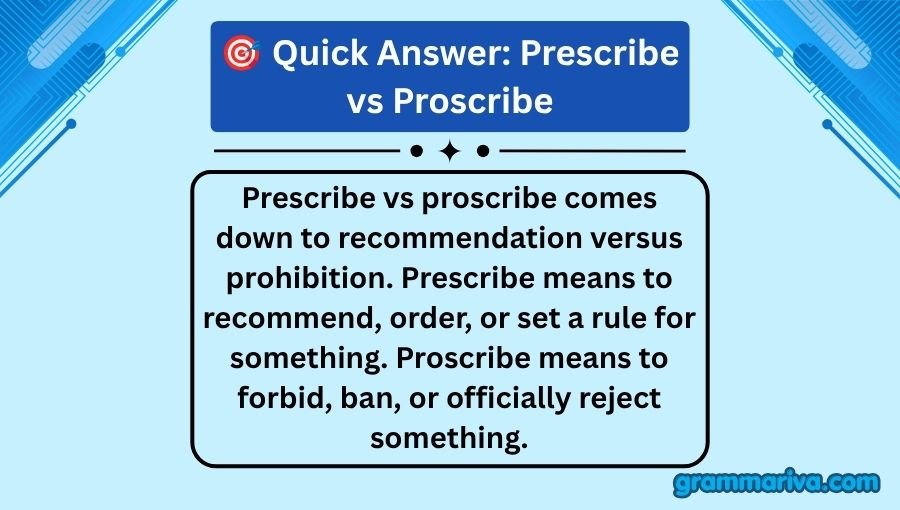
Prescribe vs proscribe comes down to recommendation versus prohibition. Prescribe means to recommend, order, or set a rule for something. Proscribe means to forbid, ban, or officially reject something.
| Word | Basic Meaning | Simple Example | Main Idea |
|---|---|---|---|
| Prescribe | Recommend or order | The doctor prescribed antibiotics. | Do this |
| Proscribe | Forbid or ban | The law proscribes the practice. | Do not do this |
A quick memory trick is:
Prescribe = provide a rule, treatment, or direction.
Proscribe = prohibit something.
Is Prescribe the Opposite of Proscribe?
Yes, in many situations, the two words point in opposite directions. Prescribe tells someone what should be done, while proscribe tells someone what must not be done.
The difference becomes clearer when you put both words into simple sentences.
- A doctor prescribes medicine.
- A government may proscribe an illegal activity.
- A teacher may prescribe a reading plan.
- A rule may proscribe certain behavior.
The important point is that the words are not interchangeable.
Prescribe: Tell Someone What to Do
Prescribe is a verb. It can mean to recommend or order something, especially as a treatment or course of action.
For example:
The doctor prescribed a new medication.
Here, the doctor ordered the medication as part of the patient’s treatment.
The word can also be used outside medicine:
The coach prescribed a strict training schedule.
The coach did not necessarily write a medical prescription. Instead, the coach recommended or required a specific plan.
Proscribe: Tell Someone What Not to Do
Proscribe is also a verb. It means to forbid, ban, or officially reject something.
For example:
The organization proscribes discrimination.
The organization does not recommend discrimination. It forbids it.
The word often appears in formal contexts involving laws, rules, policies, or official standards.
| Word | What It Does | Direction | Example |
|---|---|---|---|
| Prescribe | Recommends or orders | Toward an action | The doctor prescribed rest. |
| Proscribe | Forbids or bans | Away from an action | The policy proscribes discrimination. |
💡 What Does Prescribe Mean?
Prescribe means to recommend, order, or officially set something as a rule or course of action. It is especially common when talking about medical treatment, but it can also describe rules and required methods.
The most familiar use is medical.
The doctor prescribed pain medication.
The structure is simple:
- The doctor = subject
- prescribed = verb
- pain medication = object
The doctor gave an official instruction about treatment.
But medical use is not the only use.
Prescribe in Medicine
Doctors, dentists, and other qualified health professionals may prescribe medicines or treatments.
Examples:
✅ The doctor prescribed antibiotics for the infection.
❌ The doctor proscribed antibiotics for the infection.
The first sentence means the doctor ordered or recommended antibiotics. The second would suggest that the doctor banned antibiotics, which is a very different idea.
Prescribe as a Rule
The word can also mean to set a rule or requirement.
The school prescribes a specific dress code.
This means the school sets or requires that dress code.
Another example:
The instructions prescribe a waiting period before use.
Here, the instructions establish what should happen.
Summary of Common Meanings
| Meaning | Word Type | Example Sentence |
|---|---|---|
| Order medical treatment | Verb | The doctor prescribed medication. |
| Recommend an action | Verb | The adviser prescribed a simple plan. |
| Set a rule or standard | Verb | The policy prescribes certain procedures. |
💡 Test Tip
Ask yourself:
“Is someone telling me what to do?”
If yes, prescribe may be the right word.
⚠️ What Does Proscribe Mean?
Proscribe means to forbid, ban, or officially declare something unacceptable. It is commonly used when discussing laws, rules, policies, organizations, or prohibited behavior.
For example:
The law proscribes the use of certain materials.
This means the law forbids their use.
Another example is:
The company proscribes harassment in the workplace.
The company policy says that harassment is not allowed.
Proscribe in Rules and Laws
The word often appears in formal language.
The regulation proscribes unsafe practices.
The regulation does not tell workers to perform unsafe practices. It prohibits them.
Proscribe in General Writing
You may also see the word in essays, reports, and academic writing.
The policy proscribes discrimination based on personal characteristics.
The meaning is simply that the policy bans or forbids discrimination.
| Use of Proscribe | Meaning | Example |
|---|---|---|
| Law | Forbid | The law proscribes the conduct. |
| Policy | Ban | The policy proscribes harassment. |
| Rules | Prohibit | The rules proscribe certain actions. |
| Formal writing | Declare unacceptable | The organization proscribes the practice. |
📝 Prescribe vs Proscribe at a Glance
The easiest way to understand prescribe vs proscribe is to compare their direction.
| Form | Type | Meaning | Example | Correct/Incorrect |
|---|---|---|---|---|
| Prescribe | Verb | Recommend or order | The doctor prescribed medicine. | ✅ Correct |
| Proscribe | Verb | Forbid or ban | The law proscribes the activity. | ✅ Correct |
| Prescribe | Verb | Forbid | The law prescribes the activity. | ❌ Usually incorrect |
| Proscribe | Verb | Recommend | The doctor proscribed medicine. | ❌ Incorrect for this meaning |
The words can look almost like twins, but their jobs are very different.
Think of a doctor and a law.
Doctor → prescribe → treatment
Law → proscribe → forbidden behavior
That simple pairing can help you choose the right word quickly.
Why Do People Confuse Prescribe and Proscribe?
People confuse these words because they look similar, sound similar, and both appear in formal contexts. Their spellings differ by only a few letters, but their meanings are very different.
There is another reason. People often know that prescription relates to medicine. They may then assume that proscription is simply another form of the same word.
It is not.
I once edited a short business report in which the writer used “proscribe” when the intended meaning was “recommend.” The sentence sounded formal, so the mistake was easy to miss at first. Once I checked the meaning, the problem was obvious.
The Most Common Sources of Confusion
| Reason | How It Causes Errors |
|---|---|
| Similar spelling | The words look almost alike. |
| Similar sound | Fast speech can hide the difference. |
| Formal usage | Both appear in serious writing. |
| Limited exposure | Readers may rarely see “proscribe.” |
| Context guessing | Writers may choose by appearance instead of meaning. |
The best solution is not to memorize the spelling alone. Memorize the meaning and direction.
How Can You Remember the Difference?
A short memory trick can make the difference much easier. When learning prescribe vs proscribe, it helps to focus on what the speaker wants someone to do. One word gives direction, while the other sets a restriction.
Remember “Prescribe” With “Prescription”
Think of a prescription from a doctor.
Prescribe → prescription → treatment
When someone prescribes something, they tell you what to do, take, follow, or use.
Remember “Proscribe” With “Prohibit”
Think:
Proscribe → prohibit
Both mean that something is forbidden.
| Word | Memory Link | Meaning |
|---|---|---|
| Prescribe | Prescription | Recommend or order |
| Proscribe | Prohibit | Forbid or ban |
Another useful trick is to ask:
Is the sentence moving toward an action or away from it?
- Toward an action → prescribe
- Away from an action → proscribe
This is not a perfect rule for every advanced use, but it works very well for everyday writing.
📚 Correct Meanings and Uses
Both words have several related uses, but the core difference stays the same.
Prescribe for Medical Treatment
This is the use most people know.
The physician prescribed a lower dose.
The physician gave a treatment instruction.
Prescribe for Recommended Action
The word can describe a recommended course of action.
The trainer prescribed daily stretching.
The trainer told the person to follow that routine.
Prescribe for Rules
A document can prescribe a required procedure.
The manual prescribes a three-step process.
The manual establishes what should be done.
Proscribe for Prohibited Conduct
The policy proscribes abusive behavior.
The policy forbids the behavior.
Proscribe for Official Bans
The government proscribed the organization.
In a formal context, this can mean that the organization was officially banned or condemned.
| Word | Use | Example |
|---|---|---|
| Prescribe | Medical treatment | The doctor prescribed rest. |
| Prescribe | Recommended action | The coach prescribed daily practice. |
| Prescribe | Required procedure | The manual prescribes a safety check. |
| Proscribe | Forbidden behavior | The rules proscribe cheating. |
| Proscribe | Official ban | The authority proscribed the group. |
🧪 How Do You Use Prescribe in a Sentence?
Use prescribe when a person, authority, system, or document tells someone what should be done.
Common sentence patterns include:
Subject + prescribe + object
Example:
The doctor prescribed medication.
You can also see:
Subject + prescribe + a course of action
Example:
The guide prescribed a careful approach.
And:
Subject + prescribe + requirements
Example:
The regulations prescribe specific safety measures.
Correct and Incorrect Examples
✅ The doctor prescribed antibiotics.
❌ The doctor proscribed antibiotics.
✅ The rules prescribe a waiting period.
❌ The rules proscribe a waiting period.
The incorrect examples change the intended meaning because proscribe means to forbid rather than recommend or require.
🚫 How Do You Use Proscribe in a Sentence?
Use proscribe when the sentence means forbid, ban, or prohibit.
Common sentence patterns include:
Subject + proscribe + object
Example:
The law proscribes the activity.
Another example:
The organization proscribes discriminatory conduct.
The object after proscribe is the thing that is forbidden.
Correct and Incorrect Examples
✅ The policy proscribes harassment.
❌ The policy prescribes harassment.
✅ The law proscribes the practice.
❌ The law prescribes the practice.
The exact meaning depends on context, but the basic distinction stays stable.
🧑💼 Case Study: A Workplace Policy
Imagine a company is writing a workplace handbook.
The handbook says:
“Company policy proscribes harassment and threats in the workplace.”
That is correct because the policy forbids those behaviors.
The same handbook might say:
“Company policy prescribes annual safety training for all employees.”
That is also correct. The policy requires employees to complete the training.
Notice how both words can appear in the same document.
One tells employees what is required.
The other tells employees what is forbidden.
| Workplace Statement | Correct Word | Reason |
|---|---|---|
| The policy requires annual training. | Prescribe | It establishes an action. |
| The policy bans harassment. | Proscribe | It forbids an action. |
| The manual sets safety steps. | Prescribe | It establishes a procedure. |
| The rules ban threats. | Proscribe | They forbid behavior. |
This is a useful real-world example because professional documents often contain both kinds of instructions.
📖 Grammar Rules Explanation
The grammar itself is not complicated. Both prescribe and proscribe are verbs. The main issue is choosing the verb that matches the intended meaning.
Use prescribe when the subject recommends, orders, or establishes something.
Use proscribe when the subject forbids or bans something.
Most standard dictionaries and grammar references make this same basic distinction. The safest approach is to check the meaning of the sentence before choosing the word.
Do not choose based only on how formal or familiar a word looks.
Correct vs Incorrect at a Glance
| Sentence | Correct/Incorrect | Why |
|---|---|---|
| The doctor prescribed a new treatment. | ✅ Correct | The doctor ordered the treatment. |
| The law proscribes the activity. | ✅ Correct | The law forbids the activity. |
| The doctor proscribed a new treatment. | ❌ Incorrect | It would suggest the doctor banned it. |
| The policy prescribes harassment. | ❌ Incorrect | “Prescribes” means recommends or requires here. |
| The manual prescribes safety checks. | ✅ Correct | The manual establishes what should be done. |
The important lesson is simple:
Prescribe gives direction. Proscribe gives prohibition.
⚠️ Common Mistakes With These Words
The most common mistake is using proscribe when the writer means prescribe.
Another mistake is assuming that the “pro-” beginning makes proscribe sound like a stronger form of prescribe. It does not.
I once caught myself typing “proscribed” in a sentence where I meant “prescribed.” I had written the sentence quickly and was focused on the overall paragraph. A quick reread caught the mistake.
Fast writing creates these errors because the eye often recognizes the general shape of a word before the brain checks its exact meaning.
Similar Grammar Confusions
| Confusion | Correct Meaning |
|---|---|
| It’s / its | “It’s” = it is; “its” = possession |
| Your / you’re | “Your” = possession; “you’re” = you are |
| Affect / effect | Usually verb vs. noun, depending on context |
| Then / than | “Then” = time; “than” = comparison |
| Accept / except | “Accept” = receive; “except” = exclude |
Specific Wrong Uses
| Wrong Form or Use | What’s Wrong | Correct Form |
|---|---|---|
| The doctor proscribed medicine. | Wrong meaning if medicine was ordered. | The doctor prescribed medicine. |
| The law prescribed the banned activity. | Wrong meaning if the law forbids it. | The law proscribed the activity. |
| She proscribed a treatment plan. | “Proscribe” does not mean recommend. | She prescribed a treatment plan. |
| The rules prescribed cheating. | This says the rules required cheating. | The rules proscribed cheating. |
| The doctor prescribed the medication was dangerous. | Incorrect sentence structure. | The doctor prescribed the medication. |
| The policy proscribed new safety steps. | Wrong if the policy requires them. | The policy prescribed new safety steps. |
🧠 Prescribe vs Proscribe in Different Contexts
The context often gives you a strong clue. The meaning of prescribe vs proscribe can become even clearer when you look at the setting. The same basic rule works in everyday, professional, creative, and digital writing.
In everyday conversation, prescribe is more common because people often discuss medical treatment.
In professional writing, both words may appear. Prescribe can describe requirements, while proscribe can describe bans.
Creative writing can use either word when the context supports it.
Social media tends to favor simpler words such as “recommend” and “ban.”
| Context | Which Term to Use | Example |
|---|---|---|
| Everyday conversation | Prescribe | My doctor prescribed rest. |
| Professional writing | Either | The policy prescribes training. |
| Professional writing | Proscribe | The policy proscribes harassment. |
| Creative writing | Either | The king proscribed the practice. |
| Social media/texting | Usually simpler alternatives | The rule bans the behavior. |
💬 Common Phrases With Prescribe and Proscribe
Neither word has many casual idioms, but both appear in useful formal phrases.
| Phrase | Meaning |
|---|---|
| Prescribe medication | Order medicine as treatment |
| Prescribe treatment | Order or recommend treatment |
| Prescribe a course of action | Recommend a specific action |
| Prescribe rules | Establish requirements |
| Proscribe conduct | Forbid behavior |
| Proscribe an activity | Ban an activity |
These phrases can help you recognize the words when reading.
If you see prescribe treatment, think recommend or order.
If you see proscribe conduct, think forbid.
🔄 Synonyms and Alternatives
Understanding prescribe vs proscribe also helps you choose simpler alternatives when a formal word is not needed. Words such as “recommend,” “require,” “ban,” and “prohibit” can often make your meaning clearer. Sometimes a simpler word is better.
For prescribe, alternatives include:
- recommend
- order
- require
- establish
- advise
For proscribe, alternatives include:
- prohibit
- ban
- forbid
- outlaw
- disallow
The best choice depends on the sentence.
| Alternative | Works When | Does Not Work When |
|---|---|---|
| Recommend | Something is suggested | A strict ban is meant |
| Order | Someone has authority to direct action | You only mean a casual suggestion |
| Require | Something is mandatory | Something is merely suggested |
| Prohibit | Something is formally forbidden | Something is being recommended |
| Ban | Something is not allowed | The meaning is simply “recommend” |
Using a simpler synonym can sometimes make your writing clearer.
For example:
The policy prohibits smoking.
That may be easier for a general audience than:
The policy proscribes smoking.
Both can communicate the idea of a ban, but the first is more familiar.
🌎 Why Prescribe vs Proscribe Matters
Knowing the difference improves clarity. These words can change the meaning of an entire sentence. A clear understanding of prescribe vs proscribe is especially useful in professional writing because these words can point readers toward completely different actions.
Imagine reading:
“The safety guide prescribes the use of protective equipment.”
That means the guide requires or recommends protective equipment.
Now change one word:
“The safety guide proscribes the use of protective equipment.”
That means the guide forbids protective equipment.
Those sentences send opposite messages.
Clear word choice matters in:
- medical communication
- workplace policies
- legal writing
- academic papers
- published articles
- instructions
- professional emails
A short sentence can carry a serious message. One wrong word can make that message unclear.
“Good word choice makes the intended action hard to misunderstand.”
| Situation | Why Getting It Right Matters |
|---|---|
| Resume | Shows careful writing skills |
| Client email | Prevents confusion |
| Published content | Protects accuracy and credibility |
| Workplace policy | Makes rules clear |
| Medical writing | Prevents serious misunderstandings |
Is Proscribe a Formal Word?
Yes. Proscribe is generally more formal than everyday alternatives such as “ban” or “forbid.”
You are more likely to see it in:
- legal writing
- policy documents
- academic writing
- formal reports
- government-related writing
- serious commentary
That does not make it better in every sentence.
If your readers may not know the word, prohibit or ban may be clearer.
For example:
The school prohibits bullying.
This is very direct.
The school proscribes bullying.
This is formal and correct, but less common in everyday speech.
Is Prescribe Only Used for Medicine?
No. This is one of the most useful facts to remember.
Prescribe is strongly associated with medicine, but it can also mean to establish or require a particular course of action.
For example:
The regulations prescribe strict safety procedures.
No medicine is involved.
The regulations establish what people must do.
| Sentence | Meaning |
|---|---|
| The doctor prescribed medicine. | The doctor ordered treatment. |
| The therapist prescribed rest. | The therapist recommended rest. |
| The rules prescribe a process. | The rules establish the process. |
| The manual prescribes safety steps. | The manual requires or sets those steps. |
So do not limit prescribe to doctors and prescriptions.
Can Both Words Be Used in the Same Sentence?
Yes. In fact, using them together can make their difference very clear.
The policy prescribes safety training and proscribes dangerous conduct.
This means the policy requires safety training while banning dangerous conduct.
Another example:
The code prescribes proper procedures and proscribes misuse of company property.
The first action is required. The second is forbidden.
| Prescribe | Proscribe |
|---|---|
| Tells what should happen | Tells what must not happen |
| Sets a requirement | Sets a prohibition |
| Recommends an action | Bans an action |
| Gives direction | Blocks an action |
This contrast is one of the best ways to remember the pair.
✏️ Practice Examples
Try choosing the correct word before reading the answer. These practice sentences put prescribe vs proscribe into real situations, so you can test whether you understand the difference instead of simply memorizing the definitions.
Example 1
The doctor ______ a course of physical therapy.
Answer: prescribed
Why? The doctor recommended or ordered the treatment.
Example 2
The company policy ______ harassment.
Answer: proscribes
Why? The policy forbids harassment.
Example 3
The manual ______ several steps for safe operation.
Answer: prescribes
Why? The manual establishes the steps.
| Practice Sentence | Answer | Reason |
|---|---|---|
| The doctor ___ medication. | Prescribed | Treatment was ordered. |
| The law ___ the activity. | Proscribes | The activity is forbidden. |
| The guide ___ a procedure. | Prescribes | The procedure is established. |
❓ Is Prescribe the Same as Recommend?
Not always, but the meanings can overlap. Prescribe can mean to recommend something, especially when the recommendation comes from someone with authority.
For example:
The doctor prescribed more rest.
This is stronger and more official than a casual friend saying:
I recommend more rest.
The exact strength depends on the context.
❓ Is Proscribe the Same as Prohibit?
Yes, they are very close in meaning. Proscribe generally means to forbid, ban, or declare something unacceptable.
However, prohibit is much more common in everyday English.
For general readers, “prohibit” may be the clearer choice.
❓ Can You Prescribe a Rule?
Yes. Prescribe can mean to establish or set a rule, procedure, or requirement.
For example:
The regulations prescribe a specific safety procedure.
This means the regulations establish what should be done.
❓ Can You Proscribe a Person?
In formal or historical contexts, proscribe can be used in connection with officially banning or condemning a person or group. However, this use is much less common in ordinary modern conversation.
For most everyday situations, “ban,” “exclude,” or another more specific verb may be clearer.
❓ What Is the Difference Between Prescribe and Proscribe?
Prescribe means to recommend, order, or establish something. Proscribe means to forbid or ban something.
A simple memory rule is:
Prescribe = do this.
Proscribe = do not do this.
❓ How Do You Remember Prescribe vs Proscribe?
Connect prescribe with prescription and proscribe with prohibit.
A prescription tells you what treatment to take.
A prohibition tells you what you cannot do.
This gives you two easy memory links:
Prescribe → prescription → treatment
Proscribe → prohibit → ban
❓ Is Prescribe More Common Than Proscribe?
In ordinary English, prescribe is usually more familiar because of its common medical use. Proscribe is more formal and often appears in discussions of rules, laws, policies, or prohibited conduct.
❓ Can a Policy Prescribe Something?
Yes. A policy can prescribe a procedure, requirement, or course of action.
Example:
The company policy prescribes annual safety training.
The policy establishes or requires the training.
❓ Can a Law Proscribe Something?
Yes. A law can proscribe conduct or activities that are forbidden.
Example:
The law proscribes certain forms of conduct.
Here, the law places a ban or prohibition on that conduct.
❓ What Is the Easiest Way to Choose Between Them?
Ask one question:
Does the sentence mean “do this” or “do not do this”?
If it means do this, choose prescribe.
If it means do not do this, choose proscribe.
That simple test will solve most everyday cases.
✅ Quick Recap Checklist
Before you finish your sentence, ask yourself these questions.
| Question | If Yes → Use |
|---|---|
| Does the word mean recommend? | Prescribe |
| Does it mean order treatment? | Prescribe |
| Does it mean establish a rule? | Prescribe |
| Does it mean forbid? | Proscribe |
| Does it mean ban? | Proscribe |
| Is the action officially not allowed? | Proscribe |
Three Final Practice Examples
- The doctor prescribed a new treatment. ✅
- The law proscribes the activity. ✅
- The company policy prescribes annual training and proscribes harassment. ✅
If you can explain why each word works, you understand the difference.
📋 Prescribe vs Proscribe: A Final Comparison
| Feature | Prescribe | Proscribe |
|---|---|---|
| Part of speech | Verb | Verb |
| Main meaning | Recommend, order, establish | Forbid, ban |
| Common context | Medicine, rules, procedures | Laws, rules, policies |
| Direction | Toward an action | Away from an action |
| Related familiar word | Prescription | Prohibit |
| Example | The doctor prescribed rest. | The law proscribes the conduct. |
| Simple memory | Do this | Do not do this |
The spelling is similar, but the meaning is not.
FAQs About Prescribe vs Proscribe
What is the main difference between prescribe and proscribe?
Prescribe means to recommend, order, or establish something. Proscribe means to forbid, ban, or prohibit something.
Does a doctor prescribe or proscribe medicine?
A doctor prescribes medicine when the doctor orders or recommends it as treatment.
Does a law prescribe or proscribe illegal behavior?
A law may proscribe behavior when it forbids or bans that behavior.
Is proscribe a synonym for prohibit?
Yes. Proscribe and prohibit can both mean to forbid something, although “prohibit” is more common in everyday English.
Is prescribe only a medical word?
No. Prescribe can also mean to establish or require a rule, procedure, or course of action.
Can you prescribe a rule?
Yes. A rule, regulation, manual, or policy can prescribe a required action or procedure.
Can you proscribe a behavior?
Yes. Proscribe can mean to forbid or ban behavior.
Which word is easier to remember?
Connect prescribe with prescription and proscribe with prohibit. This gives you a simple meaning-based memory trick.
What is a simple sentence with prescribe?
The doctor prescribed a new medication.
It means the doctor ordered or recommended the medication.
What is a simple sentence with proscribe?
The policy proscribes harassment.
It means the policy forbids harassment.
🎯 Final Takeaway: Prescribe vs Proscribe
Prescribe vs proscribe becomes much easier once you focus on direction rather than spelling. Prescribe means to recommend, order, or establish something. Proscribe means to forbid, ban, or prohibit something.
When you see prescribe, think of a doctor giving a prescription or a rule telling you what to do. When you see proscribe, think of a prohibition that tells you what not to do.
I use this quick test whenever I am unsure: Is the sentence giving an instruction or creating a ban? An instruction points to prescribe. A ban points to proscribe.
Clear word choice makes writing easier to understand and much harder to misread. Whether you are writing a school paper, workplace policy, medical explanation, or online article, choosing the right word matters. ✨
Remember the shortest version:
Prescribe = recommend or require.
Proscribe = forbid or ban.
Once that pair is locked in your mind, these two look-alike words become much easier to handle. ✅

Hi, I’m Ethan Brooks. I’m an English grammar writer at Grammariva, where I work on clear explanations, practical examples, and useful writing tips. I enjoy making difficult grammar topics easier to understand.

[…] mistake for good. By the end, you should be able to spot the correct form almost instantly. 🧠 Prescribe vs Proscribe | Whole Day or All Day | Pajamas vs […]