Momma or mama can look like a simple spelling question, but the choice can depend on tone, region, family habits, and the kind of writing you are doing. Both forms are used in English, and both can refer to a mother. The main difference is that mama is the more common and widely accepted spelling, while momma is often used as a warm, familiar, or regional form.
I have seen this question come up in casual messages, social media posts, family cards, and even polished writing. The confusion is easy to understand because both words sound very similar. They can also carry the same loving meaning. ❤️
So, which one should you choose? In most situations, mama is the safest choice. However, momma is not automatically wrong. It can be perfectly natural when you want a more personal, affectionate, or conversational feel.
This guide explains the difference between momma and mama, shows how each word works, and gives you simple rules for choosing the right form. Acception vs Exception | Affirm vs Confirm |Has Ran or Has Run
Quick Answer: Momma or Mama? 🎯
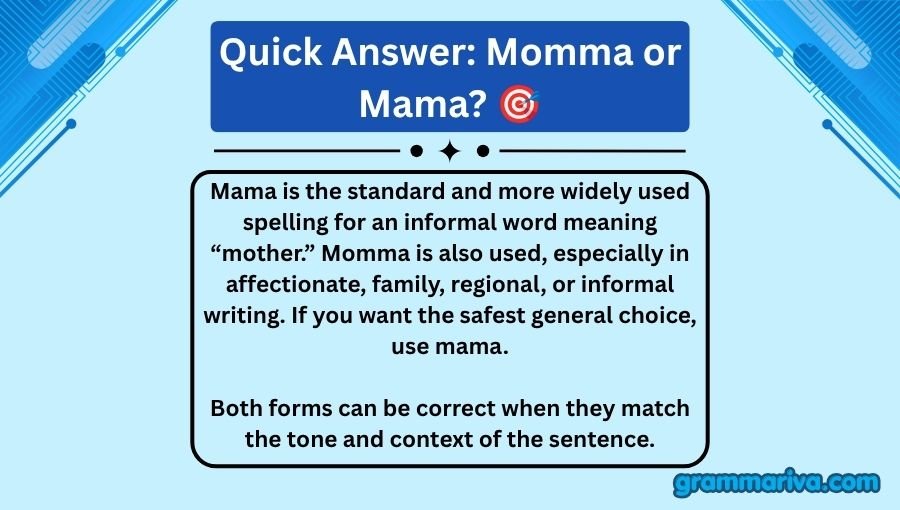
Mama is the standard and more widely used spelling for an informal word meaning “mother.” Momma is also used, especially in affectionate, family, regional, or informal writing. If you want the safest general choice, use mama.
Both forms can be correct when they match the tone and context of the sentence.
| Word | Type | General Use | Example |
|---|---|---|---|
| mama | Informal noun | Common name for a mother | “Mama made dinner.” |
| momma | Informal noun | Warm or familiar form of mother | “Momma always knows what to say.” |
Is Momma the Same as Mama? 🤔
Yes, momma and mama can mean the same thing: a mother or a familiar name for one’s mother. The difference is mainly in spelling, tone, and usage rather than basic meaning.
Mama is generally the more common form. It appears naturally in everyday speech, family writing, children’s language, and many forms of informal English.
Momma has a slightly different feel for many readers. It can sound more affectionate, personal, folksy, or regional. A writer may choose it because it matches the way a family member says the word.
For example:
- ✅ Correct: “Mama is waiting for you.”
- ✅ Correct: “Momma is waiting for you.”
Both sentences can be grammatical. The writer’s intended voice decides which form feels better.
The important point is that momma should not automatically be marked as a spelling error. It is a recognized informal form. The choice depends on context.
Momma or Mama at a Glance 📊
The easiest way to understand momma or mama is to compare their normal uses side by side.
| Form | Type | Meaning | Example | Correct/Incorrect |
|---|---|---|---|---|
| mama | Informal noun | Mother | “Mama called this morning.” | ✅ Correct |
| momma | Informal noun | Mother | “Momma gave me a hug.” | ✅ Correct |
| mamma | Variant noun | Mother | “The child called for mamma.” | ✅ Correct, but less common in US English |
| mom | Informal noun | Mother | “Mom is home.” | ✅ Correct |
| mother | Standard noun | Female parent | “My mother lives nearby.” | ✅ Correct |
In American English, mama is usually the best general-purpose choice when you want an informal word for “mother.”
Momma works well when the writer wants to preserve a personal voice.
Why Do People Confuse Momma and Mama? 🧠
People confuse momma and mama because they are very close in sound and meaning. Both are informal family words, and both are used to address or describe a mother.
Spelling also plays a role. English has many words where small changes in letters create different forms. That makes it easy to wonder whether one spelling is correct and the other is wrong.
Another reason is personal experience. Some people grow up hearing mama. Others hear momma at home. When people write the word later, they often spell it the way they remember seeing or hearing it.
I once helped a student who had written “momma” in a school assignment. She thought the word had to be wrong because her teacher usually used “mama.” The word itself was not the real problem. The bigger issue was tone. Her sentence was formal, so “mother” would have worked better.
That example shows why context matters.
Personal, Regional, and Family Style
Family language can be very personal. A person may always call their mother “Mama,” while another person may naturally say “Momma.”
You may also see momma in writing that aims to sound warm, traditional, rural, Southern, or strongly conversational. That does not mean every person from those backgrounds uses it. It simply means the spelling can carry a certain voice.
| Reason for the Choice | More Natural Form | Example |
|---|---|---|
| General informal writing | mama | “Mama is coming over.” |
| Family nickname | mama or momma | “Momma, look at this!” |
| Warm personal writing | momma or mama | “My momma always supported me.” |
| Formal writing | mother | “My mother attended the meeting.” |
| Children’s speech | mama | “Mama, can you help me?” |
What Does Mama Mean? ❤️
Mama is an informal noun used to mean “mother.” It can be used when talking about a person’s mother or when directly addressing her.
The word is common in family conversations and other informal settings.
Consider this sentence:
“Mama made my favorite soup.”
Here, mama is the noun naming the speaker’s mother. It is informal and affectionate.
Another example is:
“I called Mama after work.”
Again, the word refers to the speaker’s mother.
When used as a direct form of address, capitalization can depend on how the sentence is structured.
- “I asked my mama for help.”
- “Mama, can you help me?”
The second sentence treats Mama like a name or direct form of address, so capitalization is natural.
Mama in Everyday Speech
You can use mama in:
- family conversations
- personal letters
- children’s books
- informal social media posts
- emotional or affectionate writing
- stories with a conversational voice
It is usually not the best choice for highly formal writing.
For example:
- ✅ Correct: “My mama taught me how to bake.”
- ❌ Less suitable for formal writing: “My mama attended the annual corporate meeting.”
The second sentence is not grammatically wrong. It simply sounds more casual than mother.
What Does Momma Mean? 🌼
Momma is an informal word for mother. It is often used as a warm or affectionate form of address or reference.
For many speakers, momma feels more personal than mama. It may suggest a family voice or a particular style of speech.
For example:
- ✅ Correct: “My momma always believed in me.”
- ✅ Correct: “Momma, I need your help.”
Both sentences are informal.
The spelling can be especially effective in creative writing when the writer wants dialogue to sound natural.
A novelist might write:
“Momma, wait for me!”
That spelling can help show the character’s voice. In other writing, mama may be cleaner and more widely familiar.
| Meaning | Word Type | Example Sentence |
|---|---|---|
| Mother | Informal noun | “My momma lives nearby.” |
| Direct address | Informal noun/name | “Momma, I’m home!” |
| Affectionate family term | Informal noun | “Her momma taught her to cook.” |
Test Tip 💡
Ask yourself one simple question:
Am I trying to sound general, or am I trying to preserve a personal voice?
If you want the most widely understood informal form, choose mama.
If you want a warmer, more personal, or family-specific tone, momma may fit better.
Which Spelling Is Better in American English? 🇺🇸
In general American English, mama is the safer choice when you need a widely recognized informal term for mother. Momma is also usable, but it has a stronger informal and personal flavor.
This does not mean that momma is wrong. It means that mama is often the better default when you are unsure.
Think about the audience.
If you are writing a family caption, either form may work.
If you are writing a school paper, mother may be better.
If you are writing dialogue, choose the form that matches the character.
| Writing Situation | Recommended Choice | Reason |
|---|---|---|
| General US English | mama | Widely familiar |
| Formal essay | mother | More formal |
| Family message | mama or momma | Both can sound natural |
| Character dialogue | Either | Match the character’s voice |
| Social media caption | Either | Tone matters most |
| Professional report | mother | More formal and precise |
What Are the Grammar Rules for Momma and Mama?
Both mama and momma function as informal nouns meaning “mother.” Neither spelling changes the basic grammar of a sentence simply because one has an extra m.
They can be used as subjects, objects, or forms of direct address.
As a subject:
Mama made breakfast.
As an object:
I called mama.
As direct address:
Mama, please wait.
The same basic patterns can work with momma.
Capitalization depends on use. When the word functions like a personal name in direct address, capitalization is appropriate.
- “Mama, I missed you.”
- “I told my mama the news.”
The first uses Mama as direct address. The second uses mama as a common noun.
The same principle applies to Momma.
- “Momma, can you hear me?”
- “Her momma called earlier.”
The main grammar rule is therefore about how the noun is being used, not about choosing one spelling as the only grammatical option.
Correct vs. Incorrect at a Glance
| Sentence | Correct/Incorrect | Why |
|---|---|---|
| “Mama made breakfast.” | ✅ Correct | Mama is an informal noun for mother. |
| “Momma made breakfast.” | ✅ Correct | Momma is also an informal form. |
| “Mama, can you help me?” | ✅ Correct | The word is used as direct address. |
| “My mama is a teacher.” | ✅ Correct | Mama functions as a noun. |
| “My mother, mama, is a teacher.” | ❌ Incorrect | The sentence uses the words awkwardly and needs clearer structure. |
Case Study: Choosing the Right Form in Real Life 📝
Imagine you are writing a birthday message for your mother.
You might write:
“Happy birthday to my mama, my biggest supporter and my best friend.”
That sounds warm and natural.
You could also write:
“Happy birthday to my momma, my biggest supporter and my best friend.”
This version feels a little more personal and conversational.
Now imagine you are writing a formal article:
“The child’s mother attended the school meeting.”
Here, mother is the better choice because the sentence is formal and neutral.
I once edited a family newsletter where the writer used momma in every paragraph. The spelling was not the problem. The newsletter was meant to sound like a formal community report. We changed most instances to mother and kept momma inside one personal quote. The result sounded much more natural.
That is the key lesson: word choice should match purpose.
Common Mistakes With Momma and Mama ⚠️
Most mistakes happen because writers assume one spelling must be right and the other must be wrong. That is not always true.
Here are some common causes:
- Fast typing: Writers may add or remove a letter without noticing.
- Autocorrect: A phone may change a familiar family spelling.
- Lack of knowledge: Writers may not know that both forms can be used.
- Personal habit: People often spell family words the way they heard them growing up.
- Tone confusion: A casual word may be used in a formal sentence.
| Common Confusion | Correct Form | Main Difference |
|---|---|---|
| it’s / its | Both | It’s = it is; its = possession |
| your / you’re | Both | Your = possession; you’re = you are |
| their / there / they’re | All three | Different meanings and functions |
| affect / effect | Both | Different common uses |
| momma / mama | Both | Mainly spelling and tone |
The big difference is that momma and mama are not a standard wrong-versus-right pair. They can both be valid informal forms.
Specific Mistakes to Avoid
| Wrong Form | What’s Wrong | Correct Form |
|---|---|---|
| “Moma” | Missing an m in the common form | Mama |
| “Mommah” | Unnecessary ending | Mama or Momma |
| “Momma” in every formal document | Too informal for some contexts | Mother |
| “Mama” called yesterday | May need capitalization if used as direct address | “Mama called yesterday.” |
| “My Mama called yesterday” | Capitalization may be too formal if used as a common noun | “My mama called yesterday.” |
The last two examples depend on context. Capitalization is not always a simple spelling issue.
I once caught myself typing “moma” in a quick text because I was rushing. I noticed it only after sending the message. That small mistake reminded me how easily familiar words can be misspelled when we type quickly.
Momma or Mama in Different Contexts 📱
The best choice changes with the setting. A family text can be very different from a business report.
In everyday conversation, both forms may sound natural.
In professional writing, mother is usually the clearest choice.
In creative writing, the writer has more freedom. The spelling can help create a character’s voice.
On social media, either mama or momma can work, especially when the goal is warmth.
| Context | Which Term to Use | Example |
|---|---|---|
| Everyday conversation | mama or momma | “I’m going to call mama.” |
| Professional writing | mother | “The mother signed the form.” |
| Creative writing | mama or momma | “Momma, tell me a story.” |
| Social media/texting | mama or momma | “Love you, Momma! ❤️” |
Common Phrases With Mama and Momma 💬
Neither spelling has to appear in a special idiom to be useful. Both can appear in everyday family expressions.
Common phrases include:
- Mama’s boy
- Mama’s girl
- mama bear
- Hey, mama
- Momma’s little one
- Love you, mama
Some expressions have a fixed spelling or cultural meaning. Others are simply natural combinations used in conversation.
| Phrase | Meaning |
|---|---|
| Mama’s boy | A boy or man who is very close to his mother |
| Mama’s girl | A girl or woman who is very close to her mother |
| mama bear | A protective mother |
| Hey, mama | A casual or affectionate way to address a woman or mother |
| Momma’s little one | An affectionate phrase for a child |
| Love you, mama | A warm expression of affection toward one’s mother |
Because these phrases are informal, the tone matters more than strict formality.
Can You Use Mama and Momma in Creative Writing? ✍️
Yes. Creative writing gives you more freedom to choose between mama and momma. The best spelling is the one that supports the character, setting, and emotional tone.
Dialogue is especially flexible.
For example:
“Mama, I don’t want you to go.”
This sounds natural and simple.
You could also write:
“Momma, I don’t want you to go.”
The second version may feel more intimate or regional.
Writers should avoid changing spellings randomly, though. If one character calls her Momma, keep that choice consistent unless there is a reason for the change.
Consistency helps readers understand the character’s voice.
Synonyms and Alternatives for Mama and Momma 🔄
Sometimes you do not need either informal form. The word mother may be a better choice.
Other alternatives include mom, mommy, and parent, but each one has a different tone or meaning.
| Alternative | Works When | Does Not Work When |
|---|---|---|
| mother | Formal or neutral writing | You want a very casual family tone |
| mom | Casual American English | You need a more formal tone |
| mommy | Very young children or affectionate speech | Formal adult writing |
| parent | Gender-neutral or general references | You specifically mean the mother |
| mama | Warm, informal references | Formal reports |
Choose the word that matches the relationship and setting.
Why Does Choosing the Right Form Matter? 🎯
Choosing between mama, momma, and mother matters because words carry tone. A sentence can be grammatically correct but still sound wrong for its audience.
Clarity is especially important in professional writing. A formal report should usually use neutral language.
Personal writing is different. A family story may sound much better with mama or momma.
Digital communication also benefits from clear word choice. Social posts, captions, texts, and emails can all create different impressions.
A simple rule I use is:
Choose the word that matches both your meaning and your audience.
| Situation | Why Getting It Right Matters |
|---|---|
| Resume | Formal language creates a professional tone |
| Client email | Neutral wording improves clarity |
| Published content | Consistent word choice builds trust |
| Social post | Personal wording can create warmth and emotion |
How To Remember the Difference 🧠
You do not need a complicated trick to remember momma or mama.
Think of the extra m in momma as an optional style choice.
Mama = the simpler, more general informal form.
Momma = a more personal or conversational variant.
When you are unsure, choose mama for general informal writing.
When you are writing dialogue, a family message, or a personal story, choose whichever form sounds natural to the speaker.
Here is a quick memory line:
“Mama is the simple default. Momma adds a little extra family flavor.”
That is not a grammar law. It is simply an easy way to remember the usual difference in feel.
Is Momma More Informal Than Mama? 💡
Usually, yes. Both words are informal, but momma can feel more strongly personal, affectionate, or conversational.
Mama is broad and familiar. Momma may sound more like a family nickname or spoken form.
However, there is no universal rule saying that every speaker will feel exactly the same way. Personal and regional speech habits can affect the tone.
Is Mama More Common Than Momma? 📚
In general US English, mama is the safer and more widely recognized spelling. Momma is still a valid informal variant.
If you are writing for a broad audience and have no special reason to choose momma, mama is usually the better default.
For a personal story or direct quote, however, momma may be exactly the right choice.
Should You Use Mama or Momma in Formal Writing? 📝
Use mother in most formal writing. Mama and momma are informal terms, so they may sound too casual in academic, legal, business, or professional documents.
There are exceptions. A formal article may quote someone saying “Mama.” A research paper may discuss the exact wording of a source. In those cases, preserving the original wording can be appropriate.
The key is to separate formal narration from quoted speech.
Can Mama and Momma Be Used as Names? 👩👧
Yes. When someone directly addresses their mother as Mama or Momma, the word can function much like a name.
For example:
“Mama, can I ask you something?”
Here, Mama is being used to address the person directly.
Compare it with:
“My mama is in the kitchen.”
Here, mama is a common noun describing the relationship.
This difference explains why capitalization can change.
Quick Recap Checklist ✅
Use this checklist when you are unsure about momma or mama.
| Question | If Yes → Use |
|---|---|
| Do you want the most general informal form? | Mama |
| Are you writing a personal family message? | Mama or Momma |
| Are you writing character dialogue? | Match the character’s voice |
| Are you writing a formal report? | Mother |
| Are you preserving someone’s exact speech? | Keep their original form |
Practice Examples
- “Mama, dinner is ready.” → ✅ Natural direct address.
- “My momma taught me to cook.” → ✅ Natural informal usage.
- “The mother completed the official form.” → ✅ Best for formal writing.
FAQs About Momma vs Mama ❓
Is momma or mama correct?
Both momma and mama can be correct informal words for “mother.” Mama is generally the safer and more common choice, while momma can sound more personal, affectionate, or conversational.
Is momma a real word?
Yes. Momma is an established informal form of “mother.” It is not simply a typing mistake or a misspelling of mama.
Is mama more correct than momma?
Not in every situation. Mama is usually the better general choice in US English, but momma can also be correct when the informal and personal tone fits the context.
Should I write mama or momma in a formal essay?
For a formal essay, mother is usually the best choice. Both mama and momma are informal, so they may make formal writing sound too casual unless they appear in a quotation or are part of the topic being discussed.
Is momma more affectionate than mama?
It can sound more affectionate or personal, but this depends on the speaker. Some families use mama as their most affectionate form, while others naturally use momma.
Why do people spell mama as momma?
People may use momma because it matches how the word sounds in their family or region. It can also be a preferred spelling in personal, creative, or conversational writing.
Can I use Momma as a name?
Yes. When directly addressing your mother, Momma can be capitalized like a name.
Example:
“Momma, I need your help.”
Should mama be capitalized?
Capitalize Mama when it is used as a direct name or form of address. Use lowercase mama when it functions as a common noun.
Compare:
- “Mama, please wait.”
- “My mama called me.”
Is mama informal?
Yes. Mama is an informal word for mother. It works well in family conversations, personal writing, children’s speech, social media, and other casual settings.
What is the safest word to use instead of mama or momma?
If you need a neutral and formal word, use mother. It works well in academic, professional, legal, and formal writing.
Conclusion 🌟
Momma or mama is not always a simple case of right versus wrong. Both forms can be used as informal words for “mother,” but mama is generally the safer and more widely familiar choice in US English. Momma can add a warmer, more personal, or conversational feel.
If you are writing a formal document, choose mother. If you are writing a text, family message, social media caption, or personal story, mama and momma can both work. When writing dialogue, match the spelling to the speaker’s natural voice.
The biggest lesson is to think about tone, audience, and purpose before choosing a word. 💛 You do not need to treat momma as an automatic spelling error. Instead, see it as a valid informal variant with its own style.
When in doubt, remember the simple rule: mama is the safe general choice, momma is a personal style choice, and mother is the formal choice.
Choose the word that sounds right for the person, the message, and the moment. ✨

Hi, I’m Ethan Brooks. I’m an English grammar writer at Grammariva, where I work on clear explanations, practical examples, and useful writing tips. I enjoy making difficult grammar topics easier to understand.

[…] writing quickly. By the end, you should be able to choose the correct word with confidence. ✨ Momma or Mama | Acception vs Exception | Affirm vs […]
[…] examples, compare similar expressions, and give you simple ways to remember it. ✨ Too vs To | Momma or Mama | Acception vs […]