Have you ever clicked a checkbox, selected a file, or picked an option and then wondered whether you should unselect or deselect it? 🤔 This is a small word choice, but it can cause real confusion in emails, software instructions, help articles, and everyday writing.
Both forms may appear in digital spaces, but they do not have the same level of standard usage. Deselect is the established and widely preferred word when you mean to remove a selection. Unselect can be understood, and it does appear in some technical or informal settings, but it is less common and is often treated as a less standard alternative.
I work with English wording and editing, and I have seen this question come up in everything from classroom exercises to software instructions. The good news is that the rule is easy once you connect the word to the action.
In this guide, I will explain the difference, show clear examples, cover common mistakes, and give you simple ways to remember which word to choose. ✨ Company-Wide or Companywide | Input or Imput | To Fast or Too Fast
🎯 Quick Answer: Unselect or Deselect
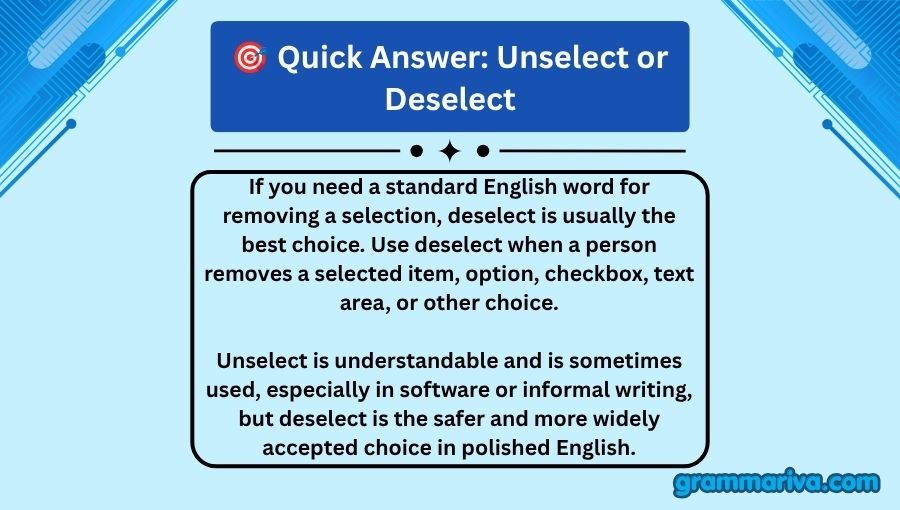
If you need a standard English word for removing a selection, deselect is usually the best choice. Use deselect when a person removes a selected item, option, checkbox, text area, or other choice.
Unselect is understandable and is sometimes used, especially in software or informal writing, but deselect is the safer and more widely accepted choice in polished English.
| Word | Main Use | Standard Choice? | Example |
|---|---|---|---|
| Deselect | Remove a selection | Yes | Deselect the files you do not want. |
| Unselect | Remove a selection | Less common | Unselect the option if needed. |
| Select | Choose something | Yes | Select the correct answer. |
🔎 Is Unselect the Same as Deselect?
Unselect and deselect can express the same basic action: removing something from a selected state. However, they are not equally common or equally preferred in standard writing.
The verb select means to choose something. When you want to describe reversing that action, deselect is the normal choice in many contexts.
For example:
- ✅ Please deselect the box before continuing.
- ❌ Please unselect the box before continuing.
The second sentence is understandable. A reader will probably know what you mean. Still, the first sentence sounds more natural and polished.
This difference matters most when you are writing instructions for a broad audience. A software manual, website guide, training document, or professional email should normally use deselect.
A simple way to think about it
Think of the process as two actions:
- Select = choose it.
- Deselect = remove the choice.
That creates a clean pair:
Select → Deselect
This pattern is easy to remember because deselect clearly describes reversing a selection.
| Action | Preferred Verb | Example |
|---|---|---|
| Make a choice | Select | Select the image. |
| Remove the choice | Deselect | Deselect the image. |
| Choose a checkbox | Select | Select the checkbox. |
| Remove a checkbox choice | Deselect | Deselect the checkbox. |
| Choose several files | Select | Select three files. |
| Remove the file choices | Deselect | Deselect the files. |
📝 Unselect or Deselect at a Glance
The main difference is one of standard usage. Deselect is the more established and preferred verb for reversing a selection, while unselect is less common.
| Form | Type | Meaning | Example | Correct/Incorrect |
|---|---|---|---|---|
| Select | Verb | Choose something | Select the file. | ✅ Correct |
| Deselect | Verb | Remove a selection | Deselect the file. | ✅ Correct |
| Unselect | Verb | Remove a selection | Unselect the file. | ⚠️ Less preferred |
| Selected | Adjective/past participle | Chosen | The file is selected. | ✅ Correct |
| Deselected | Adjective/past participle | No longer selected | The file is deselected. | ✅ Correct |
In normal professional writing, choose deselect when you mean “remove from the selected group.”
💡 Why Do People Confuse Unselect and Deselect?
People confuse these forms because un- is a familiar English prefix. We use it to show reversal in words such as unlock, untie, unplug, and undo. It may therefore feel natural to create unselect from select.
There is also a simple visual reason for the confusion. In digital interfaces, users often see buttons and commands that use different wording. One program may say “Deselect All,” while another may use language such as “Unselect.”
I once edited a short software guide where the writer used unselect several times. The meaning was clear, but the wording sounded uneven beside other standard interface terms. I changed the instructions to deselect, and the whole guide became more consistent.
The confusion usually comes from three things:
- The prefix un- often means “reverse an action.”
- Software interfaces do not always use the same wording.
- People may form the word naturally without checking standard usage.
| Reason for Confusion | What Happens | Better Choice |
|---|---|---|
| Familiar prefix | Writers think “un-” should reverse select. | Deselect |
| Software wording | Different programs may use different labels. | Deselect in general writing |
| Fast typing | Writers choose the first word that comes to mind. | Check the sentence |
| Informal speech | People may understand either form. | Prefer deselect in formal writing |
| Limited vocabulary knowledge | The writer has not seen the standard term often. | Learn the select/deselect pair |
📚 Deselect: Meaning and Correct Use
Deselect means to remove something from a selected state. It is most common when discussing choices in forms, menus, programs, websites, lists, and digital tools.
The word works as a verb.
Consider this sentence:
Deselect the “Send Notifications” option.
Here, deselect is an instruction. The reader should remove the check or selection from that option.
Another example:
Deselect any files you do not want to upload.
The action is clear. The files were selected first, and the user is now being told to remove some of those choices.
Common situations for deselect
You can use deselect when someone:
- removes a checkbox selection
- removes a highlighted item
- removes an item from a group of choices
- reverses a previous selection
- clears selected files
- removes a chosen menu option
- changes a selected setting
| Situation | Example |
|---|---|
| Checkbox | Deselect the checkbox. |
| File list | Deselect the files you do not need. |
| Menu | Deselect the current option. |
| Form | Deselect the box if you do not agree. |
| Image editor | Deselect the selected area. |
| Settings | Deselect automatic updates. |
❌ Is Unselect Wrong in Every Situation?
No. Unselect is understandable and does occur in English, especially in technical or informal contexts. However, that does not make it the best choice for every piece of writing.
Language users sometimes create understandable words by applying familiar patterns. Unselect follows a pattern that seems logical because un- can express reversal. Still, standard usage favors deselect for the action of removing a selection.
So, calling unselect completely meaningless would be inaccurate. The better point is that deselect is the safer standard choice.
Compare these examples:
- ✅ Deselect all items before closing the window.
- ⚠️ Unselect all items before closing the window.
The second sentence can be understood. The first is more natural for polished instructions.
| Sentence | Status | Reason |
|---|---|---|
| Please deselect the option. | ✅ Preferred | Standard and clear |
| Please unselect the option. | ⚠️ Less preferred | Understandable but less common |
| Deselect all files. | ✅ Preferred | Natural software instruction |
| Unselect all files. | ⚠️ Less preferred | May appear in some interfaces |
| The button lets users deselect items. | ✅ Preferred | Standard wording |
✍️ How Do You Use Deselect in a Sentence?
Use deselect when the subject needs to remove a choice that has already been selected.
The structure is simple:
Subject + deselect + object
Examples include:
Users can deselect an item at any time.
Please deselect the option before saving.
She deselected the files by mistake.
The program allows you to deselect multiple images.
Notice that deselect can be used in different tenses.
| Tense | Example |
|---|---|
| Present | I deselect the option. |
| Present progressive | I am deselecting the option. |
| Past | I deselected the option. |
| Present perfect | I have deselected the option. |
| Future | I will deselect the option. |
| Modal | You should deselect the option. |
The form stays easy to recognize because the base word is select, with de- added to express the reverse action.
🧪 What Is the Best Test for Choosing Deselect?
A quick test is to ask yourself: Am I removing something that was selected?
If the answer is yes, deselect is usually the word you want.
Try this mental test:
“I selected it. Now I need to ______ it.”
The natural standard answer is:
“I need to deselect it.”
This works especially well for computer instructions.
Test Tip 💡
Replace the blank with remove the selection.
If the sentence still makes sense, deselect is probably the right verb.
For example:
“Please ______ the checkbox.”
“Please remove the selection from the checkbox” makes sense.
So:
Please deselect the checkbox.
This simple test can save you from choosing an unfamiliar form just because it sounds logical.
📝 Case Study: A Software Instruction
Imagine that you are writing instructions for a photo-editing program.
The program lets users select several images. After making a selection, they can remove individual images from the group.
A draft instruction says:
“Click an image to select it. Click it again to unselect it.”
The meaning is understandable. But for polished documentation, I would write:
“Click an image to select it. Click it again to deselect it.”
The second version creates a clean pair:
select → deselect
A similar situation happened to me while reviewing a set of online instructions. The writer had used different verbs for the same action in different sections. I replaced the less standard wording with deselect and kept the terminology consistent throughout the guide.
| Draft Wording | Edited Wording | Why |
|---|---|---|
| Unselect the image. | Deselect the image. | More standard |
| Unselect the box. | Deselect the box. | Clearer instruction |
| Unselect unwanted files. | Deselect unwanted files. | Consistent terminology |
| Select or unselect items. | Select or deselect items. | Balanced word pair |
📖 Grammar Rules Explanation
The standard verb deselect is formed from select with the prefix de-, which can express removal or reversal in words that describe an action.
In this use, deselect functions as a regular verb. It can take an object:
Deselect the option.
It can also appear in other grammatical forms:
The option was deselected.
Users can deselect several files.
The key grammar point is not that unselect cannot be understood. The key point is that deselect is the established choice for reversing a selection in standard English usage.
The word select describes choosing something. Deselect describes removing that choice.
There is no need to invent a complicated rule. The most useful pattern is:
select = choose
deselect = remove the choice
Most standard English reference sources support the use of established vocabulary rather than forcing a newly formed alternative when a clear standard verb already exists.
Correct vs Incorrect at a Glance
| Sentence | Correct/Incorrect | Why |
|---|---|---|
| Please deselect the checkbox. | ✅ Correct | Uses the standard verb |
| Please unselect the checkbox. | ⚠️ Less preferred | Understandable but less standard |
| Deselect the files before uploading. | ✅ Correct | Clearly reverses a selection |
| Unselect the files before uploading. | ⚠️ Less preferred | The meaning is clear, but deselect is better |
| She deselected the wrong image. | ✅ Correct | Correct past-tense form |
⚠️ Common Mistakes With Deselect
The most common mistake is choosing unselect simply because un- often means “reverse.”
For example, English has:
- unlock
- unpack
- untie
- unplug
- unwrap
- undo
That pattern makes unselect feel perfectly natural. But English does not always create words by following one simple prefix rule.
Another problem is fast typing. When someone writes quickly, they may type the first word that sounds right. Autocorrect can also make things confusing because a word may not be flagged as a spelling error even when another word would be better for the context.
A third problem is lack of exposure. If you mostly interact with software that uses unusual wording, you may start copying that wording into your own writing.
| Similar Confusion | Common Wrong Choice | Correct Choice |
|---|---|---|
| Possession vs contraction | its / it’s | Check the meaning |
| You are vs possession | your / you’re | Check the sentence |
| They are vs possession | their / they’re | Check the meaning |
| Choice vs reversal | select / deselect | Match the action |
| Advice vs verb | advice / advise | Match the word type |
Common specific mistakes
| Wrong Form | What’s Wrong | Correct Form |
|---|---|---|
| Unselect the box. | Less standard wording | Deselect the box. |
| Unselected the files. | Less preferred past form | Deselected the files. |
| Unselecting the option | Less preferred form | Deselecting the option |
| Unselectable after saving | Awkward in many contexts | Cannot be deselected after saving |
| Re-unselect the item | Unnecessary and awkward | Deselect the item again |
🔤 Why Does Deselect Work Better Than Unselect?
Deselect works better because English already has a well-established verb for reversing a selection. When a standard word exists, using it usually makes writing clearer. The main reason writers compare unselect or deselect is that both forms can suggest the same basic action.
Think about professional communication. You do not want readers to stop and wonder whether a word is standard. You want them to understand the instruction immediately.
This is especially useful in:
- software documentation
- online help pages
- workplace instructions
- educational materials
- technical manuals
- customer support messages
- website interfaces
A short, familiar verb is often the strongest choice.
| Writing Goal | Better Choice | Reason |
|---|---|---|
| Clear software instructions | Deselect | Familiar and direct |
| Formal documentation | Deselect | More standard |
| Academic writing | Deselect | Safer standard usage |
| Casual conversation | Deselect | Still clear and natural |
| Informal interface wording | Either may appear | Interface style can vary |
🌐 How Is Deselect Used in Different Contexts?
The preferred choice stays the same across most contexts, but the sentence around it can change.
Everyday conversation
People may say:
“Deselect that option.”
This is simple and clear.
Professional writing
Professional instructions should normally use:
“Please deselect the option before submitting the form.”
Creative writing
Creative writing may rarely need this word unless the story involves technology, forms, or selection.
Social media and texting
Short digital messages may use either form, but deselect remains the safer standard form.
| Context | Which Term to Use | Example |
|---|---|---|
| Everyday conversation | Deselect | Deselect that option. |
| Professional writing | Deselect | Please deselect the box. |
| Creative writing | Deselect when needed | He deselected the wrong file. |
| Social media/texting | Deselect preferred | Deselect the filter first. |
💻 What About Software and User Interfaces?
Software is one area where you may encounter unselect. Interface designers sometimes use different labels based on product style, internal terminology, or design choices.
That does not mean every interface choice becomes the best choice for general English.
If you are writing your own software documentation, deselect is a strong default.
For example:
Select All
paired with:
Deselect All
looks natural and balanced.
That pairing is especially useful because users can understand the relationship immediately.
| Interface Action | Recommended Label |
|---|---|
| Choose everything | Select All |
| Remove all choices | Deselect All |
| Choose an item | Select |
| Remove one choice | Deselect |
| Show chosen items | Selected Items |
| Show items with choices removed | Deselected Items |
🎯 How To Remember the Difference
The easiest memory trick is to treat the two words as action partners:
Select = choose.
Deselect = unchoose.
You do not need to remember a long grammar rule.
Imagine clicking a checkbox.
First click:
Select ☑️
Second click:
Deselect ☐
This visual idea makes the difference easier to remember.
Another useful trick is to think of deselect as the standard computer action. If you are writing a help article, manual, or professional message, choose the word that sounds like a familiar menu command.
| Memory Question | Answer |
|---|---|
| What does select mean? | Choose |
| What does deselect mean? | Remove the choice |
| Is unselect understandable? | Yes |
| Is unselect the safest standard choice? | No |
| What should I use in formal writing? | Deselect |
🗣️ Common Sentence Patterns With Deselect
Learning common sentence patterns can make correct usage automatic.
Here are some useful structures:
- Deselect + noun
- Deselect + the + noun
- Deselect + all + plural noun
- Deselect + any + plural noun
- Can + subject + deselect…?
- Please + deselect + noun
Examples:
Deselect the option.
Deselect all images.
Please deselect any unwanted files.
Can I deselect this item?
Users can deselect individual files.
| Pattern | Example |
|---|---|
| Deselect + noun | Deselect the option. |
| Deselect + all | Deselect all files. |
| Deselect + any | Deselect any unwanted items. |
| Can + deselect | Can I deselect this choice? |
| Please + deselect | Please deselect the box. |
🔄 What Are Some Alternatives to Deselect?
Sometimes you can avoid the word entirely. The best alternative depends on the action you are describing.
For example, clear may work when discussing a checkbox or form field. Remove the selection is another clear phrase. Clear the choice can work in some contexts.
However, these alternatives are not always exact replacements.
| Alternative | Works When | Does Not Work When |
|---|---|---|
| Remove the selection | You want a clear general phrase | A short interface label is needed |
| Clear | Removing a check or field value | The action specifically concerns a selected object |
| Clear the choice | Reversing a simple choice | The software uses formal selection terminology |
| Remove | Taking an item away | The item remains present but is no longer selected |
| Cancel the selection | Reversing a current selection | You mean deleting the actual item |
For example, “remove the file” may mean delete the file. “Deselect the file” means keep the file but remove its selected status. That difference matters.
⚠️ Why Does Getting This Word Right Matter?
A single word can affect how quickly a reader understands an instruction.
If you tell someone to deselect a file, the intended action is clear. The file stays where it is. Only its selection status changes.
If you say remove the file, the reader may think the file should be deleted.
That is why precise wording matters in digital communication.
A useful writing principle is:
Choose the clearest word that describes the exact action.
Why this matters in real writing
| Situation | Why Getting It Right Matters |
|---|---|
| Resume or portfolio | Shows careful language use |
| Client email | Keeps instructions professional |
| Published content | Builds reader trust |
| Software guide | Prevents user confusion |
| Social post | Makes short instructions clearer |
Clear wording also makes content easier to scan. This matters for websites, apps, help centers, and online learning materials.
💬 A Short Quote About Clear Writing
“Clear words make clear actions.”
That simple idea fits this topic well. When readers know exactly what action a sentence describes, they are less likely to make mistakes.
🚫 When Should You Avoid Unselect?
You should generally avoid unselect when writing formal, edited, or widely published content.
That includes:
- academic assignments
- professional documentation
- customer instructions
- grammar articles
- website help pages
- business emails
- training materials
If your goal is standard English, deselect is the stronger choice.
You may still encounter unselect in software, forums, informal writing, or other digital contexts. Seeing it does not mean you need to copy it.
| Writing Type | Recommended Choice |
|---|---|
| Grammar article | Deselect |
| Business email | Deselect |
| Technical guide | Deselect |
| Academic paper | Deselect |
| Casual software discussion | Deselect preferred |
| Informal interface wording | May vary |
🧠 Can Deselect Be Used in Different Tenses?
Yes.In most contexts, unselect or deselect is a choice between a less common form and the more established word deselect. Deselect is a regular verb, so its forms are easy to build.
The past tense is deselected, and the -ing form is deselecting.
Examples:
I deselect the option whenever I change the settings.
I deselected the wrong file yesterday.
She is deselecting the images now.
They have deselected the automatic update option.
The same pattern applies when the verb is used in passive constructions:
The option was deselected by the user.
| Form | Example |
|---|---|
| Base | Deselect the option. |
| Third-person singular | She deselects the option. |
| Past | She deselected the option. |
| -ing form | She is deselecting the option. |
| Past participle | The option was deselected. |
📌 Deselect vs Select: The Full Action Pair
It is easier to understand the difference when you look at the two verbs together.
Select starts the action. Deselect reverses it.
Imagine a list of five files.
You click File A.
File A is selected.
You decide you do not need it.
File A is deselected.
The file still exists. Only its selection status changes.
| Stage | Action | Sentence |
|---|---|---|
| 1 | Select | Select the file. |
| 2 | File becomes selected | The file is selected. |
| 3 | Deselect | Deselect the file. |
| 4 | File loses selection | The file is deselected. |
This distinction is especially important because deselect does not normally mean delete.
❓ Does Deselect Mean Delete?
No. Deselect means to remove an item’s selected status, while delete means to remove the item itself.
For example:
Deselect the photo.
The photo remains available.
But:
Delete the photo.
The photo is removed.
These actions are very different.
| Word | Action | Result |
|---|---|---|
| Select | Choose | Item becomes selected |
| Deselect | Remove selection | Item remains |
| Delete | Remove item | Item may be erased |
| Clear | Remove a value or choice | Depends on context |
This is one reason deselect is useful in technical writing. It gives the reader a specific action instead of a vague one.
🔍 Is Unselect Ever Better Than Deselect?
In standard writing, there is usually no strong reason to prefer unselect over deselect when you mean to remove a selection.
A specific product or interface might use unselect as its own wording. If you are quoting the exact label of that product, preserving the original wording may be appropriate.
Outside such a case, deselect is normally the better option.
| Situation | Best Approach |
|---|---|
| Your own writing | Use deselect |
| Formal documentation | Use deselect |
| General grammar article | Use deselect |
| Quoting an interface | Keep the exact interface wording if needed |
| Informal message | Deselect is still preferred |
🧩 Practice Examples for Unselect or Deselect
Try choosing the better word before checking the answers. These examples make the difference between unselect or deselect easier to recognize in real sentences.
Example 1
Please ______ the boxes you do not need.
Answer: deselect
- ✅ Please deselect the boxes you do not need.
- ❌ Please unselect the boxes you do not need.
Example 2
You can ______ the image by clicking it again.
- ✅ You can deselect the image by clicking it again.
- ❌ You can unselect the image by clicking it again.
Example 3
______ all options before starting the test.
- ✅ Deselect all options before starting the test.
- ❌ Unselect all options before starting the test.
Example 4
She accidentally ______ the file.
- ✅ She accidentally deselected the file.
- ❌ She accidentally unselected the file.
| Practice | Preferred Answer |
|---|---|
| Remove a checkbox choice | Deselect |
| Remove a selected image | Deselect |
| Remove selected files | Deselect |
| Reverse a previous choice | Deselect |
📋 Quick Recap Checklist
The core rule is simple: use deselect when you mean to remove a selection. Keep this checklist handy when you are unsure. If you are still unsure about unselect or deselect, remember that deselect is the safer choice for standard English.
| Question | If Yes → Use |
|---|---|
| Am I removing a choice? | Deselect |
| Was the item already selected? | Deselect |
| Am I writing formal instructions? | Deselect |
| Am I writing software documentation? | Deselect |
| Am I trying to say “delete”? | Do not use deselect |
| Am I referring to a product’s exact wording? | Follow the product wording if quoting it |
Practice Examples
- Select the photos you want, then deselect the ones you do not need.
- Please deselect the checkbox before submitting the form.
- Users can deselect individual files without deleting them.
❓ FAQs About Unselect vs Deselect
Is deselect the correct word?
Yes. Deselect is the standard and preferred word when you mean to remove something from a selected state.
Is unselect grammatically correct?
Unselect is understandable and does appear in some usage, especially in technical or informal settings. However, it is less preferred than deselect in standard polished writing.
What is the difference between select and deselect?
Select means to choose something. Deselect means to remove that choice. For example, you select a checkbox when you check it and deselect it when you remove the check.
Should I use unselect or deselect in software documentation?
Use deselect as your default choice. It is clear, established, and easy for a broad audience to understand.
Can I say unselected instead of deselected?
You may encounter unselected, but deselected is generally the clearer standard form when you mean that an item no longer has a selection status.
Does deselect mean delete?
No. Deselect means to remove the selection. Delete means to remove the item itself. A deselected file can still remain on your computer.
How do you use deselect in a sentence?
You can say, “Please deselect the option before continuing.” You can also say, “Deselect all files you do not want to upload.”
Why does unselect sound natural?
It sounds natural because English often uses un- to show the reversal of an action. Words such as unlock and untie make unselect seem logical. However, English does not always use the same prefix pattern for every verb.
Is deselect used only for computers?
No. It is most common in digital and selection-related contexts, but it can describe any action where something is removed from a selected state.
What is the easiest way to remember deselect?
Remember the pair select → deselect. Select means “choose.” Deselect means “remove the choice.” This simple pair works well for forms, files, menus, and other digital selections.
🎯 Final Takeaway
Unselect or deselect can seem like a tiny grammar choice, but the safer standard answer is clear: use deselect when you mean to remove something from a selected state. The word works naturally in software instructions, forms, technical writing, professional emails, and everyday digital communication.
The key pair to remember is simple: select means choose, while deselect means remove the choice. You can use deselect in different tenses, and it should not be confused with delete, which means removing the item itself.
I recommend choosing deselect whenever you are writing for a general audience. It is clear, familiar, and precise. ✨ Once you connect the two actions, this word choice becomes much easier.
So, the next time you select a checkbox and then change your mind, remember one simple rule: select it when you choose it, deselect it when you change your choice. 👍

Hi, I’m Olivia Carter. I’m an English language editor at Grammariva, and I work on making grammar lessons clear, accurate, and easy to follow. I especially enjoy writing about common grammar mistakes and everyday English.

[…] mistakes, and practice questions. By the end, you should know exactly when to use each form. 😊 Unselect or Deselect | Company-Wide or Companywide | Input or […]