Have you ever typed spoilt vs spoiled and stopped because you were not sure which word looked right? You are not alone. Both forms are real English words, but they are not used in exactly the same way in every variety of English. The main difference comes down to American English versus British English and, in some cases, the role of the word in a sentence.
As a US English writer, I usually recommend spoiled for American readers. It is the standard past tense and past participle form used in American English. Spoilt is also correct, but it is more common in British English and some other varieties of English.
This small spelling difference can cause confusion in schoolwork, emails, articles, and social media posts. The good news is that the rule is easy to remember once you see how the two forms work. 😊
In this guide, I will explain spoilt vs spoiled with simple rules, examples, tables, common mistakes, memory tips, and FAQs. On Friday or In Friday | On Friday or In Friday | Artefact vs Artifact
🎯 Quick Answer: Spoilt vs Spoiled
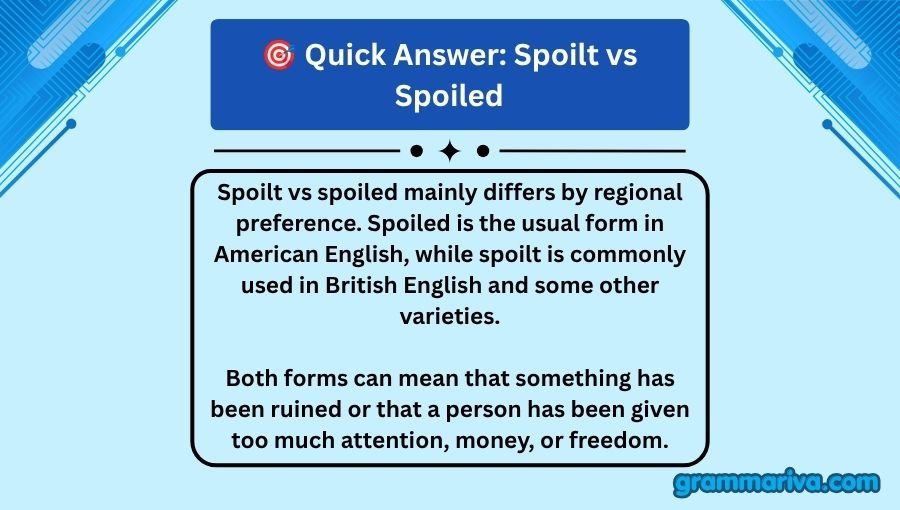
Spoilt vs spoiled mainly differs by regional preference. Spoiled is the usual form in American English, while spoilt is commonly used in British English and some other varieties.
Both forms can mean that something has been ruined or that a person has been given too much attention, money, or freedom.
| Word | Common Variety | Basic Use | Example |
|---|---|---|---|
| spoiled | American English | Past tense/past participle | The milk was spoiled. |
| spoilt | British English and some other varieties | Past tense/past participle | The milk was spoilt. |
For US English writing, choose spoiled in most situations.
📚 What Do Spoilt and Spoiled Mean?
Spoiled and spoilt are forms of the verb spoil. They can describe something that has been damaged, ruined, or made unpleasant. They can also describe a person who has received so much attention or material comfort that they have become demanding or badly behaved.
The meaning does not usually change simply because the spelling changes.
For example:
- The hot weather spoiled our picnic.
- The hot weather spoilt our picnic.
Both sentences communicate the same basic idea. The main difference is the variety of English being used.
Spoiled in American English
American English normally uses spoiled as the past tense and past participle.
Examples:
✅ The rain spoiled our plans.
❌ The rain spoilt our plans.
Not the usual choice in standard American English.
Spoilt in British English
British English often uses spoilt as the past tense and past participle.
Examples:
✅ The rain spoilt our plans.
❌ The rain spoiled our plans.
This is not grammatically wrong in British English, but “spoilt” is a common British preference.
The Core Difference
The safest rule is simple:
Use “spoiled” for American English. Use “spoilt” when following a British English style.
That distinction will solve most cases.
🔍 Spoilt vs Spoiled at a Glance
The two forms belong to the same verb. The main difference is regional usage and style.
| Form | Type | Meaning | Example | Correct/Incorrect |
|---|---|---|---|---|
| spoiled | Past tense/past participle | Ruined or damaged | The food was spoiled. | ✅ Correct |
| spoilt | Past tense/past participle | Ruined or damaged | The food was spoilt. | ✅ Correct |
| spoil | Base verb | To ruin or damage | Heat can spoil food. | ✅ Correct |
| spoiling | Present participle | Causing damage or ruin | The rain is spoiling the event. | ✅ Correct |
| spoils | Present tense | Ruins or damages | Too much sugar spoils the taste. | ✅ Correct |
The key point is that spoilt is not simply a spelling mistake. It is a legitimate form of spoil.
🧠 Is Spoilt or Spoiled Correct in American English?
Spoiled is the preferred form in American English. If you are writing for a US audience, use spoiled in formal and informal writing unless you are deliberately preserving British wording.
For example:
✅ The bad weather spoiled the game.
❌ The bad weather spoilt the game.
The second sentence may be understood by American readers, but it can look distinctly British.
I teach students to think about their audience before choosing between the two. If the assignment is for an American school or college, spoiled is usually the better choice.
A Simple US English Rule
When writing American English, remember:
spoil → spoiled → spoiled
Examples:
- The surprise was spoiled.
- The milk spoiled.
- The joke was spoiled by the interruption.
- His behavior spoiled the evening.
Test Tip 💡
Replace the word with another familiar American verb such as walked or played in your mind. You are looking for the normal US past-tense form.
If your sentence is written for a US audience, spoiled should usually be your first choice.
🇬🇧 When Is Spoilt the Better Choice?
Spoilt is a good choice when you are writing in British English or following a style that commonly uses British forms.
For example:
✅ The children were spoilt by their grandparents.
This wording is natural in British English.
You may see spoilt in British books, newspapers, websites, school materials, and everyday conversation.
The important thing is consistency. Do not switch between American and British forms without a reason.
| Writing Situation | Preferred Form | Example |
|---|---|---|
| US school assignment | spoiled | The child was spoiled. |
| US business email | spoiled | The delay spoiled the schedule. |
| British article | spoilt | The delay spoilt the schedule. |
| British personal message | spoilt | You have spoilt me! |
| International writing | Depends on chosen style | Follow the publication’s style guide. |
If your entire article uses American spelling, spoiled is the safer choice.
❓ Why Do People Confuse Spoilt and Spoiled?
People confuse these words because both forms are accepted in English. Unlike a simple typo, spoilt has a real grammatical role. That makes the choice less obvious.
Another reason is exposure. Someone who reads British novels may see spoilt often. Someone who mainly reads American websites will probably see spoiled much more often.
I once reviewed a student’s essay where she used spoilt in one paragraph and spoiled in another. Neither word was the real problem. The problem was that her writing mixed two spelling styles. Once she chose American English as her target style, the solution was easy.
Common Reasons for Confusion
| Reason | What Happens |
|---|---|
| Different English varieties | Writers see different accepted forms. |
| School materials | Students may read British and American sources. |
| Autocorrect | Software may favor one regional spelling. |
| Fast typing | Writers may not stop to check regional usage. |
| Online content | Readers encounter many English varieties. |
| Lack of knowledge | Writers may think one form must be wrong. |
The important lesson is this: regional variation does not automatically mean grammatical error.
📝 Correct Meanings and Uses of Spoiled
Spoiled can appear in several common situations. The exact meaning depends on context.
1. Food Has Gone Bad
One common use describes food that is no longer fresh or safe to eat.
Example:
✅ The milk spoiled because it was left outside.
Here, spoiled means the food became bad.
2. Something Was Ruined
The word can also mean that something was damaged or made less enjoyable.
Example:
✅ The loud noise spoiled the movie.
Here, the movie itself was not physically damaged. The experience was ruined.
3. A Person Received Too Much
A person can also be described as spoiled when they have been given too much attention, money, praise, or freedom.
Example:
✅ The child was spoiled by his grandparents.
This meaning often suggests that the person has become demanding or entitled.
4. A Surprise Was Revealed
The word can describe a surprise that was accidentally revealed.
Example:
✅ Someone spoiled the ending of the movie.
In this case, the person gave away information that was meant to remain unknown.
| Meaning | Word Type | Example Sentence |
|---|---|---|
| Food becomes bad | Verb/adjective | The fruit was spoiled. |
| Something is ruined | Verb | The rain spoiled our plans. |
| Someone receives excessive attention | Adjective/participle | The child is spoiled. |
| A surprise is revealed | Verb | He spoiled the surprise. |
✨ How Is Spoiled Used in Everyday Sentences?
Spoiled is very flexible. It can describe food, plans, experiences, children, pets, surprises, and more.
Consider these examples:
✅ The heat spoiled the chocolate.
Here, heat caused the chocolate to become unsuitable.
✅ The argument spoiled dinner.
Here, the argument made the dinner experience unpleasant.
✅ My parents spoiled me on my birthday.
Here, the speaker received extra attention or gifts.
❌ The heat spoilt the chocolate.
This is not necessarily grammatically wrong. It simply follows a British-style form rather than the usual American form.
Sentence Breakdown
Take this sentence:
The rain spoiled our picnic.
- The rain = subject
- spoiled = past-tense verb
- our picnic = object
The verb tells us what the rain did to the picnic.
This is why context matters more than the spelling alone.
⚖️ Spoilt vs Spoiled in Different Contexts
Both forms can appear in many types of writing. Your choice should match your audience and style.
| Context | Which Term to Use | Example |
|---|---|---|
| Everyday US conversation | spoiled | You spoiled the surprise. |
| US professional writing | spoiled | The delay spoiled the schedule. |
| British conversation | spoilt | You spoilt the surprise. |
| Creative writing | Depends on setting/style | The storm spoiled the mood. |
| Social media | Either, depending on style | Totally spoiled today! |
For American readers, spoiled is generally the most natural option.
💼 Case Study: A Workplace Email
Imagine that a manager needs to explain why a client meeting did not go well.
A US employee might write:
“The technical problem spoiled the presentation, but the team quickly fixed the issue.”
That sentence sounds natural in American professional writing.
A British employee might write:
“The technical problem spoilt the presentation, but the team quickly fixed the issue.”
The message is the same. The spelling reflects a different regional style.
The practical lesson is simple: choose one English variety and stay consistent.
If your company uses American English, choose spoiled. If your organization follows British English, spoilt may be preferred.
📖 Grammar Rules Explanation
The verb spoil has more than one accepted past form in English. Spoiled is the standard form in American English, while spoilt is widely used in British English.
Neither form should automatically be labeled incorrect without considering the variety of English being used.
The base verb is:
spoil
The common forms include:
- spoil
- spoils
- spoiled
- spoilt
- spoiling
The important grammar point is that spoiled and spoilt can both function as the past tense or past participle of spoil.
Most standard English reference sources recognize the regional difference. The best choice depends on the style of English you are writing.
Correct vs Incorrect at a Glance
| Sentence | Correct/Incorrect | Why |
|---|---|---|
| The heat spoiled the food. | ✅ Correct | Standard American English. |
| The heat spoilt the food. | ✅ Correct | Common in British English. |
| The heat spoil the food yesterday. | ❌ Incorrect | Wrong past-tense form. |
| The food was spoiled by heat. | ✅ Correct | Correct American construction. |
| The food was spoiling quickly. | ✅ Correct | Correct -ing form. |
The most useful rule is not “one is right and one is wrong.” The better rule is “match the form to your English variety.”
⚠️ Common Mistakes With Spoilt and Spoiled
Mistakes often happen when writers type quickly or move between different English sources.
Fast Typing
When people type quickly, they may use whichever form comes to mind first.
Autocorrect
Autocorrect can also influence spelling. A device may be set to US English while the writer is trying to produce British English, or the reverse.
Lack of Knowledge
Some writers simply do not know that both forms exist. They may assume spoilt is always wrong because they learned spoiled at school.
I once caught myself typing spoilt in an American client document after reading several British articles earlier that morning. I changed it to spoiled before sending the document. The lesson was a useful one: the surrounding text can influence your word choices without you noticing.
Similar Grammar Confusions
| Confusion | Correct Form | Basic Rule |
|---|---|---|
| it’s / its | Depends on meaning | It’s = it is; its = possession |
| your / you’re | Depends on meaning | Your = possession; you’re = you are |
| their / there | Depends on meaning | Their = possession; there = place/existence |
| affect / effect | Depends on function | Usually affect = verb; effect = noun |
| then / than | Depends on meaning | Then = time/order; than = comparison |
| spoiled / spoilt | Depends on English variety | Spoiled is usual in US English; spoilt is common in British English |
Specific Wrong Forms and Uses
| Wrong Form | What’s Wrong | Correct Form |
|---|---|---|
| spoil-ed | Unnecessary hyphen | spoiled |
| spoild | Missing letter | spoiled |
| spoyled | Incorrect spelling | spoiled |
| spoilted | Double past form | spoilt or spoiled |
| spoil | Wrong tense in many past contexts | spoiled/spoilt |
| spoilinged | Incorrect combination | spoiling |
One especially common mistake is “spoilted.” Do not add -ed to spoilt. The word is already a past form.
🕰️ Where Do Spoilt and Spoiled Come From?
The two forms developed as alternative past forms of the same English verb. Modern English retained both spoiled and spoilt, with regional preferences developing over time.
The exact history is less important for everyday writing than the modern usage rule. You do not need to memorize historical details to use the words correctly.
A simple modern timeline is enough:
| Period | Form | General Note |
|---|---|---|
| Earlier English | spoil | Base verb develops in English usage. |
| Later English | spoiled/spoilt | More than one past form becomes established. |
| Modern British English | spoilt/spoiled | Both can occur, with regional preferences. |
| Modern American English | spoiled | Spoiled is the usual US form. |
| Modern global English | Both | Usage depends on region and style. |
So, when you see spoilt, do not assume someone made a spelling error. It may simply reflect British English.
🌎 Spoilt vs Spoiled in American and British English
Regional spelling is one of the most interesting parts of English. The same idea can be expressed with different accepted forms depending on where the writer lives or which style guide they follow.
| Feature | American English | British English |
|---|---|---|
| Past form of spoil | spoiled | spoiled/spoilt |
| Common preference | spoiled | spoilt often preferred |
| Example | The rain spoiled it. | The rain spoilt it. |
| Audience | US readers | UK readers |
| Best approach | Use US style consistently | Use UK style consistently |
If you are writing a US grammar article, spoiled should normally be your default.
💬 How Do Spoilt and Spoiled Work in Conversation?
In everyday speech, people may use either form based on their regional background.
A British speaker might say:
“You have spoilt me!”
An American speaker might say:
“You have spoiled me!”
Both sentences express appreciation mixed with the idea that someone has received unusually generous treatment.
The same difference can appear in writing:
✅ She spoiled the surprise.
✅ She spoilt the surprise.
The meaning stays the same.
📱 How Should You Use Spoiled or Spoilt Online?
Social media is more flexible than formal writing. People often choose words based on personality, location, audience, or the style of the account.
For a US audience:
- Feeling spoiled today! 🎁
- My friends totally spoiled me!
- You spoiled the surprise!
For a British audience:
- Feeling spoilt today!
- My friends totally spoilt me!
- You spoilt the surprise!
Neither choice is automatically better for social media. Your target audience matters.
🗣️ Common Phrases With Spoiled and Spoilt
There are several everyday expressions that use spoiled or spoilt.
| Phrase | Meaning |
|---|---|
| spoiled for choice | Having so many good options that choosing is difficult |
| spoiled child | A child who receives too much and may behave badly |
| spoiled rotten | Given an unusually large amount of attention or gifts |
| spoiled surprise | A surprise that has been revealed too early |
| spoiled food | Food that has gone bad |
| spoiled mood | A mood or experience that has been ruined |
British English may use spoilt in equivalent phrases, depending on the expression and speaker.
🔄 Synonyms and Alternatives
Sometimes you can avoid the regional spelling issue by choosing another word. However, the replacement must match the intended meaning.
For example, ruined can often replace spoiled when something has been made worse.
| Alternative | Works When | Does Not Work When |
|---|---|---|
| ruined | Something has been made much worse | You mean food has gone bad |
| damaged | Something has suffered physical harm | You mean someone received too much attention |
| rotten | Food has gone bad | You mean an event was ruined |
| pampered | Someone receives lots of comfort or attention | You mean a plan was ruined |
| revealed | A secret or surprise was exposed | You mean food became bad |
For example:
The rain spoiled the picnic.
can become:
The rain ruined the picnic.
But:
The milk spoiled.
cannot always be replaced naturally with pampered or revealed.
Always choose a synonym based on meaning, not just spelling.
🎯 Why Does Getting Spoilt vs Spoiled Right Matter?
Knowing spoilt vs spoiled matters because good writing should match its audience. A US reader expects American spelling in American content. A British reader may expect British conventions.
Correct regional usage improves:
- clarity
- consistency
- professionalism
- reader trust
- editing quality
A Simple Writing Principle
Good grammar helps readers focus on your message instead of your mistakes.
You do not need complicated grammar to write well. You need consistent choices.
| Situation | Why Getting It Right Matters |
|---|---|
| Resume | Shows careful writing. |
| Client email | Creates a professional impression. |
| Published article | Keeps regional style consistent. |
| Social post | Helps the wording feel natural to the audience. |
If you write for US readers, spoiled is usually the better choice.
❓ Is Spoiled Always the Correct Form?
No. Spoiled is not the only correct form. Spoilt is also a valid English form.
However, spoiled is the normal choice in American English. Spoilt is especially common in British English.
Therefore, saying “spoilt is always wrong” would be inaccurate.
❓ Is Spoilt Grammatically Correct?
Yes. Spoilt is grammatically correct when used as the past tense or past participle of spoil.
For example:
The surprise was spoilt.
This is acceptable British English.
For American English, write:
The surprise was spoiled.
🧩 How To Remember the Difference
Use a simple location rule:
🇺🇸 US English = Spoiled
Think:
America → spoiled
🇬🇧 British English = Spoilt
Think:
Britain → spoilt
This is not an absolute rule for every English-speaking region, but it works very well when choosing between the two forms for American and British writing.
Another useful trick is to remember that spoiled looks like other common American past-tense forms ending in -ed.
Examples:
- called
- played
- learned
- spoiled
That makes spoiled a natural choice in American English.
❓ Can Spoilt and Spoiled Be Used in the Same Sentence?
Technically, you may see both forms in a large piece of writing, but switching between them without a reason is poor style.
For example:
❌ The rain spoiled the game, but the delay spoilt our evening.
The sentence is understandable, but the mixed forms may make the regional style look inconsistent.
A better American version is:
✅ The rain spoiled the game, but the delay spoiled our evening.
A British-style version can be:
✅ The rain spoilt the game, but the delay spoilt our evening.
Consistency makes the writing cleaner.
📋 Quick Recap Checklist
Use this checklist whenever you are unsure which form to choose.
| Question | If Yes → Use |
|---|---|
| Am I writing standard US English? | spoiled |
| Am I writing British English? | spoilt is often preferred |
| Am I describing food that has gone bad? | spoiled/spoilt |
| Am I saying something was ruined? | spoiled/spoilt |
| Am I describing someone who received too much attention? | spoiled/spoilt |
| Am I revealing a surprise? | spoiled/spoilt |
Practice Examples
- The heat ___ the milk.
Answer: spoiled in American English. - The secret was ___ before the party.
Answer: spoiled in American English. - The child was completely ___ by his grandparents.
Answer: spoiled in American English.
Once you identify your English variety, the choice becomes much easier.
❓ FAQs About Spoilt vs Spoiled
What is the difference between spoilt and spoiled?
Spoilt and spoiled are both forms of the verb spoil. The main difference is regional preference. Spoiled is the usual form in American English, while spoilt is widely used in British English.
Is spoiled correct in American English?
Yes. Spoiled is the standard and most common choice in American English. Use it when writing for a US audience.
Is spoilt correct in British English?
Yes. Spoilt is a common British English form of the past tense and past participle of spoil.
Should I use spoilt or spoiled in a US essay?
Use spoiled in a US essay. It matches standard American English usage and will sound natural to most American readers.
Is spoilt a spelling mistake?
No. Spoilt is not simply a spelling mistake. It is an accepted form of spoil, especially common in British English.
Is “spoilted” correct?
No. Spoilted is not the correct form. Use spoilt or spoiled, depending on your English variety.
Can spoiled describe a person?
Yes. Spoiled can describe someone who has received excessive attention, gifts, money, or freedom and has developed demanding or badly behaved habits.
Example:
The child was spoiled by his grandparents.
Can spoiled describe food?
Yes. Spoiled can describe food that has gone bad or is no longer fresh.
Example:
The milk was spoiled because it was left unrefrigerated.
Does spoilt mean something different from spoiled?
Usually, no. The basic meaning is the same. The main difference is regional usage and style.
Which one should I use in SEO content for a US audience?
Use spoiled as the main form when targeting US readers. You can mention spoilt as the British English alternative when explaining the difference. This keeps the article natural while still answering searches about both forms.
🧠 Final Rule for Spoilt vs Spoiled
Spoilt vs spoiled is mainly a question of English variety, not a simple right-versus-wrong grammar battle. Spoiled is the preferred form in American English, while spoilt is widely used in British English.
When you write for a US audience, choose spoiled. Use it for food that has gone bad, plans that have been ruined, surprises that have been revealed, or people who have received excessive attention or material comfort.
If your audience uses British English, spoilt may be the more natural choice.
The biggest mistake is not choosing one form over the other. It is mixing regional styles without a clear reason. Pick your target variety, stay consistent, and your writing will sound much more polished. ✨
Once you remember US English = spoiled, the choice becomes easy.
Choose your English style, keep it consistent, and let your writing speak clearly. 🌟

Hi, I’m Nathan Reed. I’m a grammar and writing specialist at Grammariva. I work on practical grammar content that helps readers understand sentence structure, punctuation, vocabulary, and better writing habits.
[…] forms differ, how to avoid common mistakes, and how the choice affects professional writing. ✨ Spoilt vs Spoiled | On Friday or In Friday | One or More Is or One or More […]