Anywhere is the standard spelling when you mean “in, at, or to any place.” It is normally written as one word.
Any where is not normally correct when you mean “any place.” In standard English, use anywhere instead.
Have you ever typed anywhere or any where and stopped because both versions seemed possible? You are not alone. This is a small spelling question, but it can cause real confusion because English has many words that combine smaller words into one. Think about someone, something, everywhere, and nowhere. The same pattern helps explain why anywhere is usually the correct choice. ✍️
In this guide, I will explain the difference in simple US English. I will show you when to use anywhere, why any where is normally incorrect, and how to avoid the mistake in emails, schoolwork, social media posts, and everyday conversations. I will also cover common phrases, sentence patterns, memory tricks, and real examples.
If you have ever wondered whether you should write “You can sit anywhere” or “You can sit any where,” this article will give you a clear answer. By the end, you should be able to choose the right form without stopping to think twice. 😊 Reschedule to or Reschedule for | Dual vs Duel | Bad Rap or Bad Rep
🎯 Quick Answer: Anywhere or Any Where
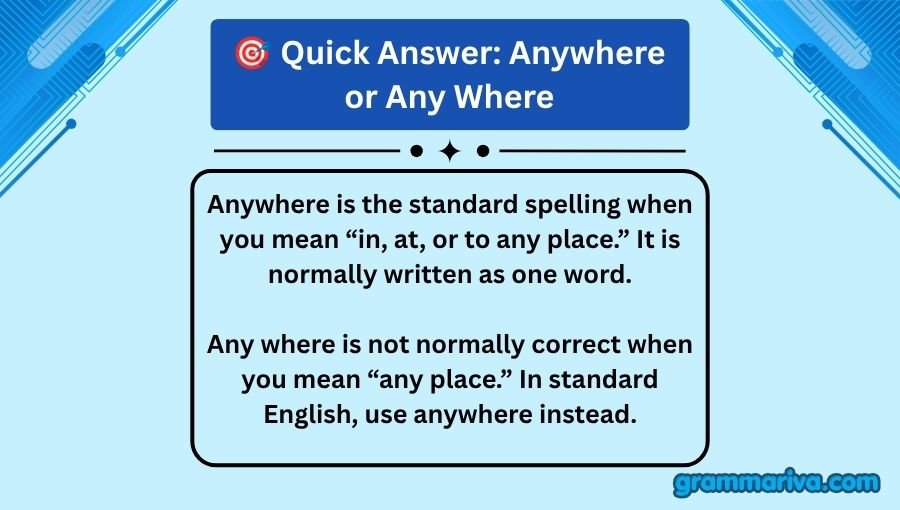
Anywhere is the standard spelling when you mean “in, at, or to any place.” It is normally written as one word.
Any where is not normally correct when you mean “any place.” In standard English, use anywhere instead.
| Form | Standard Use | Example |
|---|---|---|
| anywhere | Correct adverb/pronoun form | You can sit anywhere. |
| any where | Usually incorrect for “any place” | You can sit any where. ❌ |
| anywhere else | Correct phrase | Is there anywhere else to go? |
| from anywhere | Correct phrase | I can work from anywhere. |
The easiest rule is simple: when anywhere means “any place,” keep it together.
📚 Is Anywhere the Same as Any Where?
No. Anywhere is a standard one-word form meaning “any place.” The two-word spelling any where is generally not used for this meaning.
I teach students to think of anywhere as a complete word. You do not need to break it into any plus where when you mean an unspecified place.
Compare these sentences:
- ✅ You can meet me anywhere.
- ❌ You can meet me any where.
The first sentence is standard English.
The confusion happens because any and where are both real English words. However, the fact that two words exist separately does not mean they should always be written separately.
English has many combined words that work in a similar way.
- someone
- somewhere
- anyone
- anywhere
- everyone
- everywhere
- no one
- nowhere
These forms have different grammar rules, so it helps to learn each one as a complete word.
✏️ Anywhere: Meaning and Correct Use
Anywhere refers to an unspecified place or to any place that meets a condition. It is most often used as an adverb.
Here are some common uses.
Anywhere as “Any Place”
This is the most common meaning.
- ✅ You can park anywhere on this street.
- ❌ You can park any where on this street.
Here, anywhere means “any place on this street.”
The exact location does not matter. The speaker is saying that all suitable places are possible.
Anywhere in Questions
We often use anywhere when asking about a possible location.
- ✅ Did you go anywhere after work?
- ❌ Did you go any where after work?
The speaker is asking whether the person went to any place.
Another example:
- ✅ Have you seen my keys anywhere?
- ❌ Have you seen my keys any where?
Again, anywhere is one word.
Anywhere in Negative Sentences
Anywhere is also common with negative words such as not.
- ✅ I couldn’t find my phone anywhere.
- ❌ I couldn’t find my phone any where.
The sentence means that the speaker searched all possible places but did not find the phone.
Anywhere With “Else”
The phrase anywhere else is also very common.
- ✅ Would you like to go anywhere else?
- ❌ Would you like to go any where else?
The word else means another or additional place in this context.
Meaning Summary
| Meaning | Word Type | Example Sentence |
|---|---|---|
| Any place | Adverb | Sit anywhere you like. |
| Any possible place | Adverb | I looked anywhere I could. |
| An unspecified place in a question | Adverb | Did you travel anywhere? |
| No place at all in a negative sentence | Adverb | We couldn’t find it anywhere. |
💡 Test Tip
Replace anywhere with any place.
If the sentence still makes sense, anywhere is probably the form you need.
For example:
You can go anywhere.
Replace the word:
You can go any place.
The meaning still works. That tells you that anywhere is being used as the one-word form of “any place.”
🔎 Anywhere vs Any Where at a Glance
The basic difference is spelling and grammatical function. Anywhere is the normal word for an unspecified place, while any where is generally not the standard spelling for that meaning.
| Form | Type | Meaning | Example | Correct/Incorrect |
|---|---|---|---|---|
| anywhere | Adverb | Any place | We can eat anywhere. | ✅ Correct |
| any where | Two separate words | Usually not the intended form | We can eat any where. | ❌ Incorrect |
| anywhere else | Phrase | Any other place | Let’s look anywhere else. | ✅ Correct |
| from anywhere | Phrase | From any place | She can work from anywhere. | ✅ Correct |
| anywhere nearby | Phrase | Any place nearby | Is there anywhere nearby? | ✅ Correct |
🧠 Why Do People Confuse Anywhere and Any Where?
People often confuse these forms because any and where can both appear as separate words in English. When someone types quickly, it is easy to treat them as two independent words.
Another reason is that English spelling does not always follow a simple rule. Some combinations become one word, while others stay separate.
For example:
- anyone is one word.
- anywhere is one word.
- any time can often be written as two words.
- anyway is one word.
I once reviewed a student’s short essay where the student wrote “any where” several times. The student knew exactly what the sentence meant. The problem was not grammar knowledge. The student was simply treating any and where as separate building blocks. Once we connected anywhere with somewhere and everywhere, the pattern became much easier to remember.
| Confusion | Correct Form | Reason |
|---|---|---|
| any where | anywhere | Standard word for any place |
| some where | somewhere | Standard word for some place |
| every where | everywhere | Standard word for all places |
| no where | nowhere | Standard word for no place |
| any one | anyone | Standard word for any person |
| some one | someone | Standard word for some person |
The pattern is useful because it gives your brain a familiar group to remember.
📝 Case Study: A Simple Workplace Example
Imagine that you are writing an email to a coworker about a meeting.
You might write:
“We can meet anywhere near the office.”
That sentence is clear and professional. You are telling your coworker that the exact location is flexible.
Now imagine writing:
“We can meet any where near the office.”
The meaning is still easy to understand, but the spelling looks incorrect. A professional reader may notice the mistake immediately.
I once caught a similar typo while editing a short workplace message. The writer had typed any where because they were moving quickly between several tasks. The fix took only a second, but it made the message look much cleaner.
| Situation | Better Sentence | Why |
|---|---|---|
| Meeting | We can meet anywhere. | Natural and standard |
| Travel | You can stay anywhere nearby. | Shows flexible location |
| Work | I can work from anywhere. | Common expression |
| Shopping | You can buy it anywhere. | Means any place |
| Directions | Is there anywhere close? | Natural question |
The lesson is simple: even small spelling choices affect how polished your writing looks.
⚙️ Grammar Rules Explanation
The standard form for the meaning “any place” is anywhere.
The word works mainly as an adverb. It tells us about location. It can appear after a verb, at the end of a sentence, or in questions and negative statements.
Examples:
- You can sit anywhere.
- I looked everywhere, but I couldn’t find it.
- Did you go anywhere?
- She doesn’t want to live anywhere cold.
The spelling any where is normally not used when the intended meaning is simply “any place.”
There can be unusual contexts in which words happen to appear next to each other, but that does not make any where a normal alternative spelling of anywhere.
Most standard English references treat anywhere as the normal one-word form. When you are writing for school, work, publishing, or general communication, anywhere is the safe choice.
Correct vs Incorrect at a Glance
| Sentence | Correct/Incorrect | Why |
|---|---|---|
| You can sit anywhere. | ✅ Correct | Anywhere means any place. |
| You can sit any where. | ❌ Incorrect | The intended meaning requires anywhere. |
| I couldn’t find it anywhere. | ✅ Correct | Standard negative construction. |
| I couldn’t find it any where. | ❌ Incorrect | Anywhere should be one word. |
| Is there anywhere we can park? | ✅ Correct | Standard question form. |
⚠️ Common Mistakes With Anywhere
The most common mistake is simply separating the word.
This often happens for three reasons:
- Fast typing
People type quickly and accidentally insert a space. - Autocorrect
Phones and writing apps can sometimes change spacing or suggest unexpected forms. - Lack of knowledge
A writer may know what the word means but not remember its standard spelling.
Here are some related spelling confusions that work in a similar way.
| Confusion | Correct Form | Example |
|---|---|---|
| its / it’s | Depends on meaning | It’s cold. / The dog hurt its paw. |
| your / you’re | Depends on meaning | Your book. / You’re ready. |
| their / there / they’re | Depends on meaning | Their car is there. They’re inside. |
| then / than | Depends on meaning | First this, then that. |
| to / too / two | Depends on meaning | Go to school. Me too. Two books. |
Specific Anywhere Mistakes
| Wrong Form | What’s Wrong | Correct Form |
|---|---|---|
| any where | Unnecessary space | anywhere |
| any-where | Incorrect hyphenation | anywhere |
| Any Where | Incorrect capitalization and spacing | anywhere |
| any where else | Incorrect spacing | anywhere else |
| from any where | Incorrect spacing | from anywhere |
The best solution is not to memorize dozens of rules. Memorize anywhere as one complete word.
🕰️ Anywhere Word History and Spelling Pattern
The useful history here is not complicated. English developed many compounds that combine words related to people, things, and places.
Words such as somewhere, everywhere, nowhere, and anywhere follow a clear pattern. They combine a word that expresses quantity or choice with where to create a word connected to place.
| Period | Form | Note |
|---|---|---|
| Earlier English | where | Word connected with place or location |
| Compound development | somewhere | A place that is not specified |
| Compound development | everywhere | All places |
| Compound development | nowhere | No place |
| Modern English | anywhere | Any place or any possible place |
The main point for modern writers is spelling. Anywhere is now established as a standard one-word form.
You do not need to know the complete history to use it correctly.
🌎 Usage in Different Contexts
The word anywhere works naturally in many kinds of writing. Its basic meaning stays the same, but the tone can change depending on the setting.
Everyday Conversation
This is where you will hear anywhere most often.
“We can go anywhere you want.”
The sentence sounds natural and relaxed.
Professional Writing
Professional writing also uses anywhere.
“The software can be accessed from anywhere with an internet connection.”
The word is clear and standard.
Creative Writing
Writers can use anywhere to describe freedom, movement, or an unknown location.
“She wanted to run anywhere the road would take her.”
Social Media and Texting
Short posts often use anywhere because it is quick and familiar.
“Take me anywhere with good food. 🍕”
| Context | Which Term to Use | Example |
|---|---|---|
| Everyday conversation | anywhere | We can go anywhere. |
| Professional writing | anywhere | Employees can work from anywhere. |
| Creative writing | anywhere | He would travel anywhere for her. |
| Social media/texting | anywhere | Anywhere but home today! |
💬 Common Phrases With Anywhere
There are several common phrases that use anywhere.
These expressions are worth learning because they make the correct spelling feel natural.
| Phrase | Meaning |
|---|---|
| anywhere else | Any other place |
| from anywhere | From any place |
| anywhere you want | Any place you choose |
| anywhere near | At or close to any place |
| anywhere in the world | Any location in the world |
| anywhere at all | Any possible place |
Examples:
- You can choose anywhere you want.
- I would travel anywhere in the world.
- Is there anywhere else we should check?
- She can work from anywhere.
Once these phrases become familiar, writing any where starts to look strange.
🔄 Synonyms and Alternatives for Anywhere
Sometimes you can replace anywhere with another expression. The best choice depends on the sentence.
“Any Place”
This is the closest replacement.
You can sit anywhere.
can become:
You can sit in any place.
However, anywhere is shorter and more natural in many sentences.
“Wherever”
Wherever can work when you mean “in any place that” or “at any place that.”
Go anywhere you like.
can become:
Go wherever you like.
The meaning is close, but the grammar and sentence structure are slightly different.
“Every Place”
This does not always replace anywhere. It means all places, not an unspecified possible place.
| Alternative | Works When | Does Not Work When |
|---|---|---|
| any place | You want a direct phrase replacement | You want the shortest natural form |
| wherever | You mean any place that meets a condition | You are asking a simple location question |
| any location | Formal or technical writing | Casual conversation |
| anywhere | General location meaning | When you specifically mean all places |
For most everyday sentences, anywhere is the easiest and most natural choice.
🎯 How to Remember Anywhere Easily
The best memory trick is to connect anywhere with its word family.
Think:
somewhere → anywhere → everywhere → nowhere
All four are standard one-word forms.
You can also use the “any place” test.
If you can replace the word with any place, write anywhere.
Examples:
You can sit anywhere.
→ You can sit in any place.
Did you go anywhere?
→ Did you go to any place?
I couldn’t find it anywhere.
→ I couldn’t find it in any place.
This simple test works in many everyday cases.
| Memory Check | Result |
|---|---|
| Does it mean “any place”? | Use anywhere |
| Is it a question about a possible place? | Usually use anywhere |
| Is it a negative sentence about location? | Usually use anywhere |
| Are you tempted to add a space? | Check whether you mean anywhere |
🧩 When Anywhere Appears With Other Words
Anywhere can appear with many prepositions and modifiers.
Common examples include:
- anywhere in
- anywhere near
- anywhere else
- anywhere outside
- anywhere around
- anywhere at all
- from anywhere
- go anywhere
Examples:
- ✅ You can find coffee shops anywhere in this city.
- ✅ Is there anywhere near here that serves breakfast?
- ✅ I don’t want to go anywhere else.
- ✅ She can study from anywhere.
Notice that anywhere stays together even when other words follow it.
This is another reason it helps to treat the word as a complete vocabulary item rather than as two separate words.
📱 Anywhere in Digital Communication
Digital writing creates special problems because people type quickly. Text messages, social media captions, comments, and emails often contain spacing mistakes.
Still, the standard spelling does not change because the message is informal.
You might type:
“I can meet anywhere lol 😂”
The tone is casual, but anywhere is still one word.
A social media post can be informal without using incorrect spelling.
| Digital Setting | Example | Standard Spelling |
|---|---|---|
| Text message | We can go anywhere 😊 | anywhere |
| Instagram caption | Anywhere with this view. | anywhere |
| Comment | I’d eat anywhere for that pizza. | anywhere |
| We can meet anywhere nearby. | anywhere |
Informal writing gives you more freedom with tone. It does not require you to split standard words.
💼 Why Getting Anywhere Right Matters
Spelling may seem like a tiny detail, but small errors can affect how readers view your writing.
Clear spelling helps with:
- Clarity
- Professionalism
- Reading speed
- Trust
- Digital communication
A reader should focus on your message instead of wondering whether a word has been written correctly.
A useful writing principle is:
Good grammar should make your message easier to read, not harder to understand.
| Situation | Why Getting It Right Matters |
|---|---|
| Resume | Shows attention to detail |
| Client email | Creates a polished impression |
| Published content | Supports clean, professional writing |
| Social post | Makes short text look more polished |
This does not mean every typo is a disaster. It simply means that learning common words like anywhere can make your writing stronger with very little effort.
🚫 Special Exception: Is Any Where Ever Correct?
There is no normal spelling exception that makes any where an alternative form of anywhere when you mean “any place.”
In standard modern writing, use anywhere for the location meaning.
The important distinction is that English can sometimes place words next to each other for unusual grammatical reasons. That does not mean any where is a normal alternative spelling.
So if your sentence means:
“any place”
choose:
anywhere
That rule will cover almost every ordinary situation.
📋 Anywhere or Any Where: Quick Recap Checklist
Use this checklist whenever you are unsure.
| Question | If Yes → Use |
|---|---|
| Does the word mean “any place”? | anywhere |
| Are you asking whether someone went to a place? | anywhere |
| Does the sentence mean “in any possible place”? | anywhere |
| Are you using “any place” as the test? | anywhere |
| Are you tempted to add a space? | anywhere |
Practice Examples
Try these before checking the answers:
- You can sit ______ you like.
- Did you go ______ after lunch?
- I couldn’t find my wallet ______.
- Is there ______ else we can eat?
Answers:
- anywhere ✅
- anywhere ✅
- anywhere ✅
- anywhere ✅
The pattern is consistent.
❓ FAQs About Anywhere vs Any Where
Is anywhere one word?
Yes. Anywhere is normally written as one word when it means “any place” or refers to an unspecified location.
Is any where ever correct?
Usually, no. When you mean “any place,” the standard form is anywhere. Writing any where with a space is normally a spelling error.
Which is correct, anywhere or any where?
Anywhere is correct when you mean “any place.” For example, “You can sit anywhere” is correct.
Can I say “anywhere else”?
Yes. Anywhere else is a standard phrase meaning “any other place.”
Example: Would you like to go anywhere else?
Is anywhere an adverb?
Yes. Anywhere is commonly used as an adverb to describe an unspecified place or location.
Example: We can meet anywhere.
How can I remember how to spell anywhere?
Connect it with somewhere, everywhere, and nowhere. These are all normally written as one word. You can also replace anywhere with “any place” as a quick test.
Why do people write any where?
The mistake often comes from treating any and where as separate words. Fast typing, autocorrect, and uncertainty about compound words can also cause the error.
Is anywhere used in negative sentences?
Yes. Anywhere is very common in negative sentences.
Example: I couldn’t find my glasses anywhere.
Can anywhere be used in questions?
Yes. It is common in questions about possible locations.
Example: Did you go anywhere yesterday?
What is the difference between anywhere and wherever?
Anywhere usually means any place. Wherever often means any place that meets a condition or any place at all, depending on context.
For example, “Sit anywhere” and “Sit wherever you like” have very similar meanings, but their sentence structures differ.
🏁 Conclusion
Anywhere or any where becomes easy once you remember one simple rule: when you mean “any place,” write anywhere as one word. It works naturally in questions, negative sentences, everyday conversations, professional emails, creative writing, and social media posts. ✨
I recommend learning anywhere as a complete word instead of thinking of it as two separate words. The same approach works with related forms such as somewhere, everywhere, and nowhere. When you see the pattern, the spelling becomes much easier to remember.
If you are ever unsure, use the “any place” test. If the word means “any place,” anywhere is usually the right choice.
Small spelling choices can make a big difference in polished writing. So the next time you type the word, skip the space and keep it together.
Any place means anywhere, and anywhere stays one word. 🌎

Hi, I’m Nathan Reed. I’m a grammar and writing specialist at Grammariva. I work on practical grammar content that helps readers understand sentence structure, punctuation, vocabulary, and better writing habits.


[…] form, why both exist, common mistakes, examples, and an easy way to remember the difference. ✨ Anywhere or Any Where | Reschedule to or Reschedule for | Dual vs […]