Have you ever wondered about the difference between disinterested vs uninterested? These two words look similar and often confuse English learners, but they have different meanings. Disinterested describes someone who is fair and has no personal benefit in a situation. Uninterested describes someone who lacks curiosity, attention, or enthusiasm. Choosing the correct word helps you communicate clearly and avoid common grammar mistakes.
The difference between disinterested vs uninterested is simple once you understand what each word means. Disinterested describes someone who is fair and has no personal benefit in a situation. Uninterested describes someone who does not feel curious, excited, or eager about something.
As an English teacher and editor, I have seen these words cause confusion in schoolwork, business emails, and everyday writing. The good news is that you do not need to memorize a long list of grammar rules. A few simple examples can help you choose the right word every time. 🎯
In this guide, I will explain both terms, show their correct uses, and share easy memory tips. By the end, you will know how to use them with confidence. Let’s make this common grammar problem easy! 😊 Nauseous vs Nauseated | Literally vs Figuratively | Compose vs Comprise
🎯 Quick Answer: Disinterested vs Uninterested
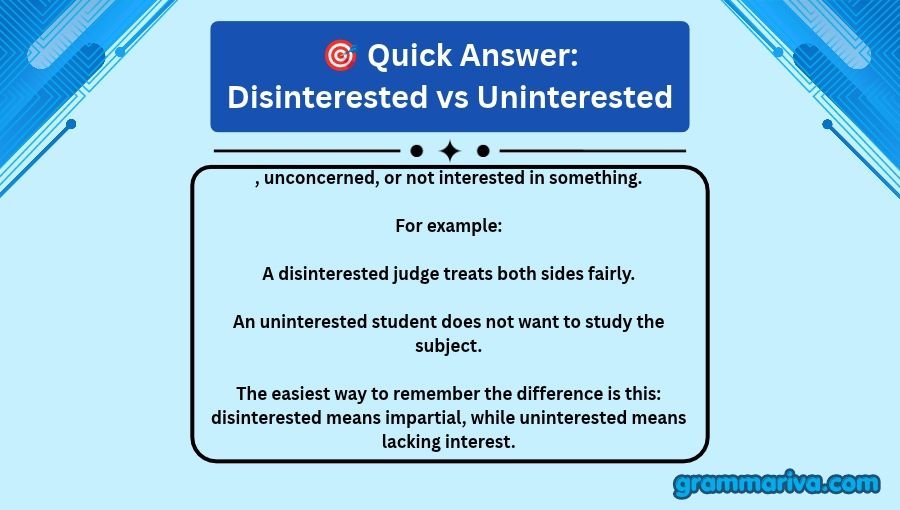
Disinterested means fair, neutral, or not personally involved in a situation. Uninterested means bored, unconcerned, or not interested in something.
For example:
- A disinterested judge treats both sides fairly.
- An uninterested student does not want to study the subject.
The easiest way to remember the difference is this: disinterested means impartial, while uninterested means lacking interest.
Understanding the Basics of Disinterested vs Uninterested
The main difference between these words is the idea they express. One describes fairness. The other describes a lack of curiosity or attention.
Both words are adjectives. They describe people, actions, or attitudes. However, they are not interchangeable in careful standard English.
Disinterested: Meaning and Correct Use
Disinterested means having no personal interest, benefit, or connection that could affect someone’s judgment.
A disinterested person can look at a situation without favoring one side. This quality is useful when making fair decisions.
Examples:
- We need a disinterested judge for the competition.
- The manager asked a disinterested expert to review the complaint.
- A disinterested observer gave an honest report.
Sentence breakdown:
In the sentence “We need a disinterested judge,” the word disinterested describes the judge. It means the judge has no personal reason to favor any contestant.
It does not mean the judge is bored or does not care about the competition.
Uninterested: Meaning and Correct Use
Uninterested means not feeling curious, excited, or willing to pay attention to something.
An uninterested person may not want to join an activity or learn about a subject. The word describes a lack of interest.
Examples:
- My brother is uninterested in sports.
- The children seemed uninterested during the long speech.
- She was uninterested in buying a new phone.
Sentence breakdown:
In the sentence “My brother is uninterested in sports,” the word uninterested explains his feelings toward sports. He does not enjoy them or want to learn more about them.
Comparison Table
| Form | Type | Meaning | Example | Correct/Incorrect |
|---|---|---|---|---|
| Disinterested | Adjective | Fair and neutral | A disinterested judge reviewed the case. | Correct |
| Uninterested | Adjective | Not curious or eager | She is uninterested in tennis. | Correct |
| Disinterested | Adjective | Used to mean bored in careful writing | He was disinterested in the movie. | Usually incorrect for this meaning |
| Uninterested | Adjective | Used to mean impartial | We need an uninterested judge. | Incorrect for the intended meaning |
What Does Disinterested Mean in Everyday English?
Disinterested means free from personal interest or benefit when making a decision. It often describes someone who can judge a situation fairly.
Neutral and Fair Judgment
A disinterested person does not allow personal feelings or rewards to control a decision.
For example:
- The company hired a disinterested reviewer.
- Both teams agreed to use a disinterested referee.
- We asked a disinterested neighbor to settle the argument.
In each example, the person is expected to be fair.
No Personal Benefit
The word can also describe someone who has nothing to gain from a choice.
For example:
“The consultant gave disinterested advice.”
This means the consultant did not recommend something because of a personal reward.
Independent Opinions
A disinterested opinion comes from someone who is not personally involved in the issue.
For example:
“We wanted a disinterested opinion before making our final choice.”
This means the group wanted advice from someone who could look at the matter fairly.
What Does Uninterested Mean in Everyday English?
Uninterested means lacking curiosity, attention, or enthusiasm. It describes a person who does not want to take part in something or learn more about it.
Lack of Curiosity
Someone who is uninterested may not want to know more about a topic.
Examples:
- He is uninterested in science.
- I was uninterested in the news.
- The child seemed uninterested in the story.
Lack of Enthusiasm
Uninterested can also describe someone who does not feel excited about an event or activity.
Examples:
- She looked uninterested in the party.
- The players seemed uninterested in practice.
- My friends were uninterested in watching the game.
Lack of Attention
A person may appear uninterested when they do not listen or pay attention.
Examples:
- The audience looked uninterested during the presentation.
- He gave an uninterested reply.
- Several students seemed uninterested in the lesson.
💡 Test Tip: How to Remember the Difference
Here is a simple trick I teach students.
Think of disinterested as disconnected from personal gain. Think of uninterested as having no interest in the subject.
Use these memory questions:
- Does the person need to be fair? Use disinterested.
- Does the person feel bored or uninterested? Use uninterested.
- Is the person free from personal benefit? Use disinterested.
- Does the person not care about an activity? Use uninterested.
Easy Memory Table
| Meaning | Word to Use | Example Sentence |
|---|---|---|
| Fair and neutral | Disinterested | We need a disinterested judge. |
| Not excited | Uninterested | He is uninterested in dancing. |
| No personal benefit | Disinterested | She offered disinterested advice. |
| Not curious | Uninterested | They seemed uninterested in the topic. |
A quick test is to replace the word with “impartial” or “not interested.” If impartial fits, choose disinterested. If not interested fits, choose uninterested.
📝 Case Study: Disinterested vs Uninterested at Work
Imagine that a company has two employees who disagree about a new project. Both believe their ideas are better. Their manager wants to solve the problem fairly.
Instead of choosing one employee’s opinion, the manager asks an outside expert to review the plans.
The expert has no connection to either employee. The expert also receives no reward based on which plan wins.
The expert is a disinterested reviewer because the person can make a neutral decision.
Now imagine that another employee is invited to attend the project meeting. The employee does not want to participate and does not care about the project.
That employee is uninterested.
What Is the Difference in This Case?
| Situation | Correct Word | Reason |
|---|---|---|
| The outside expert reviews both plans fairly. | Disinterested | The expert has no personal interest. |
| The employee does not want to attend. | Uninterested | The employee lacks interest. |
| The manager wants a neutral opinion. | Disinterested | The goal is fairness. |
| The employee ignores the discussion. | Uninterested | The employee lacks attention. |
I once edited a workplace training example where an employee was called disinterested because he did not want to attend a meeting. The intended word was uninterested. Changing that one word made the situation much clearer.
Grammar Rules Explanation: When to Use Each Word
Both words are adjectives. They describe people, feelings, and attitudes. The correct choice depends on the meaning of the sentence.
Rule A: Use Disinterested for Impartiality
Use disinterested when someone is free from personal interest or advantage.
Correct examples:
- A disinterested lawyer reviewed the agreement.
- We need a disinterested person to settle this dispute.
- The committee selected a disinterested evaluator.
The word shows that the person can make a fair decision.
Rule B: Use Uninterested for a Lack of Interest
Use uninterested when someone does not feel curious, excited, or willing to participate.
Correct examples:
- My son is uninterested in history.
- The audience seemed uninterested in the lecture.
- She was uninterested in joining the club.
The word explains a person’s feelings toward something.
Rule C: Check the Meaning Before Choosing
Do not select a word only because it looks familiar. Think about what you want to say.
Consider these sentences:
- The judge was disinterested in the case.
- The judge was uninterested in the case.
The first sentence suggests that the judge was impartial. The second suggests that the judge lacked interest in the case.
Both sentences can be grammatically correct, but they communicate different ideas.
Rule D: Use the Right Word in Formal Writing
In professional and academic writing, it is best to preserve the traditional distinction.
Most standard English reference sources recognize disinterested as meaning impartial and uninterested as meaning not interested. Although some speakers use disinterested to mean bored, uninterested is the clearer choice for that meaning.
Correct vs Incorrect at a Glance
| Sentence | Correct/Incorrect | Why |
|---|---|---|
| We need a disinterested judge. | Correct | The judge must be impartial. |
| I am uninterested in basketball. | Correct | The speaker lacks interest. |
| She is disinterested in reading because it is boring. | Usually incorrect | Uninterested better expresses boredom. |
| The committee needs an uninterested reviewer to ensure fairness. | Incorrect for intended meaning | Disinterested is the better word. |
| He gave a disinterested opinion without personal gain. | Correct | The opinion is impartial. |
Why Do People Confuse Disinterested and Uninterested?
People confuse these words because they look similar and both relate to the idea of interest. However, their meanings are different.
Similar Spellings
Both words contain the word “interested.” This makes it easy to think they mean the same thing.
However, their prefixes change their meanings.
Similar Situations
Both words can appear in conversations about people and their attitudes.
For example, someone may describe a person as disinterested during a meeting. The reader may not know whether that person was fair or bored.
The surrounding words help explain the intended meaning.
Everyday Speech
In casual conversations, people sometimes use disinterested when they mean uninterested. Listeners may understand the intended message from context.
However, this habit can create confusion in formal writing.
I once caught myself using disinterested in a draft about a student who had stopped paying attention during class. When I checked the sentence, uninterested was clearly the better choice.
Common Reasons for Confusion
- Fast typing: People choose the first similar word that comes to mind.
- Autocorrect: A writing tool may not recognize the meaning the writer intends.
- Lack of knowledge: Some people have never learned the difference.
- Similar spelling: Both words share the same root.
- Casual speech: People often use words loosely in everyday conversation.
Similar Grammar Confusions
| Word Pair | First Meaning | Second Meaning |
|---|---|---|
| It’s / Its | It is or it has | Belonging to it |
| Your / You’re | Belonging to you | You are |
| Affect / Effect | Usually a verb meaning to influence | Usually a noun meaning a result |
| Accept / Except | Receive or agree | Excluding |
| Advice / Advise | A noun for guidance | A verb meaning to guide |
| Disinterested / Uninterested | Impartial | Not interested |
Common Wrong Uses of These Terms
| Wrong Form | What’s Wrong | Correct Form |
|---|---|---|
| I am disinterested in football. | If you mean you do not enjoy it, the word is unclear. | I am uninterested in football. |
| We need an uninterested judge. | It may suggest the judge does not care. | We need a disinterested judge. |
| She gave uninterested advice. | This suggests she lacked interest while giving advice. | She gave disinterested advice. |
| He was disinterested in the lesson. | It may not clearly express boredom. | He was uninterested in the lesson. |
| A disinterested fan watched the game. | It may suggest impartiality rather than boredom. | An uninterested fan watched the game. |
| The referee was uninterested in both teams. | It does not clearly express neutrality. | The referee was disinterested in both teams. |
Disinterested vs Uninterested in Different Contexts
The correct word can change depending on what you want to communicate. Both terms are useful in everyday life, professional writing, creative work, and online conversations.
Everyday Conversation
Use uninterested when someone does not want to join an activity or discuss a topic.
Use disinterested when talking about a fair person or neutral opinion.
Examples:
- My cousin is uninterested in cooking.
- We asked a disinterested friend to settle the argument.
Professional Writing
Disinterested is useful when describing fair reviews, independent advice, and neutral decisions.
Uninterested is useful when describing a person’s lack of interest in a task or subject.
Examples:
- The company requested a disinterested review.
- The employee seemed uninterested in the training session.
Creative Writing
Writers can use both words to describe characters and their behavior.
Examples:
- The disinterested judge listened to both sides.
- The uninterested teenager left the room.
The right choice helps readers understand the character’s attitude.
Social Media and Texting
Uninterested is usually the better word when talking about something you do not enjoy.
Examples:
- I’m uninterested in that show.
- He seems uninterested in the conversation.
Disinterested can still work in posts about fairness or neutrality.
Context Comparison Table
| Context | Which Term to Use | Example |
|---|---|---|
| Everyday conversation | Both, depending on meaning | I am uninterested in golf. |
| Professional writing | Both, depending on meaning | We hired a disinterested reviewer. |
| Creative writing | Both | The uninterested boy left early. |
| Social media/texting | Usually uninterested for boredom | I’m uninterested in that trend. |
Common Phrases With Disinterested and Uninterested
Certain phrases make these words easier to understand. Learning them can help you use each adjective naturally.
Common Phrases With Disinterested
- Disinterested party
- Disinterested observer
- Disinterested judge
- Disinterested opinion
- Disinterested advice
- Disinterested evaluation
Common Phrases With Uninterested
- Uninterested audience
- Uninterested student
- Uninterested listener
- Uninterested buyer
- Uninterested reader
- Uninterested participant
Phrase Comparison Table
| Phrase | Meaning |
|---|---|
| Disinterested party | A person with no personal stake in a matter |
| Disinterested observer | Someone who watches without personal involvement |
| Disinterested opinion | An impartial point of view |
| Uninterested audience | People who lack interest in a performance |
| Uninterested buyer | Someone who does not want to purchase something |
| Uninterested reader | Someone who does not feel curious about a text |
Synonyms and Alternatives
You can sometimes replace these words with other terms. However, not every synonym works in every situation.
Alternatives for Disinterested
- Impartial: Fair and not favoring either side.
- Neutral: Not supporting one side.
- Unbiased: Free from unfair opinions.
- Objective: Based on facts rather than personal feelings.
Alternatives for Uninterested
- Bored: Not entertained or engaged.
- Indifferent: Showing little concern or feeling.
- Unconcerned: Not worried or interested.
- Apathetic: Showing little interest or enthusiasm.
Synonym Comparison Table
| Alternative | Works When | Does Not Work When |
|---|---|---|
| Impartial | Someone must judge fairly. | Someone simply feels bored. |
| Neutral | A person does not support either side. | A person has no curiosity. |
| Unbiased | An opinion must be fair. | Someone does not want to participate. |
| Bored | Someone feels tired of an activity. | Someone must make a fair decision. |
| Indifferent | Someone shows little concern. | A person is expected to act as an impartial judge. |
Remember that synonyms can have slightly different meanings. Always check the sentence before replacing a word.
⚠️ Why Using the Correct Word Matters
Choosing the right word makes your writing clear and helps readers understand your message.
Clarity in Communication
The wrong word can change the meaning of a sentence.
A disinterested judge is expected to be fair. An uninterested judge may seem unwilling to do the job.
These are two very different situations.
Professionalism
Correct word choice makes business emails, reports, and academic papers more effective.
For example, describing a reviewer as disinterested shows that you value fairness. Calling the reviewer uninterested may suggest a lack of attention.
Digital Writing Accuracy
Online readers often scan content quickly. Clear word choices help them understand your message without guessing.
This matters in blog posts, social media captions, newsletters, and website content.
A Simple Writing Reminder
“Clear words create clear meaning.”
Before publishing a sentence, ask yourself whether the word expresses fairness or a lack of interest.
Why Getting It Right Matters
| Situation | Why Getting It Right Matters |
|---|---|
| Resume | Shows strong language skills. |
| Client email | Prevents confusion about a person’s attitude. |
| Published content | Improves accuracy and reader trust. |
| Social post | Helps readers understand your message. |
How to Remember Disinterested vs Uninterested
The easiest way to remember the difference is to connect each word with a simple idea.
Remember Disinterested as Fair
Think about a judge who has no reason to support either side.
That judge should be disinterested.
Remember Uninterested as Not Interested
Think about a person who does not enjoy a movie or activity.
That person is uninterested.
Use These Simple Memory Sentences
- A disinterested referee treats both teams fairly.
- An uninterested fan does not enjoy the match.
- A disinterested expert gives neutral advice.
- An uninterested student does not want to study.
Quick Memory Table
| Word | Memory Clue | Main Idea |
|---|---|---|
| Disinterested | Fair judgment | Impartial |
| Uninterested | No curiosity | Not interested |
Quick Recap Checklist
Use this checklist before choosing either word in your writing.
| Question | If Yes → Use |
|---|---|
| Is the person expected to be fair? | Disinterested |
| Does the person have no personal benefit? | Disinterested |
| Does the person feel bored? | Uninterested |
| Does the person lack curiosity? | Uninterested |
| Does the person not want to participate? | Uninterested |
Practice Examples
Choose the correct word in each sentence.
Example A: We need a ______ person to review the complaint.
Answer: Disinterested.
Reason: The person should review the complaint fairly.
Example B: My sister is ______ in learning how to swim.
Answer: Uninterested.
Reason: She does not want to learn the activity.
Example C: The audience looked ______ during the long presentation.
Answer: Uninterested.
Reason: The audience lacked attention and enthusiasm.
Test Your Knowledge
| Sentence | Correct Answer |
|---|---|
| The judge must remain ______. | Disinterested |
| I am ______ in watching that movie. | Uninterested |
| We requested a ______ opinion. | Disinterested |
FAQs About Disinterested vs Uninterested
What Is the Difference Between Disinterested and Uninterested?
Disinterested means impartial or free from personal benefit. Uninterested means not curious, excited, or willing to pay attention to something.
Is Disinterested the Same as Uninterested?
No. Disinterested traditionally describes fairness and neutrality. Uninterested describes a lack of interest or enthusiasm. They should not be treated as exact synonyms in careful writing.
Can Disinterested Mean Bored?
Some speakers use disinterested to mean bored or not interested. However, this use can create confusion. Uninterested is the clearer and safer choice when you mean someone lacks interest.
Is Uninterested a Negative Word?
Uninterested is not automatically rude or offensive. It simply describes a lack of interest. However, the word can sound negative when used to describe someone’s attitude toward a person or activity.
How Do You Use Disinterested in a Sentence?
Use disinterested when describing someone who can make a fair decision without personal gain.
Example: “The company hired a disinterested expert to review the proposal.”
How Do You Use Uninterested in a Sentence?
Use uninterested when describing someone who does not feel curious or excited about something.
Example: “The students were uninterested in the long presentation.”
Should I Use Disinterested or Uninterested in Professional Writing?
Use disinterested when you mean impartial or unbiased. Use uninterested when you mean someone lacks interest. This distinction makes professional writing more precise.
Is a Disinterested Party Fair?
Yes. A disinterested party has no personal stake in the matter. This makes the person suitable for reviewing a dispute or helping both sides reach a fair decision.
What Is Another Word for Uninterested?
Common alternatives include bored, indifferent, unconcerned, and apathetic. The best choice depends on the exact feeling you want to describe.
What Is the Opposite of Disinterested?
Depending on the intended meaning, an opposite could be biased, partial, or personally involved. These words describe someone who has a personal interest or favors one side.
Conclusion
Understanding disinterested vs uninterested becomes easy when you focus on the meaning behind each word. Disinterested describes someone who is impartial and has no personal benefit in a situation. Uninterested describes someone who lacks curiosity, attention, or enthusiasm.
As an editor, I recommend using these words carefully, especially in professional and academic writing. A small word choice can change the message of an entire sentence. When you are unsure, try replacing disinterested with impartial or uninterested with not interested. The sentence will often reveal the correct choice.
Remember these two simple rules: a fair judge is disinterested, while a bored student is uninterested. Keep these examples in mind whenever you write an email, article, school assignment, or social media post.
Good grammar is not about using difficult words. It is about choosing the right words to express your thoughts clearly. Master this small difference, and your English will become more accurate, natural, and confident. ✨

Hi, I’m Olivia Carter. I’m an English language editor at Grammariva, and I work on making grammar lessons clear, accurate, and easy to follow. I especially enjoy writing about common grammar mistakes and everyday English.
[…] will know exactly when to use each word. Let’s make this grammar rule easy to remember! 🎯 Disinterested vs Uninterested | Nauseous vs Nauseated | Literally vs […]