Have you ever typed a word that looks right, only to wonder if one letter is wrong? 🤔 Supercede vs supersede is one of those spelling questions that can stop a writer in the middle of a sentence. The two forms look almost identical, and they are often confused because both seem to fit the same idea. However, standard modern English strongly favors one spelling.
When I edit business emails, school papers, and website content, I often see this word written with a c instead of an s. The mistake is easy to make, especially when you hear the word rather than see it. The good news is that the rule is simple once you learn it.
In this guide, I’ll explain which spelling to use, what the word means, how it works in a sentence, and why the other form causes trouble.
You’ll also see clear examples, common mistakes, memory tips, and FAQs so you can make the right choice with confidence. ✍️ Chateaus vs Chateaux | What Kind of vs What Kinds of | Has Long Been vs Has Been for a Long Time
🎯 Quick Answer: Supercede vs Supersede
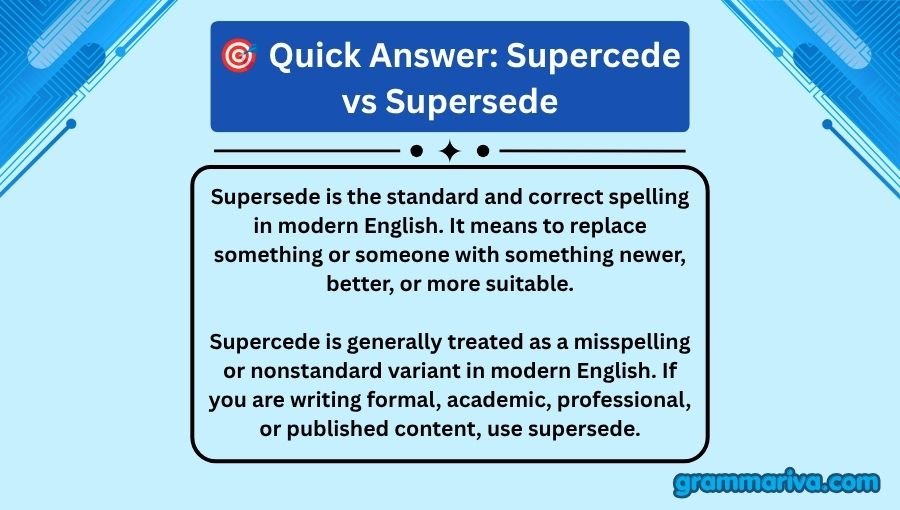
Supersede is the standard and correct spelling in modern English. It means to replace something or someone with something newer, better, or more suitable.
Supercede is generally treated as a misspelling or nonstandard variant in modern English. If you are writing formal, academic, professional, or published content, use supersede.
| Word | Standard Modern Use | Meaning | Example |
|---|---|---|---|
| supersede | ✅ Correct | To replace something or someone | The new policy will supersede the old one. |
| supercede | ❌ Usually incorrect | Intended to mean “replace” | The new policy will supercede the old one. |
The easiest rule is this: When you mean “replace,” spell the word with an S: supersede.
Is Supercede the Same as Supersede?
No. Supercede and supersede are not equally accepted spellings in standard modern English. The form you should normally use is supersede.
The confusion comes from the similar sound and appearance of the two words. When spoken aloud, the difference is not obvious. A writer may know exactly what the word means but still choose the wrong spelling.
For example:
- ✅ The new contract will supersede the previous agreement.
- ❌ The new contract will supercede the previous agreement.
Both sentences are easy to understand. However, the first uses the standard spelling.
What Does Supersede Mean?
Supersede is a verb that means to take the place of something or someone that came before.
It often appears when a new:
- rule replaces an older rule
- product replaces an older product
- policy replaces an earlier policy
- system replaces an old system
- agreement replaces a previous agreement
- version replaces an earlier version
The word does not simply mean “change.” It suggests that the newer thing takes the place of the older one.
For example:
The updated safety rules will supersede the old rules.
Here, the new rules replace the previous rules.
Supercede vs Supersede at a Glance
The main difference is spelling and standard usage. Supersede is the accepted form for standard writing, while supercede is usually considered incorrect.
| Form | Type | Meaning | Example | Correct/Incorrect |
|---|---|---|---|---|
| supersede | Verb | Replace or take the place of | The new law will supersede the old law. | ✅ Correct |
| supercede | Verb-like spelling | Intended to mean “replace” | The new law will supercede the old law. | ❌ Incorrect |
| superseded | Past tense | Replaced something | The old system was superseded. | ✅ Correct |
| superseding | Present participle | Replacing something | The new system is superseding the old one. | ✅ Correct |
| supersedes | Third-person singular | Replaces something | This rule supersedes the previous rule. | ✅ Correct |
The Core Rule
If your sentence means “replace,” use supersede.
Do not change the spelling to supercede just because the word sounds like it could contain a c.
Why Do People Confuse Supercede and Supersede?
People confuse these spellings mainly because the pronunciation does not clearly reveal the spelling. The word also looks similar to other English words that contain -cede.
I once edited a report in which a writer used supercede several times. The writer understood the meaning perfectly. The problem was simply that the spelling looked natural to them. After I pointed out the standard form, they changed every occurrence to supersede.
That is why this is usually a spelling problem rather than a meaning problem.
Common Reasons for the Confusion
- The words sound very similar.
Speech does not always tell us which letters to type. - English has many words ending in -cede.
This can make supercede look believable. - Fast typing causes errors.
Writers often type from memory without checking. - Autocorrect may not catch every mistake.
A spell-check tool is helpful, but it should not replace proofreading. - The incorrect spelling appears online.
Seeing a misspelling repeatedly can make it seem correct. - Writers may remember the sound instead of the spelling.
This is especially common when a person learned the word through conversation.
A Simple Memory Trick
Think:
Super + Sede = Supersede
The key is the S in the middle.
You can remember:
Supersede replaces. Keep the S.
That short memory line is enough for most writing situations.
What Does Supersede Mean in a Sentence?
Supersede means to replace something that was previously used, accepted, or followed.
The replacement may happen because the newer thing is better, newer, more effective, or simply now the official choice.
1. Rules and Policies
A new rule can supersede an older rule.
- ✅ The revised policy will supersede the current policy.
- ❌ The revised policy will supercede the current policy.
The new policy takes the place of the old one.
2. Technology and Products
Technology provides many natural examples.
- ✅ The latest software update supersedes the previous version.
- ❌ The latest software update supercedes the previous version.
The newer version replaces the older version as the current version.
3. Agreements and Contracts
The word is common in formal documents.
- ✅ This agreement supersedes all previous agreements.
- ❌ This agreement supercedes all previous agreements.
The meaning is that the new agreement takes priority over the earlier agreements.
4. Workplace Procedures
Businesses may replace old processes with new ones.
- ✅ The new procedure supersedes the process introduced last year.
- ❌ The new procedure supercedes the process introduced last year.
Meaning Summary
| Meaning | Word Type | Example Sentence |
|---|---|---|
| Replace an older rule | Verb | The new rule supersedes the old rule. |
| Replace an older product | Verb | This model supersedes the previous model. |
| Replace an agreement | Verb | The new contract supersedes the old contract. |
| Take the place of an earlier system | Verb | The new system supersedes the existing system. |
How Do You Use Supersede Correctly?
Use supersede when one thing takes the place of another. It is especially useful in formal and professional writing.
The basic sentence pattern is:
New thing + supersedes + old thing.
For example:
The 2026 policy supersedes the 2025 policy.
The subject is the 2026 policy. The verb is supersedes. The object is the 2025 policy.
Basic Sentence Pattern
| Subject | Verb | Object | Complete Sentence |
|---|---|---|---|
| The new rule | supersedes | the old rule | The new rule supersedes the old rule. |
| The new model | supersedes | the previous model | The new model supersedes the previous model. |
| The new agreement | supersedes | the earlier agreement | The new agreement supersedes the earlier agreement. |
| The updated system | supersedes | the old system | The updated system supersedes the old system. |
Do Not Use It Just to Mean “Change”
Supersede has a specific meaning. It is not a general replacement for words such as change, edit, adjust, or update.
For example:
I changed the sentence.
This does not necessarily mean the new sentence formally replaced an older version.
But:
The revised policy supersedes the previous policy.
This clearly says that the revised policy now takes the place of the previous one.
💡 Test Tip: How Can You Check the Spelling?
Here is my favorite quick test: replace the word with replace.
If the sentence still makes sense, supersede may be the word you need.
For example:
The new policy will supersede the old policy.
Try:
The new policy will replace the old policy.
The meaning stays almost the same. That tells you that supersede is being used correctly.
Quick Test Table
| Original Sentence | Replace Test | Result |
|---|---|---|
| The new rule supersedes the old rule. | The new rule replaces the old rule. | ✅ Correct |
| The new system supersedes the old system. | The new system replaces the old system. | ✅ Correct |
| She superseded the previous team leader. | She replaced the previous team leader. | ✅ Correct |
| I superseded the paragraph. | I replaced the paragraph. | ⚠️ Possible, but “replaced” may be clearer |
The test is not a perfect grammar rule for every sentence. Still, it is a useful way to remember the meaning.
📝 Case Study: Supersede in a Workplace Email
Imagine that a company has an old travel policy. The company creates a new policy for employees.
A manager might write:
“Please note that the updated travel policy supersedes the policy issued in January.”
This sentence is formal and precise. It tells employees that the new policy now takes the place of the earlier one.
I once caught a similar spelling issue while reviewing a workplace notice. The writer had typed supercede in a sentence about a new company procedure. The meaning was clear, but the spelling weakened an otherwise polished notice. Changing it to supersede fixed the problem immediately.
Why the Word Works Well Here
Supersede is useful in workplace writing because it clearly shows that one document, policy, or process has replaced another.
| Workplace Situation | Example |
|---|---|
| New company policy | The new policy supersedes the old policy. |
| New employee handbook | The revised handbook supersedes the previous edition. |
| New procedure | The new procedure supersedes the former process. |
| New contract | The signed agreement supersedes earlier agreements. |
Grammar Rules Explanation
The standard form is supersede. It functions as a verb and describes an action in which something takes the place of something that came before.
The form supercede is commonly treated as a misspelling in standard modern English. It may appear because writers naturally expect the word to follow spelling patterns found in other words. However, that does not make it the preferred spelling.
Most standard reference sources and dictionaries use supersede as the standard spelling. For formal writing, that is the form to choose.
Why the Spelling Matters
English spelling often contains patterns that are not fully predictable from pronunciation. This is one example.
You may hear the word and think:
“Supercede looks right.”
But spelling should be based on the established form, not only on sound.
Correct vs Incorrect at a Glance
| Sentence | Correct/Incorrect | Why |
|---|---|---|
| The new rule will supersede the old rule. | ✅ Correct | Supersede is the standard spelling. |
| The new rule will supercede the old rule. | ❌ Incorrect | Supercede is generally treated as a misspelling. |
| This contract supersedes the previous agreement. | ✅ Correct | Supersedes is the correct third-person form. |
| This contract supercedes the previous agreement. | ❌ Incorrect | The standard spelling uses -sede. |
| The old system was superseded last year. | ✅ Correct | Superseded is the correct past form. |
Verb Forms of Supersede
The base form is supersede.
Other forms include:
- supersedes
- superseded
- superseding
Examples:
- The new law supersedes the old law.
- The new law superseded the old law.
- The new law is superseding the old law.
⚠️ Common Mistakes With Supercede and Supersede
The biggest mistake is simple: using supercede instead of supersede.
But the confusion can also lead to other errors, such as using the word where a simpler verb would be clearer.
Why These Errors Happen
| Reason | What Happens | Example |
|---|---|---|
| Fast typing | A writer types from sound or memory | supercede |
| Autocorrect | A writer trusts software without checking | Wrong form remains |
| Lack of knowledge | The writer has never learned the standard spelling | supercede |
| Visual familiarity | A repeated misspelling begins to look correct | supercede |
| Pronunciation | The spoken word does not show the spelling clearly | Confusion between forms |
Similar English Confusions
This issue is similar to other common pairs.
| Confusing Forms | Correct Use |
|---|---|
| it’s / its | It’s = it is; its = possession |
| your / you’re | Your = possession; you’re = you are |
| they’re / their / there | Different meanings and functions |
| affect / effect | Usually verb vs. noun, though usage can vary |
| then / than | Then relates to time; than is used in comparisons |
| accept / except | Accept means receive or agree; except means excluding |
These pairs show why spelling and word choice both matter. A small difference can change correctness.
Common Wrong Spellings of This Word
| Wrong Form | What’s Wrong | Correct Form |
|---|---|---|
| supercede | Uses c instead of the standard spelling | supersede |
| supercedes | Incorrect base spelling plus third-person ending | supersedes |
| superceded | Incorrect base spelling | superseded |
| superceding | Incorrect base spelling | superseding |
| supersceed | Extra letters create a misspelling | supersede |
| superscede | Letters are placed in the wrong order | supersede |
Is Supersede Used in Formal Writing?
Yes. Supersede is especially useful in formal writing because it clearly communicates that one rule, document, system, or agreement replaces another.
You may see it in:
- business documents
- policies
- contracts
- academic writing
- technical instructions
- government documents
- professional emails
- product documentation
However, formal does not always mean better. If a simple word works, replace may be easier for general readers.
Formal vs. Simple Choices
| Situation | Formal Choice | Simple Choice |
|---|---|---|
| Policy update | The new policy supersedes the old policy. | The new policy replaces the old policy. |
| Product update | The new model supersedes the old model. | The new model replaces the old model. |
| Contract | This agreement supersedes earlier agreements. | This agreement replaces earlier agreements. |
| General conversation | The new version supersedes the old one. | The new version replaces the old one. |
Both can be correct. The best choice depends on your audience.
Supercede vs Supersede in Different Contexts
The standard choice remains supersede across normal writing contexts. What changes is how often you need the word and whether a simpler alternative would be more natural.
| Context | Which Term to Use | Example |
|---|---|---|
| Everyday conversation | supersede, or simpler “replace” | The new plan supersedes the old one. |
| Professional writing | supersede | The new policy supersedes the former policy. |
| Creative writing | supersede when the meaning fits | A new leader slowly superseded the old order. |
| Social media/texting | supersede, but “replace” may sound more natural | The new version replaced the old one. |
Everyday Conversation
In casual speech, people often choose replace because it is shorter and more familiar.
The new phone replaced my old one.
This sounds very natural.
You could also say:
The new phone superseded my old one.
That is grammatically possible, but it sounds more formal.
Professional Writing
This is where supersede can be particularly useful.
The revised procedure supersedes all previous instructions.
The sentence is direct and formal.
Creative Writing
Creative writers can use supersede when they want a formal or serious tone.
A new generation slowly superseded the old order.
Social Media and Texting
There is no spelling rule that changes online. If you use the word, spell it supersede.
Still, casual readers may find replace easier.
How Does Supersede Change in Different Sentences?
The word changes slightly depending on the subject and tense.
Present Tense
Use supersede with I, you, we, and they.
The new rules will supersede the old rules.
Use supersedes with he, she, it, or a singular noun.
The new rule supersedes the old rule.
Past Tense
The past form is superseded.
The new policy superseded the previous policy.
-ing Form
The present participle is superseding.
The new system is superseding the older system.
Verb Form Table
| Form | Example |
|---|---|
| supersede | The new rule will supersede the old rule. |
| supersedes | The new rule supersedes the old rule. |
| superseded | The new rule superseded the old rule. |
| superseding | The new rule is superseding the old rule. |
Notice that none of these standard forms uses c.
Common Phrases With Supersede
There are no famous idioms built around supersede, but the word appears in several useful formal phrases.
| Phrase | Meaning |
|---|---|
| supersede the previous policy | Replace an earlier policy |
| supersede the existing rules | Take the place of current rules |
| supersede the old system | Replace an older system |
| supersede an earlier agreement | Replace a previous agreement |
| supersede the former version | Become the new version in place of the old one |
These phrases are common because the word naturally fits situations involving replacement and updated versions.
What Are Good Alternatives to Supersede?
The best alternative depends on the sentence. Replace is the simplest and most direct option.
Other alternatives include take the place of, substitute for, and sometimes outdate.
| Alternative | Works When | Does Not Work When |
|---|---|---|
| replace | One thing takes the place of another | You only mean “change” |
| take the place of | You want plain, clear English | A very short formal sentence is needed |
| substitute for | One thing is used instead of another | The meaning involves formal replacement over time |
| outdate | A newer thing makes an older thing outdated | The old thing is still officially replaced |
| update | You mean improve or bring something current | You specifically mean remove and replace |
For most readers, replace is the safest simple alternative.
Is Supersede Better Than Replace?
Neither word is automatically better. They serve slightly different style needs.
Supersede has a more formal tone and often fits policies, agreements, rules, and official documents. Replace is more common and easier for everyday readers.
For example:
The new policy supersedes the old policy.
This sounds formal.
The new policy replaces the old policy.
This sounds simpler.
Both communicate the main idea clearly.
Choosing Between Them
| Your Goal | Suggested Word |
|---|---|
| Maximum simplicity | replace |
| Formal policy writing | supersede |
| General business writing | supersede or replace |
| Casual conversation | replace |
| Technical documentation | supersede or replace |
| Legal-style writing | supersede |
The key is not to use a complex word simply because it sounds formal.
Why Does Correct Spelling Matter?
Correct spelling helps readers trust and understand your writing. A spelling mistake may not change the meaning, but it can distract the reader.
This matters most when you are writing something that represents you or your organization.
Clarity in Communication
Correct spelling makes your message easier to read.
Professionalism
A spelling mistake in a resume, proposal, or client email can make the document look less polished.
Digital Communication
Online writing moves quickly. That makes proofreading even more useful. A single misspelled word can be copied into emails, websites, posts, and documents.
“Clear writing makes the message easier to trust.”
That simple principle is worth remembering whenever you proofread.
Why It Matters by Situation
| Situation | Why Getting It Right Matters |
|---|---|
| Resume | Shows care and attention to detail |
| Client email | Supports a professional tone |
| Published content | Protects writing quality |
| Social post | Makes the message easier to understand |
Can You Use Supercede in Any Situation?
For standard English writing, it is best to avoid supercede and use supersede instead.
You may encounter supercede in older material, informal writing, websites, or user-generated content. Seeing it does not mean it is the preferred spelling for your own writing.
There is no useful everyday grammar rule that says you should switch to supercede in casual writing. The safest standard form remains supersede.
A Practical Editing Rule
If you see:
supercede
change it to:
supersede
Then check whether replace might make the sentence even clearer for your audience.
How To Remember the Correct Spelling
If you often forget supercede vs supersede, connect the correct spelling with the idea of replacement. The strongest memory trick is to connect the spelling with the idea of replacement.
Remember “S for Standard Supersede”
Think:
Supersede = replace
Supercede = avoid
You can also memorize this short sentence:
The S in supersede stays.
Another useful trick is to remember the ending:
super + sede
Not:
super + cede
Memory Table
| Remember This | Avoid This |
|---|---|
| supersede | supercede |
| supersedes | supercedes |
| superseded | superceded |
| superseding | superceding |
If you remember the first standard spelling, the other forms become easier.
How Is Supersede Used in Academic Writing?
Academic writers can use supersede when discussing theories, systems, models, rules, or ideas that replace earlier ones.
For example:
The new model supersedes the earlier model.
Or:
Later research superseded the original explanation.
The word can help make the relationship between two ideas clear.
However, academic writing still benefits from simple language. If replace communicates the same idea more clearly, there is no need to choose the longer word.
Academic Examples
| Topic | Example |
|---|---|
| Theory | The newer theory superseded the earlier model. |
| Research | Later findings superseded the original explanation. |
| Policy | The revised policy supersedes the previous guidelines. |
| Model | The updated model supersedes the older framework. |
How Is Supersede Used in Business Writing?
Business writing often needs precise language. Supersede works well when a new document, policy, contract, or process officially replaces an earlier one. Understanding supercede vs supersede is useful when choosing the correct spelling in academic writing.
For example:
This version supersedes all previous versions.
This tells the reader that the current version should be treated as the replacement.
Useful Business Examples
- The updated handbook supersedes the previous edition.
- The new procedure supersedes the old process.
- This agreement supersedes all earlier agreements.
- The revised schedule supersedes the schedule sent yesterday.
- The new pricing structure supersedes the former pricing structure.
These examples all describe a clear replacement.
What Is the Difference Between Supersede and Replace?
When comparing supercede vs supersede with replace, supersede and replace can have similar meanings…
For example:
The new regulation supersedes the old regulation.
The sentence clearly suggests that the new regulation is now the one that applies.
The new regulation replaces the old regulation.
This is also clear but more general.
Difference Table
| Feature | Supersede | Replace |
|---|---|---|
| Basic meaning | Take the place of something | Put something new in place of something else |
| Tone | Often formal | Neutral |
| Business use | Common | Very common |
| Everyday use | Less common | Very common |
| Simple for beginners | Moderate | Easy |
Neither word should be used just to make writing sound impressive. Choose the one that fits your audience.Before finishing, review supercede vs supersede one more time so the correct spelling stays fresh.
Quick Recap Checklist
Use this checklist whenever you are unsure about the spelling.
| Question | If Yes → Use |
|---|---|
| Do you mean “replace”? | supersede |
| Are you writing formally? | supersede |
| Are you talking about a new policy taking the place of an old one? | supersede |
| Are you unsure between the C and S forms? | supersede |
| Are you writing casual text and want simpler language? | replace |
Practice Examples
- The new software will supersede the old version.
- This agreement supersedes all previous agreements.
- The updated policy superseded the earlier policy.
Final Practice Test
Which spelling belongs in each sentence?
A. The new rules will ______ the old rules.
B. The new contract ______ the previous contract.
C. The updated system ______ the old system last year.
Answers:
A. supersede
B. supersedes
C. superseded
FAQs About Supercede vs Supersede
Is supersede the correct spelling?
Yes. Supersede is the standard spelling used in modern English when you mean “replace” or “take the place of.”
Is supercede a word?
Supercede appears in writing, but it is generally treated as a misspelling or nonstandard form in modern standard English. For formal writing, use supersede.
What does supersede mean?
Supersede means to replace something or someone that came before. It is often used for rules, policies, systems, products, agreements, and procedures.
How do you spell supersede?
The standard spelling is S-U-P-E-R-S-E-D-E: supersede.
Why is supersede spelled with an S?
The standard spelling is established as supersede, even though the pronunciation can make other spellings seem possible. Remember S for supersede.
What is the past tense of supersede?
The past tense is superseded.
Example:
The new policy superseded the old policy.
What is the difference between supersede and replace?
Both can describe one thing taking the place of another. Supersede is often more formal, while replace is simpler and more common in everyday English.
Is it supersedes or supercedes?
The correct standard form is supersedes.
Example:
The new policy supersedes the old policy.
Is it superseded or superceded?
The correct form is superseded.
Example:
The new system superseded the old system.
Can I use supersede in casual writing?
Yes, but it may sound more formal than replace. In casual writing, replace is often the more natural choice.
Conclusion: Supercede vs Supersede Made Simple
Supercede vs supersede becomes much easier once you remember one simple rule: use supersede when you mean “replace” or “take the place of” something older. The standard spelling contains an s, not a c. ✅
You can use supersede for policies, rules, contracts, systems, products, procedures, and other things that replace what came before. Its related forms are supersedes, superseded, and superseding. Avoid forms such as supercede, supercedes, and superceded in standard writing.
When I proofread this word, I use a simple check: if the sentence means “replace,” I look for supersede. If the audience needs very plain English, I may choose replace instead.
So remember: supersede has the S you need. Keep that spelling in mind, and this common word-choice problem becomes one less thing to worry about. ✨

Hi, I’m Madison Hayes. I’m an English learning writer at Grammariva, where I work on simple lessons and examples for people who want to improve their grammar and writing. I love turning confusing rules into easy-to-follow explanations.


[…] the difference step by step so you can choose the correct form with confidence. Plane vs Plain | Supercede vs Supersede | Chateaus vs […]