Have you ever stopped while writing and wondered whether to say “curious of” or “curious about”? You are not alone. Both phrases may sound possible at first, but standard modern English strongly favors “curious about” when you want to say that you want to know more about something. 😊
I see this confusion often in student writing, emails, and casual messages. The problem usually comes from the fact that English has many adjectives that can be followed by different prepositions. A learner may naturally try to use “curious of” because other adjective-plus-preposition patterns are common.
The good news is that the basic rule is simple. When you mean that someone wants to know, learn, or discover more about something, use curious about. The phrase curious of is not the normal choice in standard modern English for that meaning.
In this guide, I will explain the difference, show clear examples, cover common mistakes, and give you simple tests you can use when writing. For example, you may see both expressions in informal writing, but standard English strongly favors “curious about.” Postfix vs Suffix | Awaiting vs Waiting | Couple or Few or Some or Several or Many
🎯 Quick Answer: Curious of or Curious About?
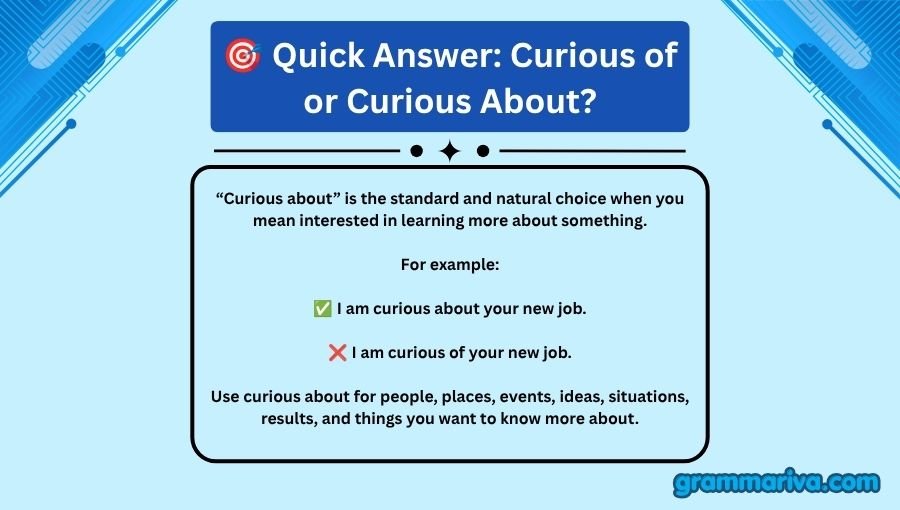
“Curious about” is the standard and natural choice when you mean interested in learning more about something.
For example:
- ✅ I am curious about your new job.
- ❌ I am curious of your new job.
Use curious about for people, places, events, ideas, situations, results, and things you want to know more about.
| Expression | Standard Use | Example |
|---|---|---|
| curious about | Wanting to know more | I am curious about the results. |
| curious of | Uncommon or nonstandard for this meaning | I am curious of the results. |
The easiest rule to remember is: If you mean “wanting to know more,” choose “curious about.”
Is Curious About the Correct Expression?
Yes. Curious about is the normal expression when curious means interested in finding out more information.
The word curious describes a desire to know, understand, explore, or discover something. The preposition about connects that feeling of interest to its subject.
Consider these examples:
- ✅ She is curious about the new teacher.
- ❌ She is curious of the new teacher.
- ✅ We were curious about what happened.
- ❌ We were curious of what happened.
- ✅ He is curious about how the machine works.
- ❌ He is curious of how the machine works.
The first versions sound natural to most modern English speakers.
Why “About” Works Naturally
The word about often introduces the subject that someone wants information about.
For example:
I am curious about the project.
Here, the project is the thing that creates the speaker’s curiosity.
The same pattern works with questions:
She is curious about why he left.
They are curious about what will happen next.
I am curious about whether the plan will work.
| Pattern | Example |
|---|---|
| curious about + noun | I am curious about the book. |
| curious about + person | She is curious about her neighbor. |
| curious about + event | We are curious about the meeting. |
| curious about + question | He is curious about why they left. |
| curious about + situation | I am curious about the situation. |
🤔 Why Do People Confuse Curious Of and Curious About?
People often confuse these expressions because English contains many adjective-and-preposition combinations that must simply be learned.
For example, we say:
- afraid of
- proud of
- interested in
- excited about
- curious about
A learner who knows that afraid of and proud of are correct may assume that curious of should also work.
I once edited a short school essay where a student repeatedly wrote “curious of.” The student knew exactly what the sentences meant but had copied the preposition pattern from another adjective. Changing each instance to “curious about” made the writing sound much more natural.
The key lesson is that you cannot always predict the correct preposition from the meaning of an adjective.
| Adjective | Common Preposition | Example |
|---|---|---|
| afraid | of | She is afraid of spiders. |
| proud | of | He is proud of his work. |
| interested | in | I am interested in art. |
| excited | about | They are excited about the trip. |
| curious | about | We are curious about the answer. |
Curious About: Meaning and Correct Use
Curious about means wanting to know, understand, or discover more about something.
It can describe a small question in everyday conversation or a strong desire to investigate something.
Curiosity About a Person
Use curious about when you want to know more about another person.
- ✅ I am curious about your new friend.
- ❌ I am curious of your new friend.
- ✅ Maria was curious about her new coworker.
- ❌ Maria was curious of her new coworker.
This does not automatically mean suspicion. It simply means the person wants more information.
Curiosity About an Event
You can also use the phrase for an event or situation.
- ✅ Everyone was curious about the announcement.
- ❌ Everyone was curious of the announcement.
- ✅ We were curious about the meeting.
- ❌ We were curious of the meeting.
Curiosity About Information
The expression is especially common when someone wants an answer.
- ✅ I am curious about the final result.
- ❌ I am curious of the final result.
- ✅ She is curious about the reason.
- ❌ She is curious of the reason.
| Meaning | Word Type | Example Sentence |
|---|---|---|
| Wanting information | Adjective phrase | I am curious about the answer. |
| Wanting to understand | Adjective phrase | He is curious about how it works. |
| Wanting to learn more about a person | Adjective phrase | She is curious about her neighbor. |
| Wanting to discover something | Adjective phrase | We are curious about what happens next. |
🔍 Can You Say Curious Of in English?
You may occasionally encounter curious of in older, unusual, regional, or nonstandard writing, but it is not the normal modern construction for expressing interest in something.
For everyday American English, professional writing, academic work, and general online content, curious about is the safer and more natural choice.
Compare:
- ❌ I am curious of the answer.
- ✅ I am curious about the answer.
The problem with curious of is not that readers can never understand it. They usually can. The problem is that it does not match the standard pattern most readers expect.
| Sentence | Natural in Standard English? | Better Version |
|---|---|---|
| I am curious about the result. | Yes | I am curious about the result. |
| I am curious of the result. | No, uncommon | I am curious about the result. |
| She is curious about him. | Yes | She is curious about him. |
| She is curious of him. | No, uncommon | She is curious about him. |
| We are curious about the plan. | Yes | We are curious about the plan. |
📚 Curious Of or Curious About at a Glance
The core difference is simple: curious about is the normal modern phrase, while curious of is not the standard choice for expressing curiosity.
| Form | Type | Meaning | Example | Correct/Incorrect |
|---|---|---|---|---|
| curious about | Adjective phrase | Wanting to know more | I am curious about the story. | ✅ Correct |
| curious of | Adjective phrase | Intended to mean wanting to know more | I am curious of the story. | ❌ Not standard |
| curious | Adjective | Interested in knowing | She is curious. | ✅ Correct |
| curious to know | Adjective + infinitive | Wanting information | I am curious to know the answer. | ✅ Correct |
This table gives you three useful patterns:
curious about + noun
I am curious about the results.
curious about + question clause
I am curious about why she left.
curious to know + information
I am curious to know why she left.
💡 Test Tip: How Can You Check the Correct Preposition?
Here is my easiest test.
Ask yourself:
“Do I mean that I want to know more about something?”
If the answer is yes, use curious about.
For example:
I want to know more about the new policy.
Change that idea to:
I am curious about the new policy.
Do not change it to:
I am curious of the new policy.
Another useful test is to replace curious with interested in. The two phrases are not identical, but they can help you identify the subject of your interest.
| Test | Result |
|---|---|
| I want to know more about it. | Use curious about |
| I am interested in it. | Similar idea |
| I want information about it. | curious about works |
| I want to describe fear of it. | Use another structure, such as afraid of |
📝 Case Study: Curious About in a Workplace Email
Imagine that a manager announces a new training program.
An employee wants to ask about it but does not want to sound demanding.
A natural email might say:
“Hi Jordan, I’m curious about the new training program. Could you tell me when registration opens?”
That sounds polite and natural.
Now compare:
“Hi Jordan, I’m curious of the new training program.”
The meaning is still understandable, but the preposition sounds wrong to a standard American English reader.
I once saw a similar sentence in a workplace message where the writer used the wrong preposition after curious. The rest of the email was clear and professional. One small change to curious about fixed the issue immediately.
The lesson is useful beyond grammar tests. Correct preposition choices help your writing sound smooth and confident.
🧠 Grammar Rules Explanation
The word curious is an adjective. When it describes a person’s desire to know more about a subject, standard English commonly uses the preposition about.
The basic structure is:
subject + be + curious + about + subject of curiosity
Examples:
I am curious about the decision.
She is curious about the new plan.
They were curious about what happened.
The word about introduces the topic that creates the curiosity.
Another useful structure is:
curious + to-infinitive
For example:
I am curious to know the answer.
Here, to know explains the action the speaker wants to take.
You can also use a question clause after curious about:
I am curious about why they canceled the event.
She is curious about whether he will attend.
The important point is that the preposition should match the standard pattern used by modern English speakers. Standard reference sources generally support curious about for this meaning.
Correct vs Incorrect at a Glance
| Sentence | Correct/Incorrect | Why |
|---|---|---|
| I am curious about the answer. | ✅ Correct | About introduces the subject of curiosity. |
| I am curious of the answer. | ❌ Incorrect in standard usage | Of is not the normal preposition after curious for this meaning. |
| She is curious about his plans. | ✅ Correct | The plans are the topic she wants to know more about. |
| They are curious of his plans. | ❌ Incorrect in standard usage | Use curious about instead. |
| We are curious to know the truth. | ✅ Correct | Curious to know is another natural construction. |
⚠️ Common Mistakes With Curious About
Most mistakes with this phrase come from choosing a preposition based on another adjective.
Someone may know:
proud of
afraid of
tired of
and then assume:
curious of
But English does not work that way.
Why These Mistakes Happen
Three common causes are:
- Fast typing: People often write the first preposition that comes to mind.
- Autocorrect: A phone or browser may not catch a grammar problem when the resulting phrase is still understandable.
- Lack of knowledge: Learners may know the word but not the preposition that normally follows it.
A fourth cause is direct translation. A phrase that sounds natural in one language may not use the same preposition in English.
| Common Confusion | Correct Form | Example |
|---|---|---|
| it’s / its | depends on meaning | It’s cold. / Its color is blue. |
| your / you’re | depends on meaning | Your book is here. / You’re late. |
| their / there / they’re | depends on meaning | Their car is there. / They’re ready. |
| interested on / interested in | interested in | She is interested in music. |
| curious of / curious about | curious about | He is curious about the result. |
Specific Curious Mistakes
| Wrong Form | What’s Wrong | Correct Form |
|---|---|---|
| curious of the answer | Wrong preposition for standard usage | curious about the answer |
| curious of him | Wrong preposition | curious about him |
| curious of the result | Unnatural construction | curious about the result |
| curious on the topic | Wrong preposition | curious about the topic |
| curious in the topic | Confuses the pattern for interested | curious about the topic |
✍️ How To Use Curious About in Different Contexts
The phrase works in many kinds of writing. The level of formality can change, but the basic grammar stays the same.
Everyday Conversation
“I’m curious about your new car.”
This is natural and friendly.
Professional Writing
“I am curious about the timeline for the project.”
This works well in an email or meeting.
Creative Writing
“She was curious about the strange sound coming from upstairs.”
The phrase can help show a character’s thoughts.
Social Media and Texting
“Okay, now I’m curious about what happened!”
This is casual and natural.
| Context | Which Term to Use | Example |
|---|---|---|
| Everyday conversation | curious about | I’m curious about your trip. |
| Professional writing | curious about | I’m curious about the next steps. |
| Creative writing | curious about | He was curious about the strange noise. |
| Social media/texting | curious about | Now I’m curious about the story! |
❓ Is Curious About Too Formal?
No. Curious about is not limited to formal writing. It is common in everyday conversation, text messages, school writing, business communication, and creative writing.
For example:
“I’m curious about your idea.”
sounds completely natural in a casual conversation.
In a formal setting, you can also use a more direct phrase:
“I would like to know more about your proposal.”
The second sentence is more formal, but the first is not incorrect or overly casual.
| Situation | Natural Choice |
|---|---|
| Talking with a friend | I’m curious about it. |
| Asking a coworker | I’m curious about the timeline. |
| Writing an essay | Researchers are curious about the results. |
| Writing a formal email | I am curious about the next steps. |
🔄 Alternatives to Curious About
Sometimes you may want to avoid repeating curious about. Several alternatives can work, but they do not always have exactly the same meaning.
Interested in is useful when you want to show general interest.
Want to know more about is direct and simple.
Eager to learn about can suggest stronger interest.
Intrigued by can suggest that something has caught your attention in an unusual or interesting way.
| Alternative | Works When | Does Not Work When |
|---|---|---|
| interested in | You have general interest | You specifically want to stress a question |
| want to know more about | You want a very direct phrase | You need a compact adjective phrase |
| eager to learn about | You have strong interest | You want a neutral tone |
| intrigued by | Something strongly catches your attention | You simply need a basic question |
For example:
I am curious about the new product.
can become:
I want to know more about the new product.
Both are natural, but the second is more direct.
💬 Common Phrases With Curious About
There are several natural sentence patterns built around curious about. These are more useful to memorize than isolated grammar rules.
| Phrase | Meaning |
|---|---|
| curious about the answer | Wanting to know the answer |
| curious about what happened | Wanting information about an event |
| curious about how it works | Wanting to understand a process |
| curious about the result | Wanting to know the outcome |
| curious about someone | Wanting to know more about a person |
Examples include:
I’m curious about what happened.
She is curious about how the system works.
We are curious about the final result.
He was curious about his new neighbor.
These patterns can become automatic with practice.
🧩 Curious About With Questions and Clauses
One useful feature of curious about is that it can be followed by a question clause.
For example:
I am curious about why she left.
Here, why she left tells us exactly what the speaker wants to understand.
You can also use:
I am curious about whether they accepted the offer.
She is curious about what will happen next.
We are curious about how the machine works.
Notice that these are not direct questions.
Compare:
Why did she leave?
with:
I am curious about why she left.
The second sentence contains the question idea inside a larger sentence.
| Structure | Example |
|---|---|
| curious about + noun | I am curious about the decision. |
| curious about + who | I am curious about who called. |
| curious about + why | I am curious about why she left. |
| curious about + how | I am curious about how it works. |
| curious about + whether | I am curious about whether he agreed. |
🏫 Why This Grammar Matters
Using the right preposition may seem like a small detail, but small details affect how clear and polished your writing sounds.
Clarity in Communication
Correct word patterns help readers understand your meaning without distraction.
Professionalism
A natural preposition choice can make an email, report, or application sound more polished.
Digital Writing Accuracy
Online writing is read quickly. A phrase that sounds unusual can distract readers even when the meaning is clear.
A useful rule is:
Small grammar choices create smooth sentences.
| Situation | Why Getting It Right Matters |
|---|---|
| Resume or application | Shows careful writing |
| Client email | Creates clear communication |
| Published content | Improves readability |
| Social post | Makes the wording sound natural |
🧠 How To Remember the Difference
Here is the memory trick I recommend to students:
Curious = wants to know → curious about
Think:
“I want to know more about it.”
Then turn it into:
“I am curious about it.”
You do not need a complicated grammar formula.
Remember these three patterns:
- curious about + noun
- curious about + question clause
- curious to know + information
Examples:
I am curious about the answer.
I am curious about why she left.
I am curious to know the answer.
| Memory Pattern | Example |
|---|---|
| curious about + thing | curious about the movie |
| curious about + person | curious about her |
| curious about + question | curious about why he left |
| curious to know | curious to know the reason |
🔎 Is Curious About the Same as Interested In?
They are similar, but they are not always identical.
Interested in often describes general attention or interest in a subject.
Curious about more strongly suggests a desire to find out something.
Compare:
I am interested in science.
This may describe a broad interest in the subject.
I am curious about the new scientific discovery.
This suggests that the speaker wants to know more about a particular discovery.
| Expression | Main Idea | Example |
|---|---|---|
| curious about | Wants to know more | I’m curious about the result. |
| interested in | Has an interest in something | I’m interested in science. |
| eager to learn about | Strong desire to learn | She is eager to learn about the topic. |
| want to know more about | Direct desire for information | I want to know more about the plan. |
📝 Practice: Choose the Correct Form
Try completing each sentence before checking the answers.
Practice 1
I am curious ___ the final score.
Answer: about
I am curious about the final score. ✅
Practice 2
She was curious ___ why he canceled.
Answer: about
She was curious about why he canceled. ✅
Practice 3
They are curious ___ the new project.
Answer: about
They are curious about the new project. ✅
Practice 4
He is curious ___ how the machine works.
Answer: about
He is curious about how the machine works. ✅
| Question | Correct Answer |
|---|---|
| Curious ___ the result | about |
| Curious ___ the reason | about |
| Curious ___ what happened | about |
| Curious ___ the new plan | about |
| Curious ___ how it works | about |
🎯 Quick Recap Checklist
Use this checklist whenever you are unsure.
| Question | If Yes → Use |
|---|---|
| Do I mean “wanting to know more”? | curious about |
| Am I introducing the subject of curiosity? | curious about |
| Am I asking what, why, how, or whether something happened? | curious about + clause |
| Am I saying that I want information? | curious to know |
| Am I tempted to write “curious of”? | Change it to curious about |
Three Final Practice Examples
- ✅ I am curious about your new idea.
- ✅ She is curious about what happened.
- ✅ We are curious to know the final result.
The key is to connect curious with the idea of wanting information.
❓ FAQs About Curious Of vs Curious About
Is “curious about” grammatically correct?
Yes. Curious about is the standard and natural expression when someone wants to know or learn more about a person, thing, event, or situation.
Is “curious of” correct English?
Curious of is not the normal standard expression when you mean “wanting to know more.” In ordinary modern American English, use curious about instead.
Should I say “curious about” or “curious of”?
Say curious about in standard modern English when describing interest or a desire for information.
I’m curious about the answer. ✅
Can curious about be followed by a person?
Yes. You can say:
I’m curious about him.
This means you want to know more about him or understand something about him.
Can I say “curious about why”?
Yes. This is completely natural.
I’m curious about why she left.
The phrase about why introduces the question the speaker wants to understand.
Is “curious to know” correct?
Yes. Curious to know is another standard construction.
I am curious to know what happened.
It is especially useful when you want to emphasize the desire to receive specific information.
Is “curious about” casual or formal?
It works in both casual and formal English. You can use it in conversation, emails, school writing, professional communication, and many other settings.
What is the easiest way to remember curious about?
Think of the sentence:
“I want to know more about it.”
Then change it to:
“I am curious about it.”
That simple connection will help you remember the correct preposition.
Can “curious about” describe a situation?
Yes. For example:
We are curious about the situation.
It can also describe a result, decision, person, event, process, or question.
What is another way to say “curious about”?
Depending on the context, you can use interested in, want to know more about, eager to learn about, or intrigued by. These alternatives have slightly different meanings, so choose the one that best matches your intended tone.
✅ Conclusion
Curious of or curious about is a simple choice once you remember the standard pattern: use curious about when someone wants to know, understand, or discover more about something.
For example, say:
I am curious about the result.
not:
I am curious of the result.
You can also use curious about before a person, object, event, situation, or question clause. When you want to focus on the act of getting information, curious to know is another natural option.
The main mistake is usually caused by transferring the preposition from another adjective such as afraid of or proud of. English adjective patterns do not always follow the same rule, so learning common combinations is useful.
When in doubt, remember this simple sentence: I want to know more about it. That naturally becomes I am curious about it. 😊
Once that pattern becomes familiar, this grammar question becomes easy to answer every time. ✨

Hi, I’m Ethan Brooks. I’m an English grammar writer at Grammariva, where I work on clear explanations, practical examples, and useful writing tips. I enjoy making difficult grammar topics easier to understand.
[…] English, and how to avoid this common mistake in emails, conversations, and everyday writing. Curious of or Curious About | Postfix vs Suffix | Awaiting vs […]
[…] In this guide, I will explain the difference in plain US English. We will look at sentence patterns, common mistakes, workplace examples, fixed expressions, and practical tests. By the end, you will know when each form works. 😊 Baptised vs Baptized | Reply Me vs Reply to Me | Curious of or Curious About […]