If you have ever stopped while writing a sentence and wondered whether to use are vs were, you are not alone. These two words are both forms of the verb be, but they do not usually point to the same time.
Are normally talks about the present, while were usually talks about the past. That sounds simple, yet the choice can become confusing when a sentence contains questions, conditions, reported speech, or more than one time idea. 😊
I teach grammar by looking at what a sentence means first, not by asking students to memorize long rules. When you understand the time and subject in a sentence, choosing between these two forms becomes much easier.
In this guide, I will explain are vs were with simple rules, clear examples, tables, common mistakes, practical situations, and quick tests. By the end, you should be able to choose the right form with confidence. ✨ Which vs wherein | Arc vs Ark | All Was or All Were
🎯 Quick Answer: Are vs Were
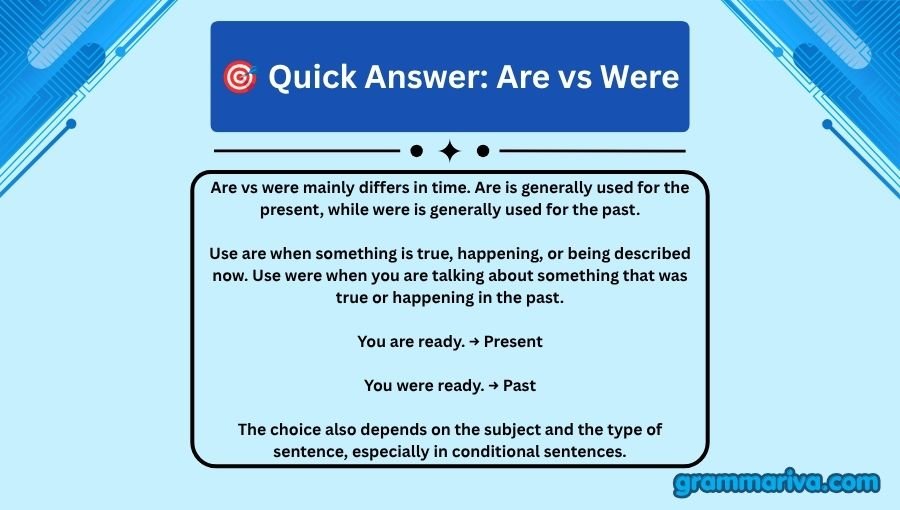
Are vs were mainly differs in time. Are is generally used for the present, while were is generally used for the past.
Use are when something is true, happening, or being described now. Use were when you are talking about something that was true or happening in the past.
- You are ready. → Present
- You were ready. → Past
The choice also depends on the subject and the type of sentence, especially in conditional sentences.
Are vs Were: Meaning and Related Forms
The words are and were are forms of the verb be. They belong to the same verb family, but they serve different grammatical purposes.
Here are the main forms that are useful when learning this topic:
| Form | Type | Example |
|---|---|---|
| be | Base form | I want to be helpful. |
| am | Present form | I am ready. |
| is | Present form | She is ready. |
| are | Present form | They are ready. |
| was | Past form | He was tired. |
| were | Past form | They were tired. |
| being | -ing form | They are being careful. |
| been | Past participle | They have been helpful. |
The important point is that are and were are not interchangeable simply because both come from be.
Understanding the Basics of Are vs Were
The easiest way to understand are vs were is to ask one question: When is the situation happening?
If the situation is connected to the present, are may be correct. If the situation happened in the past, were may be correct.
| Form | Type | Meaning | Example | Correct/Incorrect |
|---|---|---|---|---|
| are | Present | True or happening now | You are late. | ✅ Correct |
| were | Past | True or happening before now | You were late. | ✅ Correct |
| are | Present | Describes a current state | They are happy. | ✅ Correct |
| were | Past | Describes a past state | They were happy. | ✅ Correct |
| were | Past | Used with a past condition | If they were ready, we could leave. | ✅ Correct |
Are for Present Situations
Use are when the subject is connected to the present and the subject is you, we, they, or a plural noun.
Examples:
- You are my best friend. ✅
- We are ready to leave. ✅
- They are at school. ✅
- The children are tired. ✅
Here, the sentences describe situations that exist now.
Were for Past Situations
Use were when you are talking about a past situation with you, we, they, or plural nouns.
Examples:
- You were my best friend in college. ✅
- We were ready an hour ago. ✅
- They were at school yesterday. ✅
- The children were tired after the trip. ✅
The word were places the situation in the past.
The Simple Time Test
When you are unsure, look for a time clue.
Words such as now, today, currently, this week, and at the moment often point toward the present.
Words such as yesterday, last year, earlier, before, and at that time often point toward the past.
| Time Clue | Likely Form | Example |
|---|---|---|
| now | are | They are busy now. |
| today | are | We are working today. |
| at the moment | are | You are studying at the moment. |
| yesterday | were | They were busy yesterday. |
| last night | were | We were working last night. |
| earlier | were | You were studying earlier. |
Is Are the Same as Were?
No. Are and were are different forms of be that normally refer to different times.
Are generally describes a present situation. Were generally describes a past situation.
Compare:
- They are outside. → They are outside now. ✅
- They were outside. → They were outside earlier. ✅
Changing are to were can change the time and therefore change the meaning of the sentence.
Consider this pair:
We are busy.
This means the people are busy now.
We were busy.
This means the people were busy at some earlier time.
The difference may be only one word, but that word tells the reader when the situation occurred.
Why Do People Confuse Are and Were?
People often confuse are and were because both forms are used with many of the same subjects.
For example:
- We are tired.
- We were tired.
- They are late.
- They were late.
- You are correct.
- You were correct.
The subject does not always tell you which word to choose. You also need to consider time and meaning.
I once helped a student edit a short school paragraph. The student had written, “My friends were waiting outside,” even though the next sentence explained that the friends were still waiting. The sentence needed are waiting, because the action was still happening at the time being described.
That small change made the timeline much clearer.
A Useful Question
Before choosing the word, ask:
“Am I talking about now or about an earlier time?”
If the answer is now, are may be appropriate.
If the answer is an earlier time, were may be appropriate.
Key Differences Between Are and Were
The main difference between these forms is their relationship to time.
| Feature | Are | Were |
|---|---|---|
| Main time | Present | Past |
| Common subjects | You, we, they, plural nouns | You, we, they, plural nouns |
| Basic use | Current state or situation | Past state or situation |
| Example | They are happy. | They were happy. |
| Time meaning | Now | Before now |
Compare These Sentences
The students are quiet.
This says the students are quiet now.
The students were quiet.
This says the students were quiet at some earlier time.
You are busy.
This describes your current situation.
You were busy.
This describes your past situation.
The grammar is easy once the time is clear.
How Do You Use Are in a Sentence?
Use are with you, we, they, and plural subjects when describing a present state or situation.
With You
- You are very kind. ✅
- You are ready for the test. ✅
- You are responsible for this task. ✅
With We
- We are excited about the trip. ✅
- We are ready to begin. ✅
- We are in the right room. ✅
With They
- They are outside. ✅
- They are working today. ✅
- They are happy with the result. ✅
With Plural Nouns
- The books are on the table. ✅
- My parents are home. ✅
- The employees are ready. ✅
The key idea is that are normally connects the subject to a present condition, location, identity, or ongoing situation.
When Should You Use Were?
Use were for past situations involving you, we, they, and plural subjects.
Examples:
- You were right yesterday. ✅
- We were tired after the journey. ✅
- They were at the meeting. ✅
- The players were ready before the game. ✅
A past-time word often makes the choice obvious.
- We were there last week. ✅
- They were busy yesterday. ✅
- You were late this morning. ✅
However, a sentence does not always need an obvious time word. The surrounding context can show that the situation happened in the past.
💡 Test Tip: Try the Time Swap
When you are unsure about are vs were, temporarily add now or then to the sentence.
For example:
They ___ at home.
Try:
They are at home now.
That works if you mean the current situation.
Or:
They were at home then.
That works if you mean an earlier situation.
This simple test is useful because it forces you to identify the time before choosing the verb.
Correct Meanings and Uses
The two forms have several common uses.
| Meaning | Word Type | Example Sentence |
|---|---|---|
| Present state | Verb | They are tired. |
| Present location | Verb | We are outside. |
| Present identity | Verb | They are teachers. |
| Past state | Verb | They were tired. |
| Past location | Verb | We were outside. |
| Past identity | Verb | They were teachers. |
Describing a State
Use are for a current state:
The children are sleepy. ✅
Use were for a past state:
The children were sleepy after lunch. ✅
Describing Location
Use are when the location is current:
We are in the office. ✅
Use were when the location was true in the past:
We were in the office yesterday. ✅
Describing Identity
Use are for a current identity or role:
They are doctors. ✅
Use were for a past identity or role:
They were students ten years ago. ✅
Are vs Were in Questions
Both forms can appear in questions.
Use are when asking about a present situation:
- Are you ready? ✅
- Are they at home? ✅
- Are we late? ✅
Use were when asking about a past situation:
- Were you ready yesterday? ✅
- Were they at home last night? ✅
- Were we late for the meeting? ✅
Compare:
Are you tired?
This asks about your current condition.
Were you tired after the flight?
This asks about your condition at an earlier time.
Are vs Were in Negative Sentences
The negative forms are are not and were not.
Common contractions are aren’t and weren’t.
| Positive | Negative | Contracted |
|---|---|---|
| You are ready. | You are not ready. | You aren’t ready. |
| They are busy. | They are not busy. | They aren’t busy. |
| We were ready. | We were not ready. | We weren’t ready. |
| They were busy. | They were not busy. | They weren’t busy. |
Examples:
- We aren’t finished yet. ✅
- They weren’t finished yesterday. ✅
- You aren’t late. ✅
- You weren’t late yesterday. ✅
The same time difference remains even in negative sentences.
Are vs Were in Continuous Tenses
Both forms can help create continuous verb phrases.
Are + verb-ing usually describes something happening now:
They are working on the project. ✅
Were + verb-ing usually describes something that was happening at a past time:
They were working on the project yesterday. ✅
Compare:
| Form | Time | Example |
|---|---|---|
| are working | Present | We are working now. |
| were working | Past | We were working earlier. |
| are studying | Present | They are studying today. |
| were studying | Past | They were studying last night. |
The form of be helps establish when the ongoing action happens.
Are vs Were in Conditional Sentences
This is one area where were can appear even when the sentence is not simply describing a past event.
Consider:
If I were you, I would apologize.
Here, were is used in a hypothetical expression. The sentence is not saying that the speaker was literally the other person in the past.
The same pattern appears in:
- If she were here, she could help us. ✅
- If he were more careful, he might avoid the problem. ✅
- If I were rich, I would travel more. ✅
This is a special grammatical use of were. It is common in formal and careful English.
That means you should not always assume that were = past time. In ordinary past statements, it marks past time. In certain hypothetical clauses, it can signal an unreal or imagined situation.
📝 Case Study: A Workplace Conversation
Imagine a manager speaking to an employee about a meeting.
The manager says:
“You are responsible for the presentation.”
This means the responsibility exists now.
Later, the manager discusses the previous meeting:
“You were responsible for the presentation yesterday.”
Now the sentence refers to the past.
The difference becomes even clearer in an email:
“The team is ready.”
This describes the team’s current condition.
But:
“The team was ready before the client arrived.”
That sentence describes an earlier condition.
I once caught myself changing a sentence from present to past while editing a project update. The original writer said, “The files are ready,” but the report described a completed event from the previous afternoon. The past form made the timeline accurate.
Grammar Rules Explanation
The basic grammar rule is simple: are is a present-tense form of be, while were is a past-tense form of be.
For standard statements:
- You are = present
- We are = present
- They are = present
- You were = past
- We were = past
- They were = past
The subject also matters. For example, standard English normally uses was with singular subjects such as he, she, it, while were is used with you, we, they, and plural subjects.
Correct vs Incorrect at a Glance
| Sentence | Correct/Incorrect | Why |
|---|---|---|
| They are ready now. | ✅ Correct | Present situation |
| They were ready yesterday. | ✅ Correct | Past situation |
| They are ready yesterday. | ❌ Incorrect | Present form does not fit the past time clue |
| We were at home last night. | ✅ Correct | Past location |
| We are at home last night. | ❌ Incorrect | Present form conflicts with the past time clue |
Standard grammar references and major dictionaries agree on the basic distinction between present and past forms of be. The key is to match the verb form to the meaning and time of the sentence.
⚠️ Common Mistakes With Are and Were
Mistakes often happen because people write quickly or focus on the subject without checking the time.
Why These Errors Happen
- Fast typing
A writer may type the first form that comes to mind. - Autocorrect or predictive text
A keyboard may suggest a form that does not fit the sentence. - Lack of grammar knowledge
If someone has not learned the present and past forms of be, the difference can feel random. - Long sentences
Extra words can hide the time clue. - Mixed timelines
A sentence may move from past to present, making the correct form less obvious.
Similar Grammar Confusions
| Confusion | Correct Difference |
|---|---|
| it’s / its | It’s = it is; its = possessive |
| your / you’re | Your = possessive; you’re = you are |
| they’re / their / there | Different meanings and functions |
| then / than | Then relates to time; than compares |
| was / were | Both are past forms, but subject and sentence type matter |
Specific Wrong Forms and Uses
| Wrong Form | What’s Wrong | Correct Form |
|---|---|---|
| They was happy. | Plural subject needs were. | They were happy. |
| We was ready. | We takes were in standard English. | We were ready. |
| They are yesterday. | Present are does not fit this past time expression. | They were there yesterday. |
| We were now ready. | Usually conflicts with a present meaning. | We are now ready. |
| You was late. | Standard English uses were with you. | You were late. |
| They were here now. | Usually wrong if now means the current moment. | They are here now. |
Why Subject Agreement Matters
Time is not the only issue. The subject also affects which form of be you need.
For example:
They are happy. ✅
The subject they takes are in the present.
In the past:
They were happy. ✅
The subject they takes were.
But with a singular subject:
She is happy. ✅
Past:
She was happy. ✅
So the full decision involves both time and subject.
| Subject | Present | Past |
|---|---|---|
| I | am | was |
| you | are | were |
| he | is | was |
| she | is | was |
| it | is | was |
| we | are | were |
| they | are | were |
This table is worth remembering because it gives you the full basic pattern of be.
How To Remember The Difference
A simple memory trick is: Understanding are vs were becomes much easier when you connect each form to the time of the action.
Are = now. Were = before.
This is not a complete rule for every possible sentence because were also appears in hypothetical constructions. Still, it works well for ordinary statements.
Try these pairs:
- They are here now.
- They were here earlier.
- We are busy today.
- We were busy yesterday.
- You are my teammate.
- You were my teammate last year.
If the sentence describes a current fact, think are.
If it describes an earlier fact, think were.
The One-Word Test
Take:
They ___ tired.
Ask:
Are they tired now?
If yes:
They are tired.
Ask:
Were they tired earlier?
If yes:
They were tired.
This test works because it makes you identify the intended time.
Usage in Different Contexts
The choice between are and were stays the same across most forms of writing, but the context can change how often you use each one.
| Context | Which Term to Use | Example |
|---|---|---|
| Everyday conversation | Are for now; were for past | They are here now. |
| Professional writing | Match the verb to the timeline | The documents are ready. |
| Creative writing | Match the time of the scene | They were walking home. |
| Social media/texting | Usually follow normal grammar | We are finally here! |
Everyday Conversation
People use both forms constantly in speech.
“Where are you?”
“We are at the mall.”
Later:
“Where were you yesterday?”
“We were at home.”
Professional Writing
Clear verb choices matter in emails, reports, and workplace messages.
Compare:
The files are ready for review.
This means the files are ready now.
The files were ready for review yesterday.
This puts the readiness in the past.
Creative Writing
Writers often move between time periods.
The streets were empty when the storm began.
If the narrator then describes the current scene:
The streets are busy again.
The verb helps readers follow the timeline.
Social Media and Texting
Informal writing may contain shortcuts, but are and were still carry different meanings.
We are finally on vacation! 🌴
We were there last summer!
Common Phrases With Are and Were
These forms appear in many everyday expressions.
| Phrase | Meaning |
|---|---|
| We are ready | We are prepared now |
| They are on their way | They are currently traveling toward a place |
| You are right | Your statement is correct |
| We were there | We were at that place in the past |
| They were together | They were together at an earlier time |
| If I were you | A hypothetical suggestion |
These phrases are useful because they show how the forms work naturally in real communication.
Are vs Were in Reported Speech
Reported speech can make verb choices more complex because the reporting verb may be in the past.
For example:
She said, “They are ready.”
When reported later, a writer might say:
She said that they were ready.
This is common because the reporting structure shifts the time frame.
However, the exact choice can depend on whether the statement is still true and on the writer’s intended meaning.
Compare:
The manager said that the employees were ready.
This commonly reports what the manager said at that earlier time.
But:
The manager said that the employees are ready.
This can emphasize that the employees are still ready now.
The surrounding context matters.
Are vs Were in Passive Constructions
Both forms can also appear with passive structures.
Present:
The documents are reviewed every Friday. ✅
Past:
The documents were reviewed last Friday. ✅
The difference is again connected to time.
| Form | Example | Meaning |
|---|---|---|
| are reviewed | The files are reviewed weekly. | Current or regular process |
| were reviewed | The files were reviewed yesterday. | Completed past process |
| are included | The names are included. | Present fact |
| were included | The names were included. | Past fact |
Synonyms and Alternatives
You cannot always replace are or were with another word because they often serve as essential grammar verbs. However, some sentences can be rewritten using different structures.
| Alternative | Works When | Does Not Work When |
|---|---|---|
| exist | Describing existence | Describing every state |
| remain | Describing a continuing condition | Describing a simple identity |
| seem | Describing an appearance or impression | Stating a direct fact |
| stay | Describing continued location or condition | Replacing every use of be |
| became | Describing a change | Describing a simple current state |
For example:
They are happy.
Could sometimes become:
They seem happy.
But the meanings are not identical. Are happy states the condition directly. Seem happy describes an impression.
Likewise:
They were quiet.
Could become:
They remained quiet.
But remained adds the idea that the quietness continued.
Why It Matters
Choosing the correct form improves clarity because readers can understand when something happened.
Clarity in Communication
A reader needs to know whether you are describing something that is true now or something that was true before.
Professionalism
A small verb error can make a professional email look rushed.
Digital Communication
Even short posts, messages, and captions benefit from clear grammar.
| Situation | Why Getting It Right Matters |
|---|---|
| Resume | Keeps descriptions accurate |
| Client email | Makes timing clear |
| Published content | Improves trust and readability |
| Social post | Prevents confusion about events |
A useful rule is:
Clear grammar helps the reader spend less time guessing and more time understanding.
Good grammar is not about making every sentence sound formal. It is about making your meaning easy to follow.
Is Were Always About the Past?
No. Were is usually a past form, but it also appears in certain hypothetical or unreal conditions.
For example:
If I were taller, I would play basketball.
The speaker is not saying that being taller happened in the past. The sentence describes an imagined condition.
Another example:
I wish she were here.
The speaker is talking about a situation that is not true at the moment.
This special use is often called the subjunctive mood. You do not need to memorize the term to use the pattern correctly. Just remember that were can appear in hypothetical statements such as if I were and I wish I were.
Special Exception: If I Were You
The phrase “If I were you” is one of the most familiar special cases.
Examples:
- If I were you, I would wait. ✅
- If I were you, I would ask for help. ✅
- If I were in your position, I would think carefully. ✅
Even though the subject is I, the standard form in this hypothetical construction is were.
This is different from an ordinary past statement:
I was tired yesterday. ✅
Here, was is the normal past form for I.
So compare:
I was tired yesterday. → Real past event.
If I were you, I would leave. → Hypothetical situation.
Quick Recap Checklist
Use this checklist whenever you are unsure.
| Question | If Yes → Use |
|---|---|
| Is the situation happening now? | are |
| Did the situation happen in the past? | were |
| Is the subject you, we, they, or plural? | Check are/were |
| Is the sentence hypothetical, such as “If I ___ you”? | Usually were |
| Does a past-time clue appear? | Usually were |
| Does a present-time clue appear? | Usually are |
Practice Examples
Fill in the blank:
- They ___ waiting outside now.
- We ___ at the restaurant last night.
- You ___ very helpful today.
- If I ___ you, I would check again.
Answers:
- They are waiting outside. ✅
- We were at the restaurant last night. ✅
- You are very helpful today. ✅
- If I were you, I would check again. ✅
FAQs About Are vs Were
Are vs were: what is the main difference?
Are normally refers to the present, while were normally refers to the past. For example, “They are ready” describes the present, while “They were ready” describes an earlier time.
Is “are” present tense?
Yes. Are is a present-tense form of the verb be. It is commonly used with you, we, they, and plural nouns.
Is “were” past tense?
Yes, in ordinary statements were is a past-tense form of be. It is commonly used with you, we, they, and plural nouns.
Should I say “you are” or “you were”?
Use you are for a present situation and you were for a past situation.
- You are correct now.
- You were correct yesterday.
Should I say “they are” or “they were”?
Both can be correct. Use they are for a present situation and they were for a past situation.
- They are at home.
- They were at home last night.
Is “if I were” grammatically correct?
Yes. If I were is the standard form in hypothetical statements such as “If I were you, I would wait.”
Can “were” refer to something that is not in the past?
Yes. Were can appear in hypothetical or unreal statements. For example, “If she were here, she could help” describes an imagined situation, not necessarily a past event.
What is the difference between “are working” and “were working”?
Are working normally describes an action happening now. Were working describes an action that was happening at an earlier time.
- They are working now.
- They were working yesterday.
Can “are” and “were” be used with the same subject?
Yes. Subjects such as you, we, they, and plural nouns can take both forms. The choice usually depends on whether you are describing the present or the past.
How can I quickly remember are vs were?
Think are = now and were = before for ordinary statements. Then check the subject and watch for special hypothetical patterns such as if I were.
Conclusion
Are vs were becomes much easier when you first identify the time and then check the subject. Use are for present situations with you, we, they, and plural subjects. Use were for past situations with those same subjects. For example, “They are ready” describes the present, while “They were ready” describes the past.
Remember that were has one important special use in hypothetical expressions. Phrases such as “If I were you” and “I wish I were there” can use were even though they do not describe an ordinary past event.
When you are stuck, ask yourself two questions: Is this happening now or did it happen before? Who is the subject? Those two questions will solve most problems quickly. 🌟
Good grammar does not have to feel complicated. Once you connect the verb to the time and meaning, the correct choice becomes natural. Choose the form that matches the time, check the subject, and let the sentence tell the story. ✨

Hi, I’m Lucas Bennett. I’m a grammar content specialist at Grammariva. I work on articles covering everyday grammar questions, sentence usage, and writing tips that readers can apply with confidence.

[…] and frequently asked questions. By the end, choosing between the two should feel easy. 😊 Are vs Were | Which vs wherein | Arc vs […]