Have you ever typed a word and then stopped because the spelling looked wrong? 🤔 Rancor vs rancour is one of those spelling questions that can make even careful writers pause. Both forms refer to a deep, lasting feeling of anger or bitterness toward someone. The main difference is not meaning. It is regional spelling.
Rancor is the standard spelling in American English. Rancour is the traditional spelling used in British English and is also common in other varieties of English influenced by British spelling.
So, if you are writing for a US audience, rancor is usually the right choice. If you are following British English, rancour is appropriate.
I have seen this kind of spelling issue cause confusion in essays, emails, and edited articles. The good news is that the rule is simple once you know where each form belongs.
In this guide, I’ll explain the difference, show real examples, cover common mistakes, and give you an easy way to remember the correct spelling. ✨ Awoke vs Woke | Modelling vs Modeling | With Regard to or With Regards To
🎯 Quick Answer: Rancor vs Rancour
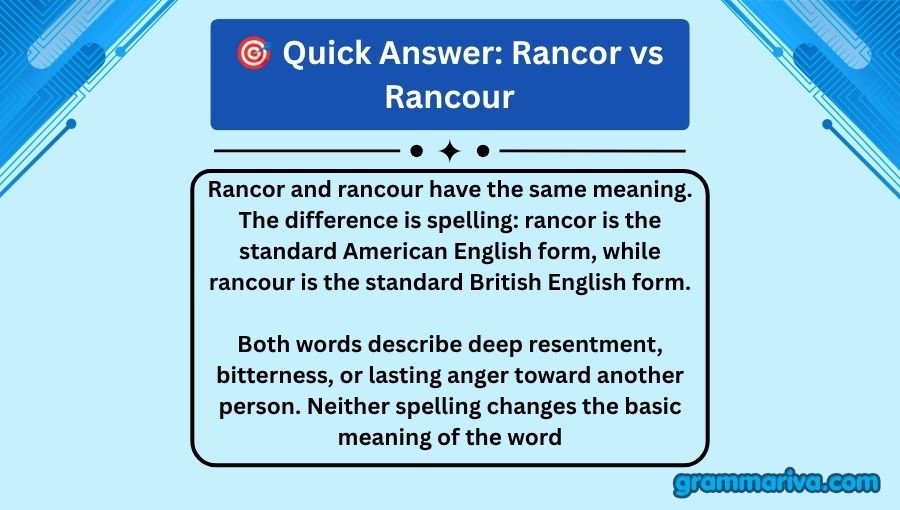
Rancor and rancour have the same meaning. The difference is spelling: rancor is the standard American English form, while rancour is the standard British English form.
Both words describe deep resentment, bitterness, or lasting anger toward another person. Neither spelling changes the basic meaning of the word.
| Spelling | Main Usage | Meaning | Example |
|---|---|---|---|
| rancor | American English | Deep resentment or bitterness | He spoke without rancor. |
| rancour | British English | Deep resentment or bitterness | She felt no rancour toward him. |
The easiest rule is this:
US English → rancor
British English → rancour
🧩 Related Word Forms of Rancor and Rancour
The two spellings do not create different meanings. They are regional variants of the same noun.
The word is usually used as a noun. It refers to a strong and lasting feeling of anger or bitterness.
| Form | Type | Example |
|---|---|---|
| rancor | Noun, US spelling | He left the company without rancor. |
| rancour | Noun, British spelling | They settled the dispute without rancour. |
| rancors | Plural noun, US spelling | Old rancors can damage friendships. |
| rancours | Plural noun, British spelling | The meeting ended with old rancours still present. |
| rancor’s | Possessive, US spelling | The rancor’s effects lasted for years. |
| rancour’s | Possessive, British spelling | The rancour’s effects were clear. |
In normal writing, you will most often see the singular forms rancor and rancour.
❓ Is Rancor the Same as Rancour?
Yes. Rancor and rancour mean the same thing. The only standard difference is the spelling used in different English varieties.
American English usually drops the u in this word. British English keeps it. This is similar to other spelling differences such as color/colour, favor/favour, and honor/honour.
| Form | English Variety | Correct? | Example |
|---|---|---|---|
| rancor | American English | ✅ Correct | He showed no rancor. |
| rancour | British English | ✅ Correct | He showed no rancour. |
| rancour | American English style | ⚠️ Usually avoided in US writing | The editor changed it to rancor. |
| rancor | British English style | ⚠️ Less consistent with UK spelling | The editor changed it to rancour. |
Neither spelling is inherently more correct. The right choice depends on the variety of English you are using.
📚 Understanding the Basics of Rancor vs Rancour
The core difference between these two words is regional spelling. Rancor belongs to standard American English spelling, while rancour is the usual British English spelling.
Both words are nouns.
They describe a feeling that goes beyond a brief moment of anger. Rancor often suggests resentment that has lasted for some time.
Consider this sentence:
The two former business partners spoke without rancor.
Here, rancor is the noun. It tells us that the speakers did not have deep bitterness toward each other.
The same sentence can be written in British English:
The two former business partners spoke without rancour.
The meaning stays the same.
Rancor in American English
American writers generally use rancor without the u.
For example:
- The debate ended without rancor.
- She tried to forgive him and let go of her rancor.
- Years of rancor made their friendship difficult.
Rancour in British English
British writers generally use rancour with the u.
For example:
- The debate ended without rancour.
- She tried to forgive him and let go of her rancour.
- Years of rancour made their friendship difficult.
| Form | Type | Meaning | Example | Correct/Incorrect |
|---|---|---|---|---|
| rancor | Noun | Deep resentment | He spoke without rancor. | ✅ Correct in US English |
| rancour | Noun | Deep resentment | He spoke without rancour. | ✅ Correct in British English |
| rancor | Verb | Not the standard use | He rancored at his rival. | ❌ Incorrect |
| rancour | Verb | Not the standard use | She rancoured at him. | ❌ Incorrect |
💡 Test Tip
Ask yourself one question:
Which English spelling system am I using?
If your writing follows US English, choose rancor.
If your writing follows British English, choose rancour.
Do not switch between the two styles in the same piece unless you are quoting a source or intentionally discussing regional spelling.
❓ What Does Rancor Mean?
Rancor means a deep and lasting feeling of anger, resentment, or bitterness toward someone. It often suggests that the negative feeling has continued for a long time.
For example:
The brothers settled their disagreement without rancor.
The sentence means that they resolved their disagreement without continuing to feel bitter toward each other.
Another example:
She still felt rancor after the unfair decision.
Here, the word describes a lasting feeling of resentment.
| Meaning | Word Type | Example Sentence |
|---|---|---|
| Deep resentment | Noun | He carried rancor for years. |
| Lasting bitterness | Noun | There was no rancor between them. |
| Strong ill feeling | Noun | The dispute created lasting rancor. |
Rancor is usually stronger than simple annoyance. If someone is mildly annoyed, rancor may be too strong.
❓ When Should You Use Rancor?
Use rancor when writing in American English and you want to describe deep, lasting resentment or bitterness.
It often appears in phrases involving conflict, disagreement, politics, family disputes, lawsuits, or broken relationships.
Here are some natural examples:
- He left the team without rancor.
- The rivals met without rancor.
- She tried to put her rancor aside.
- Their argument created years of rancor.
- The two sides reached an agreement without rancor.
Notice that the word often appears after without.
Without rancor means without bitterness or hostility.
Common Sentence Pattern
A useful pattern is:
without + rancor
Example:
They discussed the issue without rancor.
This means they discussed it calmly and without deep resentment.
Another common pattern is:
feel + rancor
Example:
He still felt rancor toward his former partner.
❓ When Should You Use Rancour?
Use rancour when your writing follows British English spelling conventions.
The meaning is exactly the same as rancor.
For example:
They discussed the disagreement without rancour.
A British newspaper, academic paper, novel, or workplace document may use rancour naturally.
American vs British Examples
| American English | British English |
|---|---|
| He spoke without rancor. | He spoke without rancour. |
| There was no rancor between them. | There was no rancour between them. |
| Years of rancor divided the family. | Years of rancour divided the family. |
| She felt deep rancor. | She felt deep rancour. |
This is a spelling choice, not a meaning difference.
📝 Case Study: A Workplace Example
Imagine two coworkers disagree about who should lead an important project.
After several tense meetings, one employee accepts the manager’s decision. He writes an email to his colleague:
“I disagree with the decision, but I hope we can move forward without rancor.”
That sentence works well in American English.
A British English version would be:
“I disagree with the decision, but I hope we can move forward without rancour.”
The message is professional because it acknowledges disagreement without encouraging hostility.
I once edited a workplace document where the writer used several American spellings and then suddenly switched to British spellings. The individual words were understandable, but the document felt inconsistent. Keeping one spelling system throughout made the final version much cleaner.
| Situation | US Version | UK Version |
|---|---|---|
| Professional email | without rancor | without rancour |
| Formal report | political rancor | political rancour |
| Personal letter | no rancor | no rancour |
| Opinion article | public rancor | public rancour |
⚖️ Rancor vs Rancour at a Glance
The difference can be summarized in one rule: rancor is the American spelling, and rancour is the British spelling.
| Feature | Rancor | Rancour |
|---|---|---|
| Meaning | Deep resentment | Deep resentment |
| Word type | Noun | Noun |
| US English | ✅ Preferred | ⚠️ Less common |
| British English | ⚠️ Less common | ✅ Preferred |
| Meaning changes | No | No |
| Pronunciation changes | Generally no | Generally no |
| Main difference | Spelling | Spelling |
If you remember only one thing, remember the missing u.
🧠 Why Do People Confuse Rancor and Rancour?
People often confuse these spellings because both are correct English words.The problem is that they belong to different spelling traditions. If you often get confused by similar English words, check out our guide to [Affect vs Effect] to learn another common word difference with simple examples.
Other words follow the same pattern.
| American English | British English |
|---|---|
| color | colour |
| favor | favour |
| honor | honour |
| behavior | behaviour |
| rumor | rumour |
| rancor | rancour |
There is also a practical reason for the confusion. Many people read websites, books, news articles, and social media posts from several countries. That means they see both spelling systems every day.
I remember a student once asking why color was marked wrong in one assignment but accepted in another. The answer was not that one spelling was bad. The assignments simply followed different English standards.
The same idea applies to rancor vs rancour.
📖 Grammar Rules for Rancor and Rancour
The grammar rule is simple: rancor and rancour function as nouns, and the spelling depends on the variety of English being used. Standard English reference works recognize both regional spellings. For an additional reference, you can check the [Merriam-Webster entry for rancor] for the word’s standard American English usage.
They can act as the subject or object of a sentence.
For example:
Rancor can destroy a friendship.
Here, rancor is the subject.
He carried rancor for years.
Here, rancor is the object of the verb carried.
The British spelling works in the same grammatical positions:
Rancour can destroy a friendship.
He carried rancour for years.
Standard English reference works recognize the two regional spellings. The important point for writers is consistency. Choose the spelling that matches your intended variety of English.
Correct vs Incorrect at a Glance
| Sentence | Correct/Incorrect | Why |
|---|---|---|
| He spoke without rancor. | ✅ Correct | Standard US spelling |
| He spoke without rancour. | ✅ Correct | Standard British spelling |
| She rancored against her boss. | ❌ Incorrect | Rancor is normally a noun |
| They carried years of rancour. | ✅ Correct | Standard British spelling and noun use |
| He had deep rancor toward his rival. | ✅ Correct | Standard US spelling |
⚠️ Common Mistakes With Rancor and Rancour
Most mistakes happen for simple reasons. A writer may type quickly, follow an inconsistent style guide, or rely on autocorrect.
Here are some common causes:
- Fast typing: You may add or remove the u without thinking.
- Autocorrect: Your device may follow its own language setting.
- Lack of knowledge: You may not know that both spellings are accepted.
- Mixed reading habits: You may see US and UK English on the same day.
- Style inconsistency: A document may begin in US English and end in British English.
| Confusion | Correct Forms | Main Difference |
|---|---|---|
| it’s / its | it’s, its | Contraction vs possessive |
| your / you’re | your, you’re | Possessive vs contraction |
| their / they’re | their, they’re | Possessive vs contraction |
| affect / effect | affect, effect | Different grammatical roles and meanings |
| rancor / rancour | rancor, rancour | US vs British spelling |
Specific Wrong Forms
| Wrong Form | What’s Wrong | Correct Form |
|---|---|---|
| rancorr | Extra letter | rancor / rancour |
| rancourr | Extra letter | rancour |
| rancor for UK style | Style mismatch | rancour |
| rancour for US style | Style mismatch | rancor |
| rancored | Incorrect attempt to make a verb | felt rancor / had rancor |
| rancouring | Incorrect verb form | feeling resentment |
The last few examples are especially useful. You should not automatically turn rancor into a verb just because English allows many nouns to become verbs.
❓ Does Rancor Mean Anger?
Rancor can involve anger, but it usually means deep and lasting resentment or bitterness, not just temporary anger.
For example:
I was angry when my friend canceled dinner.
That does not necessarily involve rancor.
But:
I carried rancor toward my former business partner for years.
This suggests a much deeper and longer-lasting negative feeling.
| Word | Typical Strength | Meaning |
|---|---|---|
| annoyance | Low | Mild irritation |
| anger | Medium | Strong displeasure |
| resentment | Medium to strong | Bitter feeling caused by unfairness |
| rancor | Strong | Deep, lasting bitterness |
| hatred | Very strong | Intense dislike or hostility |
This distinction helps you choose the right word.
❓ Is Rancor More Formal Than Anger?
Yes, rancor is generally more formal or literary than ordinary words such as anger or annoyance. It often appears in serious writing about disputes and relationships.
You might say:
He was angry about the decision.
That sounds natural in everyday conversation.
You could write:
He expressed his disagreement without rancor.
That sounds more formal and measured.
This does not mean rancor is only for formal writing. You can use it in everyday conversation when the situation involves strong, lasting bitterness.
✍️ Usage in Different Contexts
Both spellings work in the same kinds of contexts. The choice depends mainly on the English variety used by your audience.
| Context | Which Term to Use | Example |
|---|---|---|
| Everyday conversation | rancor in US English; rancour in UK English | I have no rancor toward her. |
| Professional writing | Match your style guide | The talks ended without rancor. |
| Creative writing | Match the setting or chosen English variety | He carried rancor in his heart. |
| Social media/texting | Match your usual English style | No rancor, just moving on. |
Everyday Conversation
In casual US conversation, rancor is the normal spelling.
I don’t want any rancor between us.
In British English:
I don’t want any rancour between us.
Professional Writing
Consistency matters more in professional writing.
If your company uses US English, use rancor.
If it uses UK English, use rancour.
Creative Writing
Authors can choose either spelling based on their language style, audience, and setting.
Social Media
Social media is more flexible. Still, consistent spelling makes your writing look polished.
💬 Common Phrases With Rancor and Rancour
Several natural phrases commonly use this word. These phrases usually describe disagreement without bitterness.
| Phrase | Meaning |
|---|---|
| without rancor | Without bitterness or resentment |
| deep rancor | Very strong resentment |
| political rancor | Bitter feelings linked to political disagreement |
| personal rancor | Resentment between individuals |
| years of rancor | Long-lasting bitterness |
| lingering rancor | Resentment that remains over time |
The phrase without rancor is especially useful.
For example:
They parted without rancor.
This means they separated without continuing to feel bitter toward each other.
In American English, use rancor. In British English, use rancour.
🔄 Synonyms and Alternatives for Rancor
You can sometimes replace rancor with words such as resentment, bitterness, hostility, ill will, or anger. However, these words are not perfect substitutes in every sentence.
| Alternative | Works When | Does Not Work When |
|---|---|---|
| resentment | You mean a lasting feeling of unfairness | You need a stronger sense of bitterness |
| bitterness | You want to stress emotional pain or anger | The context needs a neutral term |
| hostility | You mean openly unfriendly behavior | The feeling is private and internal |
| ill will | You mean a negative attitude toward someone | You need a stronger emotional word |
| anger | You mean general displeasure | The feeling is long-lasting and bitter |
For example, anger may describe a reaction that lasts a few minutes. Rancor usually suggests something that has stayed around much longer.
❓ Is Rancour the British Spelling?
Yes. Rancour is the standard British English spelling of the word that appears as rancor in American English.
This follows a broader spelling pattern in which British English often keeps -our while American English uses -or.
Examples include:
- colour / color
- favour / favor
- honour / honor
- behaviour / behavior
- rumour / rumor
- rancour / rancor
The meaning does not change.
❓ Is Rancor the American Spelling?
Yes. Rancor is the standard American English spelling.
If you are writing an article for a US audience, rancor is normally the better choice.
For example:
The two candidates exchanged harsh words but avoided personal rancor.
For a British audience:
The two candidates exchanged harsh words but avoided personal rancour.
The sentence structure and meaning remain the same.
🧭 How To Remember the Difference
The easiest memory trick is to connect rancor with other American -or spellings.
Think:
US → color → favor → honor → rancor
Then think:
UK → colour → favour → honour → rancour
The key is the letter u.
| Remember This | Spelling |
|---|---|
| American English removes the “u” | rancor |
| British English keeps the “u” | rancour |
| Same meaning | Yes |
| Same basic word class | Yes |
| Different regional style | Yes |
If you are writing for Americans, leave the u out.
❓ Can You Use Rancour in American English?
You can encounter rancour in American writing, especially in quotations, imported material, or writing influenced by British English. However, rancor is the normal US spelling.
If you are creating original US English content, choose rancor.
The same principle applies in reverse. A British publication will generally prefer rancour.
This is why calling one spelling simply “wrong” can be misleading. Both are established spellings. The issue is whether the spelling matches your chosen variety of English.
❓ Can Rancor Be Used as a Verb?
No. Rancor is normally used as a noun, not as a standard verb. Writers should not create forms such as “rancored” or “rancoring” when they mean to express resentment.
Instead, use a verb that naturally expresses the feeling.
For example:
❌ He rancored against his former friend.
✅ He felt rancor toward his former friend.
❌ She rancoured over the decision.
✅ She remained bitter about the decision.
Other useful verbs include:
- feel
- hold
- carry
- harbor
- express
- develop
For example:
He harbored rancor toward his former colleague.
That sounds natural and grammatically correct.
🧾 Why Getting Rancor vs Rancour Right Matters
Correct regional spelling helps readers understand your writing style and keeps your work consistent.
| Situation | Why Getting It Right Matters |
|---|---|
| Resume | Shows attention to language style |
| Client email | Makes professional writing look polished |
| Published content | Keeps regional spelling consistent |
| Social post | Makes the intended style clear |
A spelling difference may seem tiny, but small details add up. Readers may not consciously notice every correct spelling. They often notice when spelling changes from one style to another.
A useful writing rule is:
Good writing should make the message clear without making the reader stop to question the wording.
That is exactly why regional spelling matters.
❓ Does Rancor Have a Different Meaning From Rancour?
No. Rancor and rancour do not normally have different meanings. They are two regional spellings of the same noun.
Both describe deep resentment or bitterness.
| Question | Answer |
|---|---|
| Do they mean the same thing? | Yes |
| Is rancor American English? | Yes |
| Is rancour British English? | Yes |
| Is one more emotional? | No |
| Is one stronger? | No |
| Should you mix them freely? | No, keep your style consistent |
📝 Practice Examples
Try choosing the correct spelling for each sentence based on the requested English variety.
American English
- The negotiations ended without ______.
- He carried deep ______ toward his former partner.
- The dispute created years of ______.
Answers: rancor, rancor, rancor.
British English
- The negotiations ended without ______.
- He carried deep ______ toward his former partner.
- The dispute created years of ______.
Answers: rancour, rancour, rancour.
The meaning stays exactly the same. Only the regional spelling changes.
❓ Which Is Correct, Rancor or Rancour?
Both are correct. Use rancor for American English and rancour for British English.
This is not a case where one spelling is correct and the other is a spelling mistake. It is similar to color and colour.
If your assignment says to use US English, write rancor.
If your publisher requires British English, write rancour.
❓ Which Spelling Should US Writers Use?
US writers should normally use rancor.
This spelling fits standard American English patterns and matches related words such as color, favor, honor, and rumor.
For example:
The discussion ended without rancor.
That is the preferred form for an American English article, essay, business email, or website.
❓ Which Spelling Should UK Writers Use?
UK writers should normally use rancour.
For example:
The discussion ended without rancour.
If you are following a British style guide, keeping the u is the consistent choice.
The same approach applies to other British spellings that use -our.
❓ Is Rancor a Noun or an Adjective?
Rancor is a noun. It names a feeling of deep resentment or bitterness.
For example:
His rancor was obvious.
Here, rancor names the feeling.
It is not normally used as an adjective.
Instead of trying to write:
a rancor relationship
you could write:
a bitter relationship
or:
a relationship filled with resentment.
This keeps the sentence natural.
❓ What Is the Best Way to Use Rancor in a Sentence?
A very common and natural structure is “without rancor.”
For example:
They ended their partnership without rancor.
Another useful structure is:
feel rancor toward someone
Example:
She felt no rancor toward her former manager.
You can also use:
carry rancor
Example:
He did not want to carry rancor into the future.
These patterns make the word easier to use correctly.
❓ Why Does American English Spell It Rancor Without the U?
American English often uses shorter -or spellings in words where British English commonly uses -our.
That is why you see pairs such as color/colour and favor/favour.
The same spelling pattern appears with rancor/rancour.
The difference is mainly one of spelling tradition. It does not create a different word or change the basic meaning.
🔎 Quick Recap Checklist
Use this checklist whenever you are unsure.
| Question | If Yes → Use |
|---|---|
| Am I writing standard US English? | rancor |
| Am I writing standard British English? | rancour |
| Am I talking about deep resentment? | rancor/rancour |
| Am I using the word as a noun? | rancor/rancour |
| Am I writing a US article? | rancor |
| Am I writing a UK article? | rancour |
| Am I trying to create a verb? | Use a different verb |
Practice
1. US English:
The two friends separated without ______.
Answer: rancor.
2. British English:
The two friends separated without ______.
Answer: rancour.
3. US English:
Years of ______ damaged the relationship.
Answer: rancor.
The rule is simple once you connect the spelling to the audience.
❓ How Can You Avoid Mixing Rancor and Rancour?
Choose your English variety before you start writing, then keep that choice throughout the document.
If you are writing US English, make rancor your default spelling.
If you are writing British English, make rancour your default spelling.
Also check your browser, word processor, and grammar tool language settings. An American English document checked with British English settings may suggest changes that you do not need.
Consistency is the real goal.
❓ Is Rancor More Common in American Writing?
Yes. Rancor is the form normally expected in American English writing, while British English normally uses rancour.
The difference reflects a broader regional spelling pattern.
For a US website, school paper, resume, or business document, rancor is the safer choice.
❓ Can Rancor and Rancour Be Used in the Same Article?
Technically, readers will understand both forms, but it is better not to switch between them without a reason.
For example, an American English article should normally use rancor consistently.
If you quote a British source that uses rancour, you can preserve the original spelling inside the quotation.
That is a normal exception because the quotation belongs to another writer and spelling style.
FAQs About Rancor vs Rancour
What is the difference between rancor and rancour?
There is no difference in basic meaning. Rancor is the standard American English spelling, while rancour is the standard British English spelling. Both mean deep, lasting resentment or bitterness.
Is rancor American or British English?
Rancor is American English. It is the usual US spelling. British English generally uses rancour.
Is rancour American English?
Rancour is mainly associated with British English and other varieties that follow British spelling conventions. American writers normally use rancor.
Are rancor and rancour pronounced differently?
They are generally pronounced the same way in ordinary English use. The main distinction is their spelling and regional usage.
Is rancor a noun?
Yes. Rancor is a noun. It refers to a deep feeling of resentment, bitterness, or lasting anger.
What does “without rancor” mean?
“Without rancor” means without bitterness, resentment, or hostility. For example, “They parted without rancor” means they separated without continuing to feel bitter toward each other.
Is rancor stronger than anger?
Usually, yes. Rancor suggests deep and lasting bitterness, while anger can be temporary. Someone may feel angry for a short time without developing rancor.
Can I use rancour in an American essay?
You can, but rancor is normally the better choice for standard American English. If your assignment requires US spelling, use rancor consistently.
What is the British spelling of rancor?
The British spelling is rancour. The added u follows a broader British spelling pattern seen in words such as colour and honour.
What is the easiest way to remember rancor vs rancour?
Think of the pattern US = -or and UK = -our. Therefore, American English uses rancor, while British English uses rancour.
🏁 Conclusion
Rancor vs rancour is a spelling difference, not a difference in meaning. Both words describe deep and lasting resentment, bitterness, or ill feeling. The main rule is easy: use rancor in American English and rancour in British English.
The word is normally a noun. It often appears in phrases such as “without rancor” and “deep rancor.” When you use it, make sure the strength of the word fits the situation. Rancor suggests more than a passing moment of anger.
For US writers, the safest choice is rancor. For British writers, choose rancour. Most importantly, stay consistent with the English style you have chosen.
Once you connect the missing u with British spelling, this common grammar question becomes much easier. ✨
Remember: same meaning, different regional spelling. Choose your audience, choose your spelling, and write with confidence. 📝

Hi, I’m Olivia Carter. I’m an English language editor at Grammariva, and I work on making grammar lessons clear, accurate, and easy to follow. I especially enjoy writing about common grammar mistakes and everyday English.


[…] simple memory tricks. By the end, you should feel confident using the right word every time. ✨ Rancor vs Rancour | Awoke vs Woke | Modelling vs […]