Have you ever typed a word that looked right, only to wonder if you chose the wrong spelling? Innate vs enate is one of those tricky word pairs. The two words look almost the same, but they do not mean the same thing. One is common in everyday English, while the other is a rare word used mainly in specialized writing. 🤔
The word innate usually describes something natural, inborn, or present from birth. You might talk about an innate talent, an innate ability, or an innate sense of curiosity. Enate, however, has a very different job. It can describe a relationship through the mother’s side of a family. It can also have a specialized biological meaning related to something growing outward.
That difference matters. Using the wrong word can make a sentence confusing or change its meaning completely.
I have seen this kind of spelling mix-up many times when checking English writing. The good news is that you only need one simple idea to remember the main rule: innate is about what is naturally present, while enate is mainly about a maternal family relationship or a specialized biological use. ✨ Zeroes or Zeros | Anywhere or Any Where | Reschedule to or Reschedule for
🎯 Quick Answer: Innate vs Enate
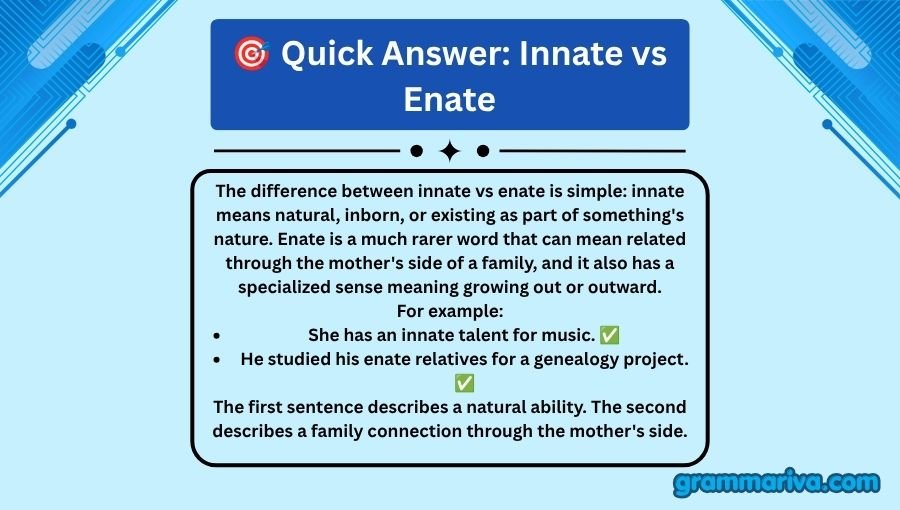
The difference between innate vs enate is simple: innate means natural, inborn, or existing as part of something’s nature. Enate is a much rarer word that can mean related through the mother’s side of a family, and it also has a specialized sense meaning growing out or outward.
For example:
- She has an innate talent for music. ✅
- He studied his enate relatives for a genealogy project. ✅
The first sentence describes a natural ability. The second describes a family connection through the mother’s side.
Is Innate the Same as Enate? 🤔
No, innate and enate are not interchangeable. They are separate words with different meanings and different uses.
Innate is the word you normally need when you mean:
- Natural
- Inborn
- Present from birth
- Inherent
- Not learned
Enate is mainly used when talking about:
- A relative on the mother’s side
- Maternal family relationships
- Certain specialized biological descriptions involving outward growth
The spelling difference is small, but the meaning difference is large.
| Word | Type | Main Meaning | Example | Correct/Incorrect |
|---|---|---|---|---|
| Innate | Adjective | Natural or inborn | She has an innate talent. | ✅ Correct |
| Enate | Adjective | Related through the mother’s side | The enate relatives were recorded. | ✅ Correct |
| Innate | Adjective | Used for maternal family ties | He studied his innate relatives. | ❌ Incorrect |
| Enate | Adjective | Used to mean natural ability | She has an enate talent. | ❌ Incorrect |
A useful rule is this: if you are talking about a quality, talent, instinct, or characteristic, think innate.
If you are talking about a maternal family relationship, think enate.
Innate: Meaning and Correct Use 🧠
Innate is an adjective used for something natural, inborn, or part of a person’s or thing’s nature. It often describes abilities, qualities, feelings, instincts, or traits.
Here are common examples:
- innate ability
- innate talent
- innate curiosity
- innate intelligence
- innate sense
- innate behavior
- innate skill
- innate knowledge
Consider this sentence:
She has an innate ability to understand people.
The word innate tells us that her ability seems natural. It does not mean she never practiced or learned anything. It simply stresses that the ability is naturally part of her.
Another example is:
Children often show an innate curiosity about the world.
Here, innate describes curiosity as something natural rather than something taught directly.
Common Uses of Innate
| Meaning | Word Type | Example Sentence |
|---|---|---|
| Natural ability | Adjective | He has an innate talent for drawing. |
| Natural quality | Adjective | Her innate kindness was easy to see. |
| Natural instinct | Adjective | The animal showed an innate response. |
| Inborn characteristic | Adjective | The study examined innate traits. |
| Natural sense | Adjective | She has an innate sense of rhythm. |
The word is common in general English. You can use it in school writing, business writing, conversations, essays, and many other settings.
What Does Enate Mean? 🔎
Enate is a real English word, but it is much less common than innate. In one major sense, it refers to someone related through the mother’s side of the family. It can be used as both an adjective and a noun.
For example:
The researcher recorded several enate relatives.
Here, enate describes relatives connected through the maternal side.
As a noun, an enate can refer to a person related on the mother’s side.
There is also a specialized biological use. In that sense, enate can describe something that grows out or outward. This use is uncommon in everyday English.
| Use of Enate | Meaning | Example |
|---|---|---|
| Family adjective | Related through the mother’s side | Her enate relatives lived nearby. |
| Family noun | A maternal-side relative | An enate attended the meeting. |
| Specialized biological adjective | Growing out or outward | The text used enate for an outward growth. |
Because enate is rare, many readers may assume it is simply a misspelling of innate. It is not.
Why Do People Confuse Innate and Enate? 🧐
When you understand the meaning behind innate vs enate, choosing the correct word becomes much easier. People confuse these words mainly because they look and sound very similar. They also share the same final letters, which makes a quick reading mistake easy.
There is another reason. Innate is familiar, while enate is unusual. When readers see the rare word, their brains may automatically replace it with the familiar one.
I once reviewed a short student essay where the writer had used a rare word correctly in one sentence but then changed it to the more familiar spelling in the next sentence. The writer had not misunderstood the idea. The unfamiliar spelling simply looked wrong to them.
That is a useful lesson. Sometimes spelling confidence is not the same as word knowledge.
| Reason for Confusion | What Happens | Easy Fix |
|---|---|---|
| Similar spelling | The words look almost identical | Check the meaning |
| Similar sound | They can be difficult to separate when heard | Look at the context |
| Rare use of enate | Readers rarely see it | Remember its maternal meaning |
| Autocorrect | Software may suggest a common word | Review the final sentence |
| Fast typing | One letter can disappear | Proofread slowly |
The best solution is not to memorize the spelling alone. Memorize the meaning attached to each spelling.
Innate vs Enate at a Glance 📋
The easiest way to understand the innate vs enate difference is to compare what each word describes.
| Feature | Innate | Enate |
|---|---|---|
| Main idea | Natural or inborn | Maternal-side relationship |
| Commonness | Common | Rare |
| Part of speech | Mainly adjective | Adjective and noun |
| Everyday use | Very common | Uncommon |
| Family relationship use | No | Yes |
| Natural talent use | Yes | No |
| Specialized biological use | Common in biology | Can describe outward growth |
| Example | innate ability | enate relative |
This table gives you the safest shortcut.
Innate = natural.
Enate = maternal-side relationship.
That distinction handles most cases you will meet.
Can Innate Describe a Talent or Ability? 🎯
Yes. Innate is a natural choice when you are describing a talent, ability, instinct, or quality that appears to be inborn.
For example:
She has an innate talent for painting. ✅
The sentence means that her talent seems natural.
Compare it with:
She has an enate talent for painting. ❌
This is not the correct use of enate. The word does not mean talented, gifted, or naturally skilled.
More examples:
- He has an innate ability to solve puzzles. ✅
- She showed an innate sense of timing. ✅
- The child displayed innate curiosity. ✅
- He developed an innate talent for writing. ❌
The last sentence is wrong because enate does not describe natural talent.
Test Tip 💡
Ask yourself:
“Am I describing something natural or inborn?”
If the answer is yes, use innate.
Can Enate Describe a Family Relationship? 👪
Yes. This is one of the main specialized meanings of enate.
An enate relationship is connected through the mother’s side of a family. The word may appear in writing about genealogy, kinship, anthropology, or related subjects.
For example:
The historian traced the family’s enate connections.
The sentence focuses on relatives connected through the maternal side.
A similar idea can be expressed more clearly in everyday English by simply saying:
relatives on the mother’s side
That phrase is much more common.
| Expression | Meaning | Everyday Use |
|---|---|---|
| Enate relative | Relative through the mother’s side | Rare |
| Maternal relative | Relative connected through the mother | Common |
| Relative on my mother’s side | Family member connected through mother | Very common |
| Mother’s family | Family connected through mother | Very common |
So, while enate is correct in the right setting, a simple phrase may be better for general readers.
How Do You Use Innate in a Sentence? ✍️
Use innate before a noun when you want to describe something natural or inborn.
Common patterns include:
innate + ability
She has an innate ability to lead.
innate + talent
His innate talent became clear at an early age.
innate + sense
She has an innate sense of humor.
innate + curiosity
His innate curiosity encouraged him to ask questions.
You can also use the related adverb innately.
She is innately curious.
There is also the noun innateness, although it is much less common in ordinary conversation.
| Form | Type | Example |
|---|---|---|
| Innate | Adjective | He has an innate skill. |
| Innately | Adverb | She is innately curious. |
| Innateness | Noun | The debate concerned the innateness of the trait. |
| Enate | Adjective/Noun | They documented an enate relative. |
| Enatic | Related adjective | The text discussed an enatic connection. |
What Is the Grammar Rule for Innate and Enate? 📚
The grammar rule is based on meaning and context, not simply spelling.
Innate works as an adjective when it modifies a noun that refers to something natural or inborn.
innate ability
innate behavior
innate talent
Enate can work as an adjective when it describes a maternal-side relationship. It can also function as a noun for a maternal-side relative.
This means you cannot swap the two words just because they look similar.
Most standard dictionary references agree on the key distinction: innate concerns natural or inborn qualities, while enate has specialized meanings connected with the mother’s side or outward growth.
Correct vs Incorrect at a Glance
| Sentence | Correct/Incorrect | Why |
|---|---|---|
| She has an innate talent for music. | ✅ Correct | Innate means natural or inborn. |
| He has an enate talent for music. | ❌ Incorrect | Enate does not mean talented. |
| They traced the enate family line. | ✅ Correct | Enate can describe maternal relationships. |
| She studied her innate relatives. | ❌ Incorrect | Innate does not describe family lineage. |
| The child showed innate curiosity. | ✅ Correct | Curiosity can be described as natural. |
The safest method is to choose the word based on the idea you want to express.
What Are the Most Common Mistakes With These Words? ⚠️
Most mistakes happen because writers remember the spelling but forget the meaning.
Here are some common sources of error:
- Fast typing
- Autocorrect
- Spell-check suggestions
- Confusing similar-looking words
- Assuming a rare word is a typo
- Not checking the sentence meaning
I once caught myself typing enate when I meant innate while editing a sentence about natural skill. I noticed the mistake because the sentence was about talent, not family. That quick meaning check fixed it immediately.
Similar Word Confusions
| Confusing Pair | Correct Difference |
|---|---|
| Its / It’s | Possession vs. “it is” |
| Your / You’re | Possession vs. “you are” |
| Affect / Effect | Influence/action vs. result |
| Then / Than | Time/order vs. comparison |
| Advice / Advise | Noun vs. verb |
| Innate / Enate | Natural/inborn vs. maternal-side or specialized biological use |
Common Wrong Forms
| Wrong Form or Use | What’s Wrong | Correct Form |
|---|---|---|
| Enate talent | Enate does not mean natural talent | Innate talent |
| Innate relative | Innate does not mean maternal relative | Enate relative |
| Inate ability | Missing an “n” | Innate ability |
| Enate ability | Wrong meaning | Innate ability |
| Innate family line | Wrong meaning | Enate family line |
| Enate curiosity | Wrong meaning | Innate curiosity |
A quick proofread can catch nearly all of these errors.
Is Enate a Real English Word? 🔤
Yes, enate is a real English word. It is not simply a misspelling of innate.
Established dictionaries list enate with specialized meanings. These include a person or relative connected through the mother’s side and an adjective sense related to growing out or outward.
However, its rarity matters.
If you are writing a normal email, school assignment, blog post, or social media caption, you will probably need innate much more often.
If you are writing about genealogy or specialized biological language, enate may be exactly the word you need.
Where Did Innate and Enate Come From? 📜
Both words have a long history connected with ideas of birth or coming into being, but their modern meanings have developed in different directions.
Innate is associated with the idea of being inborn or naturally present. Enate comes from a Latin form connected with being born or issuing forth. Modern dictionaries preserve the specialized meanings of enate, including its maternal-side and outward-growth senses.
Because the historical details can become complex, the most useful lesson for modern writers is not the history. It is the present-day distinction.
| Period | Word | General Development |
|---|---|---|
| Earlier English use | Innate | Developed around the idea of being inborn |
| Later English use | Innate | Expanded into natural qualities and abilities |
| Earlier technical use | Enate | Connected with birth or issuing outward |
| Modern specialized use | Enate | Used for maternal-side relationships and outward growth |
You do not need to study the history to use either word correctly.
How Are These Words Used in Different Contexts? 🌎
Context makes the difference very clear.
Everyday Conversation
Use innate when discussing natural qualities.
She has an innate sense of humor.
Enate is unlikely to appear in a casual conversation.
Professional Writing
Innate can be useful in education, psychology, science, and general business writing.
Enate may appear in specialized academic or research writing when the topic requires it.
Creative Writing
An author may use innate to describe a character’s natural gift.
Her innate courage kept her moving forward.
Enate could appear in historical fiction or family-centered writing if the specialized meaning fits.
Social Media and Texting
Innate is possible, especially in posts about talents or personality.
Enate is rarely useful unless you are specifically discussing genealogy or a specialized topic.
| Context | Which Term to Use | Example |
|---|---|---|
| Everyday conversation | Innate | He has an innate sense of humor. |
| Professional writing | Usually innate | Her innate leadership skills stood out. |
| Creative writing | Usually innate | She trusted her innate courage. |
| Social media/texting | Usually innate | My innate love of music is real. |
What Are the Best Alternatives to Innate? 💬
Several words can replace innate, but the exact meaning may change slightly.
Good alternatives include:
- Inborn
- Natural
- Inherent
- Instinctive
- Built-in
For example:
She has an innate ability to teach.
You could write:
She has a natural ability to teach.
The meaning is close, but natural can be broader than innate.
| Alternative | Works When | Does Not Work When |
|---|---|---|
| Inborn | Something exists from birth | You mean a learned skill |
| Natural | Something seems effortless or inherent | You need a strict birth-related meaning |
| Inherent | Something is a basic part of something | You mean a specific family relationship |
| Instinctive | An action happens without conscious thought | You are describing a general talent |
| Built-in | Something is naturally included | Formal academic writing may need a more precise word |
There is no useful everyday synonym for enate that works in every situation. In general writing, related through the mother’s side is often clearer.
What Are Common Phrases With Innate? 📝
Innate appears in many common word combinations. These phrases are much more familiar than phrases with enate.
Common examples include:
- innate ability
- innate talent
- innate curiosity
- innate sense
- innate behavior
- innate skill
- innate intelligence
- innate quality
| Phrase | Meaning |
|---|---|
| Innate ability | A naturally present ability |
| Innate talent | A natural gift or skill |
| Innate curiosity | A natural desire to learn or explore |
| Innate behavior | Behavior that is natural rather than learned |
| Innate sense | A natural understanding or feeling |
| Innate quality | A characteristic that is naturally part of something |
These combinations make the correct word easier to recognize.
Why Does Getting the Difference Right Matter? 🎯
Getting innate vs enate right matters because a single letter can change the meaning of an entire sentence.
In professional writing, unclear word choice can distract readers. In academic writing, it can create a factual problem. In digital communication, it can make a writer appear careless even when the intended idea is correct.
A useful writing rule is:
Choose the word that makes your meaning clear on the first reading.
| Situation | Why Getting It Right Matters |
|---|---|
| Resume | Shows careful word choice |
| Client email | Prevents confusion |
| Published article | Improves accuracy |
| Academic paper | Protects meaning and precision |
This is especially important when using a rare word such as enate. If your readers may not know it, a clearer phrase may sometimes be better.
How Can You Remember the Difference? 🧠
Use a simple two-part memory trick:
When you understand the meaning behind innate vs enate, choosing the correct word becomes much easier.
Innate = inborn.
Both ideas point toward something natural or present from birth.
Enate = maternal connection.
Think about the mother’s side of a family when you see enate.
Here is another quick test:
“Is this about a talent, trait, instinct, or natural quality?”
If yes, choose innate.
“Is this about a relationship through the mother’s side?”
If yes, choose enate.
| Question | If Yes → Use |
|---|---|
| Is it natural or inborn? | Innate |
| Is it a natural talent? | Innate |
| Is it an instinct? | Innate |
| Is it a maternal-side relative? | Enate |
| Is it a maternal family connection? | Enate |
| Is it a specialized outward-growth description? | Enate |
This test takes only a few seconds.
Can Enate Be Used in Biology? 🔬
Yes. Enate has a specialized biological sense connected with something growing out or outward. This meaning is much less common than the family-related sense.
That means you should always consider the subject of the text.
If you are reading about:
- Family relationships
- Maternal ancestry
- Kinship
- Genealogy
then enate may refer to the mother’s side.
If the subject is specialized biology and the text discusses outward growth, enate may have its biological sense.
By contrast, innate is widely used in biology for things that are natural or not acquired through learning. It is also used in many other fields.
Is Innate or Enate More Common? 📊
Innate is much more common in normal English. It appears regularly in everyday, academic, professional, and scientific writing.
Enate is rare and specialized. It is legitimate, but most people will encounter it far less often. Dictionary references list its specialized uses rather than treating it as a normal alternative spelling of innate.
| Word | Frequency in General English | Typical Use |
|---|---|---|
| Innate | Common | Natural traits and abilities |
| Enate | Rare | Maternal relationships and specialized biology |
| Innately | Less common but familiar | Describes something done naturally |
| Enatic | Rare | Related specialized description |
So, if you are unsure which spelling belongs in an ordinary sentence, check the meaning first. If the sentence is about something natural or inborn, innate is almost certainly the word you need.
What Should You Use in Everyday Writing? ✏️
For everyday writing, use innate when you mean natural, inborn, or inherent.
Examples:
She has an innate talent for design. ✅
He has an innate sense of direction. ✅
Children have an innate desire to explore. ✅
Do not use enate simply because you want a less common version of innate.
She has an enate talent for design. ❌
That sentence uses the wrong word.
If you need the maternal meaning, enate is correct, but a clearer phrase may be better for a general audience:
She researched relatives on her mother’s side. ✅
This sentence is easier for most readers than:
She researched her enate relatives. ✅
Both can communicate the intended idea, but the first is more familiar.
Quick Recap Checklist ✅
The entire distinction can be reduced to a few questions.
| Question | If Yes → Use |
|---|---|
| Does it mean natural? | Innate |
| Does it mean inborn? | Innate |
| Does it describe a talent? | Innate |
| Does it describe an instinct? | Innate |
| Does it describe a maternal-side relative? | Enate |
| Does it describe maternal family ties? | Enate |
| Is it a specialized biological use about outward growth? | Enate |
Practice Examples
- She has an innate gift for storytelling. ✅
- The historian traced the family’s enate relationships. ✅
- His innate curiosity made him ask many questions. ✅
Try replacing the word with natural. If the sentence still makes sense, innate is probably the right choice.
FAQs About Innate vs Enate ❓
What is the difference between innate and enate?
Innate means natural, inborn, or present as part of something’s nature. Enate is a rare word that can describe a relationship through the mother’s side of a family. It also has a specialized meaning related to growing outward.
What does innate mean?
Innate means natural, inborn, or inherent. It often describes abilities, talents, instincts, feelings, or traits that are naturally present.
Example: “She has an innate talent for music.”
What does enate mean?
Enate can mean related through the mother’s side of a family. As a noun, it can refer to a maternal-side relative. In a specialized biological use, it can also mean growing out or outward.
Is enate a real word?
Yes. Enate is a real English word. It is uncommon, but established dictionaries list it with specialized meanings involving maternal relationships and, in some references, outward growth.
Is innate the same as enate?
No. Innate means natural or inborn. Enate refers mainly to maternal-side relationships or a specialized biological idea. They are not interchangeable.
Can innate describe a natural talent?
Yes. Innate is commonly used to describe a natural talent or ability.
Example:
He has an innate talent for painting.
It suggests that the talent seems naturally present.
Can enate mean natural ability?
No. Enate does not mean natural ability, talent, or instinct. Use innate for those meanings.
Incorrect:
She has an enate ability to sing. ❌
Correct:
She has an innate ability to sing. ✅
What is an enate relative?
An enate relative is a relative connected through the mother’s side of the family. The word is specialized and is more likely to appear in genealogy, kinship, anthropology, or related writing than in everyday conversation.
What is the opposite of innate?
Depending on context, useful opposites include learned, acquired, or developed. These words describe something gained through experience, education, practice, or other outside influences rather than something naturally present.
How can I remember innate vs enate?
Use this short memory rule:
Innate = inborn.
Enate = maternal side.
If you are describing a natural ability, trait, instinct, or quality, choose innate. If you are describing a relationship through the mother’s side, choose enate.
Conclusion: Innate vs Enate Made Simple 🌟
Innate vs enate becomes easy once you focus on meaning instead of spelling. Innate is the common word for something natural, inborn, inherent, or present as part of a person’s or thing’s nature. You can use it for talents, abilities, instincts, curiosity, behavior, and many other natural qualities.
Enate is a real but much rarer word. Its main specialized use refers to a person or relationship connected through the mother’s side of a family. It can also describe outward growth in a specialized biological context.
When you are writing a normal sentence, ask yourself one question: Am I talking about something natural, or am I talking about the maternal side of a family? If it is natural or inborn, choose innate. If it concerns maternal lineage, choose enate.
I find that this simple meaning check works better than trying to memorize two similar spellings. Keep the rule in mind, and these two words will stop being confusing. ✨
Remember: innate is inborn, while enate points to the maternal side.

Hi, I’m Ethan Brooks. I’m an English grammar writer at Grammariva, where I work on clear explanations, practical examples, and useful writing tips. I enjoy making difficult grammar topics easier to understand.
[…] difference, show correct and incorrect examples, and give you easy ways to remember the rule. ✨ Innate vs Enate | Zeroes or Zeros | Anywhere or Any […]
[…] and give you quick tests you can use whenever you are unsure. With Regard to or With Regards To | Innate vs Enate | Zeroes or […]