If you have ever stopped while writing because you wondered about spectre or specter, you are not alone. Both spellings are real words, and both refer to the same basic idea: a ghost, frightening presence, or troubling possibility. The main difference is where the spelling is preferred. “Specter” is the standard spelling in American English, while “spectre” is mainly used in British English and some other varieties of English. 👀
This small spelling difference can cause big confusion. You may see “spectre” in a British novel and “specter” in an American news article. Neither writer is necessarily wrong.
I have taught and edited English for years, and I often see writers pause over words like this. The good news is that the rule is simple once you connect each spelling with its preferred form of English.
In this guide, I will explain the difference, show real examples, cover common mistakes, and give you easy ways to remember which spelling to choose. Damnit or Dammit | Apposed vs Opposed | Attain vs Obtain
🎯 Quick Answer: Spectre or Specter
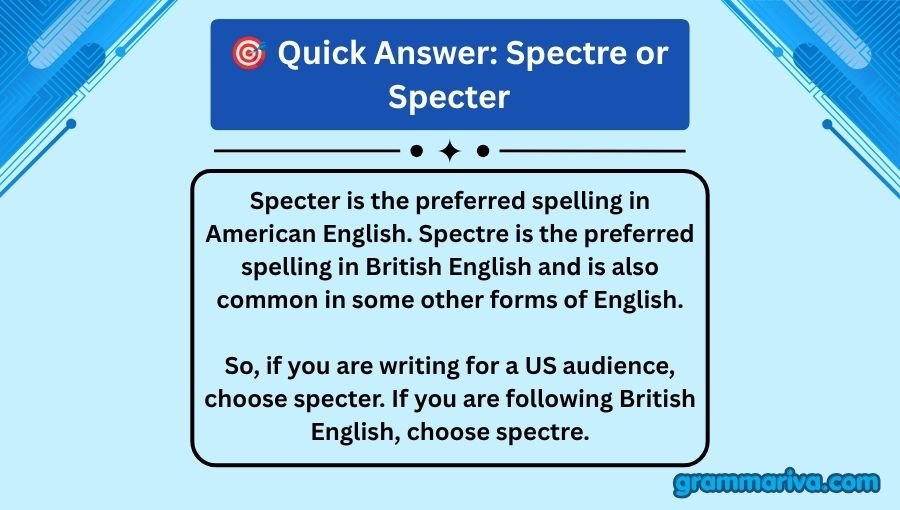
Specter is the preferred spelling in American English. Spectre is the preferred spelling in British English and is also common in some other forms of English.
So, if you are writing for a US audience, choose specter. If you are following British English, choose spectre.
📚 Is Spectre the Same as Specter?
Yes. Spectre and specter have the same basic meaning, but they follow different spelling conventions. The difference is mainly regional rather than a difference in meaning.
Both words can describe:
- A ghost or frightening spirit
- Something that seems frightening or threatening
- A disturbing possibility that people fear
- A troubling problem that seems likely to appear
For example:
✅ A specter appeared in the old house.
❌ A spectre appeared in the old house.
For American English, this spelling is not the usual choice.
However:
✅ A spectre appeared in the old house.
❌ A specter appeared in the old house.
In a piece written consistently in British English, “spectre” is normally preferred.
The key is not meaning. The key is regional spelling.
🔍 Specter vs Spectre at a Glance
The easiest way to understand spectre or specter is to compare the two spellings directly.
| Form | Type | Meaning | Example | Correct/Incorrect |
|---|---|---|---|---|
| specter | Noun | Ghost or frightening possibility | A specter haunted the building. | ✅ Correct in US English |
| spectre | Noun | Ghost or frightening possibility | A spectre haunted the building. | ✅ Correct in British English |
| specter | Noun | Threat or troubling possibility | The specter of war worried them. | ✅ Correct in US English |
| spectre | Noun | Threat or troubling possibility | The spectre of war worried them. | ✅ Correct in British English |
| spector | Misspelling | Not the standard spelling for this word | The spector appeared. | ❌ Incorrect |
| spectar | Misspelling | Not the standard spelling | A spectar appeared. | ❌ Incorrect |
The most important point is simple: American English favors specter, while British English favors spectre.
✏️ Specter: Meaning and Correct Use
Specter is a noun used in American English for a ghost, frightening figure, or troubling possibility.
The word has both a literal and a figurative use.
Literal meaning
A literal specter can be a ghost or ghostlike figure.
For example:
✅ The children believed they saw a specter in the hallway.
The noun “specter” names the frightening figure they thought they saw.
Figurative meaning
A specter can also represent a fear or danger.
For example:
✅ The specter of unemployment worried many workers.
Here, nobody is talking about a ghost. The word represents the fear of losing a job.
A useful meaning table
| Meaning | Word Type | Example Sentence |
|---|---|---|
| Ghost | Noun | A specter appeared near the window. |
| Frightening figure | Noun | The story described a dark specter. |
| Threat | Noun | The specter of conflict remained. |
| Fearful possibility | Noun | The specter of failure affected him. |
This figurative use is common in serious writing. Writers often use the word when discussing war, poverty, disease, failure, debt, or other unwanted possibilities.
💡 Test Tip
Ask yourself where your audience is.
If your readers mainly use American English, write specter.
If your readers mainly use British English, write spectre.
This simple audience test solves most cases.
🇬🇧 Why Is Spectre Used in British English?
“Spectre” is the spelling commonly preferred in British English. American English generally drops the final “-re” pattern and uses “specter.”
This is part of a larger pattern in English spelling. British and American English sometimes use different spellings for the same word.
Compare:
| British English | American English |
|---|---|
| spectre | specter |
| centre | center |
| metre | meter |
| theatre | theater |
| fibre | fiber |
| litre | liter |
These pairs do not always follow one single rule in every situation, but they show why spectre vs specter can look different while keeping the same meaning.
If you are writing for readers in the United States, “specter” will usually look more natural.
If your writing follows British conventions, “spectre” will usually fit better.
🧠 Why Do People Confuse Spectre and Specter?
People confuse these spellings because English has no single spelling system used everywhere. Different English-speaking regions developed and maintained different conventions.
A reader may see both forms online, in books, or in news reports. That can make it seem as if one spelling must be wrong.
I once reviewed a short article written by a student who had used “spectre” several times. The student was writing for an American class. The word was not wrong in meaning, but the spelling did not match the required style. We changed each occurrence to “specter.”
The lesson was useful: a spelling can be valid English and still be the wrong choice for a particular style guide or audience.
Another reason for confusion
British English often keeps spellings that end in “-re,” while American English often uses “-er” in certain word pairs.
That is why writers who read both British and American material may switch between the two without realizing it.
📝 Case Study: A Workplace Example
Imagine that an American company is preparing a report about financial risks.
The writer wants to say that a serious economic problem could affect the business.
The first draft says:
❌ The spectre of rising costs could affect our company.
The sentence is understandable, but the company uses American English throughout its reports.
The editor changes it to:
✅ The specter of rising costs could affect our company.
Nothing about the meaning changed. Only the regional spelling changed.
Now imagine the same sentence in a British publication:
✅ The spectre of rising costs could affect our company.
That version fits British spelling.
This example shows why context matters. Good editing is not always about changing a word because it is “wrong.” Sometimes the goal is to make spelling consistent with the intended variety of English.
⚙️ Grammar Rules Explanation
The basic grammar rule is straightforward: specter and spectre are spelling variants of the same noun, with specter preferred in American English and spectre preferred in British English.
The word functions as a noun.
You can use it as the subject or object of a sentence.
For example:
The specter frightened the visitors.
Here, “specter” is the subject.
The visitors feared the specter.
Here, “specter” is the object.
The word can also appear in the common phrase “the specter of”, followed by a noun or noun phrase describing a feared problem.
Examples include:
- the specter of war
- the specter of poverty
- the specter of failure
- the specter of unemployment
- the specter of violence
The same grammar applies to “spectre” in British English.
Most standard dictionaries and style references recognize the two spellings as regional forms. The important issue is choosing the spelling that matches the variety of English you are using.
Correct vs Incorrect at a Glance
| Sentence | Correct/Incorrect | Why |
|---|---|---|
| The specter of war worried the nation. | ✅ Correct | Standard US spelling |
| The spectre of war worried the nation. | ✅ Correct | Standard British spelling |
| The spector of war worried the nation. | ❌ Incorrect | “Spector” is not the standard spelling |
| A spectar appeared in the story. | ❌ Incorrect | “Spectar” is a misspelling |
| The specter appeared in the American novel. | ✅ Correct | Fits American spelling |
Remember that “incorrect” here means the spelling is not correct for the word, or it does not fit the stated regional convention. “Spectre” itself is not a misspelling.
⚠️ Common Mistakes With Spectre and Specter
The biggest mistake is assuming that one spelling is always right and the other is always wrong.
That is not true.
Mistake 1: Calling “spectre” an English error
“Spectre” is a valid English spelling. It is simply more closely associated with British English.
Mistake 2: Using “specter” in a British-style article
If an article follows British spelling throughout, switching to “specter” can make the writing inconsistent.
Mistake 3: Writing “spector”
This is a genuine spelling mistake when you mean the ghost or threat.
Why mistakes happen
Three common causes are:
- Fast typing: Writers type quickly and do not check regional spelling.
- Autocorrect: Software may favor one spelling based on its language settings.
- Lack of knowledge: Writers may not know that both forms are accepted.
I once caught myself typing “spectre” in an American-style editing project after spending several hours reading British material. The surrounding text had influenced my spelling. A quick style check fixed it.
Similar spelling confusions
| Confusion | Correct Form 1 | Correct Form 2 | Main Difference |
|---|---|---|---|
| its / it’s | its | it’s | Possession vs contraction |
| your / you’re | your | you’re | Possession vs contraction |
| their / there | their | there | Possession vs place |
| affect / effect | affect | effect | Different common functions |
| center / centre | center | centre | US vs British spelling |
| specter / spectre | specter | spectre | US vs British spelling |
Common wrong forms for this word
| Wrong Form | What’s Wrong | Correct Form |
|---|---|---|
| spector | Extra “o” changes the spelling | specter / spectre |
| spectar | Incorrect vowel pattern | specter / spectre |
| spekter | Not the standard English spelling | specter / spectre |
| spectre in a US style guide | Regional mismatch | specter |
| specter in a consistent British style | Regional mismatch | spectre |
📜 Word Origin and History
The two spellings have a long shared history in English. Over time, English developed different spelling conventions in Britain and the United States.
The important point for modern writers is not the exact historical path. It is the spelling pattern that readers now expect.
A simple timeline helps:
| Period | Form | Note |
|---|---|---|
| Earlier English use | spectre/specter forms | Spelling was not fully standardized |
| Later British usage | spectre | The “-re” spelling became established |
| American usage | specter | The “-er” spelling became preferred |
| Modern British English | spectre | Still widely used |
| Modern American English | specter | Standard US preference |
You do not need to memorize the history to use the word correctly.
For modern writing, just remember the regional difference.
🌎 How Is Specter Used in Different Contexts?
The best spelling depends on both your audience and your chosen style of English.
Everyday conversation
You may hear or read the word when someone talks about a ghost or a serious fear.
American example:
✅ The specter of another storm worried everyone.
British example:
✅ The spectre of another storm worried everyone.
Professional writing
In business, academic, or workplace writing, consistency matters.
An American report should normally use “specter.”
A British report should normally use “spectre.”
Creative writing
Fiction gives writers more freedom. A writer may choose either spelling based on the setting, narrator, publisher, or intended audience.
Social media and texting
People may use either form. However, your audience still matters if you want polished writing.
| Context | Which Term to Use | Example |
|---|---|---|
| US everyday writing | specter | The specter scared me. |
| British everyday writing | spectre | The spectre scared me. |
| US professional writing | specter | The specter of debt remains. |
| British professional writing | spectre | The spectre of debt remains. |
| US creative writing | specter | A strange specter appeared. |
| British creative writing | spectre | A strange spectre appeared. |
| US social media | specter | The specter of Monday is back. |
| British social media | spectre | The spectre of Monday is back. |
💬 What Does “The Specter of” Mean?
“The specter of” refers to a feared problem, danger, or possibility that seems likely to affect someone.
This phrase is usually figurative.
For example:
✅ The specter of unemployment worried the workers.
The sentence does not mean that a ghost named “Unemployment” appeared. It means the workers were afraid they might lose their jobs.
Other examples include:
- the specter of war
- the specter of poverty
- the specter of debt
- the specter of failure
- the specter of violence
In British English, these become:
- the spectre of war
- the spectre of poverty
- the spectre of debt
- the spectre of failure
- the spectre of violence
Common phrases
| Phrase | Meaning |
|---|---|
| the specter of war | Fear of war |
| the specter of poverty | Fear or threat of poverty |
| the specter of failure | Fear of failing |
| the specter of unemployment | Fear of losing work |
| the specter of debt | Fear or burden of debt |
| the specter of violence | Threat or fear of violence |
🔄 What Words Can Replace Specter?
Sometimes you can replace “specter” with another word. The best choice depends on what you mean.
If you mean an actual ghost, ghost is usually simpler.
If you mean a feared possibility, threat, fear, or possibility may work.
However, these alternatives do not always create the same tone.
| Alternative | Works When | Does Not Work When |
|---|---|---|
| ghost | You mean a spirit or ghost | You mean an abstract threat |
| threat | You mean a danger | You want a ghostlike image |
| fear | You mean an emotional concern | You need a physical figure |
| danger | You mean possible harm | You want a literary tone |
| possibility | You mean something that may happen | You want a strong sense of fear |
For example:
The specter of failure haunted him.
You could write:
The fear of failure haunted him.
The second sentence is clearer and simpler. The first has a more dramatic tone.
🎯 How Can You Remember the Difference?
The easiest memory trick is to connect specter with American English.
Think:
US = specter
Then remember:
British English = spectre
You can also compare the pattern with words such as “center” and “centre.”
| If You Are Writing For | Choose |
|---|---|
| United States | specter |
| United Kingdom | spectre |
| American school assignment | specter |
| British school assignment | spectre |
| US business website | specter |
| British publication | spectre |
If you are unsure, check the style guide for the project. Consistency is more important than switching randomly between forms.
🤔 Is Specter More Correct Than Spectre?
No. Specter is not universally more correct than spectre. It is the standard choice for American English, while spectre is the standard choice for British English.
This distinction matters because English is a global language.
A British writer using “spectre” has not made a spelling error simply because an American reader expects “specter.”
Likewise, an American writer using “specter” is following normal US spelling.
The best rule is:
Choose the spelling that matches your audience and keep it consistent.
🧩 When Should You Use Spectre?
Use spectre when your writing follows British English conventions or another variety that prefers that spelling.
For example:
✅ The spectre of war remained in the public mind.
This works well in British-style writing.
You might see this spelling in:
- British books
- UK news writing
- British academic work
- British websites
- Literature using British spelling
If the rest of your article uses “colour,” “centre,” and “organise,” then “spectre” will usually fit that style.
🇺🇸 When Should You Use Specter?
Use specter when your writing follows American English.
For example:
✅ The specter of war remained in the public mind.
This is the natural US spelling.
You should generally choose it for:
- American school assignments
- US business documents
- American websites
- US news-style writing
- Content written for American readers
If the rest of your writing uses “color,” “center,” and “organize,” then “specter” is the better match.
📝 Does the Meaning Change Between Spectre and Specter?
No. The meaning does not normally change between spectre and specter. The main difference is spelling by region.
Both can refer to a ghostlike figure or a frightening possibility.
| Feature | Spectre | Specter |
|---|---|---|
| Meaning | Same | Same |
| Word type | Noun | Noun |
| Ghost meaning | Yes | Yes |
| Figurative threat | Yes | Yes |
| British preference | Yes | No |
| American preference | No | Yes |
This is why the choice should be based on spelling style, not meaning.
📌 Why Getting Spectre or Specter Right Matters
Correct regional spelling helps your writing look polished and intentional.
Clarity
Readers can understand both forms, but consistent spelling makes your writing easier to trust.
Professionalism
A workplace document should follow one clear spelling style.
Digital communication
Web content reaches readers from many countries. Using a consistent style prevents unnecessary confusion.
| Situation | Why Getting It Right Matters |
|---|---|
| Resume | Shows careful writing |
| Client email | Keeps your message polished |
| Published article | Matches the publication’s style |
| Social post | Makes the wording look intentional |
A useful rule I give writers is:
Good spelling is not only about the word. It is also about the audience.
That rule applies far beyond this one pair.
✨ Special Exception: Names and Titles
There is one practical exception to keep in mind. A title, name, quotation, or official name may use a particular spelling even if it does not match your normal regional style.
For example, a British book title may contain “spectre.” If you mention that exact title, you should preserve its official spelling.
Do not “correct” a proper title simply to make it match American spelling.
In normal original writing, however, follow the spelling style of your audience.
⚡ Quick Recap Checklist
Use this checklist whenever you are unsure about spectre or specter.
| Question | If Yes → Use |
|---|---|
| Am I writing for an American audience? | specter |
| Am I writing for a British audience? | spectre |
| Does my style guide require US spelling? | specter |
| Does my style guide require British spelling? | spectre |
| Am I copying an official title? | Keep the original spelling |
| Am I using the word as a noun for a ghost or threat? | Either, based on region |
Practice examples
- The specter of failure made him nervous.
→ Correct for American English. ✅ - The spectre of failure made him nervous.
→ Correct for British English. ✅ - The spector of failure made him nervous.
→ Incorrect spelling. ❌
❓ FAQs About Spectre vs Specter
Is spectre or specter correct in American English?
Specter is the standard spelling in American English. Use it when writing for a US audience unless you are reproducing an official name or title with a different spelling.
Is spectre or specter correct in British English?
Spectre is the standard spelling in British English. It has the same basic meaning as “specter,” but the spelling follows British convention.
Is spectre a British spelling?
Yes. Spectre is commonly used in British English. American English generally uses “specter” instead.
Does specter mean ghost?
Yes. “Specter” can mean a ghost or ghostlike figure. It can also be used figuratively for something frightening or threatening.
What does “the specter of” mean?
“The specter of” usually introduces a feared problem or possibility. For example, “the specter of war” means the threat or fear of war.
Is spector a correct spelling?
No. Spector is not the standard spelling when you mean a ghost or frightening possibility. The correct regional forms are “specter” and “spectre.”
Can I use spectre in an American essay?
You can understand and recognize it, but specter is normally the better choice for an American English essay. Match the spelling style required by your teacher, school, or style guide.
Are spectre and specter pronounced differently?
They are generally treated as the same word in meaning and standard usage, with the spelling difference reflecting regional English conventions.
Which spelling should I use for a US website?
Use specter for a US-focused website. This keeps your spelling aligned with American English and with other US spellings.
Is specter more correct than spectre?
Neither is universally more correct. Specter is preferred in American English, while spectre is preferred in British English. The right choice depends on your target variety of English.
🏁 Conclusion
Spectre or specter is mainly a question of regional spelling, not meaning. American English normally uses specter, while British English normally uses spectre. Both forms can describe a ghost, frightening figure, or troubling possibility.
If you write for Americans, choose “specter.” If you write for British readers, choose “spectre.” The most important thing is to stay consistent with the English style you have chosen.
When you see the phrase “the specter of” or “the spectre of,” remember that it often describes a feared problem rather than a real ghost. 👻
I find this rule easy to teach because it removes the mystery. You do not need to memorize a long grammar rule. Just identify your audience and choose the matching spelling.
US readers? Specter. British readers? Spectre.
Once you remember that simple pair, this spelling question becomes much easier. Keep your audience in mind, stay consistent, and your writing will remain clear and polished. ✍️

Hi, I’m Nathan Reed. I’m a grammar and writing specialist at Grammariva. I work on practical grammar content that helps readers understand sentence structure, punctuation, vocabulary, and better writing habits.



[…] and mum, show you when to use each one, and give you simple tests that make the choice much easier. Spectre or Specter | Damnit or Dammit | Apposed vs […]
[…] mistakes, practice sentences, and FAQs so you can confidently choose the right word. Mom vs Mum | Spectre or Specter | Damnit or […]