Have you ever started a message with sorry for bothering you vs sorry to bother you and then stopped because you were not sure which one sounded right? You are not alone. These two phrases look almost the same, but they are used in slightly different ways. Both can be correct, depending on what you mean and when you say them. 😊
The main difference is simple. “Sorry to bother you” usually means you are apologizing for interrupting someone or asking for their attention. “Sorry for bothering you” often means you are apologizing for an action that has already happened or for causing someone trouble.
I have seen this confusion in emails, texts, workplace messages, and even school assignments. The good news is that you do not need a complicated grammar rule to choose the right phrase. Once you understand the difference between to bother and for bothering, the choice becomes much easier.
In this guide, I will explain both forms with clear examples, simple tests, common mistakes, and practical situations. ✨ Thus Far vs So Far | Checkup or Check-Up | Having vs Having Had
🎯 Quick Answer: Sorry for Bothering You vs Sorry to Bother You
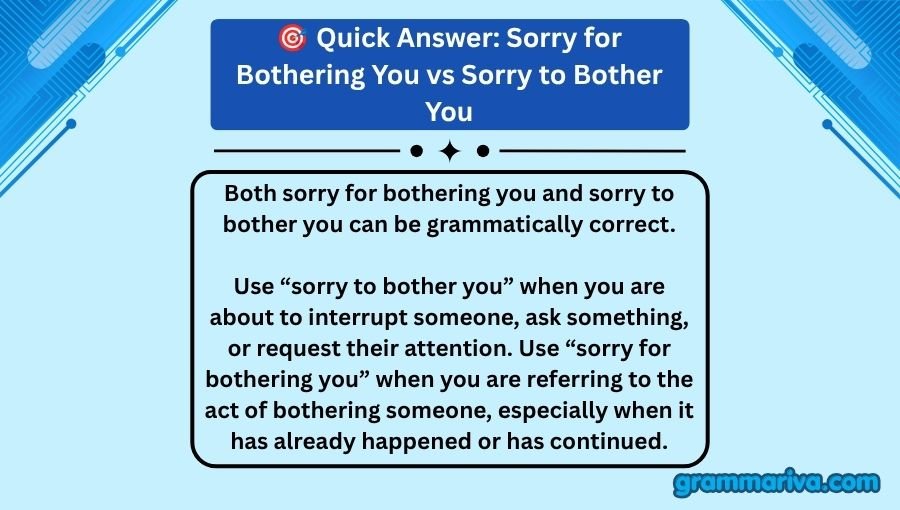
Both sorry for bothering you and sorry to bother you can be grammatically correct.
Use “sorry to bother you” when you are about to interrupt someone, ask something, or request their attention. Use “sorry for bothering you” when you are referring to the act of bothering someone, especially when it has already happened or has continued.
| Phrase | Main Use | Example |
|---|---|---|
| Sorry to bother you | Apology before an interruption or request | Sorry to bother you, but could I ask a question? |
| Sorry for bothering you | Apology for the act of bothering someone | Sorry for bothering you again about this issue. |
| Sorry to bother you? | Often used before speaking | Sorry to bother you, but do you know the time? |
| Sorry for bothering you | Often used after repeated contact | Sorry for bothering you with another email. |
The easiest rule is this: “to bother” often points to the action you are about to take, while “for bothering” focuses on the action itself.
Is “Sorry to Bother You” Correct? 🤔
Yes, “sorry to bother you” is completely correct. It is one of the most common ways to politely apologize before interrupting someone, asking for help, or taking their attention. Understanding sorry for bothering you vs sorry to bother you can make everyday English much easier.
For example:
- ✅ Sorry to bother you, but could you help me with this file? The difference between sorry for bothering you vs sorry to bother you is mainly about the grammar structure and timing.
- ❌ Sorry to bother you, but could you helping me with this file?
The first sentence uses the correct verb form after could you. The second uses an incorrect form.
The phrase can be used in many situations. You might say it to a coworker, teacher, friend, stranger, customer, or manager.
When “Sorry to Bother You” Works Best
Use it when the interruption is happening now or is about to happen.
Examples:
- Sorry to bother you, but I have a quick question.
- Sorry to bother you while you are working.
- Sorry to bother you, but could you check this number?
- Sorry to bother you so late.
- Sorry to bother you, but I need your advice.
The phrase sounds polite because it recognizes that the other person may be busy.
“Sorry to Bother You” in Questions
It often appears before a request.
For example:
Sorry to bother you, but do you know where Room 204 is?
The speaker is not saying that they have already bothered the person. They are politely introducing the interruption.
| Situation | Example | Why It Works |
|---|---|---|
| Asking for help | Sorry to bother you, but can you help me? | The request is happening now. |
| Asking a stranger | Sorry to bother you, but is this seat taken? | The speaker is starting an interaction. |
| Sorry to bother you, but I need one more detail. | The writer is asking for attention. | |
| Workplace | Sorry to bother you during lunch. | The interruption is current. |
💡 Test Tip
Ask yourself:
“Am I about to interrupt or ask this person something?”
If the answer is yes, “sorry to bother you” is usually the natural choice.
Is “Sorry for Bothering You” Correct? ✅
Yes, “sorry for bothering you” is also correct. It focuses on the act of bothering someone.
The word for is followed by bothering, which is the -ing form of the verb.
Examples:
- ✅ Sorry for bothering you again.
- ❌ Sorry for bother you again.
After the preposition for, an -ing form is normally used when the phrase refers to an action.
When “Sorry for Bothering You” Works Best
This form is especially natural when the speaker is talking about an action that has already happened or has happened repeatedly.
Consider this example:
Sorry for bothering you with so many questions.
The speaker has already asked several questions. The phrase looks back at that behavior.
Another example is:
Sorry for bothering you again about the same problem.
The word again makes the meaning even clearer. The speaker has contacted the person before.
| Meaning | Word Form | Example Sentence |
|---|---|---|
| Apology before an interruption | to + verb | Sorry to bother you. |
| Apology for an action | for + -ing | Sorry for bothering you. |
| Repeated contact | for + -ing | Sorry for bothering you again. |
| Ongoing inconvenience | for + -ing | Sorry for bothering you all week. |
The difference is small, but the time and focus can change.
What Is the Difference Between Sorry for Bothering You and Sorry to Bother You? 🔍
The core difference is focus.
“Sorry to bother you” usually focuses on the upcoming interruption or request.
“Sorry for bothering you” focuses on the act of bothering someone.
Neither phrase is automatically wrong.
| Form | Type | Meaning | Example | Correct/Incorrect |
|---|---|---|---|---|
| Sorry to bother you | Infinitive phrase | Apology before an interruption | Sorry to bother you, but I have a question. | ✅ Correct |
| Sorry for bothering you | Preposition + -ing phrase | Apology for the act of bothering | Sorry for bothering you again. | ✅ Correct |
| Sorry for bother you | Incorrect verb form | Uses base verb after “for” | Sorry for bother you again. | ❌ Incorrect |
| Sorry to bothering you | Incorrect verb form | Adds -ing after “to” in this structure | Sorry to bothering you. | ❌ Incorrect |
| Sorry bothering you | Missing structure | Missing “for” or “to” | Sorry bothering you. | ❌ Incorrect |
The Grammar Pattern
Think of the two structures like this:
sorry + to + verb
Sorry to bother you.
sorry + for + verb-ing
Sorry for bothering you.
The preposition for changes the form that follows it.
That is why “sorry for bother you” does not work in standard English.
Why Do People Confuse These Two Phrases? 🧠
People confuse these phrases because they communicate almost the same basic idea. Both show that the speaker feels they may be causing an interruption or inconvenience. Understanding sorry for bothering you vs sorry to bother you helps explain why both phrases can sound natural.
The difference is more about grammar structure and timing than basic meaning.
I once helped a student revise an email that began, “Sorry for bother you, teacher.” The student knew exactly what they wanted to say. They simply did not know that for needs the -ing form in this structure. Changing it to “Sorry for bothering you” fixed the grammar without changing the message.
There is also a second reason for confusion. Native speakers often use both phrases in similar situations.
For example:
Sorry to bother you, but I need your help.
and
Sorry for bothering you. I just need one more thing.
Both sound natural. The context tells us why the speaker chose one form.
A Simple Memory Rule
Remember:
TO → action you are about to do
FOR → action you are apologizing for
This is not a rule that covers every use of sorry, but it is a useful guide for these two phrases.
How Do You Use “Sorry to Bother You” in Everyday English? 💬
Use “sorry to bother you” when you need someone’s attention. Knowing the difference between sorry for bothering you vs sorry to bother you can help you choose the right phrase.
It is common in casual conversations and polite requests.
Examples With Friends
- Sorry to bother you, but can I borrow your charger?
- Sorry to bother you so late. Are you still awake?
- Sorry to bother you, but did you see my message?
With close friends, the phrase can sometimes sound more formal than necessary. Still, it is grammatically natural.
Examples With Strangers
- Sorry to bother you, but could you take a photo for us?
- Sorry to bother you, but is there a pharmacy nearby?
- Sorry to bother you, but do you know when the bus arrives?
It is especially useful when you need to approach someone you do not know.
Examples at Work
- Sorry to bother you, but could you review this report?
- Sorry to bother you while you are in a meeting.
- Sorry to bother you, but I need your approval.
The phrase can soften a request and show respect for the other person’s time.
How Do You Use “Sorry for Bothering You” in Everyday English? 📝
Use “sorry for bothering you” when you want to apologize for the fact that you have bothered someone. The choice between sorry for bothering you vs sorry to bother you depends on what you are apologizing for.
It often appears after contact, repeated requests, or a long interruption.
Examples include:
- Sorry for bothering you with another question.
- Sorry for bothering you again.
- Sorry for bothering you during your break.
- Sorry for bothering you about this small issue.
- Sorry for bothering you so much today.
The phrase can also be used when you realize that your request may have caused inconvenience.
| Context | Natural Phrase | Example |
|---|---|---|
| About to ask a question | Sorry to bother you | Sorry to bother you, but may I ask something? |
| After repeated questions | Sorry for bothering you | Sorry for bothering you with all these questions. |
| Another email | Sorry for bothering you | Sorry for bothering you with another email. |
| Starting a request | Sorry to bother you | Sorry to bother you, but could you help me? |
| Apologizing afterward | Sorry for bothering you | Sorry for bothering you earlier. |
Can You Use Both Phrases in the Same Situation? 🔄
Yes. In some situations, both phrases can be correct. The difference comes from what the speaker wants to emphasize. The difference between sorry for bothering you vs sorry to bother you becomes clear when you consider the timing of the apology.
Imagine you are calling your manager.
Before asking:
Sorry to bother you, but could I ask about tomorrow’s schedule?
After several follow-up calls:
Sorry for bothering you so many times about the schedule.
The first sentence focuses on the interruption you are making. The second focuses on the repeated interruptions that have already happened.
This is why choosing between the phrases is not always about right versus wrong. Sometimes it is about the speaker’s point of view.
Case Study: Choosing the Right Phrase at Work 💼
Imagine an employee needs a manager’s approval. This workplace example makes sorry for bothering you vs sorry to bother you easier to understand.
The employee walks into the manager’s office and says:
Sorry to bother you, but could you approve this form?
That is natural because the employee is interrupting the manager.
Later, the employee realizes they have sent three follow-up messages.
They write:
Sorry for bothering you with so many follow-up messages.
That is also natural. The employee is now apologizing for the repeated contact.
I once edited a short workplace message where the writer had used “sorry to bother you” after several unanswered emails. I changed it to “sorry for bothering you with another follow-up” because the writer was clearly referring to the repeated contact. The change made the message sound more precise.
What This Case Shows
The phrases are not enemies. They have different jobs.
| Moment | Best Choice | Reason |
|---|---|---|
| Before entering the manager’s office | Sorry to bother you | The interruption is about to happen. |
| Before asking for approval | Sorry to bother you | The speaker is making a request. |
| After three follow-ups | Sorry for bothering you | The speaker refers to past contact. |
| After sending too many messages | Sorry for bothering you | The action has already happened. |
What Are the Grammar Rules Behind These Phrases? 📚
The grammar becomes easier when you look at the words that follow to and for.
In “sorry to bother you,” the word to introduces an infinitive:
to bother
In “sorry for bothering you,” the word for functions as a preposition, so the verb takes the -ing form:
for bothering
This is why the following forms are standard:
Sorry to bother you.
Sorry for bothering you.
The same pattern appears in many other English expressions.
For example:
Thank you for helping me.
Not:
Thank you for help me.
Likewise:
Sorry for bothering you.
Not:
Sorry for bother you.
Standard English grammar references support the distinction between an infinitive after to and an -ing form after a preposition such as for.
Correct vs Incorrect at a Glance
| Sentence | Correct/Incorrect | Why |
|---|---|---|
| Sorry to bother you. | ✅ Correct | “To” is followed by the base verb “bother.” |
| Sorry for bothering you. | ✅ Correct | “For” is followed by the -ing form. |
| Sorry for bother you. | ❌ Incorrect | The base verb does not fit after “for” here. |
| Sorry to bothering you. | ❌ Incorrect | The infinitive structure requires “bother.” |
| Sorry for bothering you again. | ✅ Correct | “Bothering” correctly follows “for.” |
What Are the Most Common Mistakes? ⚠️
Most mistakes happen because the phrases sound so similar.
People often remember the word bother but forget which structure comes before it.
Three common causes are:
- Fast typing: People type what sounds natural without checking the structure.
- Autocorrect: A phone may change or suggest a form that does not fit the sentence.
- Lack of grammar knowledge: Writers may not know why for bothering needs the -ing form.
I once caught myself typing “sorry for bother you” in a quick message while answering several emails. I knew the correct form, but I was typing too quickly. That small mistake is a good reminder that even familiar grammar can slip during rushed writing.
Similar Grammar Confusions
| Confusion | Correct Form | Common Error |
|---|---|---|
| It’s / its | It’s raining. | Its raining. |
| You’re / your | You’re right. | Your right. |
| They’re / their / there | They’re here. | Their here. |
| Then / than | Better than before. | Better then before. |
| To / too / two | I want to go too. | I want too go. |
| For + -ing | Thanks for helping. | Thanks for help. |
Specific Mistakes With These Phrases
| Wrong Form | What’s Wrong | Correct Form |
|---|---|---|
| Sorry for bother you. | “For” needs the -ing form here. | Sorry for bothering you. |
| Sorry to bothering you. | “To” is followed by the base verb. | Sorry to bother you. |
| Sorry bother you. | The structure is incomplete. | Sorry to bother you. |
| Sorry for to bother you. | This combines two different structures. | Sorry for bothering you. |
| Sorry to bother. | “You” may be needed when addressing someone directly. | Sorry to bother you. |
| Sorry bothering you. | The normal phrase needs “for” before “bothering.” | Sorry for bothering you. |
Is “Sorry for Bothering You” More Polite Than “Sorry to Bother You”? 🙏
Not necessarily. Neither phrase is automatically more polite.
Politeness depends on the whole sentence, your tone, and the situation.
For example:
Sorry to bother you, but could you help me?
sounds polite.
So does:
Sorry for bothering you again. I really appreciate your patience.
The second sentence may sound more apologetic because it acknowledges repeated contact.
The key difference is not politeness. It is meaning and timing.
Which Phrase Is Better for Professional Emails? 📧
Both can work in professional emails, but “sorry to bother you” is often useful when beginning a request, while “sorry for bothering you” works well when acknowledging repeated contact. In professional emails, sorry for bothering you vs sorry to bother you depends on whether the interruption is happening now or has already happened.
Before a Request
Sorry to bother you, but could you confirm the meeting time?
After Repeated Messages
Sorry for bothering you with another follow-up. I just wanted to confirm that you received my last email.
However, professional writing does not always need an apology. If you are making a normal work request, you can often be more direct:
Could you please confirm the meeting time?
This may sound confident and professional without being rude.
| Professional Situation | Best Option | Example |
|---|---|---|
| New request | Sorry to bother you | Sorry to bother you, but could you review this? |
| Follow-up | Sorry for bothering you | Sorry for bothering you with another follow-up. |
| Urgent interruption | Sorry to bother you | Sorry to bother you, but this needs your attention. |
| Repeated contact | Sorry for bothering you | Sorry for bothering you again about this issue. |
How Do These Phrases Work in Different Contexts? 🌎
The choice changes slightly based on the situation, but the core rule stays the same.
| Context | Which Term to Use | Example |
|---|---|---|
| Everyday conversation | Sorry to bother you | Sorry to bother you, but do you know the way? |
| Professional writing | Either, based on timing | Sorry to bother you, but I have a question. |
| Creative writing | Either, based on character and action | “Sorry to bother you,” she said quietly. |
| Social media/texting | Either, based on meaning | Sorry to bother you again 😅 |
| Repeated emails | Sorry for bothering you | Sorry for bothering you with another message. |
Everyday Conversation
Sorry to bother you is common when approaching someone.
Professional Writing
Both forms work, but the context matters more than formality.
Creative Writing
Writers can use either phrase to show a character’s attitude.
Social Media and Texting
Short forms are common:
Sorry to bother you!
or:
Sorry for bothering you again!
The first often introduces contact. The second often refers to previous contact.
Are There Common Phrases With “Bother”? 💬
There are several natural expressions involving bother, although they do not all have the same structure.
| Phrase | Meaning |
|---|---|
| Sorry to bother you | Apologizing before interrupting someone |
| Sorry for bothering you | Apologizing for the act of bothering someone |
| Don’t bother | Saying something is unnecessary |
| Don’t bother me | Asking someone not to interrupt or annoy you |
| Bother someone | Cause inconvenience or annoyance |
| Bother to do something | Make the effort to do something |
For this topic, the two most useful fixed patterns are:
Sorry to bother you
and
Sorry for bothering you
Learning them as complete phrases can help you use them naturally.
What Are Some Alternatives to “Sorry to Bother You”? ✨
You do not always need to use the word bother.
The best alternative depends on what you are trying to communicate.
| Alternative | Works When | Does Not Work When |
|---|---|---|
| Excuse me | You need someone’s attention | You are apologizing for repeated contact |
| Sorry to interrupt | You are interrupting a conversation | There was no interruption |
| I apologize for the interruption | A formal situation needs a stronger apology | Casual conversation may feel too formal |
| I hope I’m not disturbing you | You want to check whether the timing is okay | You need a short, direct request |
| Thanks for your time | You want to sound positive and confident | You actually need to apologize for a problem |
For example, instead of:
Sorry to bother you, but can I ask something?
you could say:
Excuse me, can I ask something?
Or in a professional email:
I hope I’m not interrupting, but could you confirm this detail?
Why Does Choosing the Right Phrase Matter? 🎯
The difference may look tiny, but accurate grammar helps readers understand your intended meaning quickly.
Clarity in Communication
The two phrases can point to different moments.
Sorry to bother you usually introduces an interruption.
Sorry for bothering you usually refers to the act of bothering someone.
Professionalism
Correct grammar can make emails and messages sound polished.
A sentence such as:
Sorry for bother you again.
can distract the reader.
The corrected version is:
Sorry for bothering you again.
Digital Communication
Text messages are fast. That makes small grammar mistakes common. Still, professional emails, applications, customer messages, and published content deserve extra care.
A useful writing principle is:
Clear words make small messages easier to understand.
| Situation | Why Getting It Right Matters |
|---|---|
| Resume or application | Shows attention to language and detail |
| Client email | Builds a clear, professional tone |
| Published content | Prevents avoidable grammar mistakes |
| Social post | Keeps the message natural and easy to read |
Is There a Special Exception to This Rule? 🔎
There is no major special exception that changes the basic grammar pattern.
The important point is that “sorry to bother you” and “sorry for bothering you” are both legitimate expressions.
The choice depends on the structure and meaning.
One useful edge case is that bother can appear in many other grammatical patterns:
- It bothers me.
- Don’t bother me.
- I didn’t bother to call.
- I don’t want to bother you.
- She bothered to check the details.
These examples show why it is better to learn the whole structure rather than memorize one isolated rule.
How Can You Remember the Difference? 🧩
Use the TO versus FOR test.
Step 1: Look at the situation
Are you about to interrupt someone?
Use:
Sorry to bother you.
Step 2: Think about an action that already happened
Are you apologizing for having bothered someone?
Use:
Sorry for bothering you.
Step 3: Check the verb
After to, use:
bother
After for, use:
bothering
A simple memory line is:
To bother = what I am about to do.
For bothering = what I am apologizing for.
This quick test will solve most cases.
What Should You Use in Common Situations? 📌
Here is a quick decision guide.
| Situation | Recommended Phrase |
|---|---|
| You are about to ask a stranger a question | Sorry to bother you |
| You are interrupting a coworker | Sorry to bother you |
| You are sending another follow-up email | Sorry for bothering you |
| You already asked several questions | Sorry for bothering you |
| You need someone’s attention right now | Sorry to bother you |
| You are apologizing for repeated contact | Sorry for bothering you |
| You want to politely start a request | Sorry to bother you |
| You want to acknowledge an inconvenience | Sorry for bothering you |
Can “Sorry to Bother You” Sound Too Formal? 💬
Sometimes, yes. It depends on the relationship.
With a close friend, saying:
Sorry to bother you, but can you send me the photo?
may sound a little formal if you normally speak casually.
You might simply say:
Hey, can you send me that photo?
But in a workplace, with a stranger, or when you want to show extra respect, sorry to bother you can sound completely natural.
Tone matters as much as grammar.
Can “Sorry for Bothering You” Be Used Before a Request? 🤔
Yes, but it can change the tone.
For example:
Sorry for bothering you, but could you check this one last thing?
This is grammatically correct. It suggests that the speaker already feels they may be causing an inconvenience.
By contrast:
Sorry to bother you, but could you check this one thing?
sounds more like a polite introduction to the request.
The difference is subtle, but it can affect how the sentence feels.
What Is the Fastest Way to Choose the Correct Form? ⚡
Use this three-second test: Once you understand sorry for bothering you vs sorry to bother you, choosing the correct form becomes much easier.
About to interrupt? → “Sorry to bother you.”
Apologizing for bothering someone? → “Sorry for bothering you.”
Unsure? → Look at the word after “for” or “to.”
- to + bother ✅
- for + bothering ✅
Do not write:
- to + bothering ❌
- for + bother ❌
This test is simple enough to use while writing an email or text.
✅ Quick Recap Checklist
| Question | If Yes → Use |
|---|---|
| Am I about to interrupt someone? | Sorry to bother you |
| Am I starting a request? | Sorry to bother you |
| Am I talking about an action that already happened? | Sorry for bothering you |
| Have I contacted the person several times? | Sorry for bothering you |
| Does “to” come before the verb? | Use bother |
| Does “for” come before the verb? | Use bothering |
Practice Examples
- You need to ask your teacher a question.
→ Sorry to bother you, but may I ask a question? - You have already sent your coworker three messages.
→ Sorry for bothering you again. - You need to interrupt a friend during a conversation.
→ Sorry to bother you for a second.
Try creating your own examples. If you can identify whether the interruption is about to happen or has already happened, the choice becomes much easier.
FAQs About Sorry for Bothering You vs Sorry to Bother You
Is “sorry to bother you” grammatically correct?
Yes. “Sorry to bother you” is grammatically correct and commonly used before interrupting someone, asking a question, or making a request.
Is “sorry for bothering you” grammatically correct?
Yes. “Sorry for bothering you” is also correct. It usually focuses on the act of bothering someone, especially when the action has already happened or has happened repeatedly.
What is the difference between “sorry to bother you” and “sorry for bothering you”?
“Sorry to bother you” usually introduces an interruption or request. “Sorry for bothering you” usually refers to the act of bothering someone and apologizes for it.
Should I say “sorry to bother you” before asking a question?
Yes. This is one of the most common uses. For example: “Sorry to bother you, but could I ask you something?”
Should I say “sorry for bothering you” after sending several messages?
Yes. This phrase works well when you want to apologize for repeated contact. For example: “Sorry for bothering you with so many messages.”
Is “sorry for bother you” correct?
No. In this structure, for is followed by bothering, not the base verb bother. The correct form is “Sorry for bothering you.”
Is “sorry to bothering you” correct?
No. When to introduces the infinitive in this expression, it is followed by the base verb. The correct form is “Sorry to bother you.”
Which phrase is more polite, “sorry to bother you” or “sorry for bothering you”?
Neither is automatically more polite. Both can sound polite. The choice depends on the situation. Use “sorry to bother you” for an upcoming interruption and “sorry for bothering you” for an action you are apologizing for.
Can I use “sorry to bother you” in a professional email?
Yes. It is natural in professional emails when you need to interrupt someone, ask for information, or request help. However, you do not need to apologize for every normal workplace request.
Can I use both phrases in the same conversation?
Yes. You can use “sorry to bother you” before an interruption and “sorry for bothering you” later if you want to apologize for repeated contact or inconvenience.
Conclusion: Sorry for Bothering You vs Sorry to Bother You Made Simple
Sorry for bothering you vs sorry to bother you becomes much easier once you focus on the grammar and timing. “Sorry to bother you” is usually the better choice when you are about to interrupt someone or make a request. “Sorry for bothering you” is usually better when you are apologizing for the act of bothering someone, especially after repeated contact.
Remember the simple pattern: to + bother and for + bothering. That one detail will prevent the most common mistakes. 👍
When you write emails, texts, workplace messages, or everyday conversations, think about what you are apologizing for. If the interruption is happening now, choose “sorry to bother you.” If you are looking back at the act of bothering someone, choose “sorry for bothering you.”
Good grammar does not have to feel complicated. Learn the pattern, check the timing, and choose the phrase that matches your meaning.
When in doubt, remember: to bother is the interruption, for bothering is the apology. ✨

Hi, I’m Ethan Brooks. I’m an English grammar writer at Grammariva, where I work on clear explanations, practical examples, and useful writing tips. I enjoy making difficult grammar topics easier to understand.
[…] and FAQs. By the end, you should be able to choose the correct word quickly and confidently. Sorry for Bothering You vs Sorry to Bother You | Thus Far vs So Far | Checkup or […]