Have you ever stopped while writing because you could not remember whether something was tortuous vs torturous? 🤔 These two words look almost the same, and both can describe something difficult. That is why even strong writers sometimes mix them up.
The key difference is simple. Tortuous usually describes something that is full of twists, turns, or a complicated path. Torturous describes something that causes great pain, suffering, or extreme discomfort. They may sound related, but they do different jobs in a sentence.
I teach word-choice lessons by looking at what a sentence actually means. That method works well here. If you are talking about a winding road, a complicated argument, or a twisted route, you probably need tortuous. If you are talking about severe pain or a very unpleasant experience, torturous is usually the better choice. ✍️
This guide explains the difference with clear examples, memory tricks, tables, common mistakes, and real-life situations. By the end, you should be able to choose the right word without stopping to guess. Continuous vs Contious | Separate vs Seperate | Prescribe vs Proscribe
🎯 Quick Answer: Tortuous vs Torturous
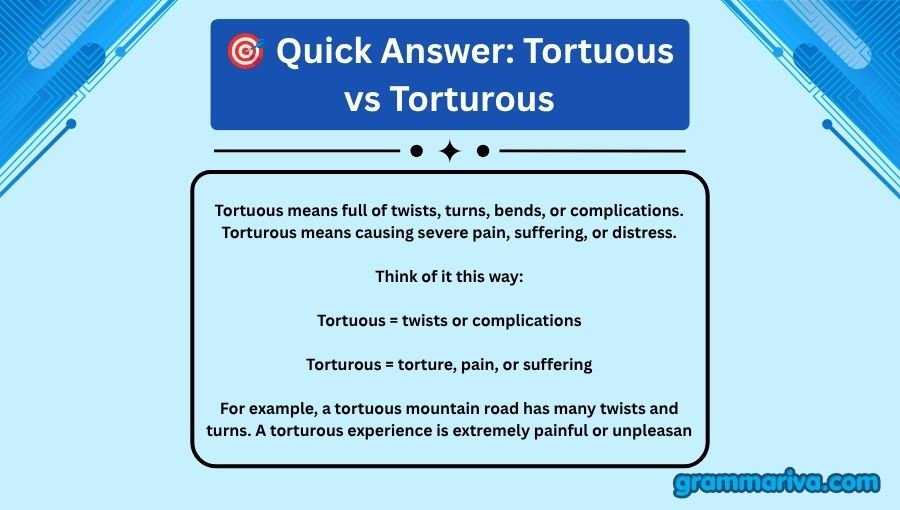
Tortuous means full of twists, turns, bends, or complications. Torturous means causing severe pain, suffering, or distress.
Think of it this way:
- Tortuous = twists or complications
- Torturous = torture, pain, or suffering
For example, a tortuous mountain road has many twists and turns. A torturous experience is extremely painful or unpleasant.
| Word | Basic Meaning | Common Use |
|---|---|---|
| Tortuous | Full of twists, bends, or complications | Roads, paths, arguments, processes |
| Torturous | Causing intense pain or suffering | Experiences, treatment, conditions, situations |
The easiest memory trick is to connect torturous with torture. If pain or suffering is the main idea, think torturous.
🔎 What Is the Difference Between Tortuous and Torturous?
The main difference is the idea each adjective expresses. Tortuous focuses on twists, turns, or complexity, while torturous focuses on pain and suffering. Understanding tortuous vs torturous starts with knowing whether you are describing a winding path or an experience involving pain and suffering.
Although the words look nearly identical, their meanings are not interchangeable.
Consider these two sentences:
- The hikers followed a tortuous trail through the mountains.
- The hikers described the final climb as torturous.
The first sentence tells us that the trail was winding or difficult to follow. The second tells us that the climb caused great discomfort or suffering.
Tortuous: Focus on Shape or Complexity
Tortuous often describes something that does not move in a straight, simple way.
It can describe:
- A winding road
- A twisting path
- A complicated process
- A difficult argument
- A long and confusing explanation
- A route with many bends
For example:
The tortuous road climbed through the hills.
Here, tortuous tells us about the road’s winding shape.
Torturous: Focus on Pain or Suffering
Torturous describes something that feels like torture or causes intense suffering.
It can describe:
- Physical pain
- Emotional suffering
- An extremely unpleasant experience
- A difficult period
- A painful procedure
- Severe discomfort
For example:
The long wait was torturous.
The wait was not necessarily full of twists or turns. It felt extremely unpleasant.
| Form | Type | Meaning | Example | Correct/Incorrect |
|---|---|---|---|---|
| Tortuous | Adjective | Twisting or complicated | We drove along a tortuous road. | ✅ Correct |
| Torturous | Adjective | Causing great pain or suffering | The treatment was torturous. | ✅ Correct |
| Tortuous | Adjective | Painful in itself | The injury was tortuous. | ❌ Usually incorrect |
| Torturous | Adjective | Winding like a road | We followed a torturous trail. | ❌ Usually incorrect |
🛣️ When Should You Use Tortuous?
Use tortuous when the main idea is twisting, winding, complicated, or indirect.
This word works well for both physical things and ideas.
Tortuous Roads and Paths
A road can be tortuous when it has many curves and bends.
The tortuous road took us through a narrow mountain pass.
The road is not being called painful. Its shape is winding.
Another example:
We followed a tortuous path through the forest.
The path changes direction many times.
Tortuous Processes
The word can also describe something complicated.
Getting approval became a tortuous process.
Here, there is no physical road. The process is difficult because it has many steps, delays, or complications.
Tortuous Arguments
An explanation or argument can also be tortuous when it is hard to follow.
His tortuous explanation made a simple issue sound complicated.
The problem is not physical pain. The problem is the confusing path of the explanation.
Test Tip 💡
Ask yourself:
“Am I describing twists, turns, or complexity?”
If the answer is yes, tortuous is likely the correct choice.
| Meaning | Word Type | Example Sentence |
|---|---|---|
| Winding road | Adjective | The tortuous road crossed the mountain. |
| Twisting path | Adjective | They walked along a tortuous trail. |
| Complicated process | Adjective | The application process was tortuous. |
| Complicated argument | Adjective | Her tortuous argument was hard to follow. |
😣 When Should You Use Torturous?
Use torturous when something causes intense pain, suffering, or extreme discomfort.
The word is strongly connected to the idea of torture.
Physical Pain
You can describe a very painful experience as torturous.
The patient described the recovery period as torturous.
The focus is the suffering involved in the recovery.
Emotional Pain
Torturous can also describe emotional experiences.
Waiting for the final decision was torturous.
The waiting caused intense emotional stress.
Extremely Unpleasant Experiences
The word does not always refer to literal physical torture. It can be used in an exaggerated everyday sense.
The three-hour meeting felt torturous.
The speaker means that the meeting was extremely unpleasant.
A Useful Test
Replace torturous with painful, agonizing, or extremely unpleasant.
If the sentence still makes sense, torturous may be the right choice.
| Situation | Better Word | Why |
|---|---|---|
| A winding road | Tortuous | It has many turns |
| A painful experience | Torturous | It causes suffering |
| A complicated procedure | Tortuous | It has many difficult steps |
| Severe emotional distress | Torturous | It causes intense suffering |
| A twisting trail | Tortuous | Its route bends and turns |
🧭 Is Tortuous the Same as Torturous?
No. Tortuous and torturous are not the same word. They overlap only because both can suggest something difficult or unpleasant.
The easiest way to separate them is to focus on the type of difficulty.
Tortuous = difficult because of twists or complexity.
Torturous = difficult because of pain or suffering.
Compare:
The tortuous route took five hours.
The route had many twists and turns.
The five-hour journey was torturous.
The journey felt extremely unpleasant.
Both sentences describe difficulty, but they describe different kinds of difficulty.
I once marked a student’s essay where the writer called a winding road “torturous.” The student clearly meant that the road had many curves. Once we changed it to tortuous, the sentence became much more precise.
| Sentence | Meaning |
|---|---|
| The tortuous road was hard to navigate. | The road had many twists and turns. |
| The journey was torturous. | The journey caused great discomfort. |
| The tortuous debate lasted for hours. | The debate was complicated and indirect. |
| The waiting period was torturous. | The waiting caused emotional distress. |
✍️ Tortuous vs Torturous at a Glance
The fastest way to understand the difference is to compare what each word points toward.
| Word | Main Idea | Typical Nouns | Example |
|---|---|---|---|
| Tortuous | Twisting | Road, trail, route | A tortuous road |
| Tortuous | Complicated | Process, argument, explanation | A tortuous process |
| Torturous | Painful | Experience, treatment, recovery | A torturous recovery |
| Torturous | Extremely unpleasant | Wait, ordeal, experience | A torturous wait |
A useful question is:
Is the thing twisting, or is it hurting?
If it is twisting or complicated, choose tortuous.
If it is causing suffering, choose torturous.
❓ Why Do People Confuse Tortuous and Torturous?
People confuse these words because they look and sound very similar. Both begin with tort-, both are adjectives, and both can describe something difficult.
There is also a meaning overlap in some sentences. A winding road can be hard to travel. A painful experience can also be hard to endure. That shared idea of difficulty can make the wrong word feel acceptable.
Another problem is fast typing.
Autocorrect can make the confusion worse. A writer may know the difference but type one form quickly and fail to notice the error.
A student once told me, “I knew the word meant painful, but I could not remember which spelling belonged to it.” That is a common problem. The solution is not to memorize both spellings as separate shapes. Connect each word with its meaning.
| Confusing Pair | Correct Difference |
|---|---|
| Its / It’s | Possession vs. “it is” |
| Your / You’re | Possession vs. “you are” |
| Affect / Effect | Usually influence vs. result |
| Principal / Principle | Person or main thing vs. rule or belief |
| Tortuous / Torturous | Twisting or complicated vs. painful or distressing |
Common Reasons for the Mix-Up
- Fast typing: You know the word but type the wrong ending.
- Autocorrect: Software may not catch a real word used in the wrong context.
- Lack of knowledge: You may have seen the words but never learned the difference.
- Similar spelling: Only a few letters separate them.
- Shared sense of difficulty: Both can describe something that is hard.
⚠️ Common Mistakes With Tortuous and Torturous
The biggest mistake is choosing the word based on how difficult something feels rather than what kind of difficulty it has.
If the sentence describes a winding road, tortuous is usually the right choice.
If it describes pain or suffering, torturous is usually the right choice.
Specific Wrong Forms and Uses
| Wrong Form or Use | What’s Wrong | Correct Form |
|---|---|---|
| The torturous road had many bends. | The intended meaning is winding. | The tortuous road had many bends. |
| The tortuous pain was unbearable. | The intended meaning is severe pain. | The torturous pain was unbearable. |
| We took a torturous route through the hills. | If the route is simply winding, the word is misleading. | We took a tortuous route through the hills. |
| The tortuous waiting period was unbearable. | If the focus is suffering, torturous fits better. | The torturous waiting period was unbearable. |
| She gave a torturous explanation. | If the explanation was complicated, tortuous is better. | She gave a tortuous explanation. |
| The tortuous injury left him in agony. | Tortuous does not normally mean painful. | The painful or torturous injury left him in agony. |
The context always matters. Some sentences could support either word if the writer intends a different meaning.
🧠 How Can You Remember the Difference?
The best memory trick is very short:When I teach tortuous vs torturous, I tell students to connect “tortuous” with turns and “torturous” with suffering.
Tortuous has twists. Torturous has torture. When I teach tortuous vs torturous, I tell students to connect “tortuous” with turns and “torturous” with suffering.
Look at the extra r in torturous. Connect it with the idea of severe suffering.
You can also remember:
Tortuous turns. Torturous hurts.
This is not a grammar rule. It is simply a memory tool.
Try these questions:
- Does the object bend or twist? → Tortuous
- Is the process complicated? → Tortuous
- Does the experience cause severe suffering? → Torturous
- Does the sentence suggest pain or agony? → Torturous
| Memory Clue | Word | Meaning |
|---|---|---|
| Twists | Tortuous | Winding or complicated |
| Turns | Tortuous | Full of bends |
| Torture | Torturous | Causing suffering |
| Hurts | Torturous | Extremely painful or unpleasant |
📧 How Does Tortuous vs Torturous Work in Real Life?
Real-world context makes this distinction easier.
Imagine an employee writing a project update:
“The approval process has been tortuous.”
This tells the reader that the process has been complicated, indirect, or difficult to navigate.
Now imagine a different email:
“The delay has been torturous.”
This tells the reader that the delay has caused significant emotional discomfort.
Both sentences are correct. They simply communicate different ideas.
Case Study: A Workplace Email
I once edited a short workplace report that described a company’s approval process as “torturous.” The writer meant that the process involved many departments, repeated forms, and several rounds of review.
I changed the word to tortuous.
Why? The writer was describing a complicated path, not physical or emotional suffering.
A polished version would be:
“The approval process has been tortuous, with several rounds of review.”
That sentence gives a clear picture without overstating the situation.
| Workplace Situation | Best Choice | Example |
|---|---|---|
| Complicated approval process | Tortuous | The approval process was tortuous. |
| Extremely stressful delay | Torturous | The delay was torturous. |
| Complicated negotiations | Tortuous | The negotiations followed a tortuous path. |
| Very painful recovery | Torturous | The recovery was torturous. |
📚 What Are the Grammar Rules for Tortuous and Torturous?
Both tortuous and torturous are adjectives. The main grammar rule is about meaning, not sentence position.
Both words can come before a noun:
- a tortuous road
- a tortuous process
- a torturous experience
- a torturous ordeal
Both can also appear after a linking verb:
- The route was tortuous.
- The experience was torturous.
The mistake happens when the adjective does not match the intended meaning.
Standard English references and dictionaries treat these as distinct words with distinct meanings. You should therefore choose based on context rather than spelling alone.
Correct vs. Incorrect at a Glance
| Sentence | Correct/Incorrect | Why |
|---|---|---|
| The tortuous road wound through the mountains. | ✅ Correct | The road has many bends. |
| The torturous road wound through the mountains. | ❌ Usually incorrect | The sentence focuses on the road’s shape. |
| The recovery was torturous. | ✅ Correct | The recovery caused suffering. |
| The tortuous recovery involved many stages. | ✅ Correct | Here, tortuous means complicated. |
| The torturous argument was difficult to follow. | ❌ Usually incorrect | The intended meaning is complicated, not painful. |
Notice something important: tortuous can sometimes describe a complicated situation that is also unpleasant. Meaning comes from the context.
🗣️ How Are These Words Used in Different Contexts?
The best word depends on what you want the reader to picture.
In everyday conversation, tortuous often describes a winding route or a complicated situation. Torturous is more emotional and often describes something extremely unpleasant.
In professional writing, both can be useful. Tortuous works well for complicated systems or processes. Torturous should be used when suffering is genuinely part of the meaning.
In creative writing, either word can create a strong image.
On social media, writers sometimes use torturous dramatically to describe boring events or long waits.
| Context | Which Term to Use | Example |
|---|---|---|
| Everyday conversation | Either, depending on meaning | The road was tortuous. |
| Professional writing | Either, depending on meaning | The review process was tortuous. |
| Creative writing | Either, depending on meaning | The journey became torturous. |
| Social media/texting | Usually torturous for dramatic discomfort | This Monday is torturous. |
📝 Tortuous in Professional and Academic Writing
Tortuous can be useful in formal writing because it describes complicated paths of thought or action.
For example:
The company followed a tortuous path toward the final agreement.
This suggests a long and complicated process.
You might also write:
The report presents a tortuous argument that takes several unexpected turns.
The argument is difficult to follow because its structure is complicated.
However, do not use tortuous simply as a fancy replacement for difficult. It has a more specific meaning.
| Professional Example | Meaning |
|---|---|
| A tortuous negotiation | A complicated negotiation |
| A tortuous process | A process with many complications |
| A tortuous explanation | An indirect or confusing explanation |
| A tortuous route | A winding route |
😖 Torturous in Everyday and Creative Writing
Torturous is stronger and more emotional.
It can describe an experience that feels almost unbearable.
Examples include:
- a torturous wait
- a torturous recovery
- a torturous experience
- a torturous ordeal
For creative writing, this word can help show emotional intensity.
The silence became torturous.
The silence is not physically twisting. It is causing emotional distress.
The final mile felt torturous.
The writer is stressing how painful or exhausting the experience felt.
| Phrase | Main Idea |
|---|---|
| Torturous wait | Extremely unpleasant waiting |
| Torturous experience | Experience involving great suffering |
| Torturous ordeal | Very painful or distressing situation |
| Torturous recovery | Recovery involving severe discomfort |
💬 Common Phrases and Natural Expressions
Neither word has a large group of fixed idioms. Still, both appear naturally with certain nouns.
These combinations can help you learn the words through context.
| Phrase | Meaning |
|---|---|
| Tortuous road | A road with many twists and turns |
| Tortuous path | A winding or complicated route |
| Tortuous process | A complicated process |
| Tortuous argument | An indirect or complicated argument |
| Torturous experience | An experience involving great suffering |
| Torturous wait | A very unpleasant or stressful wait |
A phrase such as “tortuous path” often works both literally and figuratively.
For example:
We followed a tortuous path through the forest.
Literal meaning.
Her tortuous path to success included many setbacks.
Figurative meaning.
🔄 Synonyms and Alternatives
You do not always need either word. Sometimes a simpler word will make your sentence clearer.
For tortuous, possible alternatives include winding, twisting, complicated, and indirect.
For torturous, alternatives include painful, agonizing, distressing, and unbearable.
The best choice depends on the exact meaning.
| Alternative | Works When | Does Not Work When |
|---|---|---|
| Winding | Describing roads or paths | Describing emotional suffering |
| Complicated | Describing systems or processes | Describing severe physical pain |
| Indirect | Describing arguments or routes | Describing agony |
| Painful | Describing physical or emotional suffering | Describing a winding road |
| Agonizing | Describing extreme suffering | Describing a complicated process |
Simple words are often better. If winding says exactly what you mean, there is no need to choose a more unusual adjective.
🎯 Why Does Getting Tortuous vs Torturous Right Matter?
Choosing the right word makes your writing clearer.
A reader who sees tortuous road understands that the road twists and turns. A reader who sees torturous experience understands that the experience causes suffering.
A wrong choice can create an unintended image.
Imagine writing:
“The torturous trail climbed around the mountain.”
The reader may think the trail was painfully difficult.
If you simply mean that it had many bends, write:
“The tortuous trail climbed around the mountain.”
That is much clearer.
Good word choice also matters in professional communication. Precise language helps readers understand your point without guessing.
“Clear words make clear ideas.”
| Situation | Why Getting It Right Matters |
|---|---|
| Resume | Shows strong command of language |
| Client email | Prevents confusion |
| Published content | Builds trust with readers |
| Social post | Makes the intended tone clear |
❓ Can Tortuous Describe Something Other Than a Road?
Yes. Tortuous can describe much more than physical roads or trails.
It can describe a complicated process, argument, explanation, route, or series of events.
For example:
The negotiations took a tortuous path.
Here, the negotiations did not literally travel along a road. The phrase means they developed through many complicated stages.
This figurative use is common and useful in both professional and creative writing.
| Subject | Example |
|---|---|
| Road | A tortuous mountain road |
| Trail | A tortuous forest trail |
| Process | A tortuous approval process |
| Argument | A tortuous argument |
| Career | A tortuous path to success |
❓ Can Torturous Describe Emotional Pain?
Yes. Torturous can describe an experience that causes severe emotional distress.
For example:
Waiting for the results was torturous.
The sentence emphasizes the emotional suffering caused by the wait.
It can also describe situations such as grief, uncertainty, fear, or prolonged stress when the experience feels extremely painful.
However, avoid using the word casually in formal writing when a milder word would be more accurate.
| Emotional Situation | Possible Example |
|---|---|
| Uncertainty | The uncertainty was torturous. |
| Long wait | The wait was torturous. |
| Difficult memory | The memory was torturous. |
| Painful experience | The experience was torturous. |
🧩 A Simple Decision Test
When you are unsure, do not stare at the spelling. Look at the meaning.
Ask these questions:
1. Does it twist or turn?
Use tortuous.
2. Is it complicated or indirect?
Use tortuous.
3. Does it cause intense suffering?
Use torturous.
4. Would “painful” make sense?
Try torturous.
5. Would “winding” or “complicated” make sense?
Try tortuous.
| Question | If Yes → Use |
|---|---|
| Does it have many bends? | Tortuous |
| Is the route winding? | Tortuous |
| Is the process complicated? | Tortuous |
| Does it cause great pain? | Torturous |
| Does it cause severe distress? | Torturous |
🏆 Practice Examples
Now test yourself. Choose the word that best fits each sentence.
Example 1
“The hikers faced a ______ trail through the mountains.”
The trail has many twists.
Answer: tortuous ✅
Example 2
“The endless wait for the results was ______.”
The wait caused emotional distress.
Answer: torturous ✅
Example 3
“The company went through a ______ approval process.”
The process had many complicated steps.
Answer: tortuous ✅
Example 4
“She described the recovery as ______.”
The focus is severe discomfort and suffering.
Answer: torturous ✅
| Practice Sentence | Correct Answer | Reason |
|---|---|---|
| A ___ mountain road | Tortuous | Winding |
| A ___ medical recovery | Torturous | Painful |
| A ___ legal process | Tortuous | Complicated |
| A ___ emotional experience | Torturous | Distressing |
❓ What Is the Easiest Way to Remember Tortuous vs Torturous?
Remember this short line:
Tortuous turns. Torturous hurts.
If something turns, bends, winds, or becomes complicated, choose tortuous.
If something hurts, causes suffering, or feels unbearable, choose torturous.
This memory trick works because it connects each spelling to the central idea behind the word.
❓ Which Word Should I Use for a Complicated Process?
Use tortuous when you mean that a process is complicated, indirect, or difficult to navigate.
For example:
The permit process was tortuous.
This does not necessarily mean the process caused physical pain. It means the process involved many difficult or confusing stages.
You could also use simpler alternatives such as complicated, lengthy, or complex, depending on the exact meaning.
❓ Which Word Should I Use for a Painful Experience?
Use torturous when the experience causes intense pain, suffering, or distress.
For example:
The recovery period was torturous.
If you only mean that something was mildly unpleasant, choose a less intense word such as difficult, unpleasant, or stressful.
❓ Is “Torturous Road” Ever Correct?
It can be correct if you genuinely mean that the road experience is extremely painful or distressing.
For example:
The rough road made the journey torturous.
Here, torturous describes the experience of traveling on the road.
But if you mean the road itself has many bends, use:
The road was tortuous.
The distinction depends on what you are describing.
❓ Is “Tortuous Journey” Correct?
Yes. Tortuous journey is correct when the journey has a complicated, winding, or difficult course.
For example:
Her tortuous journey toward a new career took several years.
The word highlights the complicated path rather than pain itself.
If you want to emphasize suffering, you could say:
Her journey was torturous.
That version focuses on how painful or distressing the experience felt.
❓ Can These Words Be Used Figuratively?
Yes. Both words can have figurative uses.
Tortuous can describe complicated ideas, processes, negotiations, or paths to a goal.
Torturous can describe emotional experiences, stressful situations, or extremely unpleasant periods.
| Word | Literal Use | Figurative Use |
|---|---|---|
| Tortuous | A winding road | A complicated career path |
| Tortuous | A twisting trail | A complicated argument |
| Torturous | A painful experience | A deeply stressful wait |
| Torturous | Severe suffering | An unbearable period |
❓ What Is the Difference Between Tortuous and Torturous in One Sentence?
Tortuous means twisting or complicated, while torturous means causing great pain or suffering.
That single sentence captures the main rule.
❓ What Is a Good Memory Trick for These Words?
Use:
Tortuous = turns.
Torturous = torture.
If you remember those two links, the spelling becomes much easier to choose.
❓ Can I Replace Tortuous With Complicated?
Often, yes, but not always.
Complicated works when you mean something has many parts or is hard to understand.
Tortuous adds the idea of a twisting, indirect, or winding course.
For example:
The approval process was complicated.
This is simple and clear.
The approval process was tortuous.
This suggests a long, indirect, or difficult path.
The words are related, but they are not perfect substitutes.
❓ Can I Replace Torturous With Painful?
Often, yes.
Painful is usually simpler and more direct.
Torturous is stronger. It suggests intense suffering or an experience that feels almost unbearable.
For example:
The recovery was painful.
This gives a basic description.
The recovery was torturous.
This gives a much stronger emotional impression.
Choose the stronger word only when the situation supports it.
✅ Quick Recap Checklist
Before you finish your sentence, run through this checklist.
| Question | If Yes → Use |
|---|---|
| Is something winding? | Tortuous |
| Does something have many turns? | Tortuous |
| Is a process complicated? | Tortuous |
| Is an argument indirect or hard to follow? | Tortuous |
| Does an experience cause severe suffering? | Torturous |
| Does something feel extremely painful? | Torturous |
Three Final Practice Sentences
1. The hikers followed a tortuous path through the valley. ✅
2. The long recovery was torturous. ✅
3. The company faced a tortuous series of negotiations before reaching an agreement. ✅
If you remember only one line, remember:
Tortuous turns. Torturous hurts.
❓ FAQs About Tortuous vs Torturous
What does tortuous mean?
Tortuous means full of twists, turns, bends, or complications. It can describe physical routes, such as roads and trails, as well as figurative paths, such as processes, arguments, and careers.
What does torturous mean?
Torturous means causing intense pain, suffering, distress, or extreme discomfort. It can describe physical experiences and emotional situations.
Is tortuous the same as torturous?
No. Tortuous focuses on twists, turns, or complexity. Torturous focuses on pain, suffering, or extreme unpleasantness.
Is a tortuous road correct?
Yes. A tortuous road is a correct phrase when the road has many twists, bends, or turns.
Is a torturous road correct?
It can be correct when you mean that traveling on the road is extremely painful or unpleasant. However, if you mean the road is winding, tortuous road is the better choice.
Is a tortuous process correct?
Yes. A tortuous process is a process that is complicated, indirect, or difficult to navigate.
Is a torturous experience correct?
Yes. A torturous experience is an experience involving severe pain, suffering, or distress.
How do I remember tortuous vs torturous?
Remember “Tortuous turns, torturous hurts.” Tortuous connects with twists and turns. Torturous connects with torture and suffering.
Which word means painful, tortuous or torturous?
Torturous is the word associated with pain and suffering. Tortuous normally means winding, twisting, complicated, or indirect.
Which word should I use in formal writing?
Use whichever word matches your exact meaning. Choose tortuous for complicated or winding things and torturous for severe pain or suffering. If a simpler word such as “complicated” or “painful” is clearer, that may be the better choice.
🎯 Conclusion: Tortuous vs Torturous Made Easy
Tortuous vs torturous becomes much easier when you focus on meaning instead of spelling. Tortuous describes something winding, twisting, indirect, or complicated. Torturous describes something that causes intense pain, suffering, or distress. 😊
When you see a road full of bends, think tortuous. When you think about an experience that feels unbearable, think torturous. Once you understand tortuous vs torturous, choosing between these two easily confused words becomes much faster.
The best memory trick is simple: tortuous turns, torturous hurts. It gives you a quick way to choose the right word without checking a dictionary every time.
I also recommend reading the whole sentence before making your choice. Ask what the sentence is trying to describe. Is the thing changing direction or becoming complicated? Choose tortuous. Is it causing pain or suffering? Choose torturous.
Once you connect each word with its core idea, the spelling stops being confusing. Good grammar is not just about memorizing words. It is about choosing the word that says exactly what you mean. ✨

Hi, I’m Nathan Reed. I’m a grammar and writing specialist at Grammariva. I work on practical grammar content that helps readers understand sentence structure, punctuation, vocabulary, and better writing habits.


[…] you can use when writing. By the end, you should feel confident choosing the right form. ✍️ Tortuous vs Torturous | Continuous vs Contious | Separate vs […]