Have you ever typed a word, looked at it, and wondered, “Wait, does this need one l or two?” 🤔 appal vs appall is one of those spelling questions that can make even careful writers stop for a second. Both forms are real English words, but they are not used equally in every form of English.
The good news is simple: appal and appall have the same basic meaning. Both mean to shock, horrify, or deeply upset someone. The main difference is usually English variety. Appal is the standard British spelling, while appall is the standard American spelling.
That small spelling difference matters if you write for a US audience. As an editor, I often see writers mix British and American spelling in the same article. It can make otherwise strong writing look less polished.
In this guide, I’ll explain the difference in plain English. You’ll learn when to use each spelling, how related forms work, common mistakes to avoid, and a few easy tricks to remember the rule. ✍️ Loot vs Lute | Sorry for Bothering You vs Sorry to Bother You | Thus Far vs So Far
🎯 Quick Answer: What Is the Difference Between Appal and Appall?
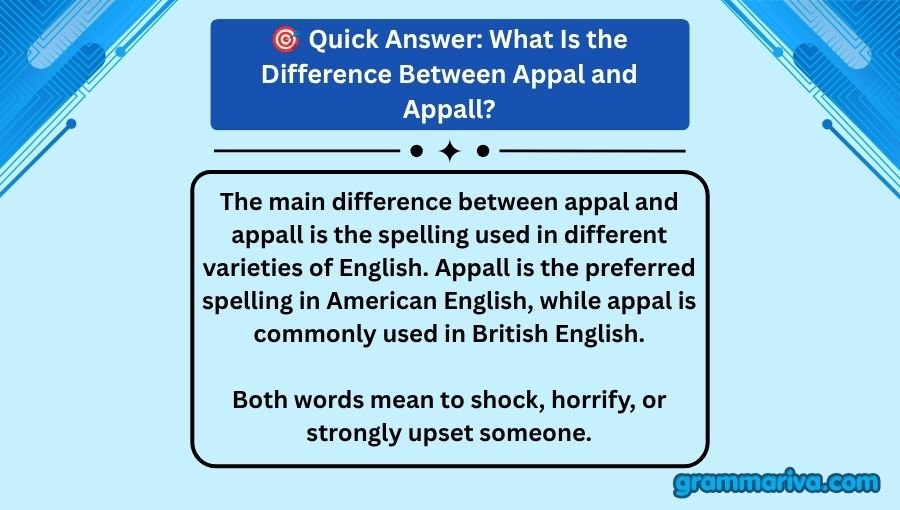
The main difference between appal and appall is the spelling used in different varieties of English. Appall is the preferred spelling in American English, while appal is commonly used in British English.
Both words mean to shock, horrify, or strongly upset someone.
| Word | Main Use | Example |
|---|---|---|
| appall | American English | The decision may appall many readers. |
| appal | British English | The decision may appal many readers. |
So, if you are writing for readers in the United States, choose appall.
Is Appal the Same as Appall?
Yes. Appal and appall have the same basic meaning. The main difference is spelling by regional variety.
In American English, the form with two l letters is normally preferred:
- The cruel treatment appalled everyone. ✅
- The cruel treatment appaled everyone. ❌
The second sentence has a spelling error because appaled drops one of the letters from the American form.
In British English, you may see:
- The cruel treatment appalled everyone. ✅
- The cruel treatment appalled everyone. ✅
This can be confusing because the past tense is normally written appalled in both varieties.
A simple rule
Think of the base forms like this:
US English: appall
British English: appal
The difference is mainly the extra l in the base verb.
Appal vs Appall at a Glance 📊
The easiest way to understand the pair is to compare spelling, meaning, and usage side by side.
| Form | Type | Meaning | Example | Correct/Incorrect |
|---|---|---|---|---|
| appal | Verb | To shock or horrify | The news may appal some readers. | ✅ Correct in British English |
| appall | Verb | To shock or horrify | The news may appall some readers. | ✅ Correct in American English |
| appaled | Verb form | Intended as past tense | The story appaled me. | ❌ Incorrect |
| appalled | Past tense | Shocked or horrified | The story appalled me. | ✅ Correct |
| appalling | Present participle/adjective | Very shocking or awful | The conditions were appalling. | ✅ Correct |
The key point is that appal is not a completely different word from appall. It is a regional spelling.
What Does Appall Mean in American English? 🇺🇸
Appall is the standard American English spelling of the verb meaning to shock, horrify, or deeply upset someone.
When something appalls you, it affects you in a strong and negative way. The reaction is usually stronger than simple surprise.
For example:
The unfair treatment of the workers appalled the manager.
Here, appalled means the manager was deeply shocked or disturbed by what happened.
Common uses of appall
You can use appall when talking about:
- shocking behavior
- cruel actions
- terrible conditions
- disturbing news
- serious mistakes
- unfair treatment
- shocking events
Sentence breakdown
The report appalled the committee.
- The report = subject
- appalled = verb
- the committee = object
The report caused the committee to feel shocked or horrified.
More examples
- The violence appalled the community. ✅
- The careless decision appalled the staff. ✅
- I was appalled by the rude behavior. ✅
- The details of the case appalled everyone. ✅
Test Tip 💡
Ask yourself:
“Am I writing in American English?”
If yes, use appall for the base verb.
If your sentence is:
The decision may ___ the public.
The American English answer is:
The decision may appall the public.
What Does Appal Mean in British English? 🇬🇧
Appal is a standard British English spelling of the same verb. It has the same basic meaning as appall.
For example:
The decision may appal many people.
The word means that the decision may shock or horrify people.
The important point is that appal is not an incorrect version of the word. It is a normal British spelling.
However, if your article, website, school assignment, or business document is written specifically for an American audience, appall is usually the better choice.
Meaning summary
| Meaning | Word Type | Example Sentence |
|---|---|---|
| Shock deeply | Verb | The news may appall readers. |
| Horrify | Verb | The images appalled the public. |
| Cause strong distress | Verb | The conditions appalled the visitors. |
The meaning stays the same even when the spelling changes.
Why Do People Confuse Appal and Appall? 🤔
People confuse these spellings because the words sound the same and carry the same meaning. The extra l is easy to miss when typing. Understanding appal vs appall as a regional spelling difference makes the choice much easier for writers.
Another reason is exposure to different types of English. Someone who reads British books may become comfortable with appal. That same writer may later see American websites using appall.
I once edited a short article for a US audience where the writer used British spellings in several places. One of them was appal. The sentence itself was correct, but the spelling did not match the rest of the American English copy. We changed it to appall to keep the article consistent.
Three common causes
| Reason | What Happens |
|---|---|
| Fast typing | A writer may forget the second l. |
| Autocorrect | Software may favor a spelling based on its language settings. |
| Lack of knowledge | A writer may not know that regional spelling differs. |
| Mixed English exposure | British and American forms may get mixed together. |
Consistency is the real goal. Neither spelling should be called universally “wrong.”
Which Spelling Should American Writers Use?
American writers should normally use appall.
This applies to:
- school papers
- US business writing
- American blogs
- news-style content
- marketing copy
- resumes
- websites
- social media posts aimed at US readers
For example:
The shocking decision appalled the entire team.
That is the natural American English spelling.
American examples
The poor conditions appalled the inspector. ✅
The poor conditions appal the inspector. ⚠️
The second version may be understandable, but it follows British spelling rather than standard American spelling.
How Do You Use Appal and Appall in a Sentence? 📝
Both words work as verbs. They describe the effect something has on a person or group.
The most common sentence pattern is:
Subject + appall/appalled + object
Examples:
The news appalled me.
The decision appalled the public.
The behavior appalled her parents.
You can also use the word after helping verbs:
The report may appall readers.
The results could appall investors.
The decision might appall the staff.
Notice that after may, could, or might, you use the base form.
Correct vs. incorrect examples
- The news appalled me. ✅
- The news appaled me. ❌
- The story may appall readers. ✅
- The story may appalled readers. ❌
- The conditions were appalling. ✅
- The conditions were appaling. ❌
What Are the Related Forms of Appall?
The verb has several useful forms. Learning them together makes spelling much easier.
| Form | Type | Example |
|---|---|---|
| appall | Base verb | The facts may appall readers. |
| appalls | Third-person singular | The behavior appalls me. |
| appalled | Past tense | The story appalled her. |
| appalling | Present participle/adjective | It was an appalling mistake. |
| appal | British base form | The facts may appal readers. |
The most useful spelling point is this:
appall → appalled → appalling
The double l stays visible in the American forms.
Why Is Appalled Spelled With Two Ls? 🔤
In American English, the past form is appalled, not appaled.
This is a common spelling trap. Writers may see the single l in British appal and assume the past form should contain only one l. That is not how the common past form is written.
Compare:
- appall → appalled ✅
- appall → appaled ❌
The same idea appears in the present participle:
- appall → appalling ✅
- appall → appaling ❌
Quick spelling pattern
| Base | Correct Form | Wrong Form |
|---|---|---|
| appall | appalled | appaled |
| appall | appalling | appaling |
| appall | appalls | appals* |
*In American English, appalls is the normal third-person singular form. British usage may use appals.
Case Study: A Workplace Email 📧
Imagine a manager writes this email to a US team:
“I was appalled by the condition of the storage room. Please make sure it is cleaned before the inspection.”
The word works well here because the manager is expressing strong shock or disapproval.
Now imagine the same message is written for a British company:
“I was appalled by the condition of the storage room.”
Notice something interesting. The past form appalled looks the same in both varieties.
That is why the spelling difference is easiest to notice with the base form.
I once caught myself typing the British form appal while preparing American-facing copy. The sentence looked familiar, so I almost left it alone. I changed it after checking the style of the rest of the document.
Workplace comparison
| Situation | American English | British English |
|---|---|---|
| Present/base form | appall | appal |
| Third-person form | appalls | appals |
| Past form | appalled | appalled |
| -ing form | appalling | appalling |
This is a useful pattern to remember.
Grammar Rules Explanation: Why the Spellings Differ
The grammar rule is straightforward: appal and appall are regional spelling variants of the same verb. The key lesson from appal vs appall is simple: choose the spelling that matches your English variety.
American English commonly uses appall. British English commonly uses appal.
The spelling difference does not create a major difference in meaning. The important choice is the variety of English you are following.
Standard English references and major dictionaries recognize the two forms as part of regional English usage. The safest approach is to choose one regional style and use it consistently.
There is no need to treat one spelling as a spelling mistake in every situation.
Correct vs. Incorrect at a Glance
| Sentence | Correct/Incorrect | Why |
|---|---|---|
| The story appalled me. | ✅ Correct | Standard past form |
| The story appaled me. | ❌ Incorrect | Missing an l |
| The story may appall me. | ✅ Correct in US English | Correct American base form |
| The story may appal me. | ✅ Correct in British English | Correct British base form |
| The story may appalled me. | ❌ Incorrect | Modal verbs take the base form |
The last example shows an important grammar point. After may, use appall or appal, not appalled.
Common Mistakes With Appal and Appall ⚠️
Most errors come from spelling, regional style, or choosing the wrong verb form.
Fast typing is one major cause. Autocorrect can also create problems if your keyboard uses a different English setting.
A writer who normally reads British English may naturally type appal. A US editor may expect appall.
Similar spelling and grammar confusions
| Confusion | Correct Use | Common Problem |
|---|---|---|
| its / it’s | its = possession; it’s = it is | Missing apostrophe |
| your / you’re | your = possession; you’re = you are | Mixing forms |
| affect / effect | Usually verb vs. noun | Choosing by sound |
| than / then | than = comparison; then = time/order | Similar spelling |
| appal / appall | Regional spelling | Mixing English varieties |
Specific wrong forms
| Wrong Form | What’s Wrong | Correct Form |
|---|---|---|
| appaled | Missing l | appalled |
| appaling | Missing l | appalling |
| appallled | Too many l letters | appalled |
| appal in US copy | British spelling in American copy | appall |
| appall in British copy | American spelling in British copy | appal |
| may appalled | Wrong verb form after modal | may appall |
The goal is not simply to memorize one spelling. Learn the whole family.
Does Appall Have a Different Meaning From Appal?
No. In normal usage, appall and appal express the same basic idea.
They describe a strong reaction of shock, horror, or distress.
The main distinction is regional spelling.
| Question | Answer |
|---|---|
| Do they mean the same thing? | Yes. |
| Is appall common in US English? | Yes. |
| Is appal common in British English? | Yes. |
| Is appal always wrong? | No. |
| Is appall always wrong? | No. |
| Should US writers prefer appall? | Yes. |
This is why context matters more than simply labeling one form right and the other wrong.
Appal vs Appall in Different Contexts 🌎
When deciding between appal vs appall, always consider who will read your writing and which English style you are following.
The best spelling depends on your audience and style guide.
Everyday conversation
In casual speech, people do not hear the spelling difference. The words sound alike.
“That really appalled me.”
The listener does not know which spelling you would choose on paper.
Professional writing
Professional writers should match the regional English expected by their audience.
For a US company, appall is the safer choice.
Creative writing
Creative writers should follow the setting and voice of the work. A British character or publication may naturally use appal.
Social media and texting
Casual posts are less strict, but spelling still affects credibility. If your content targets Americans, appall keeps the spelling consistent.
| Context | Which Term to Use | Example |
|---|---|---|
| American conversation in writing | appall | The news appalled me. |
| British writing | appal | The news appalled me. |
| US professional content | appall | The report may appall clients. |
| British professional content | appal | The report may appal clients. |
| Social media | Match your audience | The story appalled everyone. |
Common Phrases With Appall
There are several natural phrases built around this verb. They are useful because they show how the word behaves in real sentences.
| Phrase | Meaning |
|---|---|
| be appalled by | Feel shocked or horrified by something |
| be appalled at | Feel strong shock or disapproval |
| appall the public | Shock or horrify many people |
| appall the audience | Strongly disturb an audience |
| deeply appalled | Very strongly shocked |
| absolutely appalled | Extremely shocked or upset |
Examples:
She was appalled by the rude behavior.
The report appalled the public.
He was deeply appalled by what he saw.
These expressions are useful in both American and British English.
What Are Good Alternatives to Appall?
Sometimes another word can make your sentence simpler or more specific. The best alternative depends on the strength of the reaction.
Shock is broad and common.
Horrify is stronger.
Disgust focuses more on strong dislike.
Disturb can describe emotional discomfort without suggesting horror.
| Alternative | Works When | Does Not Work When |
|---|---|---|
| shock | Something causes surprise or strong reaction | You need a stronger sense of horror |
| horrify | Something causes fear or horror | The reaction is only mild surprise |
| disturb | Something causes emotional discomfort | You want to express extreme horror |
| upset | Someone feels unhappy or troubled | The reaction is much stronger than sadness |
| disgust | Something causes strong dislike | The main reaction is shock rather than disgust |
For example:
The news shocked me.
This is more general than:
The news appalled me.
The second sentence suggests a deeper negative reaction.
Why Does Correct Spelling Matter? ✨
Correct spelling helps readers understand your meaning without distraction. In professional writing, consistency also shows care.
A single regional spelling difference will rarely ruin a sentence. However, repeated mixed spelling can make an article look poorly edited.
This matters especially in:
- resumes
- client emails
- websites
- published articles
- school assignments
- marketing materials
- social media content
A useful rule is:
Clear writing respects the reader’s time.
Why getting it right matters
| Situation | Why Getting It Right Matters |
|---|---|
| Resume | Shows attention to detail |
| Client email | Builds a professional impression |
| Published content | Keeps the chosen English style consistent |
| Social post | Makes the writing easier to trust |
For US-focused writing, choosing appall is a small change that keeps your spelling aligned with your audience.
How Can You Remember the Difference? 🧠
Use a simple location trick.
US = two Ls
Think:
American English → appall
The American form has the extra l.
British = one L
Think:
British English → appal
You can also remember the related forms:
appall → appalled → appalling
That pattern is especially useful because appalled and appalling already contain two l letters.
Mini memory test
Fill in the blank:
The shocking news may ______ readers.
If you are writing American English:
The shocking news may appall readers. ✅
If you are writing British English:
The shocking news may appal readers. ✅
Can Appall Be Used as an Adjective?
Not usually in its base form. Appall is a verb.
The adjective you will often see is appalling.
For example:
The conditions were appalling.
Here, appalling describes the conditions.
You can also use appalled as an adjective to describe someone’s reaction:
I was appalled by the decision.
So the forms have different jobs.
| Word | Role | Example |
|---|---|---|
| appall | Verb | The facts may appall readers. |
| appalled | Past verb/adjective | The facts appalled readers. |
| appalling | Present participle/adjective | The facts were appalling. |
This distinction prevents many grammar mistakes.
What Is the Difference Between Appalled and Appalling?
Appalled usually describes the person who feels shocked. Appalling usually describes the thing that causes the reaction.
Compare:
I was appalled by the news.
The person feels the reaction.
The news was appalling.
The news causes the reaction.
Easy rule
Person = appalled
Thing = appalling
Examples:
- She was appalled. ✅
- The behavior was appalling. ✅
- She was appalling by the behavior. ❌
- The behavior was appalled. ❌
This is one of the most useful related-form rules to remember.
Quick Recap Checklist ✅
Use this checklist whenever you are unsure about the spelling.
| Question | If Yes → Use |
|---|---|
| Am I writing American English? | appall |
| Am I writing British English? | appal |
| Am I describing a past reaction? | appalled |
| Am I describing something shocking? | appalling |
| Does the sentence follow a modal like “may”? | Base form: appall/appal |
Practice Examples
The decision may appall many Americans. ✅
The decision may appalled many Americans. ❌
The terrible conditions were appalling. ✅
Try making your own sentence with each form. Writing the words yourself helps make the spelling stick.
Is Appal or Appall Correct in American English?
Appall is the standard choice in American English.
For example:
The report may appall the public.
If you are writing for a US audience, use appall, appalls, appalled, and appalling as appropriate.
The form appal is associated mainly with British English.
Is Appal or Appall Correct in British English?
Appal is a standard British spelling.
For example:
The report may appal the public.
British English also commonly uses appalled and appalling.
This means that the spelling difference is most obvious in the base form and some related forms.
Does Appalled Have One L or Two?
Appalled has two l letters in the middle.
The correct spelling is:
appalled ✅
Not:
appaled ❌
This form is standard in both American and British English.
Does Appalling Have One L or Two?
Appalling has two l letters.
The correct spelling is:
appalling ✅
Not:
appaling ❌
The same spelling applies in both major English varieties.
Should I Use Appal or Appall for a US Blog?
Use appall for a US-focused blog.
If your entire site follows American English, keeping the double l form helps maintain a consistent style.
For example:
The shocking details may appall readers.
That is the natural choice for American content.
Can Appal and Appall Be Used in the Same Article?
You generally should not switch between them without a reason. Pick the English variety that matches your audience and keep it consistent.
A US article should normally use appall. A British article can use appal.
Mixing them can make the writing look inconsistent.
For example:
The story may appall readers, but the next paragraph says the event could appal the public.
That switch is unnecessary if the article is written in one English variety.
Is Appal vs Appall Only a Spelling Difference?
For normal modern usage, yes, the main difference is regional spelling rather than meaning.
Both forms describe causing someone to feel shocked, horrified, or deeply upset.
The important writing decision is therefore not “Which word has the correct meaning?” but rather:
“Which English spelling style am I following?”
That question makes the choice much easier.
FAQs About Appal vs Appall
1. What is the difference between appal and appall?
Appal and appall have the same basic meaning. Appall is the common American English spelling, while appal is the common British English spelling.
2. Is appall correct in American English?
Yes. Appall is the preferred American English spelling for the base verb.
Example:
The shocking news may appall readers.
3. Is appal wrong in American English?
It is not meaningless or an invented spelling. It is a recognized British English form. However, American writers should normally use appall when following US spelling.
4. Is appal correct in British English?
Yes. Appal is a standard British English spelling of the verb.
Example:
The decision may appal some readers.
5. How do you spell the past tense of appall?
The past tense is appalled.
Correct:
The news appalled me.
Incorrect:
The news appaled me.
6. How do you spell appalling?
The correct spelling is appalling, with two l letters.
Example:
The conditions were appalling.
7. Is appalled the same in American and British English?
Yes. Appalled is commonly spelled the same in both varieties.
The main regional difference is easier to see in the base forms appall and appal.
8. Should a US writer use appal or appall?
A US writer should normally use appall.
Choose the spelling that matches the English variety used throughout your content.
9. Can appall mean “shock”?
Yes. Appall can mean to shock or deeply disturb someone.
For example:
The report appalled the committee.
This suggests a strong negative reaction.
10. Is appalling an adjective?
Yes, appalling can work as an adjective.
Example:
The service was appalling.
It describes something that is extremely bad, shocking, or disturbing. Once you understand appal vs appall, you can choose the correct form quickly without second-guessing yourself.
Conclusion
Appal vs appall becomes much easier once you remember that the main difference is regional spelling. In American English, use appall. In British English, appal is a standard form. Both express the idea of causing strong shock, horror, or distress.
For US writing, remember the simple pattern: appall, appalled, appalling. Avoid forms such as appaled and appaling, which drop an l.
If you are writing for a British audience, appal is perfectly acceptable. The most important thing is to stay consistent with the English style you have chosen.
I always recommend checking the audience before making a spelling choice. That one small habit prevents many style problems. ✍️
So the next time you stop and wonder which form to type, think US = appall. One tiny spelling check can make your writing cleaner, sharper, and more professional. 🌟

Hi, I’m Madison Hayes. I’m an English learning writer at Grammariva, where I work on simple lessons and examples for people who want to improve their grammar and writing. I love turning confusing rules into easy-to-follow explanations.

[…] tricks, and FAQs. By the end, you should be able to choose the right form with confidence. ✨ Appal vs Appall | Loot vs Lute | Sorry for Bothering You vs Sorry to Bother […]
[…] how the forms work, which mistakes to avoid, and how to remember the rule. Who Else or Whom Else | Appal vs Appall | Loot vs […]
[…] In this guide, I will explain the meanings, grammar rules, common mistakes, useful examples, and simple memory tricks. By the end, you should be able to choose the right word without stopping to second-guess yourself. 😊 Die vs Dice | Who Else or Whom Else | Appal vs Appall […]