Choosing between imbed vs embed can feel harder than it should. The two words look almost identical, sound the same, and often appear in the same kinds of sentences. 😅 If you have ever typed one and wondered whether your spell-checker was right, you are not alone.
The good news is simple: both “embed” and “imbed” are accepted English spellings, but “embed” is the more common and widely preferred form in modern writing. Cambridge lists imbed as a US form of embed, including in business and technology use.
So, should you always choose embed? In most cases, yes. It is the safer choice for schoolwork, business writing, websites, technical content, and general American English.
I have edited many sentences where writers thought imbed was simply a spelling mistake. It is not. The real issue is knowing when each form works and which one sounds more natural to modern readers.
In this guide, I will break down imbed vs embed with clear rules, examples, tables, common mistakes, and easy memory tricks. By the end, you should be able to choose the right form without stopping to second-guess yourself. ✍️ Gluing or Glueing | Accent vs Ascent vs Assent | Forgo or Forego
🎯 Quick Answer: Is Imbed or Embed Correct?
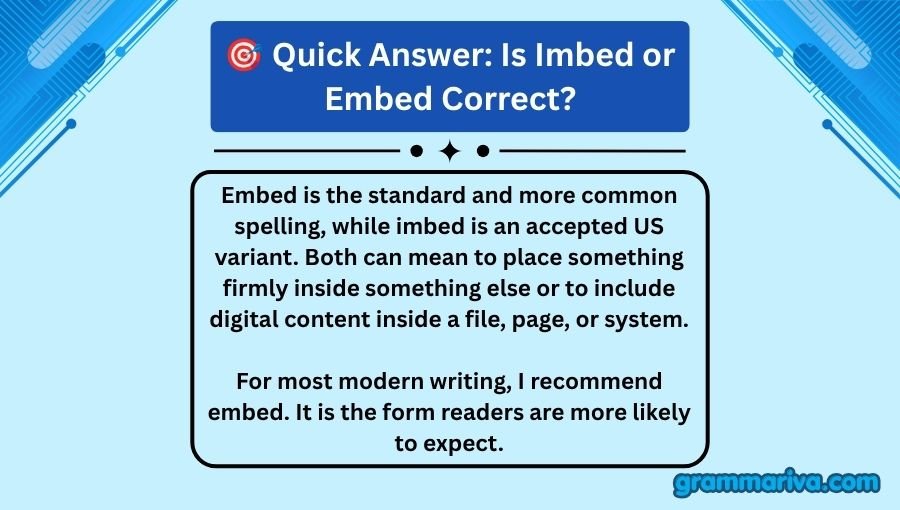
Embed is the standard and more common spelling, while imbed is an accepted US variant. Both can mean to place something firmly inside something else or to include digital content inside a file, page, or system.
For most modern writing, I recommend embed. It is the form readers are more likely to expect.
| Word | Status | Best General Choice | Example |
|---|---|---|---|
| embed | Standard/common spelling | Yes | Please embed the video. |
| imbed | Accepted US variant | Usually no | The stone was imbedded in the wall. |
| embedded | Common past/adjective form | Yes | The image is embedded in the page. |
| imbedded | US variant | Usually no | The object was imbedded in the surface. |
The key point is that imbed is not simply “wrong.” It is a recognized spelling variant. However, embed is normally the better choice when you want the clearest and most widely recognized form.
📚 Related Word Forms: Embed, Embedded, and More
The base verb has several related forms. The main difference is spelling preference, not meaning.
The common forms are:
- embed: present/base form
- embeds: third-person singular present
- embedded: past tense and past participle
- embedding: present participle or gerund
- imbed: US spelling variant
- imbeds: third-person singular variant
- imbedded: US variant of embedded
- imbedding: US variant of embedding
Cambridge also recognizes imbedded as a US form of embedded.
| Form | Type | Example |
|---|---|---|
| embed | Base verb | Embed the image in the article. |
| embeds | Present tense | The program embeds the file automatically. |
| embedded | Past participle/adjective | The video is embedded on the page. |
| embedding | -ing form | Embedding the chart makes the report easier to read. |
| imbed | US variant | The tool can imbed the image. |
| imbeds | US variant | The software imbeds the data. |
| imbedded | US variant | The object was imbedded in the material. |
| imbedding | US variant | Imbedding the content takes only a few steps. |
In practical writing, I would normally use embed, embeds, embedded, and embedding.
🔍 Understanding the Basics of Imbed vs Embed
The basic difference is spelling preference. Embed is the more common form, while imbed is a recognized US variant with the same core meaning.
Both words can describe putting something firmly into another thing.
For example:
The stone was embedded in the wall.
The stone is physically fixed inside the wall.
They can also describe digital content.
We embedded the video in the article.
Here, the video was placed directly into the article or webpage.
The same idea works for ideas, feelings, habits, and information.
The lesson was embedded in the story.
The lesson was included naturally within the story.
Imbed vs Embed at a Glance
| Form | Type | Meaning | Example | Correct/Incorrect |
|---|---|---|---|---|
| embed | Verb | Put firmly inside | Embed the image in the page. | ✅ Correct |
| imbed | Verb | Same basic meaning | Imbed the image in the page. | ✅ Correct |
| embedded | Past participle | Put inside | The image is embedded in the page. | ✅ Correct |
| imbedded | US variant | Same basic meaning | The image is imbedded in the page. | ✅ Correct |
| embeding | Misspelling | Incorrect spelling | We are embeding the file. | ❌ Incorrect |
| imbeded | Misspelling | Incorrect spelling | The file was imbeded. | ❌ Incorrect |
Notice something important: the issue is not always correct vs incorrect. Sometimes the choice is more common vs less common.
That distinction matters.
❓ Is Imbed the Same as Embed?
Yes. Imbed and embed have the same basic meaning. The main difference is that imbed is a less common US spelling variant, while embed is the more widely used form.
Both can describe physical placement:
- A bullet was embedded in the wood.
- A small chip was embedded in the device.
- The stone was imbedded in the surface.
Both can also describe digital placement:
- Embed a video in the webpage.
- Imbed a video in the webpage.
In my own editing work, I usually change imbed to embed when the goal is modern, broadly accessible English. I am not correcting the word because it is impossible. I am choosing the form that most readers expect.
| Meaning | Embed | Imbed |
|---|---|---|
| Put something physically inside another thing | ✅ | ✅ |
| Include digital content | ✅ | ✅ |
| Describe a deep idea or feeling | ✅ | ✅ |
| Use in technical writing | ✅ | ✅ |
| Use in general American English | Preferred | Accepted |
| Most familiar modern spelling | Yes | Less common |
❓ Why Do People Confuse Imbed and Embed?
People confuse these words because they sound exactly alike in normal speech and differ by only one letter in writing. The confusion around imbed vs embed usually comes from their identical meaning and very similar spelling.
The im- beginning can also feel natural because English has many words that begin with im-.
Think about:
- improve
- import
- impress
- immerse
That pattern can make imbed feel more natural to some writers.
There is another reason. Writers often see both forms in published material. If one person writes embedded and another writes imbedded, it can look like one writer made a mistake.
A student once showed me a sentence that used imbedded and asked why the spelling checker had accepted it. The answer was simple: the spelling is recognized. The student had not made a spelling error. The form was simply less common than embedded.
A Useful Test Tip 💡
When you are unsure, ask yourself:
“Which spelling would I expect to see in a modern website, report, or software guide?”
In most cases, the answer is embed.
| Question | If Your Answer Is Yes | Best Choice |
|---|---|---|
| Is this general modern writing? | Yes | embed |
| Is this a business document? | Yes | embed |
| Is this a technical guide? | Yes | embed |
| Is this a school assignment? | Yes | embed |
| Are you following a source’s house style? | Yes | Follow that style |
| Are you intentionally preserving a US variant? | Yes | imbed may work |
🎯 Embed: Meaning and Correct Use
Embed means to put something firmly inside something else or to include something as part of a larger thing.
It is especially common in technology, media, business, and everyday descriptions.
Physical Placement
You can use embed when something is physically placed into another material.
Example:
The jewel was embedded in the ring.
The jewel is not simply touching the ring. It is set into it.
Another example:
The glass became embedded in the wooden frame.
The glass is fixed within the frame.
Digital Content
This is one of the most common modern uses.
You can embed:
- videos
- images
- audio
- maps
- charts
- documents
- social media posts
- code
- links
- widgets
For example:
Please embed the YouTube video in the article.
The video becomes viewable through the article instead of requiring the reader to leave the page.
Ideas and Feelings
The word can also describe something that becomes deeply fixed in a person, group, system, or culture.
Example:
The habit became embedded in the team’s daily routine.
The habit is now a strong part of the routine.
| Meaning | Word Type | Example Sentence |
|---|---|---|
| Put something inside a material | Verb | The stone was embedded in the wall. |
| Include digital content | Verb | We embedded the video in the article. |
| Make something a fixed part of a system | Verb | The feature is embedded in the software. |
| Make an idea deeply fixed | Verb | The belief became embedded in the culture. |
❓ When Should You Use Imbed?
Use imbed when you specifically want the US spelling variant or when you are following a source or style that uses it.
It carries the same basic meaning as embed. Cambridge lists imbed as a US form of embed.
For example:
The technician imbedded the sensor inside the device.
This sentence is understandable and grammatically valid.
Still, if you are writing for a broad audience, I would usually choose:
The technician embedded the sensor inside the device.
The second version is more familiar to most readers.
Is Imbed Wrong?
No.
That is one of the most important facts in this entire article.
Imbed is an accepted spelling variant. It is not the same as a simple typo such as embded or embed-ed.
However, accepted does not always mean preferred.
| Spelling | Status | Recommendation |
|---|---|---|
| embed | Common standard form | Use freely |
| imbed | US variant | Use when appropriate |
| embedded | Common form | Preferred |
| imbedded | US variant | Acceptable |
| embeded | Misspelling | Avoid |
| embbed | Misspelling | Avoid |
📝 Case Study: Choosing the Right Form at Work
Imagine that you are writing an email to a client.
You want to tell the client that a video has been placed directly into a webpage.
You could write:
“We have imbedded the video into the landing page.”
The meaning is clear. The sentence is understandable.
But I would write:
“We have embedded the video into the landing page.”
Why?
Because embedded is the more familiar form in modern digital and professional writing.
I once edited a marketing report where the writer used imbedded several times. Nothing was grammatically broken. The writer had simply followed an older company template. We changed the spelling to embedded because the new report was aimed at a broad online audience.
That small change made the document look more consistent.
| Workplace Situation | Better Choice | Example |
|---|---|---|
| Client email | embed | We embedded the video. |
| Website instructions | embed | Embed the code here. |
| Technical guide | embed | The system embeds the data. |
| Internal document | embed | The image is embedded below. |
| Preserving a source’s wording | Follow source | Keep the original spelling. |
📖 Grammar Rules Explanation
The grammar rule is straightforward: embed and imbed are spelling variants of the same verb. They can perform the same grammatical role in a sentence.
The more common form in modern general writing is embed. The form imbed is also recognized, particularly as a US variant.
The verb can appear in several forms:
- embed
- embeds
- embedded
- embedding
The spelling changes when common English endings are added.
The past tense and past participle use -ed:
embed → embedded
The final consonant is doubled before the ending.
The same pattern applies to the variant:
imbed → imbedded
The present participle follows the same basic pattern:
embed → embedding
and:
imbed → imbedding
The main grammar point is that neither spelling creates a different grammatical meaning. The difference is primarily one of spelling preference and usage.
Correct vs Incorrect at a Glance
| Sentence | Correct/Incorrect | Why |
|---|---|---|
| Please embed the video. | ✅ Correct | Standard spelling |
| Please imbed the video. | ✅ Correct | Accepted US variant |
| The image is embedded in the article. | ✅ Correct | Common past participle |
| The image is imbedded in the article. | ✅ Correct | Accepted US variant |
| Please embded the video. | ❌ Incorrect | Misspelled form |
| The image was embeded. | ❌ Incorrect | Missing the second “d” |
A general dictionary reference such as Cambridge confirms the relationship between the two spellings, with imbed listed as a US form of embed.
⚠️ Common Mistakes With Imbed and Embed
Most errors happen because writers type quickly, rely on autocorrect, or are unsure whether imbed is accepted.
The most common problems are:
- Treating imbed as completely wrong.
- Assuming embed and imbed have different meanings.
- Forgetting to double the final consonant before -ed.
- Writing embed-ed instead of embedded.
- Writing embeding instead of embedding.
Similar Grammar Confusions
The problem is similar to other pairs where small differences create uncertainty.
| Confusion | Correct Form | Common Problem |
|---|---|---|
| it’s / its | Depends on meaning | Contraction vs possession |
| your / you’re | Depends on meaning | Possession vs “you are” |
| their / they’re | Depends on meaning | Possession vs “they are” |
| affect / effect | Depends on sentence | Verb vs noun confusion |
| then / than | Depends on sentence | Time vs comparison |
| embed / imbed | Both can work | Variant spelling |
Specific Wrong Forms
| Wrong Form | What’s Wrong | Correct Form |
|---|---|---|
| embeded | Only one “d” | embedded |
| embeding | Missing second “d” | embedding |
| embedd | Extra letter at the end | embed |
| imbeddeded | Extra ending | imbedded |
| imbeded | Missing second “d” | imbedded |
| embded | Letters are missing | embed |
Fast typing is a major cause of these errors.
Autocorrect can also make things confusing. Some tools recognize embed more readily than imbed. That does not automatically make imbed wrong.
The safest habit is to learn the difference between a variant and a misspelling.
❓ Why Is Embed Usually Better for Modern Writing?
Embed is usually better because it is the more common and familiar form. It is especially natural in technology, digital media, business writing, and general online content. When choosing between imbed vs embed, most modern writers will find embed to be the safer option.
If your goal is clarity, the familiar spelling is usually the best choice.
Consider these sentences:
Embed the chart in the report.
Embed the video in the blog post.
The feature is embedded in the app.
These sentences sound natural because embed is widely used in modern digital language.
This does not make imbed incorrect. It simply means that embed is often the safer editorial choice.
| Writing Goal | Recommended Form |
|---|---|
| Maximum reader familiarity | embed |
| SEO content | embed |
| Professional email | embed |
| Academic writing | embed |
| Technical instructions | embed |
| Preserve a quoted source | Keep original |
| Specific US variant preference | imbed can work |
🌎 Imbed vs Embed in Different Contexts
The best choice can depend on context, although embed works well in almost every modern setting.
Everyday Conversation
People are unlikely to notice the spelling when the word is spoken. The difference matters more in writing.
Professional Writing
Use embed unless a style guide says otherwise.
Creative Writing
Either form can work, depending on the author’s style.
Social Media and Texting
Both may appear, but embed is more familiar in digital contexts. Understanding imbed vs embed can help you make a consistent spelling choice in different types of writing.
| Context | Which Term to Use | Example |
|---|---|---|
| Everyday conversation | Either | The stone was embedded in the surface. |
| Professional writing | embed | We embedded the chart in the report. |
| Creative writing | Either | The memory was embedded in her mind. |
| Social media/texting | embed | Embed the post below. |
| Technical writing | embed | Embed the code in the page. |
💻 Embed in Technology and Digital Writing
Technology has made embed especially common.
When you place content inside another digital environment, you often use embed.
Examples include:
- embed a YouTube video
- embed a social media post
- embed an image
- embed a map
- embed a form
- embed a chart
- embed code
- embed a document
For example:
You can embed the map directly into the website.
The map is displayed as part of the website.
Another example:
The developer embedded the form on the contact page.
The form is included directly in that page.
| Digital Example | Meaning |
|---|---|
| Embed a video | Display a video within a page |
| Embed an image | Place an image within content |
| Embed code | Include code within another system |
| Embed a map | Display a map within a webpage |
| Embed a form | Place a form inside a page |
| Embedded content | Content placed within another digital environment |
This is one reason embed is such a useful modern word.
❓ Can You Use Embedded and Imbedded?
Yes. Embedded is the more common form, while imbedded is an accepted US variant. Cambridge lists imbedded as a US form of embedded.
Examples:
The image is embedded in the article. ✅
The image is imbedded in the article. ✅
Both are grammatically possible.
However, I recommend embedded in most professional and online writing.
The same idea applies to other forms:
- embedded systems
- embedded content
- embedded image
- embedded video
- imbedded systems
- imbedded content
- imbedded image
- imbedded video
In technical writing, embedded is particularly familiar because of phrases such as embedded systems and embedded software.
🧠 How To Remember the Difference
The easiest memory trick is:
When in doubt, choose “embed.”
Think of the word bed.
Something you embed can be thought of as being placed deeply into a “bed” of material.
For example:
The stone is embedded in the wall.
You can picture the stone sitting inside the wall.
Another trick is to remember that digital content is commonly embedded.
Think:
Embed a video.
Embed an image.
Embed a map.
Embed a link.
If you are writing a modern article, report, website, or email, embed is usually the form you want.
| Memory Trick | Example |
|---|---|
| Think “bed” | embed |
| Think digital content | embed a video |
| Think webpage | embed an image |
| Think software | embedded system |
| Unsure? | Choose embed |
❓ Are There Common Phrases With Embed?
Yes. Embed appears in several common technical and everyday phrases, although it does not have many traditional idioms.
Here are useful combinations you may see often. Knowing the difference between imbed vs embed also helps you recognize common phrases that appear in modern writing.
| Phrase | Meaning |
|---|---|
| embed a video | Put a video directly into a page |
| embed an image | Place an image within content |
| embedded content | Content placed inside another medium |
| embedded system | A computer system built into a larger device |
| embedded link | A link included within text or content |
| deeply embedded | Firmly fixed or strongly established |
These phrases are common enough that learning them can make the spelling easier to remember.
🔄 Synonyms and Alternatives to Embed
Sometimes you do not need either spelling. Another word may express your meaning more clearly.
Possible alternatives include:
- insert
- place
- include
- integrate
- implant
The best alternative depends on the sentence.
For digital content, insert or include may work.
For something physically fixed inside another object, implant or insert may work.
For ideas or features becoming part of a larger system, integrate may be a better choice.
| Alternative | Works When | Does Not Work When |
|---|---|---|
| insert | Something is placed into another thing | You need the sense of being firmly fixed |
| include | Content is simply added | Physical placement is important |
| integrate | Parts become part of a larger system | You mean literal physical placement |
| implant | Something is placed deeply inside | You are discussing ordinary webpage content |
| place | You need a simple general verb | You need the stronger meaning of embedding |
For example:
Insert the image into the document.
This works.
But:
Embed the video in the webpage.
is more precise for digital content.
⭐ Why Getting Imbed vs Embed Right Matters
The difference may seem tiny, but word choice affects how polished your writing looks.
Clarity
Using the more familiar spelling helps readers understand your sentence without distraction.
Professionalism
Professional documents benefit from consistent spelling choices.
Digital Communication
Online writers often use embed when discussing videos, images, code, and other content.
Consistency
If your article uses embed 20 times and suddenly uses imbed, readers may wonder whether the change was intentional.
A simple rule helps:
Choose the clearest form, then use it consistently.
| Situation | Why Getting It Right Matters |
|---|---|
| Resume or portfolio | Shows careful editing |
| Client email | Creates a polished impression |
| Published article | Keeps spelling consistent |
| Social post | Makes digital instructions clearer |
Good writing is not always about avoiding every rare variant. Sometimes it is about choosing the form that best fits your audience.
❓ Does American English Prefer Imbed or Embed?
American English accepts imbed, but embed is the more common modern choice.
Cambridge specifically identifies imbed as a US form of embed.
That means you should not think:
imbed = wrong
Instead, think:
embed = usual choice
imbed = accepted US variant
This distinction is useful because many spelling questions have more than one acceptable answer.
| Question | Answer |
|---|---|
| Is imbed accepted? | Yes |
| Is embed accepted? | Yes |
| Do they have different basic meanings? | No |
| Is embed more common? | Yes |
| Is imbed a typo? | Not necessarily |
| Which should you normally use? | Embed |
❓ Is Embed Better for SEO and Online Content?
Yes, embed is generally the better choice for online content because it is the more familiar form and is widely used in digital language.
Search engines are not likely to treat imbed and embed as completely unrelated words. The bigger concern is readability.
If you are writing an article about placing videos on websites, phrases such as these are natural:
- embed video
- embed YouTube video
- embed image
- embedded content
- embedded video
- embed code
Using the familiar form also makes your article easier for human readers to scan.
SEO should never force awkward spelling choices. Write naturally and use the form your audience expects.
🧩 Special Exception: Preserving a Source’s Spelling
There is one practical exception worth remembering.
If you are quoting, reproducing, or preserving an existing document, you may need to keep imbed if that is how the original source spells the word.
For example, if an old company manual consistently uses imbed, changing every instance may alter the source’s original wording.
Likewise, a specific organization’s style guide may prefer one form.
In those cases, consistency matters more than your personal preference.
| Situation | Best Approach |
|---|---|
| Your own article | Prefer embed |
| Your own business email | Prefer embed |
| Quoted material | Preserve the original |
| Company style guide | Follow the guide |
| Editing an existing document | Keep its style unless asked to modernize it |
❓ What Is the Difference Between Embed and Imbed in a Sentence?
There is no major meaning difference. Both can function as verbs with the same basic sense.
Compare:
The designer embedded the image in the article. ✅
The designer imbedded the image in the article. ✅
The first is more familiar.
Another pair:
The sensor was embedded in the machine. ✅
The sensor was imbedded in the machine. ✅
Again, both work.
The real difference is not sentence meaning. It is spelling preference and frequency.
📊 Correct and Incorrect Examples You Should Know
These examples show the difference between an accepted variant and a genuine spelling mistake.
| Example | Status | Explanation |
|---|---|---|
| Please embed the image. | ✅ Correct | Standard spelling |
| Please imbed the image. | ✅ Correct | US variant |
| The image was embedded. | ✅ Correct | Standard past participle |
| The image was imbedded. | ✅ Correct | US variant |
| Please embeded the image. | ❌ Incorrect | Wrong past-tense spelling |
| We are embeding the video. | ❌ Incorrect | Wrong -ing spelling |
| The code is embedded in the page. | ✅ Correct | Common technical usage |
| The code is imbedded in the page. | ✅ Correct | Accepted US variant |
🧪 Practice: Can You Choose the Right Form?
Try these before checking the answers.
Practice 1
Please ______ the video below the introduction.
Answer: embed
Practice 2
The small chip was ______ inside the device.
Answer: embedded
Practice 3
The writer chose the less common US spelling and ______ the image in the report.
Answer: imbedded
Practice 4
We are ______ the chart into the presentation.
Answer: embedding
| Practice Sentence | Answer |
|---|---|
| Please ___ the video. | embed |
| The chip was ___. | embedded |
| He ___ the image using the US variant. | imbedded |
| We are ___ the chart. | embedding |
❓ Which Spelling Should You Use in Formal Writing?
For formal writing, I recommend embed and its common forms embedded and embedding. For formal documents, understanding imbed vs embed can help you choose the spelling that feels most familiar to your readers.
This applies to:
- essays
- reports
- resumes
- business emails
- websites
- technical documentation
- academic content
- professional articles
Using imbed is not automatically a grammar error. However, embed is the safer choice when you want broad reader familiarity.
A formal sentence might say:
The report includes instructions for embedding charts into the final document.
That sentence is clear, natural, and professional.
❓ Is Imbedded a Correct Word?
Yes. Imbedded is an accepted US variant of embedded. It is not simply a typo. The question of imbed vs embed often comes up when writers are unsure whether imbedded is a valid spelling.
Still, embedded is the form I recommend in most modern writing.
For example:
The data is embedded in the report. ✅
The data is imbedded in the report. ✅
Both are possible.
But if you are writing for a large audience, choose the spelling most readers will recognize quickly.
❓ How Do You Spell the Past Tense of Embed?
The past tense is embedded.
The spelling is:
embed + ed = embedded
The final consonant is doubled.
The same pattern applies to the US variant:
imbed + ed = imbedded
Avoid these forms:
- embed-ed ❌
- imbeded ❌
- embded ❌
Correct:
- embedded ✅
- imbedded ✅
| Base Form | Past Form | -ing Form |
|---|---|---|
| embed | embedded | embedding |
| imbed | imbedded | imbedding |
This is one of the most useful spelling rules to memorize from this article.
❓ Is Embed Used Only for Technology?
No. Embed is not limited to technology.
It can describe physical objects, ideas, habits, beliefs, systems, and digital content.
Examples:
A piece of glass was embedded in the wood.
The lesson was embedded in the story.
The video was embedded in the webpage.
The feature is embedded in the software.
The common idea is that something becomes part of something larger or is placed firmly within it.
| Area | Example |
|---|---|
| Physical objects | The stone was embedded in the wall. |
| Ideas | The belief became embedded in the culture. |
| Habits | The routine became embedded in daily life. |
| Technology | The feature is embedded in the software. |
| Websites | The video is embedded in the article. |
❓ What Is the Easiest Way To Remember Imbed vs Embed?
The easiest rule is:
When you are unsure, use “embed.”
It is the more familiar modern form and works in almost every context where imbed could work.
Remember these three examples:
Embed the video.
The video is embedded.
We are embedding the video.
If you can remember those three forms, you will avoid most mistakes.
✅ Quick Recap Checklist
Before you finish your sentence, use this checklist.
| Question | If Yes → Use |
|---|---|
| Do you want the common modern spelling? | embed |
| Are you writing for a broad audience? | embed |
| Are you discussing digital content? | embed |
| Are you writing professional content? | embed |
| Are you intentionally using the US variant? | imbed |
| Are you preserving an original source? | Keep its spelling |
| Are you writing the past form of embed? | embedded |
| Are you writing the -ing form? | embedding |
Three Final Practice Examples
- Embed the video in the article. ✅
- The image is embedded in the webpage. ✅
- The technician imbedded the sensor inside the machine. ✅
The first two use the preferred modern forms. The third uses the accepted US variant.
❓ FAQs About Imbed vs Embed
❓ Is imbed correct or incorrect?
Imbed is correct. It is an accepted US spelling variant of embed. However, embed is more common and is usually the better choice for modern general writing.
❓ Is embed more common than imbed?
Yes. Embed is more common and widely recognized. It is especially common in technology, digital media, business writing, and online content.
❓ Are imbed and embed synonyms?
They are spelling variants rather than separate synonyms. Both have the same basic meaning: to put something firmly inside something else or include something within a larger thing.
❓ Should I use embed in American English?
Yes. Embed is the safest general choice in American English. Imbed is also accepted, but it is less common.
❓ Is imbedded a real word?
Yes. Imbedded is an accepted US variant of embedded. However, embedded is the more common spelling.
❓ Is “embed-ed” correct?
No. Embeded is a misspelling. The correct past form is embedded, with the final consonant doubled.
❓ Is “embeding” correct?
No. The correct spelling is embedding, with two d’s before the -ing ending.
❓ Should I write “embed a video” or “imbed a video”?
Both can be understood, but embed a video is the preferred modern form. It is especially natural in website and technology writing.
❓ Is “embedded” or “imbedded” better?
Embedded is better for most modern writing. Imbedded is accepted, but embedded is more familiar to most readers.
❓ Does imbed have a different meaning from embed?
No. Imbed and embed have the same basic meaning. The main difference is spelling preference and common usage, not meaning.
🏁 Conclusion: The Simple Rule to Remember
Imbed vs embed is not really a battle between a correct word and an incorrect one. Both forms are accepted, but embed is the more common and generally preferred spelling in modern English. Imbed is a recognized US variant, so seeing it does not automatically mean that the writer made a spelling mistake.
For most situations, I recommend using embed, embedded, and embedding. These forms are especially natural in professional writing, technology, websites, digital media, and general American English.
Remember the simplest rule: when you are unsure, choose embed. 👍
If you see imbed or imbedded, do not immediately mark it as wrong. Check the context. It may simply be the less common US spelling.
Good grammar is often about making clear choices. When two forms are possible, the clearest and most familiar form is usually the best one.
So next time you need to describe placing a video, image, idea, or object inside something else, you can confidently write embed. ✨

Hi, I’m Olivia Carter. I’m an English language editor at Grammariva, and I work on making grammar lessons clear, accurate, and easy to follow. I especially enjoy writing about common grammar mistakes and everyday English.
[…] feel confident using this phrase in emails, essays, articles, schoolwork, and everyday writing. Imbed vs Embed | Gluing or Glueing | Accent vs Ascent vs […]
[…] feel much more confident when choosing the right form. 😊 Comma Before or After For Example | Imbed vs Embed | Gluing or […]