Have you ever typed a sentence and stopped because you were not sure whether to fast or too fast was correct? You are not alone. These two forms look almost the same, but they do very different jobs in a sentence. One uses to, while the other uses too. That tiny extra letter can change the meaning completely. ✍️
I see this mix-up often in casual writing, texts, emails, and social media posts. The good news is that the rule is simple once you know what each word does. To is usually used before a verb or to show direction or connection. Too often means “more than needed,” “excessively,” or “also.”
In this guide, I will explain to fast or too fast in plain US English. We will look at meanings, sentence patterns, common mistakes, examples, memory tricks, and real-life situations. By the end, you should be able to choose the right form quickly and confidently. 🚀 Mine as Well or Might as Well or Mind as Well | When I Can or When Can I | Its Self or Itself
Quick Answer: To Fast or Too Fast 🎯
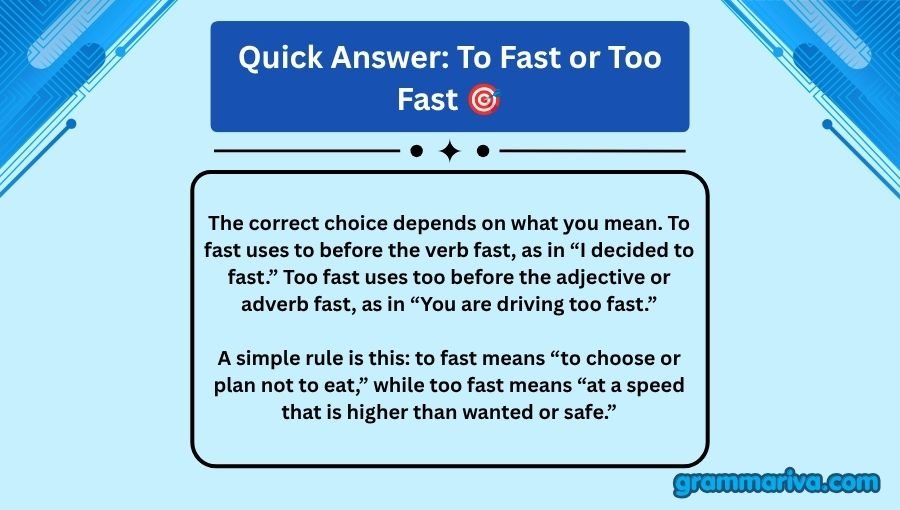
The correct choice depends on what you mean. To fast uses to before the verb fast, as in “I decided to fast.” Too fast uses too before the adjective or adverb fast, as in “You are driving too fast.”
A simple rule is this: to fast means “to choose or plan not to eat,” while too fast means “at a speed that is higher than wanted or safe.”
| Form | Type | Meaning | Example |
|---|---|---|---|
| to fast | To + verb | To go without food for a period | I plan to fast tomorrow. |
| too fast | Adverb + adverb/adjective | Faster than needed or desired | The car is moving too fast. |
| to | Preposition or infinitive marker | Shows direction, connection, or a verb form | I want to learn. |
| too | Adverb | More than needed or also | The soup is too hot. |
The key is meaning. If you are talking about not eating, use to fast. If you are talking about excessive speed, use too fast.
What Does To Fast Mean? 📝
To fast means to go without food for a period of time, usually for a chosen reason. Grammatically, to is the infinitive marker, and fast is the base verb. When you understand when to use to fast, the difference becomes much easier to spot in everyday writing. ✅
For example:
I decided to fast before the event.
Here, “to fast” is the action the speaker decided to do. The phrase does not describe speed.
To Fast as a Verb
The verb fast can describe the act of not eating. It can appear after verbs such as:
- decide
- plan
- choose
- want
- need
- hope
- try
Examples:
She wants to fast tomorrow.
They decided to fast for a short period.
I plan to fast before the test.
The phrase to fast works because the sentence is talking about an action.
| Sentence | What “to fast” means |
|---|---|
| I plan to fast tomorrow. | I plan not to eat for a period. |
| She wants to fast today. | She wants to go without food. |
| They chose to fast together. | They chose not to eat for a period. |
| He hopes to fast successfully. | He hopes to complete a period without food. |
A Simple Test Tip 💡
Ask yourself:
“Am I talking about not eating?”
If the answer is yes, to fast may be the form you need.
For example:
I want ___ tomorrow.
The intended meaning is not eating.
So the sentence becomes:
I want to fast tomorrow.
If you are talking about speed, however, too fast is usually the correct phrase.
What Does Too Fast Mean? ⚡
Too fast means at a speed that is greater than wanted, needed, comfortable, or safe. The word too adds the idea of excess.
Consider this sentence:
You are walking too fast.
The speaker thinks the person is walking faster than necessary or comfortable.
Here are more examples:
The car is going too fast.
You spoke too fast for me to understand.
The video plays too fast.
He runs too fast for his younger brother to keep up.
The word too is doing important work. It tells us that the amount or degree is beyond a suitable level.
| Phrase | Meaning | Example |
|---|---|---|
| too fast | Faster than desired | The train is moving too fast. |
| very fast | At a high speed | The train is moving very fast. |
| so fast | At a notably high speed | The train moved so fast. |
| fast enough | At a sufficient speed | The train is moving fast enough. |
Notice the difference between very fast and too fast. “Very fast” simply describes high speed. “Too fast” says the speed is more than suitable.
Is To Fast the Same as Too Fast? 🤔
No. To fast and too fast do not mean the same thing. To fast refers to the verb meaning to go without food, while too fast describes excessive speed.
Compare these sentences:
❌ I decided too fast tomorrow.
This does not express the intended meaning of fasting.
✅ I decided to fast tomorrow.
Here, “to fast” correctly expresses the planned action.
Now look at speed:
❌ The driver is going to fast.
This could be read as “going in order to fast,” although the intended meaning is usually unclear.
✅ The driver is going too fast.
Now the meaning is clear. The driver is traveling at an excessive speed.
| Phrase | Main idea | Typical question |
|---|---|---|
| to fast | Not eating | What action will someone do? |
| too fast | Excessive speed | How fast is something happening? |
| very fast | High speed | How fast is something? |
| fast enough | Sufficient speed | Is the speed enough? |
To Fast or Too Fast at a Glance 🔎
The easiest way to remember the difference is to focus on the extra o in too. That extra letter can remind you of “more” or “extra.”
| Form | Word role | Meaning | Correct Example |
|---|---|---|---|
| to fast | Infinitive phrase | To go without food | I chose to fast. |
| too fast | Adverbial phrase | At excessive speed | She is driving too fast. |
| to | Function word | Introduces a verb or shows relation/direction | I want to study. |
| too | Adverb | Excessively or also | It is too late. |
A useful memory trick is:
One “o” in “to” = a small connecting word.
Two “o’s” in “too” = extra or excessive.
This is not a formal grammar rule. It is simply a memory aid. It can help you make the right choice quickly.
Why Do People Confuse To and Too? 🧠
People confuse to and too because they sound alike in many forms of spoken English. When we hear a sentence, context helps us understand the intended word. When we write it, we must choose the correct spelling.
I once edited a short email where the writer had used too before several verbs. The meaning was easy to understand, but the repeated spelling error made the message look rushed. Once we changed those forms to to, the email looked much cleaner.
Here are the main reasons this mistake happens:
- The words sound similar.
- Fast typing encourages shortcuts.
- Autocorrect may not catch a real English word used in the wrong place.
- Writers may not know the grammar difference.
- People often rely on sound instead of sentence structure.
| Common confusion | Correct choice | Basic rule |
|---|---|---|
| to / too | Depends | Check the meaning. |
| your / you’re | Depends | Possession vs. “you are.” |
| its / it’s | Depends | Possession vs. “it is.” |
| their / there / they’re | Depends | Possession, place, or “they are.” |
| then / than | Depends | Time/order vs. comparison. |
The lesson is simple: spelling alone is not enough. You need to understand the job of the word in the sentence.
How Can You Tell Which Form Is Correct? 🎯
You can usually solve the problem by asking one question: What does the sentence mean?
When you understand the meaning behind to fast or too fast, choosing the correct form becomes much easier. Always check whether you are describing an action or an excessive speed.
If the sentence refers to going without food, choose to fast.
If it refers to excessive speed, choose too fast.
Try these:
❌ I plan too fast tomorrow.
✅ I plan to fast tomorrow.
The first sentence uses the wrong form for the intended action.
Now try:
❌ The cyclist is riding to fast.
✅ The cyclist is riding too fast.
Here, the sentence describes excessive speed.
The Replacement Test
You can also replace too with excessively.
The car is too fast.
→ The car is excessively fast.
The meaning still works.
But you cannot use this test for to fast:
I want to excessively fast tomorrow.
That changes the meaning and sounds wrong.
| Test | Result | Example |
|---|---|---|
| Does it mean “go without food”? | Use to fast | I want to fast. |
| Does it mean “excessively fast”? | Use too fast | He drives too fast. |
| Can “too” mean “also”? | Use too | I want to go too. |
| Does a base verb follow it? | Often use to | I want to learn. |
Correct Meanings and Uses of To Fast ✨
The phrase to fast has one main grammatical use in this comparison: it introduces the verb fast.
After Verbs of Choice
Use to fast after verbs that can take an infinitive.
I decided to fast.
She chose to fast.
They want to fast.
The pattern is:
Subject + verb + to + base verb
Examples include:
I want to learn.
She plans to travel.
He decided to stay.
They chose to wait.
In the same pattern:
I decided to fast.
In Plans and Intentions
The phrase can also describe something a person plans or intends to do.
I plan to fast tomorrow.
She hopes to fast during the morning.
He wants to fast before the appointment.
The exact reason for fasting can vary. The grammar stays the same.
| Meaning | Word Type | Example Sentence |
|---|---|---|
| Go without food | Verb | I decided to fast. |
| Plan to go without food | Infinitive phrase | We plan to fast tomorrow. |
| Choose to go without food | Infinitive phrase | She chose to fast. |
Correct Meanings and Uses of Too Fast 🚗
The phrase too fast is used when speed is higher than an appropriate level.
Physical Speed
The car is going too fast.
The driver is traveling at an excessive speed.
Speech
You are talking too fast.
The speaker’s speed makes understanding difficult.
Movement
The child is running too fast.
The child is moving faster than the situation calls for.
Digital Media
The video is playing too fast.
The playback speed is higher than desired.
| Situation | Example | Why “too” works |
|---|---|---|
| Driving | The car is going too fast. | Speed is excessive. |
| Speaking | She talks too fast. | Speech is faster than needed. |
| Running | He runs too fast. | Speed is beyond the desired level. |
| Video | The clip plays too fast. | Playback speed is excessive. |
When you understand when to use to fast, the difference becomes much easier to spot in everyday writing.
Case Study: A Simple Workplace Example 📝
Imagine that a manager sends this message:
“The presentation is moving too fast. Please slow down during the final section.”
The phrase too fast is correct because the manager is describing the pace of the presentation. The presentation is moving at a speed that is higher than the audience can comfortably follow.
Now imagine a different message:
“I plan to fast tomorrow, so I may skip the team lunch.”
Here, to fast is correct because the writer is describing an intended action.
These two examples show why context matters.
I once caught myself typing too when I meant to in a quick message. I reread the sentence before sending it and noticed that the next word was a verb. That quick check saved me from sending an obvious error.
| Situation | Correct phrase | Reason |
|---|---|---|
| A person plans not to eat | to fast | “Fast” is the verb. |
| A car exceeds a safe speed | too fast | “Too” shows excess. |
| A speaker talks at excessive speed | too fast | The pace is higher than wanted. |
| A person chooses not to eat | to fast | “To fast” names the chosen action. |
Grammar Rules Explanation 📚
The difference comes from the grammatical jobs of to and too.
To is commonly used as an infinitive marker before a base verb.
Examples include:
to walk
to write
to study
to fast
In to fast, the word fast functions as a verb.
Too is an adverb. It can show an excessive degree or mean “also.”
In too fast, it modifies fast and tells us that the speed or pace is beyond an appropriate level.
This distinction explains why the two forms cannot normally be swapped.
A simple structure makes the rule easier:
to + verb
too + adjective/adverb
So:
to fast
but:
too fast
Standard English grammar references and major dictionaries make the same basic distinction between the infinitive marker to and the adverb too.
Correct vs. Incorrect at a Glance
| Sentence | Correct/Incorrect | Why |
|---|---|---|
| I decided to fast tomorrow. | ✅ Correct | “To” introduces the verb “fast.” |
| The driver is going too fast. | ✅ Correct | “Too” shows excessive speed. |
| She wants too fast tomorrow. | ❌ Incorrect | The intended verb phrase needs “to fast.” |
| He is driving to fast. | ❌ Incorrect | The intended meaning is excessive speed. |
| The speaker talks too fast. | ✅ Correct | The speaking pace is excessive. |
The important point is that to and too are not alternate spellings. They are different words with different grammatical roles.
Common Mistakes With To Fast and Too Fast ⚠️
The most common mistake is choosing the word that sounds right instead of checking its function.
Mistake 1: Using Too Before a Verb
❌ I want too fast tomorrow.
✅ I want to fast tomorrow.
The verb “want” is followed by an infinitive. Therefore, to fast is needed.
Mistake 2: Using To for Excessive Speed
❌ You are driving to fast.
✅ You are driving too fast.
The sentence describes speed. Too means the speed is higher than it should be.
Mistake 3: Trusting Autocorrect
Autocorrect may not help because both to and too are real English words. A spelling checker may see no spelling error even when the wrong word has been selected.
Mistake 4: Typing Too Quickly
Fast typing can cause writers to choose the first spelling that comes to mind. A quick reread can catch many errors.
Mistake 5: Lack of Knowledge
If someone has never learned the difference, the words can seem interchangeable. They are not.
| Mistake | Why it happens | Better habit |
|---|---|---|
| Using too before a verb | Sound-based writing | Check the next word. |
| Using to for excessive speed | Confusing similar sounds | Ask whether “excessively” fits. |
| Relying on autocorrect | Both words are correctly spelled | Check meaning yourself. |
| Fast typing | Little time to reread | Pause before sending. |
| Lack of grammar knowledge | Rule is unfamiliar | Learn the basic pattern. |
Common Wrong Forms for This Topic
| Wrong Form | What’s Wrong | Correct Form |
|---|---|---|
| I want too fast. | “Too” does not introduce the intended verb. | I want to fast. |
| He drives to fast. | “To” does not show excessive speed. | He drives too fast. |
| She plans too fast tomorrow. | The infinitive marker is missing. | She plans to fast tomorrow. |
| The bike moves to fast. | Excessive speed requires “too.” | The bike moves too fast. |
| We decided too fast. | The intended action needs “to.” | We decided to fast. |
How To Remember the Difference 🧩
The easiest way to remember to fast or too fast is to connect each form with its meaning. Think about the action first, then choose the spelling that fits. Use the extra O trick.
Think of too as having something extra.
too = extra
So:
too fast = faster than needed
The trick is especially useful when you are writing quickly.
You can also use these two questions:
Question 1: Is the sentence about not eating?
→ Use to fast.
Question 2: Is something moving or happening faster than wanted?
→ Use too fast.
For example:
I decided to fast.
Ask: “Is this about not eating?” Yes.
The car is going too fast.
Ask: “Is this about excessive speed?” Yes.
| Memory clue | Meaning | Example |
|---|---|---|
| to + verb | Introduces an action | to fast |
| too = extra | Shows excess | too fast |
| “Not eating?” | Choose to fast | I plan to fast. |
| “Excessive speed?” | Choose too fast | It is too fast. |
Usage in Different Contexts 🌎
The correct form stays the same across different types of writing. What changes is the situation in which you use it.
Everyday Conversation
People often use too fast when talking about driving, walking, speaking, or moving.
“You are walking too fast!”
They may use to fast when discussing a plan.
“I decided to fast tomorrow.”
Professional Writing
Professional writing needs extra care because small errors can affect credibility.
“The speaker is talking too fast.”
“I plan to fast tomorrow.”
Creative Writing
Authors can use both phrases naturally.
“The horse was running too fast.”
“She chose to fast before the journey.”
Social Media and Texting
Casual posts may contain shortcuts, but the standard forms remain the same.
“This week is going too fast!”
“I decided to fast today.”
| Context | Which Term to Use | Example |
|---|---|---|
| Everyday conversation | Depends on meaning | You are moving too fast. |
| Professional writing | Depends on meaning | The process is moving too fast. |
| Creative writing | Depends on meaning | He chose to fast. |
| Social media/texting | Depends on meaning | Time is going too fast! |
Common Phrases With Too Fast 💬
There are several natural expressions that use too fast. They usually describe speed or pace that is higher than wanted.
| Phrase | Meaning |
|---|---|
| going too fast | Moving at excessive speed |
| moving too fast | Progressing faster than desired |
| talking too fast | Speaking faster than listeners can follow |
| driving too fast | Driving above a suitable speed |
| happening too fast | Events are occurring sooner or faster than expected |
| growing too fast | Developing at an unexpectedly high rate |
These phrases are common because too gives the idea of “more than is suitable.”
For example:
The project is moving too fast for the team.
The issue is not simply speed. The speed is greater than the team can comfortably handle.
Synonyms and Alternatives 🔄
Sometimes you can replace too fast with another expression. However, the replacement may slightly change the meaning.
| Alternative | Works When | Does Not Work When |
|---|---|---|
| too quickly | You mean excessive speed or pace | You mean the verb “fast” as in not eating |
| excessively fast | Formal writing needs a stronger phrase | Casual conversation may sound unnatural |
| faster than necessary | You want to explain the problem clearly | A short, casual phrase is preferred |
| at an unsafe speed | Safety is the main concern | The issue is simply quick progress |
| very fast | You only mean high speed | You need to show that the speed is excessive |
For example:
The car is going too fast.
can become:
The car is going too quickly.
But:
I decided to fast.
cannot become:
I decided to quickly.
The grammatical structure changes, so the replacement does not work.
Why Getting This Difference Right Matters ✍️
Correct word choice improves clarity. It also makes your writing look more polished.
A reader may understand your sentence even when you use to instead of too, but the error can still distract them. In professional communication, repeated small mistakes can weaken the impression your writing creates.
A useful writing principle is:
Small word choices can make a big difference in clear writing.
| Situation | Why Getting It Right Matters |
|---|---|
| Resume | Shows attention to detail. |
| Client email | Creates a professional impression. |
| Published content | Builds reader trust. |
| Social post | Makes the message easier to read. |
I think of these words as tiny traffic signs. They are small, but they guide the reader toward the intended meaning. When the sign is wrong, the reader may still reach the destination, but the trip becomes less smooth.
Is Too Fast Always About Physical Speed? 🚀
No. Too fast can describe more than cars or runners. It can describe speech, learning, change, growth, progress, video playback, and many other kinds of pace.
For example:
You are learning too fast for me to keep up.
Here, “too fast” does not describe physical movement. It describes the pace of learning.
Other examples include:
The story develops too fast.
The music changes too fast.
The video is moving too fast.
The company is growing too fast.
The shared idea is that something is happening at a pace that is considered excessive.
Can Too Fast Describe Time? ⏰
Yes. Too fast can describe how quickly time seems to pass.
For example:
This year is going too fast.
The speaker means that the year seems to be passing more quickly than they would like or expect.
Another example is:
The weekend went by too fast.
This means the weekend seemed to end sooner than the speaker wanted.
| Expression | Meaning |
|---|---|
| The year is going too fast. | Time seems to pass very quickly. |
| The weekend ended too fast. | The weekend seemed too short. |
| The project moved too fast. | Progress happened faster than suitable. |
| The lesson went too fast. | The lesson moved faster than the learner could follow. |
Can You Use To Fast in Every Sentence About Fasting? 🍽️
Not always. To fast is specifically the infinitive form. Other forms of the verb fast can appear in different sentence structures.
For example:
I fast on certain days.
She is fasting today.
They fasted last week.
He has fasted before.
When the infinitive is needed, use to fast:
I want to fast.
This distinction shows that the issue is not simply spelling. It is also about grammar and sentence structure.
| Verb Form | Example |
|---|---|
| Base verb | I fast regularly. |
| Infinitive | I want to fast. |
| Present participle | She is fasting today. |
| Past form | They fasted yesterday. |
How Does To Fast Compare With Other To + Verb Forms? 📖
The same grammar pattern appears with many verbs.
We say:
to walk
to write
to read
to learn
to fast
We do not normally replace to with too in these infinitive structures.
| Correct Infinitive | Incorrect Substitute |
|---|---|
| to walk | too walk |
| to write | too write |
| to learn | too learn |
| to study | too study |
| to fast | too fast |
This broader pattern can make the rule easier to remember. To often introduces the base form of a verb.
How Does Too Fast Compare With Very Fast? ⚖️
This is another useful distinction.
Very fast means something has a high speed.
Too fast means the speed is higher than a suitable level.
Compare:
The athlete runs very fast.
This is praise or neutral description.
The athlete runs too fast for the group.
This says the athlete’s speed creates a problem for the group.
| Phrase | Main idea | Example |
|---|---|---|
| very fast | High speed | She runs very fast. |
| too fast | Excessive speed | She runs too fast for me. |
| fast enough | Sufficient speed | She runs fast enough to win. |
| so fast | Strong emphasis on speed | She ran so fast. |
This distinction is useful because writers sometimes use too when they simply mean very. The two words are not always interchangeable.
Special Exception and Edge Cases 🧐
There is no special spelling exception that makes to fast and too fast interchangeable. The standard distinction remains based on grammar and meaning.
However, fast itself can have more than one role in English. It can be a verb related to going without food, and it can also describe speed.
That is why context matters so much.
Compare:
I plan to fast.
Here, fast is a verb.
The train is too fast.
Here, fast describes speed.
The word fast looks identical in both sentences, but the surrounding words tell us how it functions.
Quick Recap Checklist ✅
Use this checklist whenever you hesitate.
| Question | If Yes → Use |
|---|---|
| Does the sentence mean “go without food”? | to fast |
| Does it describe excessive speed? | too fast |
| Does to introduce a base verb? | to |
| Does too mean “more than needed”? | too |
| Can you replace “too” with “excessively”? | too |
Practice Examples
- I decided ___ tomorrow.
Answer: to fast - The driver is going ___ fast.
Answer: too fast - She wants ___ during the morning.
Answer: to fast - You are speaking ___.
Answer: too fast - The video is playing ___.
Answer: too fast
If you still wonder whether to fast is the right choice, check whether “fast” is acting as a verb. If it is, the infinitive form to fast is correct. ✅ A quick final test is to focus on meaning rather than sound.
FAQs About To vs Too
What is the difference between to fast and too fast?
To fast means to go without food for a period. Too fast means at a speed or pace that is greater than desired, needed, or suitable.
Is “to fast” grammatically correct?
Yes. To fast is grammatically correct when fast is being used as a verb and to introduces the infinitive.
Example: I decided to fast tomorrow.
Is “too fast” grammatically correct?
Yes. Too fast is correct when you mean that something is happening or moving at an excessive speed or pace.
Example: The car is going too fast.
When should I use to fast?
Use to fast when the sentence describes an intention, plan, decision, or desire to go without food.
Example: She plans to fast tomorrow.
When should I use too fast?
Use too fast when something is happening faster than wanted, needed, comfortable, or safe.
Example: He is driving too fast.
Why do people confuse to and too?
They are commonly confused because they sound alike in many forms of speech. Fast typing and limited grammar knowledge can also lead to mistakes.
Is “I want too fast” correct?
No, if you mean that you want to go without food. The correct sentence is “I want to fast.”
Is “He drives to fast” correct?
No, if you mean that he drives at excessive speed. The correct sentence is “He drives too fast.”
Can too fast describe speaking?
Yes. Too fast can describe speech when someone talks at a speed that makes understanding difficult.
Example: You are speaking too fast.
What is the easiest way to remember to vs. too?
Remember that to commonly introduces a verb, while too can mean “more than needed.” Therefore, to fast describes an action, while too fast describes excessive speed or pace. If you still wonder whether to fast is the right choice, check whether “fast” is acting as a verb. If it is, the infinitive form to fast is correct. ✅
Conclusion
To fast or too fast becomes easy once you focus on meaning and grammar instead of sound. Use to fast when fast is the verb meaning to go without food. Use too fast when you mean that something is moving, happening, speaking, or progressing at an excessive pace.
The simplest memory trick is to think of too as having something extra. The extra o can remind you of “more than needed.” When you see an infinitive structure, remember the basic pattern to + verb.
I recommend reading the entire sentence before choosing the word. Do not rely only on how the phrase sounds. That small habit can prevent many common errors in emails, schoolwork, social posts, and everyday messages. 😊
Once you learn this difference, you will spot the correct form much faster. Clear grammar does not have to be complicated. Sometimes one tiny letter is all you need to make your meaning clear. ✨

Hi, I’m Lucas Bennett. I’m a grammar content specialist at Grammariva. I work on articles covering everyday grammar questions, sentence usage, and writing tips that readers can apply with confidence.



[…] remember the spelling, and how to use the word naturally in everyday and professional writing. 😊 To Fast or Too Fast | Mine as Well or Might as Well or Mind as Wel | When I Can or When Can […]
[…] media, common mistakes, alternatives, and frequently asked questions. ✍️ Input or Imput | To Fast or Too Fast | Mine as Well or Might as Well or Mind as […]