If you have ever stopped while writing and wondered about by which or in which, you are not alone. These two phrases look similar, but they do different jobs in a sentence. The small word you choose can change the meaning of the whole sentence. 📚
The good news is that the rule is simple once you understand what each phrase describes. By which usually points to a method, process, means, or agent. In which usually points to a place, situation, condition, period, or context where something happens.
I teach grammar by looking at the meaning first, not by asking students to memorize long rules. That method works especially well here. Once you ask, “Am I talking about how something happens or where or in what situation it happens?” the correct choice becomes much easier.
In this guide, I will explain the difference between by which or in which, show clear examples, cover common mistakes, and give you simple tests you can use in your own writing. ✍️ Brite vs Bright | Passerbyers or Passersby or Passerby | I Didn’t Do Nothing or I Didn’t Do Anything
Quick Answer: By Which or In Which? 🎯
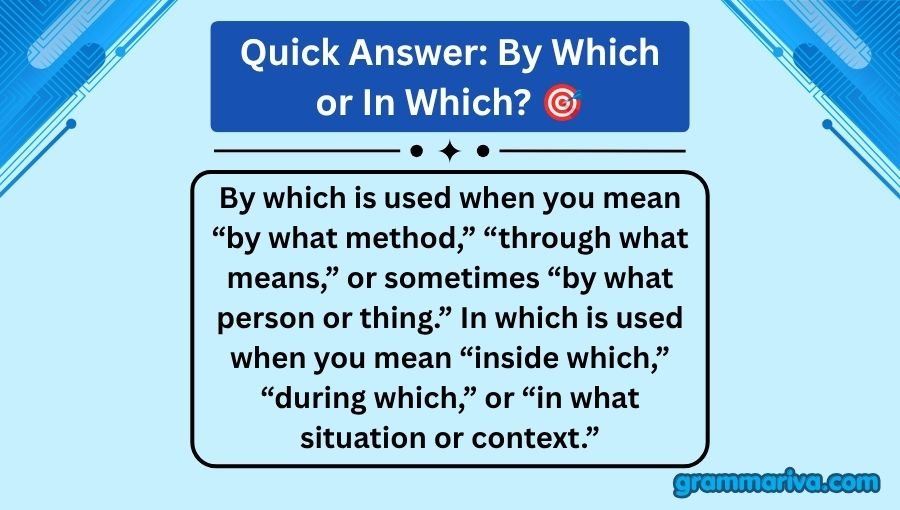
By which is used when you mean “by what method,” “through what means,” or sometimes “by what person or thing.” In which is used when you mean “inside which,” “during which,” or “in what situation or context.”
Compare these examples:
- The method by which we solved the problem was simple.
- The room in which we met was small.
The first sentence focuses on the method. The second focuses on the place.
Is By Which the Same as In Which? 🤔
No. By which and in which are not interchangeable in most sentences. The correct phrase depends on the relationship between the noun and the action that follows.
By which often answers how?
In which often answers where?, when?, or in what situation?
| Form | Type | Meaning | Example | Correct/Incorrect |
|---|---|---|---|---|
| by which | preposition + relative pronoun | by what method or means | The process by which it works is complex. | ✅ Correct |
| in which | preposition + relative pronoun | in what place, time, or situation | The office in which she works is nearby. | ✅ Correct |
| by which | used for a physical container without a method meaning | unnatural in many cases | The box by which I stored the books | ❌ Incorrect |
| in which | used for a method | wrong relationship | The method in which we solved it | ❌ Usually incorrect |
A useful shortcut is this:
How? → by which
Where, when, or in what situation? → in which
That simple question will solve many cases.
By Which: Meaning and Correct Use 💡
By which normally introduces a phrase that explains the method, means, process, or agent connected with an earlier noun.
For example:
The system by which the company tracks orders is efficient.
Here, by which refers to the system. The sentence asks how the company tracks orders. The answer is through that system.
Another example is:
She explained the process by which the data was collected.
The phrase by which introduces the process used to collect the data.
By Which for Methods
This is one of the most common uses.
- The method by which plants absorb water is fascinating. ✅
- The method in which plants absorb water is fascinating. ❌
The sentence is about how plants absorb water. Therefore, by which fits.
By Which for Means
You can also use by which when something happens through a particular means.
- This is the tool by which the machine is controlled. ✅
- This is the tool in which the machine is controlled. ❌
The tool is the means used for control.
By Which for an Agent
In some formal passive sentences, by which can point to the thing that performs an action.
- The force by which the door was opened was strong. ✅
This is more formal than everyday speech. Still, it follows the same basic idea: by identifies the means or force connected to the action.
Test Tip 💡
Replace by which with “by what method?” or “through what means?”
If the sentence still makes sense, by which is probably the right choice.
| Meaning | Word Type | Example Sentence |
|---|---|---|
| Method | Preposition + relative pronoun | The method by which we learn matters. |
| Means | Preposition + relative pronoun | The tool by which it works is useful. |
| Process | Preposition + relative pronoun | We studied the process by which cells divide. |
| Force or agent | Preposition + relative pronoun | The force by which the object moved was strong. |
In Which: Meaning and Correct Use 🏠
In which usually introduces a place, time, situation, condition, or context.
For example:
The house in which I grew up is still standing.
Here, in which means roughly “in the house.”
Another example:
We entered a period in which prices increased quickly.
Here, in which refers to a period. It means something like “during that period.”
In Which for Places
Use in which when something happens inside or within a place.
- The room in which we met was quiet. ✅
- The room by which we met was quiet. ❌
The meeting happened in the room, not by the room.
In Which for Situations
In which can also describe a situation.
- She faced a situation in which she had to choose quickly. ✅
- She faced a situation by which she had to choose quickly. ❌
The choice happened within that situation.
In Which for Time Periods
A period can also take in which.
- It was a year in which many changes occurred. ✅
- It was a year by which many changes occurred. ❌
Here, in which has a time meaning similar to “during which.”
Test Tip 💡
Try replacing in which with “in that place,” “during that time,” or “in that situation.”
If one of those replacements works, in which is likely correct.
| Meaning | Word Type | Example Sentence |
|---|---|---|
| Place | Preposition + relative pronoun | The building in which he works is old. |
| Situation | Preposition + relative pronoun | This is a case in which caution is needed. |
| Time period | Preposition + relative pronoun | It was a month in which sales improved. |
| Condition or context | Preposition + relative pronoun | They entered a stage in which testing was required. |
How Can You Tell Which Phrase Is Correct? 🧠
The fastest way to choose between by which or in which is to identify the relationship between the noun and the action.
Ask one simple question:
Does the noun describe how something happens, or where, when, or in what situation it happens?
If it describes how, choose by which.
If it describes where, when, or in what situation, choose in which.
Consider:
The technique by which she paints is unusual.
Ask: How does she paint?
Answer: By using that technique.
Now consider:
The studio in which she paints is bright.
Ask: Where does she paint?
Answer: In the studio.
That is the key difference.
By Which or In Which at a Glance
| Question | Likely Choice | Example |
|---|---|---|
| How does it happen? | by which | The process by which it happens |
| Through what means? | by which | The tool by which it works |
| Where does it happen? | in which | The room in which it happens |
| When does it happen? | in which | The period in which it happens |
| In what situation? | in which | The situation in which it happens |
Why Do People Confuse By Which and In Which? 🌀
People often confuse these phrases because which stays the same while the preposition changes. The sentence may look almost identical, even though the meaning changes.
Another reason is that both phrases are common in formal writing. Writers sometimes focus on sounding formal instead of checking the exact relationship between the noun and the action.
I once helped a student edit a short school report. He had written “the method in which the experiment was completed.” He thought in which sounded more formal. I asked him, “Are you describing the method or the place?” Once he answered “the method,” he immediately saw why by which was better.
Fast typing also creates mistakes. Autocorrect can make things worse because it may not understand the meaning of the sentence.
| Confusion | Correct Form | Why People Mix Them Up |
|---|---|---|
| its / it’s | depends on meaning | Apostrophe confusion |
| your / you’re | depends on grammar | Similar sound |
| there / their / they’re | depends on meaning | Same or similar sound |
| by which / in which | depends on relationship | Similar sentence structure |
| affect / effect | depends on word function | Similar sound and meaning |
Case Study: A Workplace Email 📧
Imagine a manager writing this email:
“Please review the process by which customer requests are approved.”
That sentence asks employees to review how requests are approved. The focus is the approval method.
Now imagine the manager writes:
“Please review the document in which customer requests are listed.”
Here, the focus is the document. The requests are contained within it.
The difference is small in form but large in meaning.
I once edited a workplace memo where a writer had used “the file by which the records were stored.” The intended meaning was that the records were inside the file. Changing by which to in which fixed the sentence immediately.
| Sentence | Meaning | Best Choice |
|---|---|---|
| Review the method ___ the data was collected. | How data was collected | by which |
| Review the file ___ the data was stored. | Where data was stored | in which |
| Explain the process ___ the payment is made. | How payment is made | by which |
| Explain the system ___ the records are kept. | Where records are kept | in which |
Grammar Rules Explanation 📖
The grammar becomes easier when you look at the preposition first.
By commonly expresses a means, method, process, or agent. In commonly expresses location, inclusion, time, condition, or context.
The relative pronoun which refers back to a noun. The preposition tells us how that noun relates to the rest of the sentence.
For example:
The method by which we solved the problem was effective.
- method = the noun being described
- by = shows the means
- which = refers back to method
- we solved the problem = explains what happened
Now look at:
The room in which we solved the problem was quiet.
- room = the noun being described
- in = shows location
- which = refers back to room
- we solved the problem = explains what happened there
This is why changing the preposition can change the meaning.
Standard grammar references and dictionaries generally treat prepositions such as by and in according to their normal meanings and grammatical roles. The safest approach is to focus on the relationship you want to express.
Correct vs Incorrect at a Glance
| Sentence | Correct/Incorrect | Why |
|---|---|---|
| The process by which we collect data is simple. | ✅ Correct | The phrase describes how data is collected. |
| The process in which we collect data is simple. | ⚠️ Usually awkward | A process is being treated as a setting rather than a method. |
| The room in which we work is large. | ✅ Correct | The room is the place where we work. |
| The room by which we work is large. | ❌ Incorrect | The intended meaning is location, not method. |
| The system by which payments are made is secure. | ✅ Correct | The system is the means or method. |
Can By Which Be Used in Formal Writing? ✍️
Yes. By which is especially common in formal and academic writing because it clearly describes methods and processes.
For example:
Researchers examined the method by which the samples were tested.
You might see this style in research papers, reports, textbooks, legal writing, and technical documents.
In casual conversation, people often choose simpler wording:
Researchers examined how the samples were tested.
Both versions can be correct. The shorter version is often easier to read.
| Style | Example | Best Use |
|---|---|---|
| Formal | The method by which the data was analyzed | Academic or professional writing |
| Neutral | The way the data was analyzed | General writing |
| Simple | How the data was analyzed | Conversation and easy prose |
| Formal | The process by which the system operates | Technical writing |
| Simple | How the system works | Everyday explanation |
When Should You Use In Which? 🏢
Use in which when the noun creates a place, period, situation, or context for the action.
For example:
The company opened a new office in which employees could work together.
The office is the place where employees work.
Another example:
She described a period in which the team faced many problems.
The period provides the time setting.
The same pattern appears with abstract situations:
This is a situation in which patience is necessary.
The situation is the context in which patience is needed.
What Are the Most Common Uses of By Which? 🔍
The most common uses involve methods, means, processes, and ways of doing something.
Here are several examples:
- The method by which the machine operates is complex.
- We studied the process by which the product is made.
- This is the system by which payments are processed.
- She explained the way by which the team reached its goal.
The last sentence is grammatically possible but can sound heavy. In natural US English, “the way the team reached its goal” or “the method by which the team reached its goal” is usually smoother.
| Pattern | Example | Naturalness |
|---|---|---|
| method by which | The method by which it works | Very natural in formal writing |
| process by which | The process by which it develops | Natural |
| system by which | The system by which orders are tracked | Natural |
| way by which | The way by which it happened | Formal and sometimes awkward |
How Does Context Change the Choice? 🌎
Context can make the correct phrase obvious.
Everyday Conversation
People usually prefer simple structures.
Tell me how you fixed it.
This sounds more natural than:
Tell me the method by which you fixed it.
Professional Writing
Formal structures can be useful.
The procedure by which applications are reviewed must be followed.
Creative Writing
Both phrases can work, depending on the style.
She remembered the house in which she had spent her childhood.
Social Media and Texting
Short forms are usually better.
The way I got here still surprises me.
| Context | Which Term to Use | Example |
|---|---|---|
| Everyday conversation | Often simpler “how/in” phrasing | Tell me how you did it. |
| Professional writing | by which for methods | The process by which it works |
| Creative writing | in which for places or settings | The house in which she lived |
| Social media/texting | Usually simpler wording | The way I learned this |
Are There Common Phrases With By Which and In Which? 📝
There are no major idioms that require these phrases in the same way that expressions such as “by the way” do. However, certain formal patterns appear often.
| Phrase | Meaning |
|---|---|
| the method by which | the method used to do something |
| the process by which | the process used to make something happen |
| the system by which | the system used to manage something |
| the means by which | the way something is achieved |
| the way in which | the manner or way something happens |
| the situation in which | the situation where something happens |
One useful point is that “the way in which” is a common formal construction.
For example:
I like the way in which she explains difficult ideas.
Here, in which works because the phrase means roughly “the way that” or “how.”
This is an important exception to the simple “how = by which” shortcut. Context always matters.
Is “The Way in Which” Correct? ✅
Yes. The way in which is a standard and correct construction.
For example:
I admire the way in which she handles difficult questions.
It means:
I admire how she handles difficult questions.
This does not mean that in which always replaces by which after words such as method or process. The noun and meaning still matter.
Compare:
- The method by which the machine works = the method used by the machine.
- The way in which the machine works = how the machine works.
Both can be correct, but the structures are not identical.
Synonyms and Simpler Alternatives 💬
Sometimes the best solution is to avoid both phrases.
For example:
The method by which we solved the issue was simple.
can become:
The way we solved the issue was simple.
Likewise:
The room in which we met was small.
can become:
The room where we met was small.
| Alternative | Works When | Does Not Work When |
|---|---|---|
| how | Explaining a method or manner | You need a noun phrase after a preposition |
| the way | Explaining manner | A specific physical location is intended |
| where | Explaining a place | A method or process is intended |
| during which | Explaining a time period | You mean a physical place |
| through which | Explaining movement or a channel | You simply mean location inside something |
Choosing a simpler alternative can make your writing more natural without changing the meaning.
What Are the Common Mistakes With By Which and In Which? ⚠️
Most mistakes come from choosing the phrase based on sound rather than meaning.
Here are the biggest causes:
- Fast typing: Writers choose the first phrase that comes to mind.
- Autocorrect: Software may not understand the intended relationship.
- Lack of knowledge: The writer may know the words but not the grammar behind them.
- Over-formal writing: Some writers assume the more formal phrase is always better.
- Direct translation: A phrase that works in another language may not work naturally in English.
Common Wrong Uses
| Wrong Form | What’s Wrong | Correct Form |
|---|---|---|
| The room by which we met | “By” does not show the intended location | The room in which we met |
| The method in which we solved it | “In” does not clearly express the method | The method by which we solved it |
| The tool in which the job was completed | The tool is being treated as a location | The tool by which the job was completed |
| The situation by which she was placed | The situation is the context | The situation in which she was placed |
| The process in which the machine operates | The intended meaning is the process or method | The process by which the machine operates |
Why Does Getting the Preposition Right Matter? 🎯
A single preposition can change the relationship between two parts of a sentence.
Good grammar is not only about avoiding mistakes. It helps readers understand your exact meaning without stopping to guess.
Consider:
The system by which payments are processed
This tells the reader that the system is the means or method.
Now consider:
The system in which payments are processed
This suggests that the system is a setting or structure within which the processing occurs. That can be possible in some contexts, but it creates a different idea.
Clear writing matters in:
| Situation | Why Getting It Right Matters |
|---|---|
| Resume | Shows careful writing and attention to detail |
| Client email | Prevents confusion about instructions |
| Published content | Makes explanations easier to trust and understand |
| Social post | Keeps short messages clear |
A simple rule I often give writers is:
Choose the preposition that shows the relationship you actually mean.
That rule is more useful than memorizing isolated sentences.
How Can You Remember By Which or In Which? 🧩
Use the HOW vs WHERE test.
Step 1: Find the noun
Look at the word before which.
Example:
the method by which
The noun is method.
Step 2: Ask what the noun does
Does it explain how something happens?
Yes.
So use by which.
Now try:
the office in which
The noun is office.
Does it tell you where something happens?
Yes.
So use in which.
Step 3: Replace the phrase
Try one of these:
- by which → by what method
- in which → in that place
- in which → during that period
- in which → in that situation
If the replacement makes sense, your choice is probably right.
Can You Use “By Which” With People? 👥
Yes, but the sentence must have a suitable meaning. By which normally refers to a thing, method, process, means, or force. When referring directly to a person, by whom is usually the more natural formal choice.
For example:
The manager by whom the decision was made
is grammatically possible in formal writing.
But:
The manager by which the decision was made
is incorrect because which is normally used for things rather than people.
This gives us another useful distinction:
| Refers To | Preferred Relative Form |
|---|---|
| Person | who/whom |
| Thing | which |
| Method | by which |
| Place | in which |
| Possession | whose |
Special Exception: “In Which” Can Describe a Method-Like Idea ⚠️
There are cases where in which appears with words that seem related to methods.
For example:
The way in which she solved the problem was clever.
This is correct.
Why? Because the way in which is a standard structure meaning how or the manner in which.
So do not turn the rule into “methods always take by which.” Instead, look at the full construction.
Compare:
The method by which she solved the problem was clever. ✅
The way in which she solved the problem was clever. ✅
Both work because they use different grammatical patterns.
Quick Recap Checklist ✅
Use this checklist whenever you are unsure.
| Question | If Yes → Use |
|---|---|
| Am I explaining a method? | by which |
| Am I explaining a means? | by which |
| Am I describing a process used to achieve something? | by which |
| Am I describing a physical place? | in which |
| Am I describing a time period? | in which |
| Am I describing a situation or context? | in which |
| Am I using “the way in which”? | in which |
| Can I replace it with “during which”? | in which |
Practice Examples
- The process ___ the product is made is carefully controlled.
Answer: by which ✅ - The factory ___ the product is made is nearby.
Answer: in which ✅ - The year ___ the company expanded was difficult.
Answer: in which ✅
FAQs About By Which vs In Which ❓
What is the difference between by which and in which?
By which usually introduces a method, means, process, or force. In which usually introduces a place, time period, situation, or context. The choice depends on the relationship between the noun and the action.
When should I use by which?
Use by which when you are explaining how something happens or what method or means is used.
Example:
The method by which the machine works is simple.
When should I use in which?
Use in which when you are talking about a place, period, situation, condition, or context.
Example:
The room in which we met was quiet.
Is “the method in which” correct?
It can appear in some writing, but it is usually less natural when you mean the method used to do something. The method by which is normally the clearer choice.
Is “the way in which” correct?
Yes. The way in which is a standard construction. It means roughly “how” or “the manner in which.”
Can by which refer to a person?
Usually, by whom is preferred when the relative pronoun refers to a person. By which is generally used for things, methods, processes, or other nonhuman references.
Can in which refer to time?
Yes. In which can describe a period during which something happens.
Example:
It was a year in which many changes occurred.
Is by which more formal than how?
Yes, it often sounds more formal. In many sentences, how is simpler and more natural for everyday English.
Is in which more formal than where?
Often, yes. In which is common in formal or academic writing, while where is often shorter and more conversational when referring to a place.
How can I quickly remember the difference?
Ask whether you mean how or where/when/in what situation. If the answer is how, by which may fit. If the answer is where, when, or in what situation, in which is often the better choice.
Conclusion 🌟
By which or in which becomes much easier when you focus on meaning instead of memorizing a list of rules. Use by which when the noun describes a method, means, process, or force. Use in which when the noun describes a place, time, situation, or context.
Remember the simple test: How? Think “by which.” Where, when, or in what situation? Think “in which.” Then check the full sentence because special patterns such as “the way in which” are also correct.
Good grammar does not have to feel complicated. I recommend reading the sentence slowly and asking what relationship you want to show. That small pause can prevent many errors in school assignments, workplace writing, emails, and published content. ✍️
When you understand the meaning behind the preposition, choosing between these two phrases becomes almost automatic.
Choose the word that shows the relationship clearly, and your sentence will do the rest.

Hi, I’m Olivia Carter. I’m an English language editor at Grammariva, and I work on making grammar lessons clear, accurate, and easy to follow. I especially enjoy writing about common grammar mistakes and everyday English.


[…] and easy memory tips. By the end, you should feel confident choosing the right phrase. 😊 By Which or In Which | Brite vs Bright | Passerbyers or Passersby or […]
[…] each form appears, and how to avoid the most common mistakes. ✨ At the House or In the House | By Which or In Which | Brite vs […]