Choosing between time slot or timeslot can feel like a tiny spelling choice, but it matters when you want your English to look polished. You may see both forms online, in scheduling apps, and in workplace messages. That can make the correct choice confusing. 🕒
I have seen this issue often when editing emails, articles, and booking instructions. The good news is that the rule is simple. Time slot is the safest and most widely established form for standard US English. Timeslot also appears in real English usage, especially in informal, technical, or digital settings, but it is less safe when you are writing polished professional prose. Cambridge lists time slot as a noun for a planned or available time.
So, if you are writing an email, article, school paper, resume, or business message, I recommend keeping the words separate. By the end of this guide, you will know why, when each form appears, and how to avoid the most common mistakes. ✨ At the House or In the House | By Which or In Which | Brite vs Bright
Quick Answer: Time Slot or Timeslot? 🎯
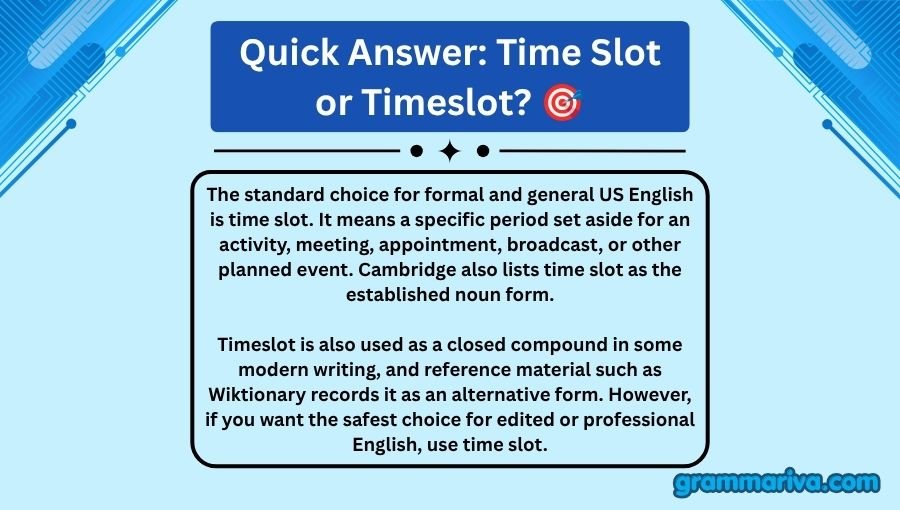
The standard choice for formal and general US English is time slot. It means a specific period set aside for an activity, meeting, appointment, broadcast, or other planned event. Cambridge also lists time slot as the established noun form.
Timeslot is also used as a closed compound in some modern writing, and reference material such as Wiktionary records it as an alternative form. However, if you want the safest choice for edited or professional English, use time slot.
Is Time Slot the Standard Form? 💡
Yes. Time slot is the standard form I recommend in formal, professional, academic, and general writing. It functions as an open compound noun, with time and slot written as two words.
For example:
- ✅ Please choose an available time slot.
- ❌ Please choose an available timeslot.
The meaning is easy to understand either way, but the two-word form is the cleaner choice for most edited writing. Cambridge gives examples such as a show’s “9pm time slot” and describes a time slot as a time when something can happen or is planned to happen.
Why the two words matter
English has many compound nouns that stay open:
- meeting room
- school bus
- coffee shop
- time zone
- time slot
The two parts work together, but they do not always need to become one word.
A simple rule
When you are unsure, write:
time slot
That choice will work in almost every normal sentence.
Time Slot vs Timeslot at a Glance 📊
The main difference is spelling and usage preference rather than meaning. Both forms can refer to a planned period of time, but time slot is the safer standard choice.
| Form | Type | Meaning | Example | Correct/Incorrect |
|---|---|---|---|---|
| time slot | Open compound noun | A planned period of time | I booked a time slot. | ✅ Correct |
| timeslot | Closed compound noun | A scheduled period | I booked a timeslot. | ⚠️ Used, but less standard |
| time-slot | Hyphenated form | A combined form | I booked a time-slot. | ⚠️ Usually avoid as a noun |
| time slots | Plural open compound | Multiple periods | Several time slots are available. | ✅ Correct |
| timeslots | Plural closed compound | Multiple periods | Several timeslots are available. | ⚠️ Less standard |
The key point is not that readers cannot understand timeslot. They usually can. The issue is which spelling gives you the strongest standard-English choice.
Why Do People Confuse Time Slot and Timeslot? 🤔
People confuse these forms because English often turns common word combinations into closed compounds over time. Words such as website and email are now familiar as single words, so writers may naturally assume that time slot should work the same way.
I once edited a short office notice that used timeslot several times. The writer had not made a grammar mistake in meaning. He had simply copied the spelling from a scheduling app. Once we changed it to time slot, the notice looked more polished and consistent.
Digital tools also make the confusion worse. A software field may use a label such as timeslot, while the surrounding instructions use time slot. Seeing both forms can make either one look correct.
Fast typing adds another problem. When people type quickly, they often join words that sound like one unit.
So the confusion comes from:
- familiar compound-word patterns
- software labels
- informal online writing
- fast typing
- autocorrect
- inconsistent editing
What Does Time Slot Mean in English? 📝
A time slot is a specific period set aside for an activity or event. It can refer to an appointment, meeting, television program, delivery, class, interview, or another scheduled activity.
Time slot for appointments
A time slot is common when people choose an appointment.
Example:
Please select a 30-minute time slot for your appointment.
Here, time slot identifies the exact period available for the appointment.
Time slot for meetings
Businesses often divide a day into meeting periods.
We have a time slot open at 2:00 PM.
The phrase tells the reader that a particular period is available.
Time slot for television
Television programs can also have scheduled periods.
The new show received a prime-time slot.
The word slot can work alone when the context is already clear.
Meaning summary
| Meaning | Word Type | Example Sentence |
|---|---|---|
| Scheduled period | Noun | I reserved a time slot. |
| Appointment period | Noun | Your time slot begins at 10 AM. |
| Broadcast period | Noun | The program has a late-night time slot. |
| Available period | Noun | I have one time slot open tomorrow. |
How Is Time Slot Used in Everyday Sentences? 🗣️
The phrase is very flexible. You can use it with verbs such as book, choose, reserve, schedule, offer, select, and assign. When comparing time slot or timeslot, standard writing usually favors time slot in everyday sentences.
Here are some natural examples:
- ✅ I booked a time slot for Friday.
- ❌ I booked a timeslot for Friday.
- ✅ Which time slot works best for you?
- ❌ Which timeslot works best for you?
- ✅ The doctor has one time slot available.
- ❌ The doctor has one timeslot available.
- ✅ Please select your preferred time slot.
- ❌ Please select your preferred timeslot.
The second version in each pair is understandable, but the first is the better choice for standard professional writing.
Test Tip 💡
Try replacing time slot with scheduled period.
If the sentence still makes sense, you are probably using the phrase correctly.
For example:
I booked a time slot.
becomes:
I booked a scheduled period.
The replacement sounds less natural, but the basic meaning remains clear.
Case Study: Choosing a Time Slot in a Work Email 📧
Imagine that a manager sends this email:
Hi Sarah,
I would like to schedule a short call about the new project. Please let me know which time slot works best for you on Thursday.
Thanks,
Daniel
This is clear and professional.
Now imagine the email says:
Please let me know which timeslot works best for you.
The meaning is still obvious. The problem is mainly style. In a polished business email, I would choose time slot.
I once caught myself typing the closed form while writing a scheduling email. I had just seen the word in a calendar interface. I stopped, checked the sentence, and changed it to time slot. That small edit made the wording match the rest of the professional message.
The lesson is simple: software spelling does not always equal editorial spelling.
Grammar Rules for Time Slot vs Timeslot 📚
The grammar rule is straightforward. Time slot is an open compound noun used to describe a period assigned to an activity. Cambridge lists time slot as a noun and gives examples involving planned events and broadcast schedules.
Timeslot is found in actual usage as a closed compound. Some references record it as an alternative form rather than treating it as a completely meaningless spelling.
That means it is better to avoid saying that timeslot is never used. It is used. The more useful rule is this:
Use “time slot” as your default form in standard, polished English.
This is especially helpful for:
- professional emails
- academic writing
- published articles
- business documents
- resumes
- customer instructions
- formal websites
Correct vs Incorrect at a Glance
| Sentence | Correct/Incorrect | Why |
|---|---|---|
| Please choose a time slot. | ✅ Correct | Standard open compound |
| Please choose a timeslot. | ⚠️ Less preferred | Closed form is used but less standard |
| We have three time slots available. | ✅ Correct | Standard plural |
| We have three timeslots available. | ⚠️ Less preferred | Closed plural is less formal |
| I booked a time-slot online. | ⚠️ Usually avoid | Hyphen is unnecessary in normal noun use |
The goal is not to make English more complicated. It is to give you a reliable default.
What Are the Common Mistakes With Time Slot? ⚠️
Most mistakes happen because writers are following what they see rather than checking what fits standard edited English.
Common reasons include:
- Fast typing
Writers may join two words without noticing. - Autocorrect
A device may learn a user’s preferred spelling. - Software labels
Apps and databases often remove spaces from labels or field names. - Lack of knowledge
A learner may not know that compound nouns can have open and closed forms. - Copying online text
A writer may assume that a common online spelling must be the formal spelling.
Similar grammar confusions
| Confusion | Correct Form | Common Problem |
|---|---|---|
| its / it’s | its / it’s | Possession vs contraction |
| your / you’re | your / you’re | Possession vs “you are” |
| their / there / they’re | their / there / they’re | Similar sound |
| everyday / every day | depends on meaning | Adjective vs time phrase |
| alot / a lot | a lot | Incorrect closed form |
The same idea applies here. A word combination can look natural when joined even when the open form is the better standard choice.
Specific spelling mistakes
| Wrong Form | What’s Wrong | Correct Form |
|---|---|---|
| time-slot | Unnecessary hyphen in normal noun use | time slot |
| timeslot | Closed form is less standard | time slot |
| timeslots | Closed plural is less standard | time slots |
| time slots | No problem | time slots |
| TimeSlot | Random capitalization | time slot |
Is Timeslot Ever Used? 🔎
Yes. Timeslot does appear in real English. It is especially easy to find in technical systems, digital products, informal writing, and some industry-specific contexts.
A current reference entry records timeslot as a noun meaning a defined time interval in a schedule and also lists time slot and time-slot as alternative forms.
That does not mean you should replace time slot everywhere with timeslot.
Think of the difference as a matter of writing context.
Where you may see timeslot
You might encounter it in:
- software interfaces
- database field names
- internal scheduling tools
- informal messages
- technical documentation
- website labels
- industry-specific systems
For ordinary prose, I would still choose time slot.
Time Slot in Different Writing Contexts ✍️
The best choice depends partly on the type of writing. Time slot works well across all four major contexts below.
| Context | Which Term to Use | Example |
|---|---|---|
| Everyday conversation | time slot | What time slot works for you? |
| Professional writing | time slot | Please confirm your time slot. |
| Creative writing | time slot | Her time slot was almost over. |
| Social media/texting | time slot | Grab a time slot before they fill up! |
In casual texting, people may use timeslot without causing confusion. Still, if your goal is correct, polished English, keeping the words separate is the better habit.
How Should You Write the Plural Form? 🔤
The standard plural is time slots, with a space between the two words. The plural form also makes time slot or timeslot easier to remember because time slots keeps the two words separate.
For example:
- ✅ Several time slots are available.
- ❌ Several timeslots are available.
The noun slot becomes plural, not time.
Compare:
one time slot
two time slots
several time slots
This is a common pattern with open compound nouns.
Singular and plural table
| Singular | Plural | Example |
|---|---|---|
| time slot | time slots | I need two time slots. |
| appointment | appointments | I have two appointments. |
| meeting room | meeting rooms | We need two meeting rooms. |
| time zone | time zones | The team works across time zones. |
This makes the pattern easier to remember.
Can You Use Time Slot in Professional Writing? 💼
Absolutely. In fact, professional writing is one of the strongest places to prefer time slot. In professional communication, time slot or timeslot is an easy choice to simplify: use time slot for clear and polished writing.
Use it in:
- client emails
- interview invitations
- appointment notices
- meeting requests
- customer support messages
- business websites
- reports
- instructions
For example:
Please select a time slot that works with your schedule.
This sentence is short, clear, and professional.
Another example:
Your interview time slot is scheduled for Tuesday at 11:30 AM.
The phrase tells the reader exactly what kind of scheduled period you mean.
Common Phrases With Time Slot 📌
There are many natural phrases built around time slot. These expressions are common in scheduling and planning.
| Phrase | Meaning |
|---|---|
| available time slot | A period that is free |
| preferred time slot | The period someone wants most |
| morning time slot | A scheduled period in the morning |
| evening time slot | A scheduled period in the evening |
| appointment time slot | A period reserved for an appointment |
| prime-time slot | A desirable broadcast period |
Examples:
- Please choose an available time slot.
- My preferred time slot is 3 PM.
- We have a morning time slot open.
- The show received a prime-time slot.
These phrases all sound natural with the two-word form.
What Alternatives Can You Use Instead? 🔄
Sometimes you do not need time slot at all. Another phrase may fit your sentence better.
The best alternative depends on what you mean.
| Alternative | Works When | Does Not Work When |
|---|---|---|
| appointment | You mean a scheduled meeting | You mean an open period |
| period | You need a broad time range | You need a bookable slot |
| window | You mean a range of possible times | You mean one exact appointment |
| schedule | You mean the full plan | You mean one specific period |
| session | You mean a planned activity or meeting | You only mean an available period |
For example:
I have a time slot at 2 PM.
could sometimes become:
I have an appointment at 2 PM.
But the meanings are not always identical. An appointment is the event. A time slot is the period assigned to it.
Why Does Getting Time Slot Right Matter? 🎯
A tiny spelling choice can affect how professional your writing feels. Readers may not stop to think about the compound itself, but consistent standard usage creates a smoother reading experience.
This matters in:
- workplace communication
- published content
- customer instructions
- academic writing
- digital communication
I like to use a simple editing rule:
Clear writing should make the reader think about the message, not the spelling.
Why accuracy matters
| Situation | Why Getting It Right Matters |
|---|---|
| Resume | Shows careful writing |
| Client email | Creates a professional impression |
| Published content | Supports editorial consistency |
| Social post | Makes the message clean and easy to read |
If you are writing for an audience, choosing the standard form removes an unnecessary distraction.
Is Time-Slot Ever Correct? ⚠️
The hyphenated form deserves a little care. Time-slot may appear when writers treat the phrase as a compound modifier in a particular sentence, but you normally do not need the hyphen when the phrase is simply a noun.
Compare:
I booked a time slot.
Here, no hyphen is needed.
A specialized modifier may sometimes be written differently depending on the style guide and sentence structure. But for everyday writing, do not create a hyphen just because two words work together.
The easiest rule is:
When you mean a scheduled period by itself, use “time slot.”
How To Remember the Difference 🧠
Use the two-word rule.
Think:
A slot of time = a time slot.
You can also connect it with other open compounds:
- time zone
- time limit
- time period
- time frame
- time slot
When you see these phrases together, keeping the words separate feels more natural.
My favorite memory trick
Imagine a calendar with separate boxes.
TIME | SLOT
The two words work together, but they still have their own spaces.
That mental picture makes the spelling easy to remember.
Quick Recap Checklist ✅
Use this checklist whenever you are unsure about the spelling.
| Question | If Yes → Use |
|---|---|
| Are you writing a professional email? | time slot |
| Are you writing an article or school paper? | time slot |
| Are you describing an appointment period? | time slot |
| Are you writing polished website copy? | time slot |
Are you working with a software field called timeslot? | Follow the system’s label |
| Are you unsure which form to choose? | time slot |
Practice examples
- Please select a time slot for your interview. ✅
- We have three time slots available tomorrow. ✅
- Which time slot would you prefer? ✅
If you remember only one thing, remember this:
When in doubt, choose “time slot.”
FAQs About Time Slot vs Timeslot ❓
Is time slot one word or two words?
Time slot is normally written as two words in standard English. It is an open compound noun that describes a planned or available period of time. Cambridge lists time slot as the noun form.
Is timeslot grammatically correct?
Timeslot is used in real English, and some references record it as an alternative form. However, it is less safe for formal writing. For professional and polished English, time slot is the better default.
Should I write time slot or timeslot in an email?
Use time slot in a professional email. For example: “Please confirm your preferred time slot.” It is clear, standard, and easy for the reader to understand.
What is the plural of time slot?
The standard plural is time slots. Only slot becomes plural.
one time slot
two time slots
Is time-slot correct?
You may encounter time-slot, but it is usually unnecessary when the phrase is functioning as an ordinary noun. In most sentences, write time slot.
Can I use timeslot in casual texting?
You can, and many readers will understand it. However, if you want to build a strong standard-English habit, keep using time slot even in casual writing.
What does time slot mean?
A time slot is a specific period reserved or planned for an activity. It can refer to an appointment, meeting, broadcast, class, delivery, interview, or another scheduled event.
Is time slot used in American English?
Yes. Time slot is used naturally in American English for scheduled periods. US dictionary and usage examples also show the phrase in contexts such as television schedules and appointments.
Can time slot and appointment mean the same thing?
Not exactly. A time slot is a period assigned to something. An appointment is the scheduled event itself. You can have an appointment at a particular time slot.
What is the easiest way to remember time slot?
Remember the phrase “a slot of time.” Since time describes the kind of slot, write the phrase as time slot. This simple connection can help you avoid joining the words.
Conclusion: Time Slot or Timeslot? 🌟
When choosing between time slot or timeslot, I recommend using time slot as your standard form. It is clear, familiar, and well established in professional and general English. Cambridge defines time slot as a planned or available time and uses the two-word spelling in its examples.
Timeslot is not meaningless or impossible to encounter. It appears as a closed compound in some real-world usage and is recorded as an alternative form by some references. Still, that does not make it the best choice for every audience.
For emails, articles, school assignments, business documents, and polished website content, keep it simple: time slot.
Once you learn this small rule, you will never need to pause over the spelling again. 🕒✨
Clear words create clear communication, and sometimes the best choice is simply to leave two good words in their proper places.

Hi, I’m Lucas Bennett. I’m a grammar content specialist at Grammariva. I work on articles covering everyday grammar questions, sentence usage, and writing tips that readers can apply with confidence.


[…] and quick memory tips. By the end, you will know exactly when to use sweep, swept, and sweeping. Time Slot or Timeslot | At the House or In the House | By Which or In […]