Have you ever typed too vs to and stopped because you were not sure which word belonged in the sentence? You are not alone. These two tiny words look simple, but they can cause big mistakes. I have seen this mix-up in school assignments, emails, social posts, and even polished business writing. The good news is that the rule is much easier than it first seems. 😊
The words too and to have different jobs. To is often used before a verb or to show direction. Too usually means “also” or “more than needed.” Once you learn those basic jobs, choosing the right word becomes much faster.
In this guide, I will explain too vs to with simple rules, clear examples, useful tests, common mistakes, tables, and real-life situations. You will also learn how to avoid the error when writing quickly. By the end, you should be able to choose the correct word with confidence. ✨ Momma or Mama | Acception vs Exception | Affirm vs Confirm
Quick Answer: Too vs To 🎯
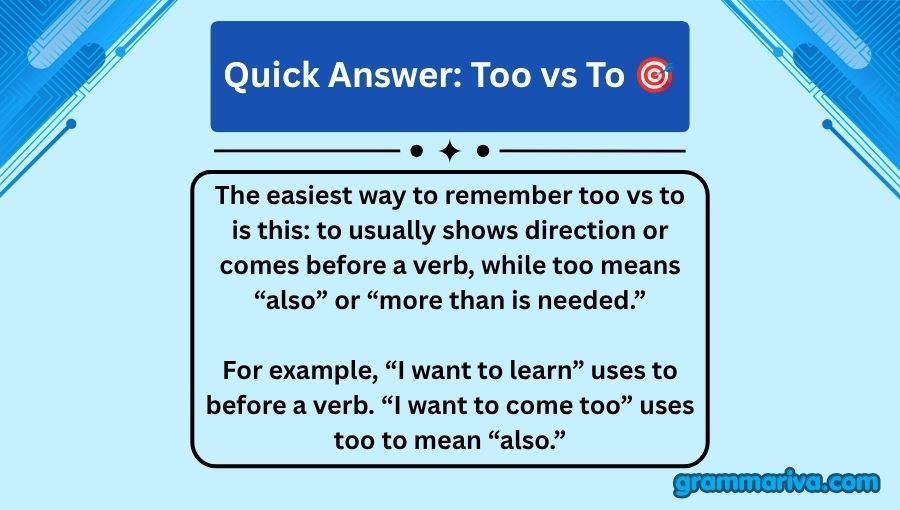
The easiest way to remember too vs to is this: to usually shows direction or comes before a verb, while too means “also” or “more than is needed.”
For example, “I want to learn” uses to before a verb. “I want to come too” uses too to mean “also.”
| Word | Main Job | Simple Meaning | Example |
|---|---|---|---|
| to | Preposition or infinitive marker | Direction, connection, or verb marker | I went to school. |
| too | Adverb | Also or excessively | I am too tired. |
| to | Before a base verb | Shows an infinitive | She wants to read. |
| too | Adds agreement | Also | I like it too. |
Is Too the Same as To? 🤔
No. Too and to are different words with different meanings and grammar jobs. They may sound alike in many sentences, but their meanings are not interchangeable.
Understanding too vs to is easier when you focus on the meaning of each word instead of how it sounds.
Think of them as two people who sound similar but have different jobs. To often helps connect a noun, place, or verb. Too adds the idea of “also” or “more than necessary.”
| Word | Can Mean | Example | What It Shows |
|---|---|---|---|
| to | Direction | We drove to town. | Movement |
| to | Verb marker | I need to study. | Action |
| too | Also | She came too. | Addition |
| too | Excessively | It is too hot. | More than needed |
The Basic Difference
Use to when you are talking about a destination, connection, or action.
- I walked to the store.
- He wants to sleep.
- Give the book to Mia.
Use too when you mean “also” or “more than needed.”
- I want dessert too.
- The box is too heavy.
- She is coming too.
A Simple Substitution Test 💡
When you are unsure, try replacing too with also.
If the sentence still makes sense, too is probably correct.
I want to go too.
I want to go also. ✅
But:
I want to go.
I want also go. ❌
That quick test can save you from many mistakes.
Too vs To at a Glance 📊
The clearest way to understand the difference is to compare their most common uses side by side.
| Form | Type | Meaning | Example | Correct/Incorrect |
|---|---|---|---|---|
| to | Preposition | Direction | She went to work. | ✅ Correct |
| to | Infinitive marker | Links to a verb | I want to help. | ✅ Correct |
| too | Adverb | Also | I want coffee too. | ✅ Correct |
| too | Adverb | Excessively | The coffee is too hot. | ✅ Correct |
| too | Adverb | Also | I went to. | ❌ Incorrect |
The key is meaning. Do not choose the word only because it sounds right.
How Is To Used Correctly? 📝
To has several common uses. Two of the most useful are showing direction and introducing an infinitive verb.
In too vs to, remember that too has its own meaning and cannot replace to before a verb.
To Shows Direction
Use to when someone or something moves toward a place or person.
Examples:
- We went to the park. ✅
- She walked to the door. ✅
- Send this letter to my office. ✅
- He drove to the airport. ✅
The word connects the action with a destination or receiver.
To Comes Before a Verb
Use to before the base form of a verb in many infinitive phrases.
Examples:
- I want to learn. ✅
- She needs to rest. ✅
- They plan to travel. ✅
- We decided to stay. ✅
A useful pattern is:
to + base verb
For example:
to read
to write
to play
to work
to study
A Small Meaning Table
| Meaning | Word Type | Example Sentence |
|---|---|---|
| Direction | Preposition | We went to school. |
| Receiver | Preposition | Give it to him. |
| Infinitive | Verb marker | I want to eat. |
| Purpose | Infinitive phrase | She came to help. |
Test Tip 💡
If the word comes directly before a base verb such as eat, study, work, learn, read, or go, check whether to is needed.
For example:
I want to learn English. ✅
Here, to introduces the verb learn.
How Is Too Used Correctly? ➕
Too has two main everyday meanings. It can mean also, or it can mean more than is wanted, needed, or suitable.
Too Means Also
When too means “also,” it adds another person or thing.
Examples:
- I like pizza too. ✅
- She wants to come too. ✅
- He is a teacher too. ✅
- We watched the movie too. ✅
In casual writing, too often appears at the end of the sentence.
Too Means More Than Needed
Here, too shows excess.
Examples:
- The bag is too heavy. ✅
- This coffee is too hot. ✅
- He talks too loudly. ✅
- The test was too difficult. ✅
Notice the meaning. The speaker is saying that something has gone beyond a useful or comfortable level.
Meaning Summary
| Meaning | Word Type | Example Sentence |
|---|---|---|
| Also | Adverb | I want one too. |
| More than needed | Adverb | The room is too cold. |
| Excessively | Adverb | She ran too quickly. |
| More than suitable | Adverb | It is too expensive. |
Why Do People Confuse Too and To? 🧠
People often confuse these words because they usually sound alike in normal speech. When we hear a sentence, context helps us understand the meaning. When we write the sentence, however, we must choose the correct spelling.
I once reviewed a short email that said, “I am happy to join you to.” The writer meant “also,” so the final word needed to be too. The sentence sounded fine when spoken, but the written version looked wrong.
Fast writing also makes the problem worse. When you type quickly, your brain may focus on the sound rather than the grammar.
| Cause | Why It Creates Errors | Example |
|---|---|---|
| Similar sound | Both words often sound alike | “I want to/too go.” |
| Fast typing | Fingers follow habit | “Me to.” |
| Autocorrect | Software may choose the wrong form | “I agree to.” |
| Limited grammar knowledge | The meanings may not be clear | “It is to hot.” |
| Lack of proofreading | Errors remain unnoticed | “I like it to.” |
The fix is simple: pause and ask what the word means.
What Are the Main Grammar Rules for Too and To?
Understanding too vs to starts with knowing what job each word performs in a sentence. The main grammar rule is based on function. To commonly works as a preposition or as a marker before an infinitive verb. Too works as an adverb.
When to is a preposition, it can show movement, direction, connection, or a receiver.
Examples include:
- We went to the store.
- Give the message to Sarah.
- He traveled to Chicago.
When to introduces an infinitive, it comes before a base verb.
Examples include:
- I hope to win.
- They want to leave.
- She needs to study.
Too does a different job. It modifies meaning by adding “also” or “more than needed.”
Examples include:
- I want to go too.
- This shirt is too small.
- She talks too fast.
The grammar is easier when you focus on the role of the word rather than its sound.
Correct vs Incorrect at a Glance
| Sentence | Correct/Incorrect | Why |
|---|---|---|
| I want to learn. | ✅ Correct | To comes before a base verb. |
| I want too learn. | ❌ Incorrect | Too cannot introduce this verb. |
| I like it too. | ✅ Correct | Too means “also.” |
| I like it to. | ❌ Incorrect | To does not mean “also.” |
| It is too cold. | ✅ Correct | Too means excessively. |
A Real-Life Case Study: Email and Conversation 📧
Imagine a manager sends this message:
“Please remember to send the report to the client. I will review it too.”
All three uses are correct.
The first to comes before the verb send. The second to identifies the receiver of the report. The final too means “also.”
Now imagine the message was written as:
“Please remember too send the report to the client. I will review it to.”
Both uses of too and to at the wrong points change the grammar.
I once caught a similar error while checking a work note. The writer had typed “too” before a verb several times. The meaning was clear, but the writing looked careless. A quick review fixed every one.
| Sentence Part | Correct Word | Reason |
|---|---|---|
| remember ___ send | to | Comes before a verb |
| send it ___ the client | to | Shows receiver |
| I will review it ___ | too | Means also |
| ___ difficult | too | Means excessively |
Common Mistakes With Too and To ⚠️
The too vs to mistake is common because both words can sound the same in everyday speech. These errors happen because the words sound alike. They also happen when people type quickly or depend too much on autocorrect.
Common grammar pairs have the same problem. For example, your and you’re sound similar but have different jobs. Its and it’s are also commonly mixed up.
| Confusing Pair | Correct Difference | Example |
|---|---|---|
| to / too | Direction or verb marker / also or excessively | I want to go too. |
| your / you’re | Possession / you are | Your bag is here. |
| its / it’s | Possession / it is | It’s cold. |
| there / their / they’re | Place / possession / they are | They’re over there. |
| then / than | Time/order / comparison | First this, then that. |
Specific Wrong Uses
| Wrong Form | What’s Wrong | Correct Form |
|---|---|---|
| I want too go. | Wrong word before the verb | I want to go. |
| It is to hot. | “More than needed” requires too | It is too hot. |
| Me to. | The meaning is “also” | Me too. |
| She came to. | If the meaning is “also,” use too | She came too. |
| I went too school. | The destination needs to | I went to school. |
| He is to tired. | Excessive degree needs too | He is too tired. |
Three Quick Reasons These Errors Survive
Fast typing: Your brain may know the answer, but your fingers choose the familiar spelling.
Autocorrect: Spell-check tools do not always understand your intended meaning.
Lack of knowledge: If you only know that both words sound alike, the choice can feel random.
Word Origin and History of Too and To 📚
The two words have long histories in English, but you do not need detailed language history to use them correctly today. Their modern roles are what matter most for everyday writing.
Over time, spelling became more fixed in written English. The separate forms to and too help readers understand different meanings even though their pronunciation can be similar.
| Period | Form | General Note |
|---|---|---|
| Early English | Related early forms | Different forms developed for different grammar roles. |
| Middle English | Forms became more varied | Spelling was not yet fully standardized. |
| Later English | to / too | The two written forms became clearer. |
| Modern English | to / too | Their modern grammar roles are well established. |
The practical lesson is simple: modern spelling gives readers a useful visual clue. Use that clue.
How Do Too and To Work in Different Contexts? 🌎
Knowing too vs to helps you write clearly in both casual and professional settings. The same grammar rules apply in everyday speech, professional writing, creative writing, and digital communication. The difference is how carefully you should proofread.
Everyday Conversation
In casual conversation, you may hear the two words pronounced almost the same. Context usually makes the meaning clear.
“I want to go too.” ✅
Professional Writing
Work emails need extra care because small grammar errors can affect how polished your message looks.
“I would like to confirm the meeting.” ✅
Creative Writing
Writers may use either word many times because both are common. Meaning still controls the choice.
“The night was too quiet.” ✅
Social Media and Texting
Casual posts often contain shortened grammar, but too and to still have separate meanings.
“I need to sleep too.” ✅
| Context | Which Term to Use | Example |
|---|---|---|
| Everyday conversation | to or too, based on meaning | I want to go too. |
| Professional writing | Correct form based on grammar | I need to reply. |
| Creative writing | Correct form based on meaning | The room was too dark. |
| Social media/texting | Correct form, even in casual writing | Me too! |
Common Phrases With Too and To 💬
Both words appear in many common expressions. Learning these phrases can help you recognize the correct spelling faster.
| Phrase | Meaning |
|---|---|
| too much | More than needed |
| too many | More items or people than needed |
| too late | Later than the useful or expected time |
| too soon | Earlier than expected or suitable |
| to begin | Starting an action |
| to be honest | Used before a statement |
| to the point | Direct and focused |
| to some extent | Partly or to a certain degree |
Examples:
- There is too much noise.
- We have too many choices.
- It is too late to call.
- I need to begin now.
- To be honest, I disagree.
Can You Replace Too or To With Another Word? 🔄
Sometimes you can replace too, but to is harder to replace because it often performs a grammar job rather than simply adding meaning. When checking too vs to, replacement tests can help you confirm which word fits the sentence.
For example, when too means “also,” you can often use also.
I want to come too.
I also want to come.
When too means “excessively,” alternatives such as overly may work in some formal sentences.
But you cannot freely replace to before a verb.
I want to leave. ✅
I want also leave. ❌
| Alternative | Works When | Does Not Work When |
|---|---|---|
| also | Too means “also” | To introduces a verb |
| as well | Too means “also” | You need direction |
| overly | Too means excessively | Too means “also” |
| excessively | Showing an excessive degree | To is a verb marker |
| toward | Some direction meanings | To comes before a verb |
Why Does Getting Too and To Right Matter? ✅
Small words carry important grammar signals. A reader may understand your meaning even when you choose the wrong one, but the mistake can still make your writing look rushed.
Learning too vs to can make your emails, schoolwork, and online writing much clearer.
I personally notice these errors most in short messages because people tend to proofread long documents but skip tiny texts. That is exactly where a two-second check can help.
A useful writing rule is:
Clear writing makes the reader work less.
| Situation | Why Getting It Right Matters |
|---|---|
| Resume | Shows attention to detail |
| Client email | Creates a professional impression |
| Published content | Improves trust and readability |
| Social post | Keeps the message polished |
The goal is not to sound perfect for the sake of perfection. The goal is to make your meaning easy to understand.
How Can You Remember the Difference? 🧠
Use three simple memory tricks.
Trick 1: Too Has an Extra O
Think of the extra o in too as “extra.”
too = extra
- too hot = extra hot
- too expensive = extra expensive
It can also mean “also,” which adds something extra.
Trick 2: Too Can Mean Also
Try replacing too with also.
I want it too.
I want it also.
The first sentence sounds more natural, but the meaning test works.
Trick 3: To Goes With Actions
When to comes before a base verb, remember:
to + action
- to read
- to write
- to study
- to work
- to sleep
These three tricks cover a large share of everyday mistakes.
Can Too Come Before an Adjective or Adverb? 📌
Yes. Too commonly comes before adjectives and adverbs when it means “more than is suitable or needed.”
Examples:
- The water is too cold. ✅
- The box is too large. ✅
- She speaks too quickly. ✅
- He arrived too late. ✅
Here, too changes the degree of the adjective or adverb.
Compare:
The soup is hot.
The soup is too hot.
The second sentence says the heat has gone beyond the desired level.
| Pattern | Example | Meaning |
|---|---|---|
| too + adjective | too cold | More cold than wanted |
| too + adjective | too expensive | More expensive than suitable |
| too + adverb | too quickly | Faster than suitable |
| too + adverb | too slowly | Slower than suitable |
Can To Come Before a Noun? 📝
Yes. To can work as a preposition before a noun or noun phrase.
Examples:
- We went to school. ✅
- Give it to me. ✅
- She spoke to her teacher. ✅
- They traveled to Canada. ✅
In these sentences, to helps show a relationship such as direction, movement, or a receiver.
This is different from to before a verb.
I went to school.
I want to study.
The first uses to before a noun phrase. The second uses to before a base verb.
What Are the Most Useful Practice Examples? ✍️
Practice is one of the fastest ways to make the difference automatic. Read each pair and ask what the word means.
Practice Pair 1
I want to eat. ✅
I want too eat. ❌
Why: The word comes before the verb eat, so use to.
Practice Pair 2
I want pizza too. ✅
I want pizza to. ❌
Why: The final word means “also,” so use too.
Practice Pair 3
The coffee is too hot. ✅
The coffee is to hot. ❌
Why: The coffee is hotter than wanted, so use too.
Practice Pair 4
She went to work. ✅
She went too work. ❌
Why: To shows the destination.
| Question | If Yes → Use |
|---|---|
| Does it mean “also”? | too |
| Does it mean “more than needed”? | too |
| Does it show direction? | to |
| Does it come before a base verb? | to |
| Does it identify a receiver? | to |
FAQs About To vs Too
What is the main difference between too and to?
To commonly shows direction, a receiver, or an infinitive verb. Too usually means “also” or “more than needed.” Their sounds can be similar, but their grammar roles are different.
Is it “me too” or “me to”?
The correct expression is “me too.” Here, too means “also.”
“I love this song.”
“Me too!” ✅
Is it “I want to go” or “I want too go”?
The correct sentence is “I want to go.” To comes before the base verb go.
Is it “too much” or “to much”?
The correct phrase is “too much.” It means more than needed.
There is too much sugar in this tea. ✅
Is it “too many” or “to many”?
Use “too many.” It means a number greater than what is wanted or suitable.
There are too many people here. ✅
Can too mean also?
Yes. Too can mean “also.”
I am going too.
This means that the speaker is going also.
Can too mean very?
Sometimes too expresses a high degree, but it usually carries the idea that the degree is excessive or beyond what is wanted.
The bag is too heavy.
This does not simply mean “very heavy.” It means the weight is a problem.
Why do too and to sound the same?
In many forms of everyday English, they have the same or nearly the same pronunciation. Their spelling helps show their different meanings and grammar roles in writing.
How can I remember too vs to?
Remember that too has an extra o. Think of the extra o as “extra.” If something is extra or means “also,” too is often the right choice. Use to for direction and before many verbs.
Which word should I use in “I like it too”?
Use too because the meaning is “I also like it.”
Quick Recap Checklist ✅
The whole rule can be reduced to a few questions.
| Question | If Yes → Use |
|---|---|
| Does the word mean “also”? | too |
| Does it mean “more than needed”? | too |
| Does it show movement or direction? | to |
| Does it come before a base verb? | to |
| Does it show a receiver? | to |
Try these three on your own:
- I need ___ finish my homework.
- I want to come ___.
- This bag is ___ heavy.
Answers:
- to
- too
- too
If you can explain why each answer works, you have understood the core rule.
Conclusion 🌟
Too vs to becomes much easier when you focus on meaning instead of sound. Use to for direction, receivers, and many infinitive verbs. Use too when you mean “also” or “more than needed.” That simple split handles most everyday cases. 😊
When I teach this difference, I encourage learners to use the meaning test first. Ask yourself whether the word means “also” or “excessively.” If it does, too is likely correct. If the word shows direction or comes before a base verb, check to.
Do not worry if you still make the mistake while typing quickly. These words are easy to mix up because they sound alike. A quick review before sending an important email or publishing an article can catch the error.
Keep this memory trick in mind: too has an extra O, and “extra” can mean also or more than needed. Once that idea becomes automatic, choosing between these two small words gets much faster.
Master the meaning, and the spelling will follow. ✨

Hi, I’m Lucas Bennett. I’m a grammar content specialist at Grammariva. I work on articles covering everyday grammar questions, sentence usage, and writing tips that readers can apply with confidence.


[…] rule, show real examples, compare similar expressions, and give you simple ways to remember it. ✨ Too vs To | Momma or Mama | Acception vs […]
[…] examples so you can choose the right word with confidence. Looking Forward to Seeing You | Too vs To | Momma or […]