Have you ever written a sentence like “I have flew there before” and then wondered whether flew or flown is correct? You are not alone. These two forms come from the same verb, but they do not work in the same places.
The main difference is simple: flew is the past tense of fly, while flown is the past participle and usually needs a helping verb such as have, has, had, or be. ✈️
I see this mix-up often in everyday writing. People know that fly changes form in the past, but they may not remember which form belongs after have or had. Once you understand the pattern, the choice becomes much easier.
In this guide, I’ll show you exactly when to use each word, explain the grammar rule in plain English, and give you plenty of examples. By the end, choosing between flew or flown should feel automatic. Boy-Friend vs Boyfriend | Herself vs Herselves vs Her-Self | Flesh Out or Flush Out
🎯 Quick Answer: Flew or Flown
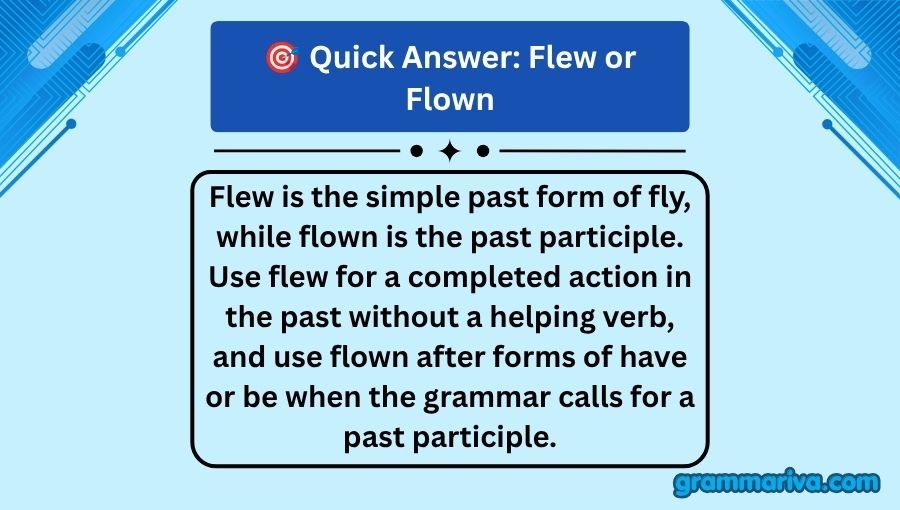
Flew is the simple past form of fly, while flown is the past participle. Use flew for a completed action in the past without a helping verb, and use flown after forms of have or be when the grammar calls for a past participle.
- ✅ I flew to Chicago last week.
- ✅ I have flown to Chicago several times.
- ❌ I have flew to Chicago several times.
- ❌ I flown to Chicago last week.
A quick rule is:
Fly → flew → flown
Think of them as three forms of the same verb:
Present: fly
Past: flew
Past participle: flown
🔎 Related Word Forms
The verb fly has several forms that are useful to know. Understanding the complete pattern makes flew or flown much easier to remember.
| Form | Type | Example |
|---|---|---|
| fly | Base form | I fly every month. |
| flies | Present tense, third person singular | She flies to Boston. |
| flew | Simple past | She flew to Boston yesterday. |
| flown | Past participle | She has flown to Boston. |
| flying | Present participle/gerund | She is flying to Boston. |
The key point is that flew and flown are not interchangeable.
You can say:
- ✅ He flew home yesterday.
- ✅ He has flown home already.
But you cannot switch the two forms:
- ❌ He flown home yesterday.
- ❌ He has flew home already.
✈️ Understanding Flew or Flown at a Glance
The basic difference between flew or flown depends on the tense and the helping verb in the sentence. Flew is simple past. Flown is a past participle.
| Form | Type | Meaning | Example | Correct/Incorrect |
|---|---|---|---|---|
| fly | Base verb | Present action | I fly often. | ✅ Correct |
| flew | Simple past | Action completed in the past | I flew yesterday. | ✅ Correct |
| flown | Past participle | Used with a helping verb | I have flown before. | ✅ Correct |
| flew | After have | Incorrect past form | I have flew before. | ❌ Incorrect |
| flown | Alone as simple past | Incorrect in standard English | I flown yesterday. | ❌ Incorrect |
The simplest rule
If you are talking about a completed action at a specific time in the past, flew is usually the right choice.
- ✅ We flew to Denver last Friday.
If you use have, has, or had, you normally need flown.
- ✅ We have flown to Denver before.
- ✅ We had flown there twice before moving.
This pattern works because English uses different verb forms for different grammatical jobs.
🕐 When Should You Use Flew?
Flew is the simple past form of fly. Use it when the action happened in the past and the sentence does not need a present-perfect or past-perfect structure.
1. Flew for a completed past action
Use flew when an action happened and ended in the past.
- ✅ I flew to New York last month.
- ✅ She flew home on Monday.
- ✅ We flew across the country yesterday.
The word flew tells us that the flying happened in the past.
2. Flew with a specific past time
A specific past-time expression often points toward the simple past.
Common examples include:
- yesterday
- last night
- last week
- last year
- two days ago
- in 2024
- on Monday
- when I was younger
Examples:
- ✅ I flew to Miami last summer.
- ✅ They flew home two days ago.
- ✅ She flew to Seattle on Tuesday.
3. Flew in storytelling
Flew is also common when telling a story about something that happened in the past.
- ✅ We flew over the mountains and landed after sunset.
- ✅ The pilot flew through the clouds.
- ✅ The bird flew out of the window.
In each case, flew describes an action that took place in the past.
🛫 When Should You Use Flown?
Flown is the past participle of fly. It usually appears with a helping verb.
Common helping verbs include:
- have
- has
- had
- be
- been
1. Flown with have
Use flown after have.
- ✅ I have flown on that airline before.
- ✅ We have flown to California several times.
- ✅ They have flown together before.
Do not use flew after have in standard English.
- ❌ I have flew on that airline before.
2. Flown with has
Use flown after has.
- ✅ She has flown to London.
- ✅ He has flown more than ten times this year.
Again, flew does not belong in this structure.
- ❌ She has flew to London.
3. Flown with had
Use flown after had when forming the past perfect.
- ✅ We had flown home before the storm arrived.
- ✅ She had flown to Dallas before she changed jobs.
The pattern is:
had + flown
Not:
had + flew
📚 What Is the Difference Between Flew and Flown?
The main difference is grammatical.
Flew is a simple past verb. Flown is a past participle. A past participle normally needs a helping verb when it is used as part of a perfect tense.
| Word | Grammar Role | Typical Pattern | Example |
|---|---|---|---|
| flew | Simple past | Subject + flew | I flew home. |
| flown | Past participle | Subject + have/has/had + flown | I have flown home. |
| flown | Past participle | be + flown | The route was flown by a trained pilot. |
| flying | Present participle | be + flying | I am flying home. |
A useful way to remember this is:
Yesterday → flew
Have/has/had → flown
That is not a rule for every possible sentence involving fly, but it is an excellent everyday guide.
🧠 Why Do People Confuse Flew and Flown?
People confuse flew or flown because both forms describe past flying. The difference is not mainly about meaning. It is about grammar.
A learner may think:
“The action happened in the past, so I should use flew.”
That works in a simple past sentence:
- ✅ I flew yesterday.
But it does not work after have:
- ❌ I have flew yesterday.
The helping verb changes the structure.
I once reviewed a short travel story where a writer used flew after had several times. The writer clearly understood the meaning of the sentences. The problem was simply the verb form. Once I changed had flew to had flown, the sentences became standard English immediately.
A quick mental check
When you see a sentence containing flew or flown, look at the words before it.
If you see:
have + ___
use flown.
If you see:
has + ___
use flown.
If you see:
had + ___
use flown.
If you simply need the past-tense action, use flew.
💡 Test Tip: How Can You Choose the Right Form?
Try replacing the sentence with another irregular verb such as go.
Consider:
- I went there yesterday.
- I have gone there before.
You would not say:
- ❌ I have went there before.
The same pattern applies to fly:
- I flew there yesterday.
- I have flown there before.
This substitution test can help you recognize the grammar pattern.
| Test Sentence | Correct Form | Reason |
|---|---|---|
| I ___ yesterday. | flew | Simple past |
| I have ___ before. | flown | Past participle |
| She has ___ twice. | flown | Past participle |
| We had ___ earlier. | flown | Past perfect |
| They ___ last night. | flew | Simple past |
📝 Case Study: Flew or Flown in Real Life
Imagine that Maya is writing an email to her manager about a business trip.
She writes:
“I have flew to Denver twice this year.”
The meaning is clear, but the grammar is wrong.
The corrected version is:
“I have flown to Denver twice this year.”
Why?
Because have requires the past participle flown, not the simple past flew.
Now imagine she writes:
“I flew to Denver last Tuesday.”
That sentence is correct because flew is the simple past.
| Original Situation | Incorrect | Correct |
|---|---|---|
| Recent experience | I have flew there. | I have flown there. |
| Specific past trip | I flew there Tuesday. | I flew there Tuesday. |
| Earlier past event | I had flew there. | I had flown there. |
| Present activity | I am flew there. | I am flying there. |
The lesson is simple: do not choose the form only because the action happened in the past. Look at the complete verb structure.
📖 Grammar Rules Explanation
The reason flew and flown cannot normally replace each other is that they have different grammatical roles.
Flew is the simple past form. It can stand as the main verb in a simple past sentence.
- I flew home.
Flown is the past participle. It is commonly used with have, has, or had.
- I have flown home.
- She has flown home.
- They had flown home.
The pattern is part of the larger system of irregular English verbs.
Compare:
- go → went → gone
- see → saw → seen
- write → wrote → written
- fly → flew → flown
A standard grammar reference or dictionary will distinguish the simple past from the past participle. You do not need to memorize complicated terminology, though. The practical pattern is enough for most writing.
Correct vs Incorrect at a Glance
| Sentence | Correct/Incorrect | Why |
|---|---|---|
| I flew to Boston yesterday. | ✅ Correct | Flew is simple past. |
| I have flown to Boston before. | ✅ Correct | Flown follows have. |
| She had flown home before noon. | ✅ Correct | Flown follows had. |
| I have flew to Boston before. | ❌ Incorrect | Have needs the past participle. |
| She flown home yesterday. | ❌ Incorrect | Flown cannot normally stand alone as simple past. |
⚠️ Common Mistakes With Flew and Flown
The most common mistake is putting flew after have, has, or had.
Mistake 1: Have flew
- ❌ I have flew to Texas.
- ✅ I have flown to Texas.
Mistake 2: Had flew
- ❌ We had flew before sunrise.
- ✅ We had flown before sunrise.
Mistake 3: Flown without a helping verb
- ❌ I flown to California last year.
- ✅ I flew to California last year.
Mistakes like these often happen because people type quickly. Autocorrect can also make things worse, especially when a writer is moving between informal messages and formal writing.
I once caught myself typing have flew in a quick message while answering several emails. I knew the rule, but my fingers followed the sound instead of the grammar. That was a useful reminder: even experienced writers should pause when two irregular forms look similar.
Similar Grammar Confusions
| Confusion | Correct Pair | Main Difference |
|---|---|---|
| flew/flown | flew/flown | Past vs past participle |
| went/gone | went/gone | Past vs past participle |
| saw/seen | saw/seen | Past vs past participle |
| wrote/written | wrote/written | Past vs past participle |
| ate/eaten | ate/eaten | Past vs past participle |
Specific Wrong Forms
| Wrong Form | What’s Wrong | Correct Form |
|---|---|---|
| have flew | Wrong form after have | have flown |
| has flew | Wrong form after has | has flown |
| had flew | Wrong form after had | had flown |
| I flown yesterday | Missing helping verb | I flew yesterday |
| I have fly | Base form after have | I have flown |
| I had fly | Base form after had | I had flown |
🧩 How the Verb Fly Changes
Knowing all the forms of fly can prevent mistakes.
| Tense/Form | Example |
|---|---|
| Present | I fly every month. |
| Present, third person | She flies every month. |
| Simple past | She flew last month. |
| Present perfect | She has flown this month. |
| Past perfect | She had flown before. |
| Present continuous | She is flying now. |
| Future | She will fly tomorrow. |
| Infinitive | She wants to fly. |
Notice the pattern:
fly → flew → flown
The word flying is different because it is the -ing form.
🗣️ Flew or Flown in Everyday Conversation
In casual conversation, people use both forms often.
| Situation | Which Term to Use | Example |
|---|---|---|
| Talking about yesterday | flew | I flew yesterday. |
| Talking about life experience | flown | I have flown before. |
| Talking about repeated experience | flown | She has flown many times. |
| Telling a past story | flew | We flew over the ocean. |
| Talking about an earlier past event | flown | They had flown there before. |
The same grammar rule applies in speech and writing.
You might hear:
“I flew there last year.”
But you might hear:
“I have flown there three times.”
Both are correct. The tense is different.
💼 Flew or Flown in Professional Writing
Professional writing benefits from precise verb forms. A small grammar error may not change the meaning, but it can make an email, report, resume, or business document look less polished.
| Professional Situation | Correct Example |
|---|---|
| Travel report | I flew to Chicago on Monday. |
| Expense report | I flew to Austin last week. |
| Work history | I have flown internationally for work. |
| Project update | Our team had flown to the site before the meeting. |
| Client email | I have flown into Denver several times. |
When writing professionally, always check the helping verb before choosing flew or flown.
✍️ Flew or Flown in Creative Writing
Creative writing often uses flew because stories frequently describe completed past actions.
- The bird flew across the valley.
- The plane flew into the sunset.
- She flew home before the rain began.
But flown can appear naturally when the story uses perfect tenses.
- He had flown across the country before.
- She has flown through worse storms.
The choice depends on the sentence structure, not on whether the writing is creative.
📱 Flew or Flown in Social Media and Texting
Social media posts are often informal, but standard grammar can still make your message clearer.
| Context | Preferred Form | Example |
|---|---|---|
| Travel memory | flew | Flew to Miami last weekend! |
| Travel experience | flown | I’ve flown there three times. |
| Short story | flew | We flew all night. |
| Casual update | flew | Just flew home. |
| Experience statement | flown | I’ve flown on that airline before. |
In very informal texting, people may leave out words. For example, “Just flew home” is common and natural as a casual fragment. In formal writing, however, use a complete sentence when appropriate.
🔄 Common Phrases With Fly, Flew, and Flown
There are many everyday phrases involving fly. The exact form still depends on grammar.
| Phrase | Meaning |
|---|---|
| fly home | Travel home by air |
| fly away | Leave by air or move quickly away |
| fly over | Travel above something by air |
| fly across the country | Travel through the air across a country |
| fly under the radar | Avoid attracting attention |
| time flies | Time seems to pass quickly |
Remember that fixed expressions do not remove normal grammar rules.
For example:
- ✅ Time flies when you are having fun.
- ✅ We flew over the mountains.
- ✅ We have flown over the mountains.
🧠 How to Remember the Difference
A simple memory trick can make flew or flown much easier.
Think:
Flew = flew yesterday.
Flown = have flown.
The word flew works well with a finished past time.
- yesterday
- last year
- two days ago
- last Monday
The word flown works well after perfect-tense helpers.
- have flown
- has flown
- had flown
Memory Table
| If You See… | Think… | Use |
|---|---|---|
| yesterday | finished past | flew |
| last week | finished past | flew |
| two years ago | finished past | flew |
| have | past participle | flown |
| has | past participle | flown |
| had | past participle | flown |
🔍 Can Flown Ever Appear Without Have, Has, or Had?
Yes, but this is where the grammar becomes a little more advanced. Flown can appear in passive constructions or other structures where a past participle is required.
For example:
- The route was flown by a highly trained crew.
Here, was flown is a passive structure.
Another example is:
- The aircraft had been flown safely.
So the practical rule “have/has/had + flown” is very useful, but it is not the only possible place where flown can occur.
The important point is that flown is a past participle. It cannot simply replace flew whenever you want to talk about something in the past.
🎯 Key Differences Between Flew and Flown
The easiest way to understand flew or flown is to compare their jobs.
| Feature | Flew | Flown |
|---|---|---|
| Verb form | Simple past | Past participle |
| Base verb | Fly | Fly |
| Usually needs helping verb | No | Yes |
| Example | I flew yesterday. | I have flown before. |
| Common helpers | None required | have, has, had, be |
| Main use | Completed past action | Perfect/passive structures |
This distinction solves most usage questions.
❓ Is Flew the Past Tense of Fly?
Yes. Flew is the simple past tense of fly. Use it for a completed action in the past.
- ✅ I flew to Dallas last week.
- ✅ She flew home yesterday.
Do not normally use flown as the simple past.
- ❌ I flown to Dallas last week.
❓ Is Flown the Past Tense of Fly?
No. Flown is the past participle of fly. It is commonly used with have, has, or had, and it can also appear in passive structures.
- ✅ I have flown there before.
- ✅ She had flown home.
For simple past, use flew.
❓ Should I Say “I Flew” or “I Have Flown”?
Both can be correct, but they express different ideas.
Use I flew when talking about a completed past event.
- I flew to Boston last Friday.
Use I have flown when talking about past experience or an action connected to the present.
- I have flown to Boston several times.
The time expression can help you decide.
| Sentence | Best Form | Reason |
|---|---|---|
| I ___ there yesterday. | flew | Specific completed past time |
| I have ___ there before. | flown | Past experience |
| I ___ there last summer. | flew | Specific past time |
| I have ___ there many times. | flown | Repeated experience |
❓ Why Is “I Have Flew” Incorrect?
“I have flew” is incorrect in standard English because have is followed by the past participle, not the simple past form.
The correct structure is:
have + flown
Therefore:
- ❌ I have flew there.
- ✅ I have flown there.
This is the same pattern seen in other irregular verbs:
- have gone, not have went
- have seen, not have saw
- have written, not have wrote
- have eaten, not have ate
❓ Why Is “I Flown” Incorrect?
“I flown” is normally incorrect when you are trying to use the simple past. The sentence needs the simple past form flew.
- ❌ I flown there yesterday.
- ✅ I flew there yesterday.
If you want to use flown, add the correct helping verb:
- ✅ I have flown there before.
📝 Synonyms and Alternatives
Sometimes you can replace flew or flown with another phrase. The replacement depends on the meaning.
| Alternative | Works When | Does Not Work When |
|---|---|---|
| traveled by air | You want to stress air travel | You specifically mean the act of flying |
| traveled | The exact method is unimportant | The flight itself matters |
| went by plane | You want simple everyday wording | You need a short or formal verb |
| took a flight | You want to describe taking a flight | You need to describe the aircraft’s movement |
| traveled by plane | You want clear, neutral wording | The context requires the verb fly |
For example:
- I flew to Denver.
- I traveled by plane to Denver.
Both can work, but they are not always exact replacements.
❤️ Why Getting Flew or Flown Right Matters
Correct verb forms improve clarity and make your writing sound polished.
| Situation | Why Getting It Right Matters |
|---|---|
| Resume | Shows careful grammar and editing |
| Client email | Creates a professional impression |
| Published content | Makes the writing easier to trust |
| Social post | Keeps informal writing clear and natural |
A small verb error rarely destroys communication. Still, repeated errors can distract readers.
I like to think of grammar as a road sign. It should help the reader move through your sentence without stopping to wonder what you meant.
Clear grammar lets your ideas take flight.
That is especially true with irregular verbs. When the form is correct, the reader can focus on the message instead of the mistake.
🧪 Practice: Choose Flew or Flown
Try these sentences before looking at the answers.
- I ___ to Chicago yesterday.
- She has ___ to Chicago three times.
- We ___ home last night.
- They had ___ before the storm arrived.
- Have you ever ___ in a small plane?
Answers
| Question | Answer | Full Sentence |
|---|---|---|
| 1 | flew | I flew to Chicago yesterday. |
| 2 | flown | She has flown to Chicago three times. |
| 3 | flew | We flew home last night. |
| 4 | flown | They had flown before the storm arrived. |
| 5 | flown | Have you ever flown in a small plane? |
🧭 Quick Recap Checklist
Use this checklist whenever you are unsure about flew or flown.
| Question | If Yes → Use |
|---|---|
| Did the action happen at a finished past time? | flew |
| Does the sentence use “have”? | flown |
| Does the sentence use “has”? | flown |
| Does the sentence use “had”? | flown |
| Are you describing a simple past story? | flew |
| Is the word part of a passive construction? | Usually flown |
Three quick practice examples
Example 1
“I ___ to Los Angeles last month.”
Answer: flew
Example 2
“I have ___ to Los Angeles before.”
Answer: flown
Example 3
“She had ___ home before the storm.”
Answer: flown
The core pattern is worth memorizing:
Fly → flew → flown
❓ FAQs About Flew vs Flown
Is flew or flown correct?
Both are correct, but they have different grammatical roles. Flew is the simple past form, while flown is the past participle.
Is “I flew” correct?
Yes. “I flew” is correct when you are describing a completed action in the past.
- ✅ I flew to New York yesterday.
Is “I have flown” correct?
Yes. “I have flown” is correct because flown is the past participle used after have.
- ✅ I have flown to New York before.
Is “I have flew” correct?
No. In standard English, use flown after have.
- ❌ I have flew there.
- ✅ I have flown there.
Should I say “I flew yesterday” or “I flown yesterday”?
Say “I flew yesterday.” A finished past-time expression such as yesterday normally calls for the simple past.
What is the past participle of fly?
The past participle of fly is flown.
The three main forms are:
fly → flew → flown
What is the simple past of fly?
The simple past of fly is flew.
For example:
- She flew home last night.
Can I say “I had flew”?
No. After had, use the past participle flown.
- ❌ I had flew there before.
- ✅ I had flown there before.
Is “flown” always used with have, has, or had?
No. Those are very common patterns, but flown can also appear in passive structures.
- The plane was flown by an experienced pilot.
How can I remember flew vs flown?
Remember this simple pair:
Flew yesterday.
Have flown.
If you see a finished past time, flew is often the right choice. If you see have, has, or had, flown is usually needed.
🚀 Final Takeaway
Flew or flown becomes easy once you remember that the two words have different jobs. Flew is the simple past form of fly, so use it for completed past actions such as “I flew home yesterday.” Flown is the past participle, so use it in structures such as “I have flown home” or “She had flown home.”
The most useful pattern is:
Fly → flew → flown
Think of flew as the form you can use by itself for a simple past action. Think of flown as the form that usually works with a helping verb such as have, has, or had. ✈️
Once you stop treating the two words as interchangeable, the choice becomes much clearer. When you write, look at the words around the verb rather than only thinking about whether the action happened in the past.
Remember: you flew yesterday, but you have flown before. Master that one

Hi, I’m Nathan Reed. I’m a grammar and writing specialist at Grammariva. I work on practical grammar content that helps readers understand sentence structure, punctuation, vocabulary, and better writing habits.


[…] how the words work in sentences, which form fits US English best, and how to avoid common mistakes. Flew or Flown | Boy-Friend vs Boyfriend | Herself vs Herselves vs […]
[…] Let’s look at the difference step by step so you can choose the right word with confidence. Admitted vs Accepted | Flutist or Flautist | Flew or Flown […]