Have you ever written a sentence and stopped to wonder whether you should use presume vs assume? 🤔 These two words are very close in meaning, so even strong English speakers sometimes mix them up. Both words can describe believing something is true without having complete proof. The small difference is in why you believe it.
I use a simple rule when teaching this pair: assume usually means you accept something as true without enough evidence, while presume often suggests that you have some reason, rule, experience, or reasonable basis for your belief. The difference is not always sharp, and the words can overlap in everyday English.
That overlap is what makes this pair confusing. You might assume that a friend is late because of traffic. You might presume that a person is innocent because the facts do not show otherwise. Both sentences can make sense, but the speaker’s level of support is different.
Let’s look at the difference step by step so you can choose the right word with confidence. Admitted vs Accepted | Flutist or Flautist | Flew or Flown
🎯 Quick Answer: Presume vs Assume
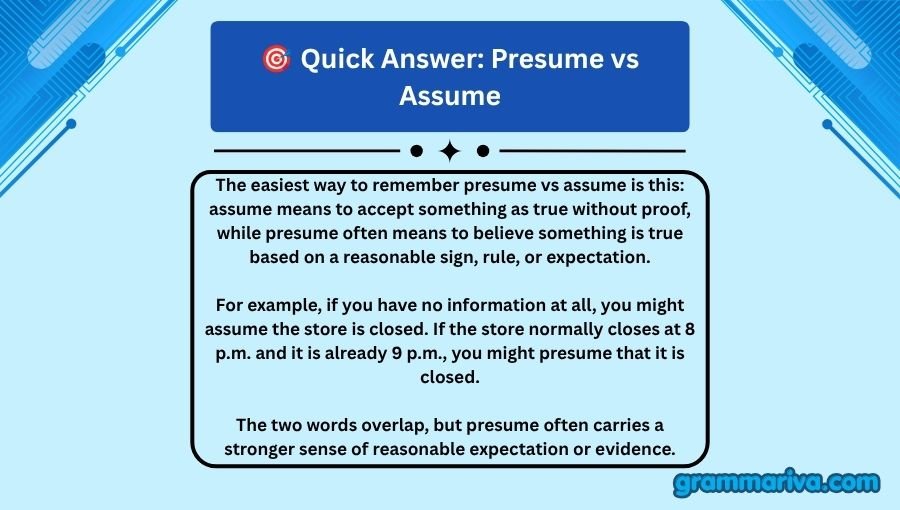
The easiest way to remember presume vs assume is this: assume means to accept something as true without proof, while presume often means to believe something is true based on a reasonable sign, rule, or expectation.
For example, if you have no information at all, you might assume the store is closed. If the store normally closes at 8 p.m. and it is already 9 p.m., you might presume that it is closed.
The two words overlap, but presume often carries a stronger sense of reasonable expectation or evidence.
What Is the Difference Between Presume and Assume?
The core difference between presume and assume is the amount of reason behind the belief. Assume can describe a belief made with little or no evidence, while presume often suggests that the belief is based on some reasonable ground.
| Form | Type | Meaning | Example | Correct/Incorrect |
|---|---|---|---|---|
| assume | Verb | Accept as true without enough proof | I assumed the meeting was canceled. | ✅ Correct |
| presume | Verb | Believe something is likely true based on reason | I presumed the meeting was canceled because nobody arrived. | ✅ Correct |
| assumed | Past-tense verb | Accepted something as true | She assumed I knew. | ✅ Correct |
| presumed | Past-tense verb | Believed something based on reasonable grounds | We presumed he would agree. | ✅ Correct |
| assume when evidence supports a conclusion | Verb | Possible, but often less precise | I assume he is home because his car is outside. | ⚠️ Possible |
| presume when there is no real basis | Verb | Often less natural | I presumed the random number was lucky. | ⚠️ Usually less natural |
The important point is that presume does not always mean “prove.” A presumption can still be wrong.
Is Presume the Same as Assume?
No, presume and assume are not exactly the same, although they are close enough to overlap in many sentences. Both can describe accepting something as true before it has been fully proved.
Think of them as two points on a scale.
Assume can be more casual:
I assumed you were busy.
This means I believed you were busy, perhaps without checking.
Presume can sound more reasoned or formal:
I presumed you were busy because you did not answer my messages.
Here, there is a reason for the belief.
The difference becomes clearer in formal settings. We often use presume when a rule, expectation, or known fact supports the conclusion.
A Simple Mental Test
Ask yourself:
“What made me believe this?”
If the answer is basically “I just thought so,” assume is often the better choice.
If the answer is “There is a reasonable reason to think so,” presume may be better.
This is not an absolute grammar rule. Native speakers often use the two words interchangeably.
Why Do People Confuse Presume and Assume?
People confuse presume vs assume because both words describe a belief that has not been completely confirmed.
I once reviewed a short business email where the writer used presume several times. The writer was trying to sound formal, but some sentences were actually simple guesses. Replacing a few instances with assume made the email sound much more natural.
Another reason is that both words can be followed by a clause:
- I assume that she knows.
- I presume that she knows.
Both are grammatically correct.
The difference is mainly about the speaker’s attitude toward the information.
| Situation | More Natural Choice | Reason |
|---|---|---|
| You have no evidence | assume | It can describe an unsupported belief |
| You have a reasonable basis | presume | It can suggest a logical expectation |
| Casual conversation | assume | It is very common |
| Formal reasoning | presume | It can sound more careful or formal |
| A legal or official context | presume | It often relates to an accepted position until shown otherwise |
| A personal guess | assume | It commonly describes a simple belief |
Presume: Meaning and Correct Use
Presume means to believe something is true or likely to be true based on a reasonable expectation, available information, or an accepted rule. Understanding presume vs assume starts with seeing how presume can suggest a reasonable basis for a belief.
Here are several common uses.
Presume Based on Evidence
You can use presume when you have a reason for your conclusion.
The lights are on, so I presume someone is home. ✅
The lights provide a reason for the belief.
Compare:
I assume someone is home. ✅
This sentence is also correct. It simply does not highlight the evidence as strongly.
Presume Based on Expectations
You can also presume something because it normally happens in a certain situation.
I presume the office will be closed on the holiday. ✅
The belief comes from a normal expectation.
Presume in Formal Language
Presume is especially useful when the tone is formal.
We may presume that the information has been reviewed. ✅
This sounds more formal than:
We can assume that the information has been reviewed. ✅
Both are grammatical, but the first has a more formal tone.
| Meaning | Word Type | Example Sentence |
|---|---|---|
| Believe based on reason | Verb | I presume she is already aware. |
| Expect something | Verb | I presume they will arrive soon. |
| Accept as likely | Verb | We presume the report is accurate. |
| Treat as true until shown otherwise | Verb | The person is presumed innocent. |
Assume: Meaning and Correct Use
Assume means to accept something as true without having complete proof. It is extremely common in everyday English. In presume vs assume, assume is often the more natural choice when you are simply accepting something as true without checking.
For example:
I assumed you had already eaten. ✅
You believed it, but you did not necessarily check.
Assume Without Checking
This is one of the most common uses.
I assumed the store was open. ✅
You did not confirm the hours.
Assume Someone Knows Something
We often use assume when talking about another person’s knowledge.
I assumed you knew about the change. ✅
This can sometimes cause problems because the person may not have known.
Assume in Everyday Speech
Assume is natural in casual conversation.
I assumed you were coming with us. ✅
This sentence sounds normal and conversational.
| Meaning | Word Type | Example Sentence |
|---|---|---|
| Believe without checking | Verb | I assumed the train was late. |
| Expect something | Verb | We assumed she would call. |
| Accept something as true | Verb | He assumed the answer was correct. |
| Take something for granted | Verb | Don’t assume everyone agrees. |
Can You Use Assume and Presume in the Same Sentence?
Yes. In many situations, either word can be grammatically correct, but the tone or meaning may change slightly.
Consider:
I assumed he was at work. ✅
This sounds like a simple belief.
Now compare:
I presumed he was at work because his car was outside. ✅
The second sentence gives a reason.
Here is another pair:
We assumed the event would be canceled. ✅
We presumed the event would be canceled because of the storm. ✅
The first focuses on the belief. The second makes the basis for that belief clearer.
💡 Test Tip: How Can You Choose the Right Word?
Use this quick test when you are unsure.
Step 1: Ask whether you simply accepted something as true.
If yes, choose assume.
Step 2: Ask whether you had a reasonable basis for your belief.
If yes, presume may be the better choice.
Step 3: Check the tone.
If the sentence is casual, assume is often more natural.
If the sentence is formal or describes a reasoned expectation, presume may fit better.
Quick Test
I ___ that the restaurant would be busy because it was Friday night.
Presume is a strong choice because there is a clear reason.
I ___ that you were tired because you went to bed early.
Again, presume works well.
But:
I ___ you were angry, but I was wrong.
Assume sounds very natural because the sentence focuses on a mistaken belief.
Presume vs Assume at a Glance
Here is a quick comparison you can save for later.
| Feature | Presume | Assume |
|---|---|---|
| Basic idea | Believe something is likely true | Accept something as true |
| Evidence | Often some basis exists | May have little or none |
| Tone | Often more formal | Often more conversational |
| Certainty | Reasonable expectation | Personal belief or guess |
| Common in casual speech | Yes | Very common |
| Common in formal writing | Yes | Yes |
| Can be wrong | Yes | Yes |
Neither word automatically means that the belief is correct.
📝 Case Study: A Workplace Email
Imagine that a manager sends this message:
I presume everyone has received the updated schedule.
This sounds formal. The manager probably expects everyone to have received it because the schedule was sent through the normal company system.
Now imagine a coworker saying:
I assumed everyone had received the schedule.
This sounds more conversational and may suggest that the coworker did not confirm it.
In a workplace setting, both can be correct. The choice depends on what you want to communicate.
I once caught myself typing “I presume you know” in a casual message to a colleague. I changed it to “I assume you know” because the second version sounded more natural for the friendly tone I wanted.
What Are the Grammar Rules for Presume and Assume?
Both presume and assume are verbs. They can be followed by a noun, pronoun, or clause depending on the sentence.
Common patterns include:
assume + noun
We assume responsibility.
assume + that-clause
I assume that she is ready.
presume + noun
We presume innocence.
presume + that-clause
I presume that he is aware of the issue.
Both verbs can also appear in different tenses.
| Tense | Assume | Presume |
|---|---|---|
| Present | I assume she knows. | I presume she knows. |
| Past | I assumed she knew. | I presumed she knew. |
| Present perfect | I have assumed this before. | I have presumed this before. |
| Future | I will assume the plan is approved. | I will presume the plan is approved. |
| Negative | I don’t assume anything. | I don’t presume anything. |
A key point is that grammar alone usually does not decide between the two. Meaning and context do.
Correct vs Incorrect at a Glance
| Sentence | Correct/Incorrect | Why |
|---|---|---|
| I assumed you knew. | ✅ Correct | It describes an unconfirmed belief. |
| I presumed you knew because she told you. | ✅ Correct | A reason supports the belief. |
| I assume that he is home. | ✅ Correct | Common everyday usage. |
| I presume that he is home because his car is outside. | ✅ Correct | There is a reasonable basis. |
| I presume that the answer is 7 because I randomly guessed it. | ⚠️ Awkward | Assume is more natural for an unsupported guess. |
⚠️ Common Mistakes With Presume and Assume
Mistakes happen for several simple reasons. People often learn these words as synonyms and never learn the small difference in tone.
Fast Typing
When people type quickly, they often choose the first similar word that comes to mind.
Autocorrect
Autocorrect may not help because both words are correctly spelled. A grammar checker may also accept both.
Lack of Knowledge
Students sometimes think presume means “know.” It does not. A presumption is still a belief that can turn out to be wrong.
| Common Confusion | Main Difference |
|---|---|
| it’s / its | contraction vs possession |
| your / you’re | possession vs “you are” |
| then / than | time/order vs comparison |
| affect / effect | usually verb vs noun, with exceptions |
| assume / presume | belief vs belief with a stronger reasonable basis |
Common Wrong Uses
| Wrong Form or Use | What’s Wrong | Better Form |
|---|---|---|
| I presumed it without any reason. | The word can sound too formal for a random guess. | I assumed it. |
| I assume he is guilty because the rule says so. | The context may call for a formal presumption. | I presume he is guilty based on the stated rule. |
| I presume you forgot because you didn’t reply. | Not necessarily wrong, but can sound overly formal. | I assume you forgot. |
| I presumed she knew, but I never checked. | Grammatically possible, but assume is more natural. | I assumed she knew. |
| I assume innocence until proven guilty. | Possible, but presume is often the more natural formal choice. | I presume innocence until proven otherwise. |
How Does the History of These Words Help?
The history of assume and presume is less useful for everyday grammar than their modern meanings. Both are long-established English verbs, and both developed meanings connected with taking something as true or accepting something before complete proof.
The important point for modern writers is not their history. It is how speakers use them today.
| Period | Form | General Note |
|---|---|---|
| Earlier English use | assume | Developed meanings connected with taking or accepting |
| Earlier English use | presume | Developed meanings connected with believing or expecting |
| Modern English | assume | Very common in everyday speech and writing |
| Modern English | presume | Common in formal, careful, and reason-based contexts |
You do not need to memorize this history to use either word correctly.
How Are Presume and Assume Used in Different Contexts?
Context is one of the easiest ways to understand presume vs assume and choose the word that fits your tone. The best word depends partly on the situation and tone.
| Context | Which Term to Use | Example |
|---|---|---|
| Everyday conversation | assume | I assume you’re ready. |
| Professional writing | assume or presume | We presume the figures are accurate. |
| Creative writing | either | She assumed he had left. |
| Social media/texting | assume | I assumed you were joking 😂 |
| Formal reasoning | presume | We may presume that the rule applies. |
In casual communication, assume is usually the safest choice.
In formal writing, presume can make your sentence sound more careful when you are describing a reasonable conclusion.
Common Phrases With Assume
Assume appears in many useful expressions.
| Phrase | Meaning |
|---|---|
| assume responsibility | accept responsibility |
| assume control | take control |
| assume the worst | expect the worst without knowing |
| assume that | accept something as true |
| don’t assume | do not accept something without checking |
| assume incorrectly | believe something that turns out to be wrong |
For example:
Don’t assume everyone understands the instructions. ✅
This is a common and natural warning.
Common Phrases With Presume
Presume also appears in several common expressions.
| Phrase | Meaning |
|---|---|
| presume innocence | treat someone as innocent unless evidence shows otherwise |
| presume that | believe something is likely true |
| presume to | dare or take the liberty to do something |
| presumed innocent | officially treated as innocent unless shown otherwise |
| presume otherwise | believe the opposite without sufficient reason |
For example:
The defendant is presumed innocent. ✅
This is a formal expression and is very different in tone from everyday statements such as “I assume you’re busy.”
What Are Good Alternatives to Assume and Presume?
Looking at alternatives can also make the presume vs assume difference easier to understand. Sometimes you can replace these words with simpler expressions. The best alternative depends on exactly what you mean.
| Alternative | Works When | Does Not Work When |
|---|---|---|
| believe | You want to express a personal belief | You need to emphasize lack of evidence |
| expect | You think something is likely to happen | You are simply making a guess |
| suppose | You are making a casual suggestion or belief | You need a formal tone |
| guess | The belief is uncertain | You have strong supporting evidence |
| infer | You reach a conclusion from information | You have no evidence to work from |
For example:
I guess she is at home.
This clearly sounds uncertain.
I infer that she is at home.
This suggests that you reached the conclusion from evidence.
I presume she is at home.
This suggests a reasonable expectation.
I assume she is at home.
This can simply mean that you accepted the idea without checking.
Why Does Getting Presume vs Assume Right Matter?
Using the right word can make your meaning clearer. It can also show readers how strongly your conclusion is supported.
| Situation | Why Getting It Right Matters |
|---|---|
| Resume | Clear wording makes professional writing stronger. |
| Client email | Your wording can show whether something is confirmed or only believed. |
| Published content | Precise language improves trust and readability. |
| Social post | Natural word choice makes your writing sound fluent. |
A useful writing principle is:
Clear words make clear thoughts easier to understand.
You do not need to use the more formal word just to sound intelligent. In many cases, the simple word assume is better.
How Can You Remember the Difference?
Use this simple presume vs assume memory trick:
Assume = accept without checking.
Presume = believe with a reasonable basis.
Think of a person looking at an empty parking space.
If the person says:
I assume nobody is coming.
That may simply be a guess.
If the person says:
I presume nobody is coming because the parking lot closes at 10 p.m.
There is a clear reason.
The distinction is not perfect in every sentence. Native speakers may choose either word when the context allows both. The goal is not to force a difference where none exists. The goal is to understand the usual difference so you can make a natural choice.
Are There Situations Where Both Words Work?
One useful part of presume vs assume is that both words can be correct when the context allows either choice.
Yes. Many sentences allow both assume and presume.
For example:
I assume that she will arrive soon.
I presume that she will arrive soon.
Both are grammatically correct.
The first sounds more neutral and conversational. The second may sound more formal or may suggest a reasonable expectation.
Another example:
We assume the package will arrive tomorrow.
We presume the package will arrive tomorrow.
Again, both can work.
The context determines which word sounds better.
Quick Recap Checklist
Use this checklist whenever you are unsure.
| Question | If Yes → Use |
|---|---|
| Am I simply accepting something as true? | assume |
| Am I making a casual guess? | assume |
| Do I have a reasonable basis for my belief? | presume |
| Does the sentence have a formal tone? | presume may fit |
| Am I talking casually with a friend? | assume is often better |
| Is this an official or formal presumption? | presume |
Practice Examples
1. I ___ you were already asleep because you did not answer.
Answer: presumed or assumed can work, but presumed highlights the reason.
2. I ___ you had the correct address, but I should have checked.
Answer: assumed.
3. We ___ that the building would be closed because it was a national holiday.
Answer: presumed is a natural choice, though assumed is also possible.
FAQs About Presume vs Assume
Is presume the same as assume?
No. They are close synonyms, but presume often suggests that there is a reasonable basis for the belief, while assume can describe accepting something as true without checking.
What is the main difference between presume and assume?
The main difference is the strength or basis of the belief. Assume often describes an unconfirmed belief or guess. Presume often suggests a reasonable expectation.
Is it better to say assume or presume?
It depends on the context. Assume is usually more natural in everyday conversation. Presume can be better in formal writing or when a reasonable basis supports the belief.
Can I use presume in casual conversation?
Yes. There is nothing grammatically wrong with using presume in casual speech. It may simply sound more formal than assume in some situations.
Can assume mean presume?
Yes. The two words overlap in meaning. In many sentences, replacing one with the other will not make the sentence grammatically wrong. However, the tone and implied basis for the belief may change.
Is “I presume” more formal than “I assume”?
Usually, yes. I presume often sounds more formal or careful. I assume is very common in everyday English.
Should I say “I assume you know” or “I presume you know”?
Both are correct. I assume you know sounds more natural in most everyday situations. I presume you know can sound more formal.
Is “presumed innocent” correct?
Yes. Presumed innocent is a standard formal expression. It means a person is treated as innocent unless the relevant facts establish otherwise.
Does presume mean you are certain?
No. A presumption is not absolute certainty. Something presumed to be true can later turn out to be false.
Which word should English learners use more often?
For everyday English, assume is usually the easier and more natural choice. Learn presume as a useful formal alternative when a reasonable basis or formal context makes it suitable.
Final Conclusion: Presume vs Assume Made Simple
Presume vs assume becomes much easier when you focus on the reason behind the belief. Assume usually means accepting something as true without checking or without enough proof. Presume often suggests that you have some reasonable basis, expectation, or rule supporting your belief.
For everyday conversation, assume will often sound more natural. For formal writing or situations where a conclusion is supported by reasonable grounds, presume may be the better choice.
Remember that these words are not strict opposites. They overlap, and native speakers sometimes use either one without creating a major change in meaning. The goal is to notice the small difference in tone and evidence.
If you are unsure, ask yourself one simple question: “Am I just accepting this as true, or do I have a reasonable reason to believe it?” 💡 That question will guide you toward the right word in most situations.
Good grammar is not about choosing the fanciest word. It is about choosing the word that communicates your meaning clearly. Keep that rule in mind, and this confusing pair will become much easier. ✨

Hi, I’m Lucas Bennett. I’m a grammar content specialist at Grammariva. I work on articles covering everyday grammar questions, sentence usage, and writing tips that readers can apply with confidence.
[…] uses, and easy memory tricks. By the end, you should know exactly which word fits your sentence. Presume vs Assume | Admitted vs Accepted | Flutist or […]