Choosing between couple or few or some or several or many can feel confusing because all five words talk about quantity. However, they do not mean exactly the same thing. Each word gives the reader a different idea about how much or how many items, people, or things you mean.
If you say, “I have a couple of questions,” you usually mean about two. If you say, “I have a few questions,” you mean a small number, often more than two. “Some questions” gives a general idea without saying how many. “Several questions” normally means more than a few but still not a large number. “Many questions” suggests a large number.
I teach writers to think about these words as points on a quantity scale. That simple idea makes the choice much easier. 😊 Once you understand the scale, you can choose the word that best matches your meaning instead of treating these terms as interchangeable.
This guide explains couple or few or some or several or many, including their meanings, grammar rules, common mistakes, professional uses, and easy memory tricks. By the end, you should know exactly which word fits your sentence. Presume vs Assume | Admitted vs Accepted | Flutist or Flautist
🎯 Quick Answer: Couple or Few or Some or Several or Many
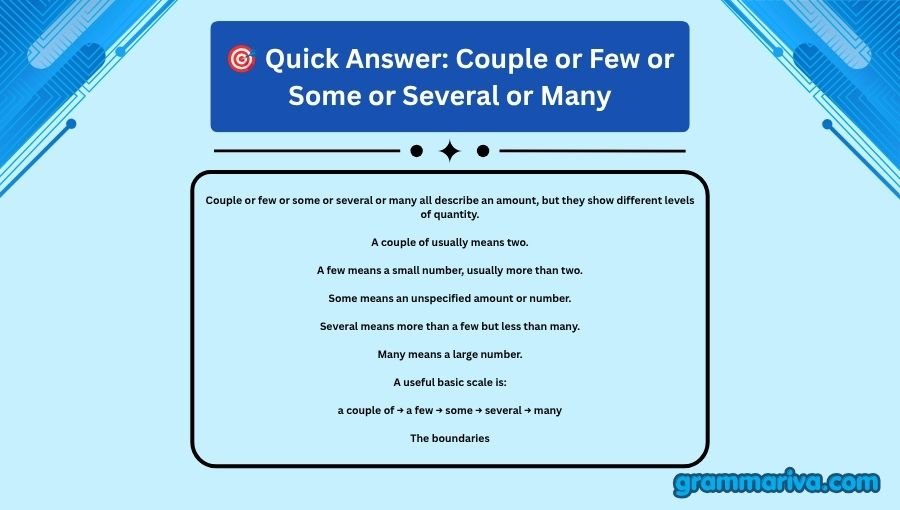
Couple or few or some or several or many all describe an amount, but they show different levels of quantity.
- A couple of usually means two.
- A few means a small number, usually more than two.
- Some means an unspecified amount or number.
- Several means more than a few but less than many.
- Many means a large number.
A useful basic scale is:
a couple of → a few → some → several → many
The boundaries are not always exact. Context matters. For example, “several” does not have one fixed number that works in every situation.
🔤 Related Word Forms and Basic Patterns
These quantity words have different grammar patterns. Knowing the pattern is just as important as knowing the meaning.
| Form | Type | Example |
|---|---|---|
| couple of | Quantity phrase | I need a couple of minutes. |
| a few | Quantifier | She bought a few books. |
| some | Determiner/quantifier | We need some chairs. |
| several | Determiner/quantifier | Several students arrived early. |
| many | Determiner/quantifier | Many people agreed. |
A key point is that these words usually work with countable plural nouns when you are talking about separate things.
For example:
- ✅ I have a few questions.
- ❌ I have a few question.
With uncountable nouns, the pattern changes:
- ✅ I need some information.
- ❌ I need several information.
📚 Understanding Couple or Few or Some or Several or Many
The main difference is the amount each word suggests. Couple points to a very small number, few points to a small number, some gives an unclear amount, several suggests a noticeable but limited number, and many suggests a large number.
| Form | Type | Meaning | Example | Correct/Incorrect |
|---|---|---|---|---|
| a couple of | Quantity phrase | About two | I need a couple of days. | ✅ Correct |
| a few | Quantifier | A small number | I read a few pages. | ✅ Correct |
| some | Quantifier | An unspecified amount | I bought some apples. | ✅ Correct |
| several | Quantifier | More than a few | Several guests stayed late. | ✅ Correct |
| many | Quantifier | A large number | Many people attended. | ✅ Correct |
A Couple of Means About Two
In everyday American English, a couple of usually means two or approximately two.
For example:
- ✅ I need a couple of minutes.
- ❌ I need a couple minute.
The first sentence means the speaker needs about two minutes.
The word couple can also refer to two people who are connected romantically. That is a different use.
- They are a married couple.
- A couple of students asked questions.
The context tells you which meaning is intended.
A Few Means a Small Number
A few refers to a small number. It normally suggests more than two, although the exact number is flexible.
- ✅ I have a few ideas.
- ❌ I have few ideas.
The second sentence can be grammatically correct, but its meaning is different. Few without a often suggests that the number is smaller than expected or almost insufficient.
Compare:
I have a few ideas.
This sounds positive or neutral.
I have few ideas.
This suggests that the speaker has almost no ideas.
That small article, a, can change the feeling of the sentence.
Some Gives an Unclear Quantity
Some is useful when the exact number does not matter or is not known.
- I bought some oranges.
- She gave me some advice.
- We need some chairs.
Unlike several, some does not strongly suggest a particular range.
For example, “I invited some friends” could mean three friends or ten friends. The listener usually needs context to know the exact amount.
Several Means More Than a Few
Several usually means more than two or more than a small number. It still describes a limited amount.
- Several employees joined the meeting.
- I visited several stores.
- She received several messages.
The exact number is not fixed. In ordinary speech, the word often gives the impression of a noticeable but not huge quantity.
Many Means a Large Number
Many indicates a large number of countable things or people.
- Many students passed the test.
- Many customers liked the product.
- Many houses were damaged.
The meaning of many depends partly on context. Five people may be many in a small meeting, while five thousand people may be many at a large event.
🔍 Is Couple the Same as Few?
No. A couple of usually points to two, while a few describes a small number that is generally greater than two.
| Expression | Typical Meaning | Example |
|---|---|---|
| a couple of | About two | I stayed for a couple of hours. |
| a few | A small number | I stayed for a few hours. |
| some | An unknown amount | I stayed for some time. |
| several | More than a few | I visited several places. |
| many | A large number | Many people visited. |
There can be overlap. If someone says “a couple of people,” they normally mean two. If someone says “a few people,” the number might be three, four, or another small number.
💡 Test Tip
Ask yourself:
“Do I want the reader to think of about two?”
If yes, a couple of is usually the best choice.
If you mean a small number but do not want to give an exact number, a few is often better.
📊 How Do Few, Some, Several, and Many Differ?
They differ mainly in how clearly they communicate quantity.
| Word | Quantity Feeling | Exact Number? | Typical Use |
|---|---|---|---|
| couple | Very small | Usually about 2 | a couple of days |
| few | Small | No | a few questions |
| some | Unclear | No | some questions |
| several | Moderate | No | several questions |
| many | Large | No | many questions |
The most important thing is not to treat this as a mathematical scale. English does not assign one exact number to every word.
For example, several is not officially “exactly five,” and many does not begin at one specific number.
Instead, these words create different impressions.
🧠 When Should You Use “A Couple of”?
Use a couple of when you mean approximately two items, people, or units.
Common examples include:
- a couple of days
- a couple of hours
- a couple of questions
- a couple of friends
- a couple of books
Correct and incorrect patterns:
- ✅ I need a couple of days.
- ❌ I need a couple days.
In informal American English, “a couple days” can be heard, but a couple of days is the safer standard form for careful writing.
Sentence Breakdown
I have a couple of questions.
- I = subject
- have = verb
- a couple of = quantity phrase
- questions = plural countable noun
The phrase tells us that the speaker has approximately two questions.
📝 When Should You Use “A Few”?
Use a few when you mean a small number.
Examples:
- I need a few minutes.
- She bought a few gifts.
- We invited a few guests.
- He made a few changes.
Notice the difference between a few and few:
| Form | Meaning | Example |
|---|---|---|
| a few | A small number, often positive/neutral | I have a few options. |
| few | Almost none or fewer than expected | I have few options. |
This is one of the most useful distinctions in this topic.
💬 When Is “Some” the Best Choice?
Use some when you do not want to state an exact amount or when the exact amount is not important.
For countable nouns:
- some books
- some people
- some questions
For uncountable nouns:
- some water
- some advice
- some information
This makes some more flexible than several of the other quantity words.
For example:
- ✅ She gave me some useful advice.
- ❌ She gave me several useful advice.
The second sentence is incorrect because advice is normally treated as an uncountable noun in standard English.
🔢 When Does “Several” Work Best?
Use several when you want to show that there is more than a small number but still not an extremely large amount.
Examples:
- Several workers complained.
- Several options are available.
- Several customers called today.
- Several questions remain unanswered.
Several usually sounds more specific than some, even though it does not give an exact number.
Compare:
Some people complained.
The number is unclear.
Several people complained.
The sentence gives a stronger impression that a noticeable number of people complained.
📈 When Should You Use “Many”?
Use many when the number is large or seems large in the situation.
Examples:
- Many people attended the event.
- Many students struggle with this rule.
- Many companies use this system.
- Many readers found the article helpful.
In formal writing, many is especially common with plural countable nouns.
| Sentence | Meaning |
|---|---|
| I received a couple of emails. | About two emails |
| I received a few emails. | A small number |
| I received some emails. | An unspecified number |
| I received several emails. | More than a few |
| I received many emails. | A large number |
🧪 Correct vs Incorrect Examples for Quantity Words
The five expressions can all be correct, but they must match the intended meaning and noun type.
- ✅ I have a couple of questions.
- ❌ I have a couple question.
- ✅ She bought a few books.
- ❌ She bought a few book.
- ✅ We need some information.
- ❌ We need several information.
- ✅ Several students attended.
- ❌ Several student attended.
- ✅ Many people agreed.
- ❌ Many person agreed.
📝 Case Study: Choosing the Right Quantity Word at Work
I once edited a short workplace email that said, “Many changes are needed before Friday.” The writer actually meant only two small changes. The word many made the task sound much bigger than it was.
I changed the sentence to:
“A couple of changes are needed before Friday.”
The message immediately became clearer.
Now imagine a manager really has ten or twenty changes to discuss. In that case, many changes may be suitable.
The lesson is simple: choose the quantity word based on the message you want the reader to understand.
| Workplace Situation | Better Choice | Example |
|---|---|---|
| Exactly about two items | a couple of | We need a couple of updates. |
| Small number | a few | I have a few suggestions. |
| Unknown amount | some | I have some feedback. |
| Noticeable limited number | several | Several issues need attention. |
| Large number | many | Many issues remain unresolved. |
📖 Grammar Rules Explanation
Quantity words do not all work in the same way. Their grammar depends on the noun that follows them and the meaning the speaker wants to express.
A couple of, a few, several, and many normally refer to countable plural nouns.
Examples include:
- a couple of chairs
- a few questions
- several employees
- many books
Some is more flexible. It can work with both plural countable nouns and uncountable nouns.
Examples:
- some chairs
- some books
- some water
- some information
Another important rule concerns few and a few. Without the article a, the word often carries a negative or limited meaning.
- A few people came.
This means a small number came. - Few people came.
This suggests that almost nobody came or that fewer people came than expected.
Most standard English references agree that these words express quantity rather than exact mathematical amounts. Their meaning depends heavily on context.
Correct vs Incorrect at a Glance
| Sentence | Correct/Incorrect | Why |
|---|---|---|
| I need a couple of minutes. | ✅ Correct | “A couple of” works with plural countable units. |
| She has a few ideas. | ✅ Correct | “A few” means a small number. |
| He gave me several advice. | ❌ Incorrect | “Advice” is uncountable. |
| Many students passed. | ✅ Correct | “Many” works with plural countable nouns. |
| We bought some furniture. | ✅ Correct | “Some” works with uncountable nouns. |
⚠️ Common Mistakes With Quantity Words
People often confuse these words because their meanings overlap. The problem becomes worse when people write quickly.
Three common causes are:
- Fast typing: Writers may choose the first quantity word that comes to mind.
- Autocorrect: Software may change a word or remove a small word such as “a.”
- Lack of knowledge: Learners may assume all quantity words mean exactly the same thing.
I once caught myself typing “few” when I meant “a few” in an email. The sentence sounded much more negative than I intended. Adding one tiny word changed the message.
Similar Grammar Confusions
| Confusion | Correct Form | Main Difference |
|---|---|---|
| it’s / its | Depends on meaning | “It’s” = it is; “its” = possession |
| your / you’re | Depends on meaning | “Your” = possession; “you’re” = you are |
| fewer / less | Depends on noun | “Fewer” usually works with countable nouns |
| much / many | Depends on noun | “Many” works with countable plural nouns |
| a few / few | Depends on meaning | “A few” is small but positive/neutral |
Specific Wrong Forms and Uses
| Wrong Form | What’s Wrong | Correct Form |
|---|---|---|
| a couple question | Missing plural pattern | a couple of questions |
| a few question | Singular noun after plural quantifier | a few questions |
| several information | “Information” is uncountable | some information |
| many person | Singular noun after “many” | many people |
| a several days | Incorrect combination | several days |
| a many people | Incorrect article | many people |
🕰️ Word Origin and History
The history of these quantity words is not necessary for choosing the correct form, but their long use in English helps explain why modern speakers treat them as flexible quantity expressions.
English has developed many ways to express amounts without giving an exact number. Words such as some, few, many, and several have long served this purpose.
The important point for modern writers is how these words function today.
| Period | Form | Note |
|---|---|---|
| Earlier English | few / many | Quantity words developed around ideas of small and large numbers. |
| Later English | some | Used broadly for an unspecified amount or number. |
| Modern English | several | Commonly used for a noticeable but limited number. |
| Modern English | a couple of | Common everyday expression for about two. |
🌎 Usage in Different Contexts
The best quantity word can change depending on the setting.
Everyday Conversation
In casual speech, a couple of, a few, and some are very common.
I need a couple of minutes.
Professional Writing
Professional writing often benefits from clear quantity language.
Several clients requested an update.
Creative Writing
Writers may choose quantity words based on tone.
A few lights were still glowing in the distance.
Social Media and Texting
Short informal expressions are common.
Give me a couple of minutes 😂
| Context | Which Term to Use | Example |
|---|---|---|
| Everyday conversation | a couple of / a few / some | Give me a few minutes. |
| Professional writing | several / many / some | Several clients responded. |
| Creative writing | a few / several / many | Several stars filled the sky. |
| Social media/texting | couple of / few / some | I need a couple of mins. |
💬 Common Phrases With Couple, Few, Some, Several, and Many
These expressions appear often in natural English.
| Phrase | Meaning |
|---|---|
| a couple of minutes | about two minutes |
| a couple of days | about two days |
| a few minutes | a short amount of time |
| a few things | a small number of things |
| some time | an unspecified amount of time |
| many times | on numerous occasions |
Some expressions are especially useful in everyday conversation.
For example:
I will call you in a couple of minutes.
This does not necessarily promise exactly 120 seconds. It usually means a short time, often around two minutes.
🔄 Synonyms and Alternatives
Sometimes another expression can replace a quantity word. However, the meaning may change slightly.
| Alternative | Works When | Does Not Work When |
|---|---|---|
| two | You know the exact number | You want an approximate number |
| a handful of | You mean a small number | You mean a large number |
| numerous | You mean many | You mean only two |
| a number of | You want an unspecified group | You need to stress “many” |
| plenty of | You mean more than enough | You mean only a couple |
For example, two is clearer than a couple of when the exact number matters.
We need two signatures.
This is better than “We need a couple of signatures” if exactly two signatures are required.
❓ Is “A Couple of” Always Exactly Two?
No. A couple of usually means two, but in everyday conversation it can sometimes mean approximately two or a very small number.
For example:
I will be there in a couple of minutes.
The speaker usually means roughly two minutes, not necessarily exactly 120 seconds.
If an exact number is legally, financially, or technically important, use the exact number instead.
❓ Is “A Few” More Than Two?
Usually, a few suggests a small number greater than two, but English does not define it as one exact number.
It could mean three, four, five, or another small amount depending on context.
For exact information, use a number:
I have three questions.
For an approximate small number, use:
I have a few questions.
❓ Is “Some” More Than “A Few”?
Not necessarily. Some does not establish a clear position on a quantity scale.
“I have some books” could mean two, five, ten, or more. The speaker is simply not giving the exact amount.
Therefore, you should not assume that some always means more than a few.
❓ Does “Several” Mean Five?
No. Several does not have one fixed number.
It normally suggests more than a very small number, but the exact amount depends on context.
For example:
Several people attended.
The sentence does not tell us whether seven, eight, or another number attended.
If the number matters, state it directly.
❓ Is “Many” the Same as “Several”?
No. Many generally suggests a larger quantity than several.
Compare:
Several customers complained.
This suggests a noticeable but limited number.
Many customers complained.
This suggests a much larger group.
The exact difference depends on the situation.
❓ Can I Use “Several” With Uncountable Nouns?
Usually, no. Several normally works with plural countable nouns.
Correct:
Several questions were answered.
Incorrect:
Several information was shared.
Better:
Some information was shared.
For an uncountable noun, choose a suitable quantity expression such as some, much, or a specific unit phrase.
❓ What Is the Difference Between “Few” and “A Few”?
A few means a small number. Few without a often suggests an insufficiently small number.
Compare:
I have a few options.
This sounds like the speaker has some options.
I have few options.
This sounds like the speaker has almost no options.
This distinction is extremely useful in both conversation and formal writing.
❓ Which Is More Formal: “A Couple of” or “Several”?
Several often sounds more formal and precise than a couple of, although both are standard English.
For example, in a business report:
Several employees requested additional training.
sounds more formal than:
A couple of employees requested additional training.
If you specifically mean two employees, however, two employees is even clearer.
❓ Can “Many” Be Used With Singular Nouns?
No, not when many means a large number of individual things.
Correct:
Many students attended.
Incorrect:
Many student attended.
Use a plural countable noun after many.
❓ Which Word Should I Use When the Exact Number Is Unknown?
Use some when you simply want to describe an unknown or unspecified amount.
Use a few when you want to show that the unknown number is small.
Use several when you want to suggest a noticeable but limited number.
Use many when you want to suggest a large number.
🎯 How to Remember the Difference
A simple mental picture can make these words easy to remember:
A couple of = about 2
A few = a small number
Some = an unspecified amount
Several = more than a few
Many = a large number
| Question | If Yes → Use |
|---|---|
| Do you mean about two? | a couple of |
| Do you mean a small number? | a few |
| Do you do not want to show the size clearly? | some |
| Do you mean more than a small number? | several |
| Do you mean a large number? | many |
Practice Examples
- I need ___ minutes to finish this.
- If you mean about two: a couple of
- She has ___ close friends.
- If you mean a small number: a few
- We received ___ feedback from readers.
- If the amount is not specified: some
These choices become easier when you focus on the amount you want the reader to imagine.
⚠️ Why Choosing the Right Quantity Word Matters
The difference between these words can affect the tone and meaning of a sentence.
| Situation | Why Getting It Right Matters |
|---|---|
| Resume | Shows clear and accurate writing |
| Client email | Prevents confusion about the amount |
| Published content | Improves grammar and readability |
| Social post | Makes the intended meaning clearer |
Consider these two sentences:
Many customers contacted us.
A couple of customers contacted us.
The first sounds like a large response. The second sounds like only two customers.
That difference can matter in a report, email, article, or conversation.
A useful writing rule is:
Choose the quantity word that creates the picture you actually mean.
That rule is simple, but it prevents many errors.
🧩 How Context Changes the Meaning
Quantity words are relative. The same number can feel small in one situation and large in another.
Imagine a classroom with ten students.
Many students were absent.
This could mean six or seven students were absent.
Now imagine a university lecture with 500 students.
Many students were absent.
The number could be much larger.
The word many is therefore shaped by context.
The same principle applies to several, a few, and even a couple of.
| Situation | Expression | Possible Impression |
|---|---|---|
| Two questions | a couple of questions | Very small number |
| Three questions | a few questions | Small number |
| Unknown number | some questions | Unclear amount |
| Noticeable group | several questions | More than a few |
| Large group | many questions | Large number |
🔎 Couple or Few or Some or Several or Many in Questions
These words are common in questions because people often ask about an amount without knowing the exact number.
Examples:
- Do you have a couple of minutes?
- Do you have a few minutes?
- Do you have some time?
- Have you visited several countries?
- Have many people responded?
Each question gives a different impression.
Compare:
Do you have a couple of minutes?
This sounds like a short request.
Do you have many minutes?
This sounds unusual in ordinary conversation because many is not normally the natural choice for a short amount of time.
For time, English often prefers expressions such as a couple of minutes, a few minutes, some time, or many hours, depending on the context.
🗣️ Natural Conversation Examples
Here are several examples that show how native-style usage changes with meaning.
- “Give me a couple of minutes.”
- “I have a few things to finish.”
- “Can you give me some advice?”
- “Several people have asked me that.”
- “Many people make this mistake.”
Notice that the words are not interchangeable without changing the meaning.
- ✅ I have a few questions.
- ❌ I have a few question.
- ✅ Several people agreed.
- ❌ Several person agreed.
- ✅ Many students passed.
- ❌ Many student passed.
- ✅ I need some information.
- ❌ I need several information.
📌 A Simple Quantity Scale
When you need a quick answer, think of the words as a rough scale rather than exact mathematical categories.
| Quantity Idea | Best Common Choice |
|---|---|
| About two | a couple of |
| Small number | a few |
| Unknown amount | some |
| More than a few | several |
| Large number | many |
This scale is not absolute. Some is especially flexible because it does not tell the reader how large the quantity is.
Also remember that exact numbers are always better when accuracy matters.
Instead of:
Several employees attended.
you can write:
Eight employees attended.
The second sentence gives the reader exact information.
🧠 A Quick Editing Test
When I edit a sentence containing one of these words, I use three questions:
- Is the noun countable or uncountable?
- Do I want to suggest a specific size?
- Would an exact number be clearer?
For example:
I received several feedback messages.
The noun feedback is normally uncountable. So the sentence needs revision.
Better:
I received some feedback.
Or:
I received several feedback messages.
The second version works because messages is countable.
✅ Quick Recap Checklist
| Question | If Yes → Use |
|---|---|
| Do you mean about two? | a couple of |
| Do you mean a small number? | a few |
| Is the amount unclear or unimportant? | some |
| Do you mean more than a few? | several |
| Do you mean a large number? | many |
| Is the exact number important? | Use the exact number |
Final Practice
1. I need ___ minutes to finish this email.
Answer: a couple of if you mean about two minutes.
2. She asked ___ questions after the lesson.
Answer: a few if she asked a small number.
3. We received ___ useful information.
Answer: some, because information is normally uncountable.
❓ FAQs About Couple or Few
What does “a couple of” mean?
“A couple of” usually means about two. It is commonly used with plural countable nouns, such as “a couple of days” or “a couple of questions.”
What does “a few” mean?
“A few” means a small number. It often suggests more than two, but it does not represent one exact number.
What is the difference between “few” and “a few”?
“A few” normally gives a neutral or positive idea of a small number. “Few” without “a” often suggests that the number is very small or less than expected.
What does “some” mean?
“Some” refers to an unspecified amount or number. It can be used with plural countable nouns and many uncountable nouns.
What does “several” mean?
“Several” usually refers to more than a very small number while still suggesting a limited amount. It does not have one exact numerical meaning.
Does “several” mean three?
Not necessarily. “Several” is flexible and depends on context. If the exact number matters, give the actual number.
Is “many” the opposite of “few”?
They can express contrasting ideas. “Few” indicates a small number, while “many” indicates a large number. However, they are not exact mathematical opposites.
Can “many” be used with uncountable nouns?
Usually not. “Many” normally works with plural countable nouns, such as “many books” or “many people.” For uncountable nouns, “much” or “some” may be appropriate.
Can “several” be used with information?
Normally, no. “Information” is generally uncountable, so “some information” is natural. You can say “several pieces of information” when you need to count individual pieces.
Which word should I use if I know the exact number?
Use the exact number when accuracy matters. For example, “two employees” is clearer than “a couple of employees” when exactly two employees are meant.
🏁 Conclusion
Couple or few or some or several or many may look like interchangeable quantity words, but each one gives the reader a different sense of amount. A couple of usually means about two. A few means a small number. Some leaves the amount open. Several suggests more than a few, while many suggests a large number.
The most useful habit is to focus on the picture you want your sentence to create. If you mean about two, choose a couple of. If you mean a small number, choose a few. If the amount is unclear, some is often the safest choice. If the number is noticeable but limited, several works well. For a large number, use many.
And when the exact number matters, do not make the reader guess. Give the number directly.
Once you learn to connect each word with its quantity feeling, these expressions become much easier to use. ✨ Clear quantity makes clear writing, and clear writing makes your message easier to trust.

Hi, I’m Madison Hayes. I’m an English learning writer at Grammariva, where I work on simple lessons and examples for people who want to improve their grammar and writing. I love turning confusing rules into easy-to-follow explanations.
[…] mistakes, sentence patterns, and practical examples so you can use both forms confidently. ✍️ Couple or Few or Some or Several or Many | Presume vs Assume | Admitted vs […]