Awaiting vs waiting can be confusing because both words describe staying until something happens, but they do not follow the same grammar rules.
If you have ever wondered whether to say “I am awaiting your reply” or “I am waiting for your reply,” you are not alone. 😊 The main difference is simple: await normally takes an object directly, while wait usually needs for before the person or thing you expect.
This small grammar difference can affect how natural and professional your writing sounds.
I often see this confusion in emails, workplace messages, essays, and everyday writing. Once you learn the basic patterns, choosing between these two words becomes much easier.
In this guide, I will explain their meanings, grammar rules, common mistakes, sentence patterns, and practical examples so you can use both forms confidently. ✍️ Couple or Few or Some or Several or Many | Presume vs Assume | Admitted vs Accepted
🎯 Quick Answer: Awaiting vs Waiting
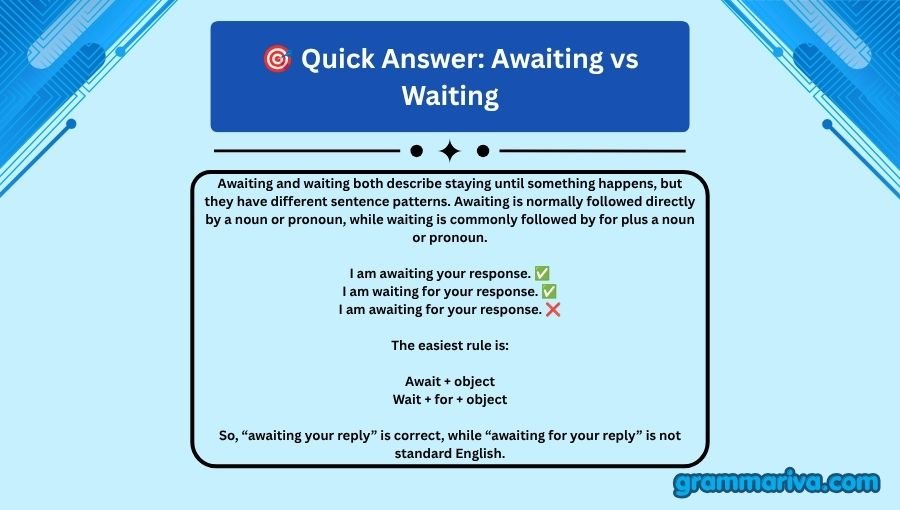
Awaiting and waiting both describe staying until something happens, but they have different sentence patterns. Awaiting is normally followed directly by a noun or pronoun, while waiting is commonly followed by for plus a noun or pronoun.
- I am awaiting your response. ✅
- I am waiting for your response. ✅
- I am awaiting for your response. ❌
The easiest rule is:
Await + object
Wait + for + object
So, “awaiting your reply” is correct, while “awaiting for your reply” is not standard English.
What Is the Difference Between Awaiting and Waiting?
The main difference is grammar and style. Awaiting is a transitive verb form, so it can take its object directly. Waiting usually uses the preposition for when you name what you are expecting.
For example:
- We are awaiting approval. ✅
- We are waiting for approval. ✅
- We are awaiting for approval. ❌
Both first and second sentences communicate nearly the same idea. The first sounds more formal. The second sounds more natural in ordinary conversation.
| Form | Type | Meaning | Example | Correct/Incorrect |
|---|---|---|---|---|
| await | verb | To wait for something | We await your decision. | ✅ Correct |
| awaiting | present participle | Currently waiting for something | We are awaiting your decision. | ✅ Correct |
| wait | verb | To stay until something happens | We will wait for you. | ✅ Correct |
| waiting | present participle | Currently staying until something happens | We are waiting for you. | ✅ Correct |
| awaiting for | Incorrect pattern | Uses an unnecessary “for” after await | We are awaiting for your answer. | ❌ Incorrect |
Awaiting: Meaning and Correct Use
Awaiting means waiting for something that is expected to happen or arrive. It is often used in formal, business, legal, technical, and written contexts.
Consider:
The team is awaiting approval.
Here, team is the subject. Is awaiting is the verb phrase. Approval is the direct object.
There is no need for for.
Compare that with:
The team is waiting for approval.
This is also correct. With wait, the preposition for is normally needed before the expected thing.
Waiting: Meaning and Correct Use
Waiting is the -ing form of wait. It is very common in everyday English.
For example:
I am waiting for the bus.
The structure is:
subject + be + waiting + for + object
You can also use waiting when the expected thing is understood:
I am waiting outside.
In this sentence, the listener does not need to know exactly what the speaker is waiting for.
| Word | Common Pattern | Example |
|---|---|---|
| await | await + object | We await your decision. |
| awaiting | be + awaiting + object | We are awaiting your decision. |
| wait | wait + for + object | We will wait for your decision. |
| waiting | be + waiting + for + object | We are waiting for your decision. |
Is Awaiting the Same as Waiting?
Awaiting and waiting have closely related meanings, but they are not always interchangeable in grammar or style. Both can describe expecting something, but await is more formal and follows a different grammatical pattern.
For example:
- I am awaiting the results. ✅
- I am waiting for the results. ✅
The meaning is almost identical.
However:
- I am awaiting for the results. ❌
- I am waiting the results. ❌
The problem is the sentence structure.
| Sentence | Correct? | Reason |
|---|---|---|
| I am awaiting the results. | ✅ | Await takes the object directly. |
| I am waiting for the results. | ✅ | Wait normally uses “for” before the object. |
| I am awaiting for the results. | ❌ | “For” is not normally used after await. |
| I am waiting the results. | ❌ | Wait normally requires “for” here. |
Why Do People Confuse Awaiting and Waiting?
People confuse these words because they express almost the same basic idea. The difference becomes clear when you look at the grammar that follows each verb.
Another reason is that await sounds like it should work exactly like wait. That makes sentences such as “I am awaiting for you” feel natural to some writers. But standard English does not normally use that pattern.
I once edited an email in which a writer used “awaiting for your confirmation” several times. The writer clearly understood the meaning. The problem was simply that they had transferred the grammar pattern from waiting for to awaiting.
A Simple Pattern to Remember
Think of these as two separate formulas:
Await → object
We await your response.
Wait → for + object
We wait for your response.
| If You Want to Say… | Use This |
|---|---|
| Waiting for a response | awaiting a response |
| Waiting for a response | waiting for a response |
| Waiting for approval | awaiting approval |
| Waiting for approval | waiting for approval |
| Waiting for someone | waiting for someone |
The last example is especially useful because await is less natural when talking about simply waiting for a person in casual conversation.
Awaiting vs Waiting in Professional English
In professional writing, both forms can be correct. The choice depends on tone and sentence structure.
Awaiting often sounds formal, concise, and businesslike.
We are awaiting your confirmation.
Waiting for is more conversational.
We are waiting for your confirmation.
Neither sentence is automatically better. The first may fit a formal notice. The second may sound warmer in a normal email.
| Situation | Better Choice | Example |
|---|---|---|
| Formal notice | awaiting | We are awaiting approval. |
| Business email | either | We are awaiting your response. |
| Friendly email | waiting for | We are waiting for your response. |
| Casual conversation | waiting for | I’m waiting for Sam. |
| Legal or official writing | awaiting | The court is awaiting further information. |
🧠 How Does Awaiting Work in a Sentence?
Awaiting usually appears as the present participle of await. It can follow forms of be to create a continuous verb phrase.
Examples include:
- I am awaiting the documents. ✅
- She is awaiting her test results. ✅
- They are awaiting instructions. ✅
- We were awaiting confirmation. ✅
The key point is that the thing being expected comes directly after awaiting.
Sentence Breakdown
Take this sentence:
The manager is awaiting approval.
- The manager = subject
- is = helping verb
- awaiting = main verb
- approval = direct object
There is no for between awaiting and approval.
| Sentence | Structure |
|---|---|
| We are awaiting confirmation. | subject + be + awaiting + object |
| She is awaiting an answer. | subject + be + awaiting + object |
| They were awaiting instructions. | subject + be + awaiting + object |
| I am awaiting the package. | subject + be + awaiting + object |
💡 Test Tip
When you see awaiting, ask:
“What are they awaiting?”
If the answer can come directly after the word, your structure is probably correct.
- awaiting approval ✅
- awaiting your reply ✅
- awaiting the results ✅
Do not automatically add for.
🧩 How Does Waiting Work in a Sentence?
Waiting commonly needs for when you identify the person or thing expected.
Examples:
- I am waiting for my friend. ✅
- She is waiting for the bus. ✅
- We are waiting for an answer. ✅
- They are waiting for the meeting to begin. ✅
The common structure is:
wait/waiting + for + person or thing
| Example | Pattern |
|---|---|
| I am waiting for you. | waiting + for + person |
| She is waiting for the bus. | waiting + for + thing |
| We are waiting for an answer. | waiting + for + thing |
| They are waiting for the doctor. | waiting + for + person |
Awaiting and Waiting: Formality and Tone
The meaning may be similar, but the tone can change.
Awaiting often feels more formal:
We are awaiting further instructions.
Waiting for usually feels more direct and conversational:
We are waiting for further instructions.
This does not mean awaiting is always better in professional writing. Good writing depends on context.
| Tone | Natural Example |
|---|---|
| Very formal | We are awaiting your decision. |
| Professional | We are waiting for your response. |
| Neutral | I’m waiting for the results. |
| Casual | I’m waiting for you. |
| Official | The department is awaiting further information. |
📝 Case Study: Awaiting vs Waiting in an Email
Imagine that a company has asked a client to approve a design.
A formal email might say:
We are awaiting your approval before moving to the next stage.
That sentence is concise and professional.
A friendlier email could say:
We are waiting for your approval before moving to the next stage.
Both are correct.
The mistake would be:
We are awaiting for your approval before moving to the next stage. ❌
I once caught a similar error while reviewing a short business notice. The writer had used awaiting for because they were thinking of the phrase waiting for. Once the two patterns were placed side by side, the correction was obvious.
| Email Version | Correct? | Tone |
|---|---|---|
| We are awaiting your approval. | ✅ | Formal |
| We are waiting for your approval. | ✅ | Neutral |
| We are awaiting for your approval. | ❌ | Incorrect grammar |
| We are waiting your approval. | ❌ | Incorrect standard pattern |
Grammar Rules Explanation
Understanding awaiting vs waiting is easier when you focus on the grammar pattern instead of only the meaning.
The grammar difference comes from how the two verbs work with objects.
Await is normally used as a transitive verb. That means it can take its object directly.
We await your response.
Wait, on the other hand, commonly uses the preposition for when it is followed by the thing or person expected.
We wait for your response.
This difference stays the same when the verbs appear in their -ing forms.
We are awaiting your response. ✅
We are waiting for your response. ✅
The rule is simple:
| Verb | Correct Pattern | Example |
|---|---|---|
| await | await + object | We await your answer. |
| awaiting | awaiting + object | We are awaiting your answer. |
| wait | wait + for + object | We wait for your answer. |
| waiting | waiting + for + object | We are waiting for your answer. |
Correct vs Incorrect at a Glance
| Sentence | Correct/Incorrect | Why |
|---|---|---|
| We are awaiting your reply. | ✅ Correct | Awaiting takes the object directly. |
| We are waiting for your reply. | ✅ Correct | Waiting uses “for” before the object. |
| We are awaiting for your reply. | ❌ Incorrect | “For” is unnecessary after awaiting. |
| We are waiting your reply. | ❌ Incorrect | “Wait” normally needs “for” here. |
| She is awaiting the results. | ✅ Correct | The object follows awaiting directly. |
Most standard English references treat await and wait as related but grammatically different verbs. The safest approach is to learn their sentence patterns rather than trying to choose based only on meaning.
⚠️ Common Mistakes With Awaiting and Waiting
Most mistakes happen because writers remember the meaning but forget the grammar.
Here are three common reasons:
- Fast typing — Writers type the familiar phrase “waiting for” and then accidentally attach it to awaiting.
- Autocorrect — Software may correct spelling but cannot always identify the intended grammar.
- Lack of knowledge — Learners may know that both words mean “wait” but may not know that they use different structures.
Similar Grammar Confusions
| Confusion | Correct Form | Common Error |
|---|---|---|
| it’s / its | It’s cold. / Its color is blue. | Mixing the two |
| your / you’re | Your car is here. / You’re early. | Your early |
| their / they’re | Their house is large. / They’re here. | Their here |
| affect / effect | The change affected us. / The effect was clear. | Mixing meanings |
| wait / await | Wait for the answer. / Await the answer. | Await for the answer |
Specific Awaiting and Waiting Mistakes
| Wrong Form | What’s Wrong | Correct Form |
|---|---|---|
| awaiting for your reply | “For” is unnecessary | awaiting your reply |
| awaiting for approval | Wrong verb pattern | awaiting approval |
| awaiting to hear from you | Awkward structure in standard use | waiting to hear from you |
| waiting your reply | “For” is missing | waiting for your reply |
| waiting approval | “For” is missing | waiting for approval |
| awaiting on your response | “On” does not belong here | awaiting your response |
A useful point is that awaiting to is usually not the best replacement for waiting to.
For example:
I am waiting to hear from you. ✅
This is natural.
I am awaiting to hear from you. ❌
Instead, you could say:
I am awaiting your response. ✅
Why Is “Awaiting For” Usually Wrong?
“Awaiting for” is usually wrong because the verb await already takes the expected person or thing directly.
Correct:
We are awaiting your response. ✅
Incorrect:
We are awaiting for your response. ❌
However, waiting for is correct:
We are waiting for your response. ✅
This is one of the most useful distinctions in the entire topic.
| Verb | Do You Need “For”? | Example |
|---|---|---|
| await | No | We await your decision. |
| awaiting | No | We are awaiting your decision. |
| wait | Usually yes before a named object | We wait for your decision. |
| waiting | Usually yes before a named object | We are waiting for your decision. |
🗣️ Awaiting vs Waiting in Different Contexts
The best choice can depend on where you are writing.
| Context | Which Term to Use | Example |
|---|---|---|
| Everyday conversation | waiting | I’m waiting for the bus. |
| Professional writing | either | We are awaiting your response. |
| Creative writing | either | She waited for the sound of footsteps. |
| Social media/texting | waiting | Still waiting for my coffee! |
| Formal notice | awaiting | We are awaiting further instructions. |
| Customer service | either | We are waiting for your reply. |
Everyday Conversation
Waiting is much more common in normal speech.
I’m waiting for my brother. ✅
Saying:
I’m awaiting my brother.
is grammatically possible in some contexts, but it sounds unusually formal and can suggest that you are expecting his arrival.
Professional Writing
Both forms work.
We are awaiting your confirmation. ✅
We are waiting for your confirmation. ✅
Choose based on the tone you want.
Creative Writing
Writers can use either word depending on the mood.
She waited for the door to open. ✅
He stood silently, awaiting the final signal. ✅
Awaiting can create a more formal or dramatic feeling.
Social Media and Texting
Waiting for is normally more natural.
Still waiting for Friday! ✅
Awaiting Friday!
The second version can work as a playful or dramatic style choice, but it is not the normal casual phrasing.
Common Phrases With Awaiting and Waiting
When learning awaiting vs waiting, common phrases are a useful way to remember which word fits each sentence pattern. There are several useful phrases worth learning as complete patterns.
| Phrase | Meaning |
|---|---|
| awaiting approval | expecting someone to approve something |
| awaiting confirmation | expecting confirmation |
| awaiting further instructions | expecting more directions |
| awaiting your response | expecting a response from you |
| waiting for a reply | expecting someone to reply |
| waiting for an answer | expecting an answer |
Notice the pattern:
awaiting + noun
but:
waiting for + noun
Learning these phrases can make professional writing much easier.
Can Awaiting Be Replaced With Waiting For?
Yes. In many situations, awaiting can be replaced by waiting for without changing the basic meaning.
For example:
We are awaiting confirmation.
can become:
We are waiting for confirmation.
Both are correct.
The main difference is tone.
| Original | Alternative | Tone |
|---|---|---|
| awaiting approval | waiting for approval | More conversational |
| awaiting a response | waiting for a response | Neutral |
| awaiting instructions | waiting for instructions | More conversational |
| awaiting the results | waiting for the results | Neutral |
| awaiting your decision | waiting for your decision | Neutral |
Synonyms and Alternatives
Sometimes you can replace awaiting or waiting for with another expression. However, the alternatives are not always exact matches.
| Alternative | Works When | Does Not Work When |
|---|---|---|
| expecting | You believe something will arrive or happen | You mean simply staying in one place |
| anticipating | You are looking forward to or preparing for something | You only mean passing time until it happens |
| pending | A decision or action has not happened yet | You are talking about physically waiting |
| looking forward to | You feel positive about something coming | The event is unwanted or uncertain |
| holding for | You are on a phone call or line | You mean general expectation |
For example:
We are awaiting approval.
could sometimes become:
Approval is pending.
But these sentences are not identical. The first focuses on the people who are waiting. The second focuses on the unfinished approval itself.
🎯 How to Remember the Difference
The fastest way to remember the rule is to memorize two short formulas.
Formula 1
Await + noun
await approval
await confirmation
await a response
await the results
Formula 2
Wait + for + noun
wait for approval
wait for confirmation
wait for a response
wait for the results
You can also use this memory trick:
Await needs no “for.” Wait usually waits “for” something.
| If You Start With… | Finish It Like This |
|---|---|
| I am awaiting… | your reply |
| I am waiting… | for your reply |
| We are awaiting… | approval |
| We are waiting… | for approval |
| She is awaiting… | the results |
| She is waiting… | for the results |
💡 Test Tip: Use the Object Test
When you are unsure, identify the thing being expected.
Ask:
“What am I awaiting?”
If the answer is your reply, say:
I am awaiting your reply. ✅
Then ask:
“What am I waiting for?”
The answer is also your reply:
I am waiting for your reply. ✅
This gives you two correct structures.
| Question | Correct Answer |
|---|---|
| What are you awaiting? | Your reply. |
| What are you waiting for? | Your reply. |
| What is she awaiting? | Approval. |
| What is she waiting for? | Approval. |
Why It Matters in Professional Communication
Small grammar differences can affect how polished a message sounds. A reader may understand “awaiting for your reply,” but the phrase is still incorrect in standard English.
Professional writing benefits from clear patterns.
| Situation | Why Getting It Right Matters |
|---|---|
| Resume or cover letter | Shows attention to language |
| Client email | Creates a polished impression |
| Published content | Builds reader confidence |
| Social post | Keeps the writing clear and natural |
A useful principle is:
Clear grammar makes a simple message easier to trust.
You do not need complicated vocabulary to sound professional. Often, the best improvement is simply choosing the right structure.
Is Awaiting More Formal Than Waiting?
Yes, awaiting generally sounds more formal than waiting for.
This does not mean awaiting is always the better choice. In casual speech, waiting for is usually more natural.
Compare:
We are awaiting your response.
with:
We are waiting for your response.
The first feels more formal. The second feels more direct and conversational.
| Phrase | General Tone |
|---|---|
| awaiting your response | Formal |
| waiting for your response | Neutral |
| awaiting approval | Formal |
| waiting for approval | Neutral |
| awaiting further instructions | Formal |
| waiting for further instructions | Neutral |
Can You Use Awaiting for a Person?
Yes, await can be used with a person in certain contexts, but it often sounds formal or literary.
For example:
The driver was awaiting the passengers. ✅
This is grammatically correct, but in ordinary conversation, most people would probably say:
The driver was waiting for the passengers. ✅
The second version sounds more natural.
| Sentence | Grammar | Naturalness |
|---|---|---|
| I am awaiting your arrival. | ✅ | Formal |
| I am waiting for you. | ✅ | Very natural |
| The team is awaiting the manager. | ✅ | Formal |
| The team is waiting for the manager. | ✅ | Natural |
What About “Waiting to”?
Waiting to is correct when another verb follows it.
For example:
I am waiting to hear from you. ✅
Here, to hear is an infinitive phrase.
You can also say:
She is waiting to speak with the manager. ✅
Do not copy this structure directly with await.
I am awaiting to hear from you. ❌
A better alternative is:
I am awaiting your response. ✅
| Intended Meaning | Natural Form |
|---|---|
| Expecting a reply | awaiting your reply |
| Expecting a reply | waiting for your reply |
| Wanting to hear from someone | waiting to hear from you |
| Expecting approval | awaiting approval |
| Expecting approval | waiting for approval |
⏳ Awaiting vs Waiting for Time Expressions
Waiting is also common with expressions that describe time or duration.
Examples:
I waited for two hours. ✅
We have been waiting since noon. ✅
Await does not usually replace these patterns naturally.
You would not normally say:
I awaited for two hours. ❌
If you mean that you stayed somewhere for two hours, waited is the natural choice.
| Meaning | Natural Sentence |
|---|---|
| Duration | I waited for two hours. |
| Starting point | I have been waiting since noon. |
| Expected object | I am awaiting your reply. |
| Expected object | I am waiting for your reply. |
This is another reason you should not treat await and wait as completely interchangeable.
🧠 Choosing the Right Word Quickly
Use awaiting when: Keeping the basic rule for awaiting vs waiting in mind will help you make the right choice quickly.
- You want a formal tone.
- The expected thing can directly follow the verb.
- You are writing a business or official message.
- You are talking about approval, confirmation, information, results, or a response.
Use waiting for when:
- You are speaking casually.
- You are talking about people or things in everyday situations.
- You want a natural conversational tone.
- You are describing the act of staying until something happens.
| Choose Awaiting When… | Choose Waiting When… |
|---|---|
| You want formal wording | You want casual wording |
| You are awaiting approval | You are waiting for a bus |
| You are awaiting confirmation | You are waiting for a friend |
| You are awaiting a response | You are waiting for an answer |
| You are writing an official notice | You are chatting with someone |
⚠️ A Few Sentences to Avoid
Here are some common forms that should be changed.
- We are awaiting for your response. ❌
We are awaiting your response. ✅ - I am waiting your reply. ❌
I am waiting for your reply. ✅ - She is awaiting to receive the package. ❌
She is waiting to receive the package. ✅ - They are awaiting on approval. ❌
They are awaiting approval. ✅ - He is waiting the bus. ❌
He is waiting for the bus. ✅
Awaiting vs Waiting: Quick Comparison Table
| Feature | Awaiting | Waiting |
|---|---|---|
| Basic meaning | Expecting something | Staying until something happens |
| Grammar | awaiting + object | waiting + for + object |
| Tone | Often formal | Usually neutral or casual |
| Common in conversation | Less common | Very common |
| Common in business | Very common | Very common |
| “For” required before object? | No | Usually yes |
| Example | awaiting approval | waiting for approval |
📋 Quick Recap Checklist
Use this checklist whenever you are unsure.
| Question | If Yes → Use |
|---|---|
| Do I want a formal expression followed directly by a noun? | awaiting |
| Am I talking about staying until a person or thing arrives? | waiting for |
| Is the expected object directly after the verb? | awaiting |
| Does the sentence contain “for” before the expected object? | waiting for |
| Am I saying “awaiting for”? | Change it to awaiting + object |
Practice Examples
- We are ___ your confirmation.
Answer: awaiting → We are awaiting your confirmation. ✅ - I am ___ for the bus.
Answer: waiting → I am waiting for the bus. ✅ - The company is ___ approval.
Answer: awaiting → The company is awaiting approval. ✅
FAQs About Awaiting vs Waiting
Is “awaiting” grammatically correct?
Yes. Awaiting is the present participle of await and is grammatically correct when used with the proper sentence structure.
We are awaiting your response. ✅
Is “waiting for” grammatically correct?
Yes. Waiting for is a standard and very common construction.
I am waiting for your response. ✅
Is “awaiting for” correct?
No. In standard English, await normally takes its object directly. Therefore, use “awaiting your response,” not “awaiting for your response.”
Should I say “awaiting your response” or “waiting for your response”?
Both are correct. Awaiting your response sounds more formal, while waiting for your response sounds more neutral and conversational.
Can I use “await” and “wait” interchangeably?
Not always. They have similar meanings, but their grammar differs. Use await + object and wait for + object.
Is “I am awaiting your reply” correct?
Yes. “I am awaiting your reply” is grammatically correct and has a formal, professional tone.
Is “I am awaiting for your reply” correct?
No. The correct form is:
I am awaiting your reply. ✅
Or:
I am waiting for your reply. ✅
Is “I am waiting to hear from you” correct?
Yes. This is a very natural expression. Waiting to + verb is different from awaiting + noun.
Which is more formal, awaiting or waiting for?
Awaiting generally sounds more formal. Waiting for is more common in everyday speech and neutral communication.
Can I say “awaiting approval”?
Yes. Awaiting approval is a standard and common phrase, especially in professional and official writing.
Conclusion: Awaiting vs Waiting Made Simple
Awaiting vs waiting becomes easy once you remember one basic grammar rule: await takes its object directly, while wait normally uses “for” before its object. So you can say “We are awaiting your response” or “We are waiting for your response,” but not “We are awaiting for your response.”
I recommend using waiting for in casual conversations because it sounds natural and familiar. Choose awaiting when you want a more formal or concise style, especially in business, official, or professional writing. 😊
The key patterns are simple:
await + object
awaiting + object
wait + for + object
waiting + for + object
Once these patterns become familiar, you will spot the difference almost instantly. Good grammar does not have to feel complicated. Learn the pattern, test the sentence, and choose the form that fits your tone. ✨
Remember: Await directly. Wait for. Get the pattern right, and the choice becomes easy.

Hi, I’m Nathan Reed. I’m a grammar and writing specialist at Grammariva. I work on practical grammar content that helps readers understand sentence structure, punctuation, vocabulary, and better writing habits.
[…] differences. By the end, you should know when each word fits and why the distinction matters. 😊 Awaiting vs Waiting | Couple or Few or Some or Several or Many | Presume vs […]