Choosing between seem or seems can feel confusing because both forms come from the same verb. The difference is small, but it matters. The right choice depends mainly on the subject of your sentence. 😊 Once you know whether the subject is singular or plural, the choice becomes much easier.
I often see this mistake in emails, school assignments, social posts, and everyday messages. Writers may know what they want to say but pause when they reach a sentence such as “She seem tired” or “They seems happy.” The good news is that the rule is simple. You do not need to memorize a long list of grammar rules.
In this guide, I will explain when to use each form, show clear examples, cover common mistakes, and give you easy tests you can use while writing.
By the end, you should be able to choose the correct form quickly and confidently. ✨ Lozenger or Lozenge | Astronomy vs Astrology | Site Seeing or Sightseeing
🎯 Quick Answer: Seem or Seems
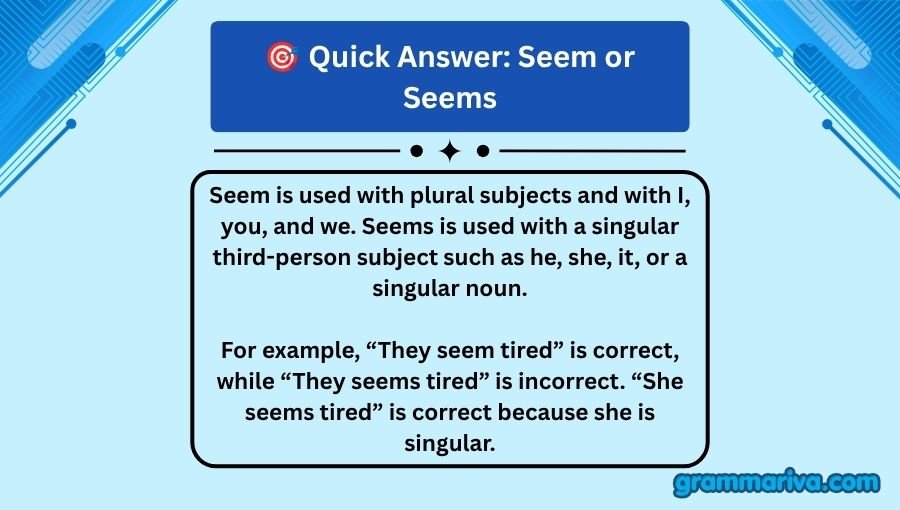
Seem is used with plural subjects and with I, you, and we. Seems is used with a singular third-person subject such as he, she, it, or a singular noun.
For example, “They seem tired” is correct, while “They seems tired” is incorrect. “She seems tired” is correct because she is singular.
| Subject | Correct Form | Example |
|---|---|---|
| I | seem | I seem nervous. |
| You | seem | You seem happy. |
| We | seem | We seem ready. |
| They | seem | They seem busy. |
| He | seems | He seems tired. |
| She | seems | She seems upset. |
| It | seems | It seems strange. |
| Singular noun | seems | The plan seems good. |
| Plural noun | seem | The plans seem good. |
🔤 Related Word Forms of Seem
The word seem has several useful forms. The main forms are seem, seems, seemed, and seeming. Each has a different grammatical role.
| Form | Type | Example |
|---|---|---|
| seem | Base verb | They seem excited. |
| seems | Present-tense form | She seems excited. |
| seemed | Past-tense form | She seemed excited. |
| seeming | Present participle | His seeming confidence surprised me. |
The form you need in the present tense depends on the subject. That is why understanding subject-verb agreement is the key to this topic.
🧠 Understanding the Basics of Seem or Seems
The main difference is subject-verb agreement. In the simple present tense, a singular third-person subject normally takes seems, while other common subjects take seem.
Compare these sentences:
| Form | Type | Meaning | Example | Correct/Incorrect |
|---|---|---|---|---|
| seem | Base verb | Appear to be | They seem ready. | ✅ Correct |
| seems | Third-person singular | Appears to be | She seems ready. | ✅ Correct |
| seem | With singular he/she/it | Appears to be | He seem ready. | ❌ Incorrect |
| seems | With plural they | Appear to be | They seems ready. | ❌ Incorrect |
| seem | With I | Appear to be | I seem tired. | ✅ Correct |
| seems | With it | Appears to be | It seems easy. | ✅ Correct |
The basic rule
If the subject is he, she, it, or one singular person, thing, or idea, use seems.
If the subject is I, you, we, they, or a plural noun, use seem.
For example:
- She seems happy. ✅
- They seem happy. ✅
- The child seems tired. ✅
- The children seem tired. ✅
The change happens because English adds -s to many present-tense verbs when the subject is third-person singular.
❓ Is Seem or Seems the Correct Form?
Both seem and seems are correct forms, but they are not interchangeable. The subject determines which one you should use.
Use seem with I, you, we, they, and plural nouns. Use seems with he, she, it, and singular nouns.
| Sentence | Correct/Incorrect | Reason |
|---|---|---|
| I seem worried. | ✅ Correct | “I” takes seem. |
| She seems worried. | ✅ Correct | “She” takes seems. |
| They seem worried. | ✅ Correct | “They” takes seem. |
| He seem worried. | ❌ Incorrect | “He” requires seems. |
| The students seem worried. | ✅ Correct | “Students” is plural. |
A useful way to remember this is to look at the subject first. Do not choose the verb just because another word appears close to it.
❓ When Should You Use Seem?
Use seem when the subject is I, you, we, they, or a plural noun. It is also used after certain helping verbs and modal verbs.
Here are some common patterns:
With I
- I seem distracted today. ✅
- I seem to remember her name. ✅
With You
- You seem upset. ✅
- You seem to understand the problem. ✅
With We
- We seem ready to leave. ✅
- We seem to have enough time. ✅
With They
- They seem excited. ✅
- They seem to agree with us. ✅
With plural nouns
- The students seem prepared. ✅
- The results seem promising. ✅
There is another important pattern: after modal verbs such as may, might, could, should, and will, use the base form seem, not seems.
For example:
- She may seem nervous. ✅
- They might seem confused. ✅
- He could seem angry. ✅
Not:
- She may seems nervous. ❌
❓ When Should You Use Seems?
Use seems with he, she, it, and singular nouns in the simple present tense.
Examples:
- He seems tired. ✅
- She seems friendly. ✅
- It seems unusual. ✅
- The answer seems correct. ✅
- My brother seems busy. ✅
The same rule applies when the subject is a singular phrase.
- The new employee seems confident. ✅
- The color of the walls seems unusual. ✅
- The idea behind the project seems useful. ✅
Notice that the words after the main noun do not change the verb. The subject is still singular.
🔍 Seem or Seems With “To Be”
Both forms can appear before to be, depending on the subject.
| Subject | Correct Pattern | Example |
|---|---|---|
| I | seem to be | I seem to be ready. |
| You | seem to be | You seem to be ready. |
| We | seem to be | We seem to be ready. |
| They | seem to be | They seem to be ready. |
| He | seems to be | He seems to be ready. |
| She | seems to be | She seems to be ready. |
| It | seems to be | It seems to be ready. |
| The team | seems to be | The team seems to be ready. |
| The teams | seem to be | The teams seem to be ready. |
The word to does not change the basic subject rule. You still need to choose the correct form before to be.
For example:
She seems to be tired.
Here, she is singular, so seems is correct.
They seem to be tired.
Here, they is plural, so seem is correct.
💡 Test Tip: Find the Subject First
When you are unsure, ignore the words between the subject and the verb. Find the true subject.
Try this simple test:
Step 1: Find the subject.
Step 2: Ask whether it is singular or plural.
Step 3: Check whether it is I, you, we, or they.
Step 4: Choose seems for third-person singular subjects and seem for the other common subjects.
For example:
The quality of these products seems excellent.
The subject is quality, not products. “Quality” is singular, so seems is correct.
Compare:
The products seem excellent.
Now the subject is products, which is plural.
| Subject | Singular/Plural | Correct Verb |
|---|---|---|
| quality | Singular | seems |
| products | Plural | seem |
| manager | Singular | seems |
| managers | Plural | seem |
| idea | Singular | seems |
| ideas | Plural | seem |
📝 Case Study: Seem or Seems in a Workplace Email
I once edited a short workplace email that contained the sentence, “The new numbers seem to be more accurate.” The writer had initially typed “seems,” but the subject was numbers, which is plural. Changing the verb to seem made the sentence grammatically correct.
Imagine this email:
The latest sales numbers seem much better than last month’s figures.
That is correct because numbers is plural.
Now consider:
The latest sales report seems much better than last month’s report.
Here, report is singular, so seems is correct.
The difference is only one letter, but the subject changes everything.
| Workplace Sentence | Correct/Incorrect | Explanation |
|---|---|---|
| The report seems accurate. | ✅ Correct | “Report” is singular. |
| The reports seem accurate. | ✅ Correct | “Reports” is plural. |
| The results seem promising. | ✅ Correct | “Results” is plural. |
| The result seems promising. | ✅ Correct | “Result” is singular. |
| The numbers seems correct. | ❌ Incorrect | “Numbers” is plural. |
📚 Grammar Rules Explanation
The reason seem and seems differ is subject-verb agreement. In the simple present tense, English usually marks a third-person singular subject with -s on the verb.
So:
- He seems.
- She seems.
- It seems.
- The dog seems.
But:
- I seem.
- You seem.
- We seem.
- They seem.
- The dogs seem.
The important point is that seems does not mean “more than seem.” It is simply the present-tense form used with a third-person singular subject.
There are also situations where a singular subject does not directly take seems because another verb controls the form. For example:
She does seem tired.
After does, the main verb returns to the base form seem.
Likewise:
She may seem tired.
After may, use seem.
Most standard English reference sources follow this basic subject-verb agreement pattern.
Correct vs Incorrect at a Glance
| Sentence | Correct/Incorrect | Why |
|---|---|---|
| She seems happy. | ✅ Correct | “She” is third-person singular. |
| They seem happy. | ✅ Correct | “They” is plural. |
| He seem happy. | ❌ Incorrect | “He” needs seems. |
| The students seem ready. | ✅ Correct | “Students” is plural. |
| The student seems ready. | ✅ Correct | “Student” is singular. |
❓ Why Do People Confuse Seem and Seems?
People often confuse these forms because the difference is only one letter. The meaning is almost the same, so the grammar mistake can be easy to overlook.
Another reason is that speakers sometimes focus on the word closest to the verb instead of the true subject.
For example:
The group of students seems ready.
The noun students is plural, but the actual subject is group, which is singular.
I remember catching myself making a similar mistake while quickly reviewing a sentence with a long subject. I initially focused on the plural noun near the verb. When I removed the extra words, the real subject became obvious.
Fast writing also creates problems. People may type a sentence quickly and add -s because it sounds natural.
Common grammar confusions
| Confusion | Correct Pair | Main Issue |
|---|---|---|
| seem / seems | They seem / She seems | Subject agreement |
| is / are | He is / They are | Singular vs. plural |
| has / have | She has / They have | Subject agreement |
| does / do | He does / They do | Subject agreement |
| was / were | He was / They were | Past-tense agreement |
| it’s / its | It’s ready / Its color | Contraction vs. possessive |
Common causes include:
- Fast typing
- Autocorrect
- Speaking faster than you write
- Lack of grammar knowledge
- Focusing on the nearest noun
- Forgetting that third-person singular verbs often take -s
⚠️ Common Mistakes With Seem
The most common mistake is adding -s when the subject is plural.
For example:
The results seems clear. ❌
The subject is results, so the correct sentence is:
The results seem clear. ✅
Another mistake happens after helping verbs.
She does seems tired. ❌
The correct form is:
She does seem tired. ✅
Once does carries the present-tense marking, the main verb stays in its base form.
Specific wrong forms and uses
| Wrong Form | What’s Wrong | Correct Form |
|---|---|---|
| They seems happy. | Plural subject takes seem. | They seem happy. |
| We seems ready. | “We” takes seem. | We seem ready. |
| He seem tired. | Singular “he” takes seems. | He seems tired. |
| She does seems upset. | “Does” is already marked for tense. | She does seem upset. |
| They may seems confused. | Modal “may” takes the base verb. | They may seem confused. |
| The answers seems right. | “Answers” is plural. | The answers seem right. |
🧩 How To Remember the Difference
A simple memory trick can make this much easier:
He, she, it → seems.
I, you, we, they → seem.
Think of he, she, and it as the small group that usually gets the -s.
| Subject Group | Memory Rule | Example |
|---|---|---|
| He | seems | He seems tired. |
| She | seems | She seems calm. |
| It | seems | It seems strange. |
| I | seem | I seem tired. |
| You | seem | You seem calm. |
| We | seem | We seem ready. |
| They | seem | They seem happy. |
When you see a singular noun, mentally replace it with he, she, or it if possible.
The machine seems broken.
You can think:
It seems broken.
That makes the choice easier.
🏠 Everyday Uses of Seem and Seems
In everyday conversation, the verb is often used when you are describing how something appears or feels.
Examples include:
- You seem busy.
- She seems nice.
- They seem excited.
- It seems cold outside.
- We seem to have a problem.
The word often helps speakers avoid sounding too certain. Instead of saying:
He is angry.
You can say:
He seems angry.
The second sentence says that his behavior gives you that impression. You are describing an appearance rather than making a firm claim about his feelings.
💼 Professional Writing Uses
Professional writing needs clear subject-verb agreement. A small mistake can make an otherwise polished email look rushed.
Consider these examples:
| Context | Correct Form | Example |
|---|---|---|
| seems | The proposal seems reasonable. | |
| Report | seem | The results seem reliable. |
| Meeting note | seems | The timeline seems realistic. |
| Business update | seem | The numbers seem stable. |
| Recommendation | seems | This option seems better. |
In formal writing, accuracy matters because readers should not have to stop and interpret what you mean.
🎨 Creative Writing Uses
Writers often use seem and seems to describe appearances, emotions, or uncertain impressions.
For example:
The old house seems empty.
Or:
The trees seem to whisper in the wind.
Or:
The streets seem quieter at night.
Creative writing can use the verb to create mystery. A character might not know the truth, so the writer describes what appears to be true.
📱 Social Media and Texting
In casual posts and messages, people often skip grammar rules. Still, using the correct form makes your writing cleaner.
| Context | Which Form to Use | Example |
|---|---|---|
| Everyday conversation | Depends on subject | You seem tired. |
| Professional writing | Depends on subject | The plan seems useful. |
| Creative writing | Depends on subject | The night seems endless. |
| Social media | Depends on subject | They seem so happy! |
Even in a short caption, the basic rule does not change.
🔄 Common Phrases With Seem
There are several common patterns worth learning. These phrases are useful because they appear often in both speech and writing.
| Phrase | Meaning |
|---|---|
| seem to be | Appear to be |
| seem like | Appear similar to or appear to be |
| it seems | This appears to be true |
| seem reasonable | Appear sensible |
| seem possible | Appear possible |
| seem unlikely | Appear unlikely |
Examples:
- It seems to be working.
- They seem to be ready.
- She seems like a kind person.
- That seems reasonable.
- The idea seems possible.
🔎 Seem or Seems in “It Seems”
The phrase it seems is especially common. It is used when the speaker wants to say that something appears to be true.
Examples:
- It seems difficult.
- It seems unfair.
- It seems like a good idea.
- It seems that everyone agrees.
The subject is it, which is singular. That is why seems is required.
A common error is:
It seem that we are late. ❌
Correct:
It seems that we are late. ✅
This is one of the easiest examples to remember because it always takes seems in this simple present structure.
🆚 Seem vs. Seems After Helping Verbs
Helping verbs can change the form you need.
After does, do, and modal verbs, use the base form seem.
| Structure | Correct Example |
|---|---|
| does + seem | She does seem tired. |
| do + seem | They do seem tired. |
| may + seem | He may seem nervous. |
| might + seem | She might seem upset. |
| could + seem | It could seem strange. |
| will + seem | The plan will seem easier later. |
Do not add -s after these helping verbs.
- She does seem tired. ✅
- She does seems tired. ❌
The helping verb already carries the tense and agreement needed in the structure.
💡 Seem or Seems With Compound Subjects
When two subjects are joined by and, the subject is usually plural, so use seem.
John and Maria seem happy. ✅
The manager and assistant seem ready. ✅
But when a phrase contains a singular main subject with extra information, use seems.
The manager, along with two assistants, seems ready. ✅
The phrase “along with two assistants” does not make manager plural.
| Sentence | Correct/Incorrect | Reason |
|---|---|---|
| John and Mike seem tired. | ✅ Correct | Two subjects joined by “and.” |
| The teacher and student seem ready. | ✅ Correct | Compound subject is plural. |
| The teacher, with her students, seems ready. | ✅ Correct | Main subject is “teacher.” |
| The team members seem ready. | ✅ Correct | “Members” is plural. |
| The team member seems ready. | ✅ Correct | “Member” is singular. |
🎯 Why the Difference Matters
Correct subject-verb agreement makes your writing easier to understand. It also gives readers confidence in your grammar.
A sentence such as:
The results seems promising.
is easy to understand, but it contains a clear agreement error.
The corrected version is:
The results seem promising.
This matters in many situations.
| Situation | Why Getting It Right Matters |
|---|---|
| Resume | Shows attention to detail |
| Client email | Creates a professional impression |
| Published content | Improves writing quality |
| Social post | Makes the message cleaner |
A useful writing principle is:
Clear writing lets the reader focus on your message instead of your mistakes.
That is especially true when the mistake is easy to avoid.
❓ Does the Subject Always Decide Between Seem and Seems?
In ordinary present-tense statements, the subject is the main factor, but helping verbs can affect the form.
For example:
She seems happy. ✅
But:
She does seem happy. ✅
And:
She might seem happy. ✅
In the last two examples, seem follows a helping or modal verb.
So the better rule is:
Use seems for a third-person singular subject when seem is the main present-tense verb. Use seem after I, you, we, they, plural subjects, and after helping or modal verbs such as does, may, might, and could.
❓ Can You Use Seem With a Singular Subject?
Yes, but the structure matters. A singular subject can use seem when another verb comes before it.
For example:
He does seem nervous. ✅
He may seem nervous. ✅
He might seem nervous. ✅
But without the helping verb:
He seems nervous. ✅
So the mistake is not that seem can never appear with a singular subject. It can. You simply need to check what comes before it.
🧪 Practice: Choose the Correct Form
Try these before looking at the answers.
- She ___ tired.
- They ___ excited.
- The answer ___ correct.
- The answers ___ correct.
- We ___ ready.
- He ___ confused.
- It ___ strange.
- You ___ busy.
- The children ___ happy.
- The child ___ happy.
Answers
| Number | Answer | Full Sentence |
|---|---|---|
| 1 | seems | She seems tired. |
| 2 | seem | They seem excited. |
| 3 | seems | The answer seems correct. |
| 4 | seem | The answers seem correct. |
| 5 | seem | We seem ready. |
| 6 | seems | He seems confused. |
| 7 | seems | It seems strange. |
| 8 | seem | You seem busy. |
| 9 | seem | The children seem happy. |
| 10 | seems | The child seems happy. |
❓ What Is the Easiest Way to Tell Them Apart?
The fastest method is to check the subject and ask one question:
Is the subject he, she, it, or one singular thing?
If yes, use seems in a simple present sentence.
If the subject is I, you, we, they, or a plural noun, use seem.
Try replacing a noun with a pronoun:
The car seems expensive.
Replace “the car” with “it”:
It seems expensive.
Now:
The cars seem expensive.
Replace “the cars” with “they”:
They seem expensive.
This substitution trick works well when a sentence has several nouns.
📝 Another Real-Life Example
A student once wrote in an assignment, “The two main reasons seems clear.” I asked the student to identify the subject. They first pointed to “reasons” and then immediately noticed the problem. Because reasons is plural, the correct sentence is:
The two main reasons seem clear. ✅
This shows why finding the subject is more useful than simply listening to how a sentence sounds.
🧭 How Seem and Seems Work in Longer Sentences
Long sentences can hide the subject. Extra phrases may appear between the subject and the verb.
Consider:
The quality of the new products seems excellent.
The phrase “of the new products” does not control the verb. The main subject is quality.
Now compare:
The new products seem excellent.
Here, the subject is products.
| Sentence | True Subject | Correct Form |
|---|---|---|
| The quality of the products seems high. | quality | seems |
| The products seem high-quality. | products | seem |
| The list of names seems complete. | list | seems |
| The names on the list seem correct. | names | seem |
| The group of players seems ready. | group | seems |
This is why long subjects can cause mistakes. Look for the main noun instead of automatically choosing the noun closest to the verb.
❓ Is “It Seem” Ever Correct?
In standard simple present English, it seem is not correct when seem is the main verb.
Use:
It seems strange. ✅
Not:
It seem strange. ❌
However, seem can follow another verb:
It may seem strange. ✅
It might seem strange. ✅
It could seem strange. ✅
So always check whether another helping or modal verb is controlling the structure.
📌 Quick Recap Checklist
Use this checklist whenever you are unsure.
| Question | If Yes → Use |
|---|---|
| Is the subject he? | seems |
| Is the subject she? | seems |
| Is the subject it? | seems |
| Is the subject one singular noun? | seems |
| Is the subject I? | seem |
| Is the subject you? | seem |
| Is the subject we? | seem |
| Is the subject they? | seem |
| Is the subject a plural noun? | seem |
| Does a modal verb come before it? | seem |
| Does “does” come before it? | seem |
Three quick practice examples
1. The plan ___ reasonable.
Answer: seems ✅
2. The plans ___ reasonable.
Answer: seem ✅
3. The plans might ___ reasonable to everyone.
Answer: seem ✅
The third example is especially useful. Even though “plans” is plural, the key point is also that might is followed by the base verb.
❓ Why Is “They Seems” Incorrect?
“They” is a plural pronoun, so it takes the base form seem in the simple present.
Correct:
They seem happy. ✅
Incorrect:
They seems happy. ❌
The same rule applies to:
- We seem
- You seem
- I seem
- They seem
The -s form belongs with third-person singular subjects such as he, she, and it.
❓ Why Is “She Seem” Incorrect?
“She” is a third-person singular pronoun. In a simple present statement, the verb therefore takes the -s form.
Correct:
She seems happy. ✅
Incorrect:
She seem happy. ❌
However, remember that another verb can change the structure:
She may seem happy. ✅
She does seem happy. ✅
So “she + seem” is not always wrong. It is wrong when seem is the main present-tense verb without a helping or modal verb.
❓ FAQs About Seem vs Seems
What is the difference between seem and seems?
Seem is used with I, you, we, they, and plural subjects. Seems is used with he, she, it, and singular subjects in simple present sentences.
Is “she seem” correct?
No, not when seem is the main verb in a simple present sentence. Use “She seems.” However, “she may seem” and “she does seem” are correct because seem follows another verb.
Is “they seems” correct?
No. They is plural, so the correct form is “They seem.”
Should I use seem or seems after “it”?
Use seems when “it” is the subject and seem is the main present-tense verb.
Example:
It seems easy. ✅
Do I say “we seem” or “we seems”?
Use “we seem.” The pronoun we takes the base form seem.
Do I say “he seem” or “he seems”?
Use “he seems” when seem is the main present-tense verb.
Example:
He seems tired. ✅
Which is correct: “the results seem” or “the results seems”?
“The results seem” is correct because results is plural.
Example:
The results seem promising. ✅
Which is correct: “the result seem” or “the result seems”?
“The result seems” is correct because result is singular.
Example:
The result seems promising. ✅
Is “does seem” correct?
Yes. After does, use the base verb seem.
Correct:
She does seem worried. ✅
Incorrect:
She does seems worried. ❌
Is “may seem” correct?
Yes. Modal verbs such as may are followed by the base form seem.
Example:
He may seem quiet at first. ✅
🏁 Conclusion
Seem or seems is easy to choose once you focus on the subject. Use seems with he, she, it, and singular nouns when seem is the main verb in a simple present sentence. Use seem with I, you, we, they, and plural nouns. Also use seem after modal and helping verbs such as may, might, could, and does.
The fastest test is simple: find the subject before choosing the verb. If the subject is one person or thing, check whether seems is needed. If the subject is plural or is I, you, we, or they, choose seem.
Once you make this habit automatic, sentences such as “The plan seems good” and “The plans seem good” become easy to write correctly. 😊
Remember this one line: He, she, and it seem to love the “s,” while I, you, we, and they use seem. Keep the subject in view, and this tiny grammar choice will rarely cause trouble again. ✨

Hi, I’m Nathan Reed. I’m a grammar and writing specialist at Grammariva. I work on practical grammar content that helps readers understand sentence structure, punctuation, vocabulary, and better writing habits.

[…] Once you understand that small difference, choosing the right form becomes much easier. 😊 Seem or Seems | Lozenger or Lozenge | Astronomy vs […]
[…] to choose the right form naturally and confidently. ✨ Has Long Been vs Has Been for a Long Time | Seem or Seems | Lozenger or […]