Have you ever stopped while writing because you were unsure whether to use state vs status? 🤔 These two words look similar because both can describe a condition or situation. Yet they do not always mean the same thing. Choosing the wrong one can make a sentence sound unclear, especially in school, work, or formal writing.
I teach grammar and editing, and this is one of those word pairs that becomes much easier once you focus on the question behind the sentence. Are you talking about a condition or situation? Or are you talking about a position, rank, or current standing?
For example, you can describe the state of a machine, but you usually describe the status of an application. You can also say that someone is in a happy state, while a person’s social status may describe their position in a group.
Let’s break down the difference in simple terms. By the end, you should be able to choose the right word without stopping to second-guess yourself. ✨ On This Matter or In This Matter | Root vs Route | Drivers or Drivers License
🎯 Quick Answer: State vs Status
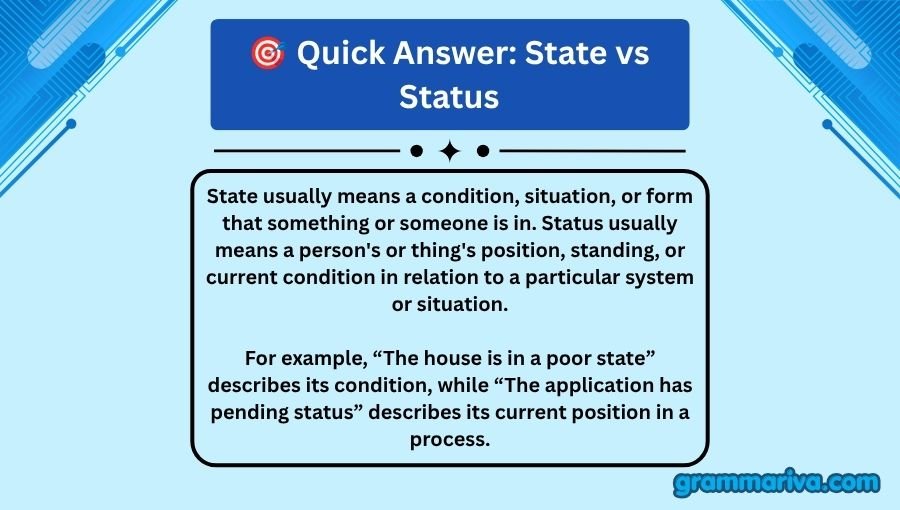
State usually means a condition, situation, or form that something or someone is in. Status usually means a person’s or thing’s position, standing, or current condition in relation to a particular system or situation.
For example, “The house is in a poor state” describes its condition, while “The application has pending status” describes its current position in a process.
| Word | Main Meaning | Simple Example |
|---|---|---|
| State | Condition or situation | The car is in good state. |
| Status | Position, standing, or official condition | The order has shipped status. |
The easiest shortcut is this:
State = what condition something is in.
Status = where something stands.
What Is the Difference Between State and Status?
The main difference is that state focuses on a condition, while status often focuses on a position, standing, or recognized condition.
The two words can overlap. That is why they sometimes cause confusion. However, they are not interchangeable in every sentence.
Think about a phone.
If you say, “The phone is in a damaged state,” you are talking about its physical condition.
If you say, “The phone repair status is pending,” you are talking about where the repair process currently stands.
State vs Status at a Glance
| Form | Type | Meaning | Example | Correct/Incorrect |
|---|---|---|---|---|
| State | Noun | Condition or situation | The building is in a poor state. | ✅ Correct |
| Status | Noun | Position or standing | The application status is pending. | ✅ Correct |
| State | Verb | Say or express something | She stated her opinion. | ✅ Correct |
| Status | Noun | Social or official position | His job status changed. | ✅ Correct |
| Status | Verb | Used as a standard verb in general English | She status the report. | ❌ Incorrect |
A useful rule is simple: state has several grammar roles, including noun and verb. Status is mainly used as a noun.
Is State the Same as Status?
No, state and status are not exactly the same. They can both describe a current condition, but their usual focus is different.
State is broader. It can describe a physical, emotional, mental, or general condition.
Status often tells us a person’s or thing’s position within a system, group, process, or social setting.
Consider these examples:
- The patient is in a stable state.
- The patient’s insurance status is active.
The first sentence focuses on condition. The second focuses on an official position within a system.
A Simple Comparison
| Question | State | Status |
|---|---|---|
| What does it focus on? | Condition | Position or standing |
| Can it describe emotions? | Yes | Usually not |
| Can it describe physical condition? | Yes | Sometimes |
| Can it describe an application? | Sometimes | Very commonly |
| Can it describe social position? | Sometimes | Very commonly |
| Can it be a verb? | Yes | No, not in standard general use |
💡 State: Meaning and Correct Use
State is a noun when it describes a condition, situation, or form that someone or something is in.
It can describe many kinds of conditions. The condition may be physical, emotional, mental, social, or general.
Physical Condition
Use state when describing the physical condition of something.
Examples:
- The old house was in a terrible state. ✅
- The machine is still in good state. ✅
- The road was in a damaged state after the storm. ✅
Here, the word describes what something is like.
Emotional or Mental Condition
State can also describe a person’s emotional or mental condition.
- She was in a calm state after the meeting. ✅
- He was in a confused state when he arrived. ✅
- The child was in a happy state after receiving the gift. ✅
The word does not mean social rank here. It describes an inner condition.
Situation or Circumstances
State can also describe a general situation.
- The country is in a difficult state.
- The project is in a poor state.
- The relationship is in a fragile state.
In each case, the word describes the overall condition of something.
Meaning Summary
| Meaning | Word Type | Example Sentence |
|---|---|---|
| Physical condition | Noun | The car is in a poor state. |
| Emotional condition | Noun | She was in a nervous state. |
| General condition | Noun | The project is in a weak state. |
| Situation | Noun | The economy is in a difficult state. |
Test Tip
Ask yourself:
“Am I describing what something is like?”
If the answer is yes, state may be the better choice.
📊 Status: Meaning and Correct Use
Status is a noun that commonly refers to a position, standing, or current condition within a particular system.
You see it often in workplaces, websites, applications, medical records, social groups, and official documents.
Official Position
Use status when talking about an official position or category.
- Her employment status is full-time. ✅
- His legal status has changed. ✅
- The student’s enrollment status is active. ✅
Progress in a Process
Status is especially common when something is moving through a process.
- The order status is “shipped.” ✅
- My application status is still pending. ✅
- The payment status says “completed.” ✅
This is one of the most useful modern uses of the word.
Social Position
Status can also describe someone’s position or level within society or a group.
- The award increased her professional status.
- He enjoys a high social status.
- Education can affect a person’s social status.
Here, the word refers to standing rather than physical condition.
Meaning Summary
| Meaning | Word Type | Example |
|---|---|---|
| Official position | Noun | His employment status is temporary. |
| Process position | Noun | The application status is pending. |
| Social standing | Noun | She has high social status. |
| Current classification | Noun | The account status is active. |
Why Do People Confuse State and Status?
People confuse these words because status can sometimes mean a current condition. That creates overlap with one meaning of state.
The safest way to separate them is to look at the context.
If you are describing how something is, think about state.
If you are describing where something stands in a system or group, think about status.
I once helped a student edit a short report about a school project. She wrote, “The state of my application is approved.” I understood what she meant, but status was the better word because the application had an official position in a process. That small change made the sentence much clearer.
Three Questions to Ask
- Is this about a condition?
- Is this about an official position?
- Is this about social standing or progress?
If it is mainly about condition, choose state. If it is about position or standing, choose status.
How Do You Use State in a Sentence?
When comparing state vs status, it helps to understand that state can work as both a noun and a verb. You can use state as both a noun and a verb. As a noun, it describes a condition or situation. As a verb, it means to say or express something clearly.
State as a Noun
- The building is in a poor state.
- He was in a confused state.
- The equipment is in excellent state.
State as a Verb
- Please state your name.
- She stated her reason clearly.
- The report states that sales increased.
These two uses are different, so context matters.
Common Patterns With State
| Pattern | Example |
|---|---|
| in a good state | The machine is in a good state. |
| in a poor state | The building is in a poor state. |
| in a confused state | He was in a confused state. |
| state a fact | Please state the facts. |
| state an opinion | She stated her opinion. |
Can Status Describe a Person?
Understanding state vs status is useful when describing a person’s condition, position, or social standing.
Yes. Status can describe a person’s social, professional, legal, or official position.
For example:
- Her employment status is permanent.
- His immigration status changed.
- The athlete has celebrity status.
- Her professional status improved.
The exact meaning depends on the context.
Notice that these examples are about a recognized position or category. They are not simply describing how the person feels.
You would normally say:
She was in a nervous state.
But:
She has a high professional status.
The first describes a condition. The second describes standing.
📝 Case Study: State vs Status at Work
Imagine that a manager sends an email about a software project.
An employee writes:
“The state of the project is approved.”
The sentence is understandable, but the intended meaning is probably that the project has received approval in an official process.
A clearer sentence would be:
“The project status is approved.”
Now imagine a different sentence:
“The project is in a poor state because several files are missing.”
Here, state is the better choice because the writer is describing the project’s condition.
I once edited a workplace document where these two words were mixed several times. The writer was not making a major grammar error. The problem was precision. Replacing state with status in process-related sentences made the whole document easier to follow.
Workplace Comparison
| Situation | Better Word | Example |
|---|---|---|
| Project condition | State | The project is in a poor state. |
| Project approval | Status | The project status is approved. |
| Employee position | Status | Her employment status is permanent. |
| Employee mood | State | He was in an anxious state. |
| Equipment condition | State | The equipment is in good state. |
Grammar Rules for State and Status
The main grammar rule is based on meaning and sentence function.
State can work as a noun or verb. As a noun, it describes a condition or situation. As a verb, it means to express or say something.
Status is normally a noun. It describes position, standing, classification, or a current position in a process.
Neither word should be selected simply because it sounds formal. The meaning must fit the sentence.
Most standard English reference sources agree on these broad uses, although exact examples and definitions can vary between references.
Correct vs Incorrect at a Glance
| Sentence | Correct/Incorrect | Why |
|---|---|---|
| The house is in a poor state. | ✅ Correct | “State” describes condition. |
| The application status is pending. | ✅ Correct | “Status” describes process position. |
| She stated her opinion. | ✅ Correct | “State” works as a verb. |
| She status her opinion. | ❌ Incorrect | “Status” is not normally used this way as a verb. |
| His social status is high. | ✅ Correct | “Status” describes social standing. |
⚠️ Common Mistakes With State and Status
Most mistakes happen because the two words overlap in meaning.
Why These Mistakes Happen
Fast typing: People often choose the first similar word that comes to mind.
Autocorrect: A device may change a word or make a nearby word seem more natural.
Lack of knowledge: Learners may know both words but not understand the difference in context.
Direct translation: A word in another language may map to both English words, creating confusion.
Similar Grammar Confusions
| Confusing Pair | Common Problem | Correct Difference |
|---|---|---|
| it’s / its | Apostrophe confusion | it’s = it is; its = belonging to it |
| your / you’re | Sound alike | your = belonging; you’re = you are |
| affect / effect | Similar meaning | affect is usually a verb; effect is usually a noun |
| then / than | Similar spelling | then = time; than = comparison |
| state / status | Overlapping meanings | state = condition; status = position or standing |
Specific State and Status Mistakes
| Wrong Form | What’s Wrong | Correct Form |
|---|---|---|
| The application state is pending. | Process position is intended. | The application status is pending. |
| My social state is high. | Social standing is intended. | My social status is high. |
| She status her opinion. | “Status” is not normally a verb. | She states her opinion. |
| The machine’s status is damaged. | Physical condition is intended. | The machine is in a damaged state. |
| His emotional status was nervous. | Emotional condition is intended. | He was in a nervous state. |
| The order is in a shipped state. | Standard process wording uses status. | The order status is shipped. |
Is State Used More Broadly Than Status?
Yes. State has a broader range of uses.
You can talk about the state of an object, a person, a relationship, a project, or a situation. You can also use it as a verb.
Status is more focused. It commonly refers to position, standing, classification, or progress within a system.
| Area | State | Status |
|---|---|---|
| Physical condition | Very common | Sometimes |
| Emotional condition | Common | Uncommon |
| General situation | Common | Less common |
| Application progress | Possible but less standard | Very common |
| Social standing | Possible in limited contexts | Very common |
| Official classification | Sometimes | Very common |
| Verb use | Yes | No in standard general use |
State vs Status in Different Contexts
The difference between state vs status becomes clearer when you look at everyday, professional, creative, and digital contexts.
The context can make the correct choice much easier.
| Context | Which Term to Use | Example |
|---|---|---|
| Everyday conversation | State for condition | The room is in a messy state. |
| Professional writing | Status for official position | Please check the application status. |
| Creative writing | State for emotions or condition | She entered a peaceful state. |
| Social media/texting | Status for an update or standing | My order status changed. |
Everyday Conversation
People often use state to describe a condition.
“Look at the state of this kitchen!”
This means the kitchen is messy or poorly maintained.
Professional Writing
Status is common when discussing formal processes.
“Please provide an update on the project status.”
Creative Writing
State works well when describing feelings or mental conditions.
“He remained in a quiet state for several minutes.”
Social Media and Texting
Status can refer to an update or current position.
For example:
“Check my status for today’s update.”
The word has become common in digital communication because many platforms use “status” for updates.
Common Phrases With State
These common phrases also make the state vs status difference easier to understand. Several natural phrases use state to describe conditions or situations.
| Phrase | Meaning |
|---|---|
| state of mind | A person’s mental or emotional condition |
| state of health | A person’s health condition |
| state of affairs | The current situation |
| state of emergency | An officially recognized emergency situation |
| state of repair | The condition of something that may need repair |
| state of confusion | A condition of being confused |
These phrases show how broad the word state can be.
Common Phrases With Status
Status also appears in many common expressions.
| Phrase | Meaning |
|---|---|
| social status | Position in society |
| legal status | Official position under the law |
| employment status | Work classification |
| marital status | Whether someone is married, single, etc. |
| status update | Information about a current situation or progress |
| current status | The present position or condition |
These expressions often relate to categories, records, positions, or official information.
How Can You Replace State or Status?
Sometimes you can replace either word with a clearer alternative. The best replacement depends on the exact meaning.
| Alternative | Works When | Does Not Work When |
|---|---|---|
| condition | Talking about physical or general condition | Talking about official rank |
| situation | Talking about circumstances | Talking about formal classification |
| position | Talking about standing or place | Describing physical condition |
| standing | Talking about social or professional position | Describing an object’s condition |
| progress | Talking about movement through a process | Describing someone’s emotional state |
For example:
- “The car is in poor condition.”
- “The application status is pending.”
- “Her professional standing is strong.”
Sometimes replacing the original word makes the sentence even clearer.
Why Does Getting State and Status Right Matter?
Using the right word improves clarity. It tells your reader exactly what you mean.
This matters in several situations.
| Situation | Why Getting It Right Matters |
|---|---|
| Resume | Shows strong command of professional English |
| Client email | Prevents confusion about project progress |
| Published content | Improves accuracy and readability |
| Social post | Makes short messages easier to understand |
A simple rule I use when editing is:
Choose the word that makes your intended meaning obvious.
That matters more than trying to sound fancy.
In professional communication, small word choices can change the reader’s understanding. A project can be in a poor state, while its approval status can be “pending.” Both can be true at the same time.
Are There Any Special Exceptions?
There is no major spelling exception that changes the basic distinction between state and status.
However, context can create overlap. In some technical or formal writing, state may refer to the current condition of a system, while status may refer to information that reports or classifies that condition.
For example, software may have a particular state, while a dashboard displays the system’s status.
The safest approach is still to focus on meaning rather than memorizing every possible phrase.
How To Remember the Difference
A simple way to remember state vs status is to connect state with condition and status with position or standing. Use this simple memory trick:
STATE = CONDITION
Think:
“What is it like?”
- The house is in a poor state.
- She was in a calm state.
- The machine is in good state.
STATUS = POSITION
Think:
“Where does it stand?”
- The application status is pending.
- His employment status is temporary.
- Her social status is high.
Here is the shortcut:
State tells you about condition. Status tells you about position, standing, or process.
When you remember that contrast, most examples become much easier.
State vs Status Practice Examples
Try choosing the correct word before looking at the answers.
Example 1
“The building is in a terrible ___.”
Answer: state ✅
The sentence describes the building’s condition.
Example 2
“My visa ___ is still pending.”
Answer: status ✅
The sentence refers to an official position in a process.
Example 3
“She was in a nervous ___.”
Answer: state ✅
The sentence describes her emotional condition.
Example 4
“His employment ___ changed last month.”
Answer: status ✅
The sentence describes his official work classification.
Example 5
“Please ___ your full name.”
Answer: state ✅
Here, state is a verb meaning to say or give information.
Quick Recap Checklist
Use this checklist whenever you are unsure.
| Question | If Yes → Use |
|---|---|
| Am I describing a physical condition? | State |
| Am I describing an emotional condition? | State |
| Am I describing a general situation? | State |
| Am I talking about an application’s position? | Status |
| Am I talking about social standing? | Status |
| Am I talking about an official classification? | Status |
| Am I using the word as a verb meaning “say”? | State |
Three More Practice Sentences
- “The computer is in a poor ___.” → state ✅
- “The order ___ says delivered.” → status ✅
- “Please ___ your reasons.” → state ✅
FAQs About State vs Status
Is state and status the same thing?
No. They can overlap when describing a current condition, but state usually focuses on condition or situation, while status often focuses on position, standing, classification, or progress.
What is the difference between state and status?
State describes what condition something or someone is in. Status describes where someone or something stands within a process, system, group, or social setting.
Should I say “application state” or “application status”?
Application status is usually the natural choice when you mean whether an application is pending, approved, rejected, or under review.
Should I say “state of the machine” or “status of the machine”?
Both can be possible, but they can carry slightly different meanings. State of the machine focuses on its condition. Status of the machine often focuses on its current operational position or reported condition.
What is the state of a person?
A person’s state can mean their current physical, emotional, or mental condition. For example, “She was in a relaxed state.”
What is the status of a person?
A person’s status can refer to their social, professional, legal, marital, or official position. For example, “His employment status is full-time.”
Can state be a verb?
Yes. State can be a verb meaning to say, express, or give information clearly. For example, “Please state your name.”
Can status be a verb?
In standard general English, status is normally used as a noun. You should not normally use it as a verb in ordinary formal writing.
Which word should I use for social position?
Use status. Expressions such as social status, professional status, and legal status are common because they describe a person’s position or standing.
Which word should I use for an emotional condition?
Use state in most cases. For example, “He was in a confused state” describes his emotional or mental condition.
Final Takeaway: State vs Status
State vs status becomes easy once you focus on the meaning you want to express. State usually describes a condition, situation, or form. It can also work as a verb meaning to say or express something. Status is mainly a noun that describes position, standing, classification, or progress within a system.
When you are unsure, ask yourself one question: Am I describing a condition, or am I describing where something stands? If you mean condition, choose state. If you mean position, standing, or official progress, choose status. 🧠
I find that this simple test works in most everyday and professional situations. Once you notice the difference, sentences such as “the state of the machine” and “the status of the application” stop feeling confusing.
Remember the rule: State describes condition. Status describes position or standing. Keep that contrast in mind, and you will make the right choice with much more confidence. ✨

Hi, I’m Olivia Carter. I’m an English language editor at Grammariva, and I work on making grammar lessons clear, accurate, and easy to follow. I especially enjoy writing about common grammar mistakes and everyday English.

[…] the end, you should be able to choose the right phrase without stopping to second-guess yourself. State vs Status | On This Matter or In This Matter | Root vs […]
[…] By the end, you should know exactly when to choose each word. ✨ Rather Than or Instead Of | State vs Status | On This Matter or In This […]