If you have ever paused while writing a sentence and wondered about someone vs somebody, you are not alone. Both words are common in American English, and both can refer to an unknown or unspecified person.
That makes the choice feel harder than it really is. The good news is that someone and somebody usually have the same basic meaning and can often replace each other without changing the meaning of a sentence. 😊
Still, there are small differences in tone, style, and context that are worth knowing. In this guide, I will explain the rule in plain English. We will look at examples, common mistakes, workplace writing, casual conversation, social media, and useful alternatives.
By the end, you will know when each word sounds most natural and how to avoid second-guessing yourself. ✨ Analog vs Analogue | Backyard or Back Yard | Their Life or Their Lives
🎯 Quick Answer: Someone vs Somebody
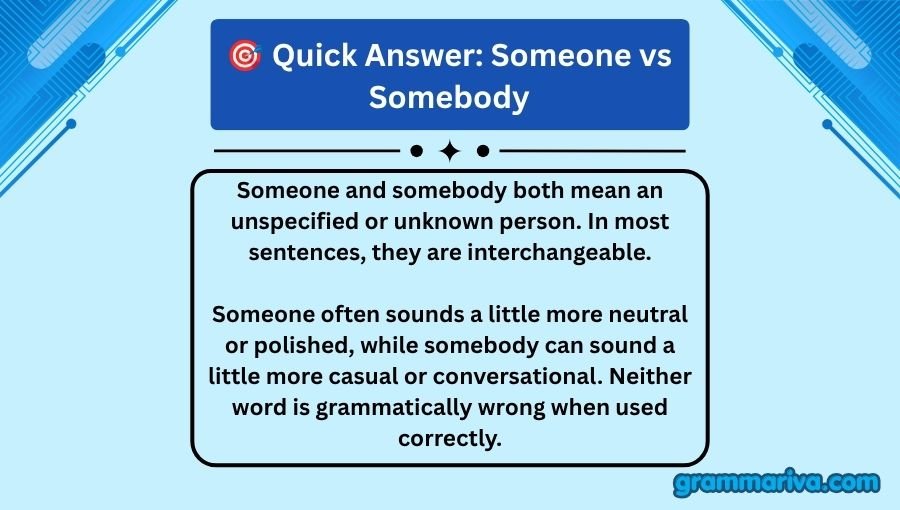
Someone and somebody both mean an unspecified or unknown person. In most sentences, they are interchangeable.
Someone often sounds a little more neutral or polished, while somebody can sound a little more casual or conversational. Neither word is grammatically wrong when used correctly.
| Word | Basic Meaning | Usual Tone | Example |
|---|---|---|---|
| Someone | An unspecified person | Neutral | Someone left a message. |
| Somebody | An unspecified person | Casual or conversational | Somebody left a message. |
👥 Is Someone the Same as Somebody?
Yes. Someone and somebody usually have the same meaning. Both refer to one person whose identity is unknown, unimportant, or not stated.
For example:
- ✅ Someone called while you were out.
- ✅ Somebody called while you were out.
Both sentences tell us that an unidentified person called.
The main difference is not grammar. It is often tone.
Someone can feel slightly more neutral:
Someone needs to answer this question.
Somebody can feel more conversational:
Somebody needs to answer this question.
In everyday American English, both are natural.
📝 Someone vs Somebody at a Glance
The easiest way to understand someone vs somebody is to focus on meaning first and tone second. Both words are indefinite pronouns. They point to a person without naming that person.
| Feature | Someone | Somebody |
|---|---|---|
| Refers to a person | Yes | Yes |
| Singular | Yes | Yes |
| Can be used as a subject | Yes | Yes |
| Can be used as an object | Yes | Yes |
| Works in questions | Yes | Yes |
| Works in negative sentences | Yes | Yes |
| Common in conversation | Yes | Yes |
| Often feels neutral | Yes | Usually |
| Often feels casual | Sometimes | Yes |
A useful rule is simple: If someone works in the sentence, somebody will usually work too.
Compare these examples
- ✅ Someone wants to speak with you.
- ✅ Somebody wants to speak with you.
- ✅ I saw someone near the entrance.
- ✅ I saw somebody near the entrance.
- ❌ Someone are waiting outside.
- ❌ Somebody are waiting outside.
The last pair is wrong because both words are singular. The correct verb is is:
- ✅ Someone is waiting outside.
- ✅ Somebody is waiting outside.
💡 What Does Someone Mean?
Someone means an unspecified person. It is used when you know that a person exists but do not name that person.
Consider this sentence:
Someone broke the window.
The speaker does not tell us who broke it. The word someone stands for that unknown person.
Sentence breakdown
Someone = an unspecified person
broke = the action
the window = the object affected by the action
Here are more examples:
- ✅ Someone sent me an email.
- ❌ Someone sent me an emails.
- ✅ Someone is waiting at the door.
- ❌ Someone are waiting at the door.
- ✅ I need someone to help me.
- ❌ I need someone helps me.
The third example shows an important pattern. After someone, English often uses to + verb when describing a person needed for an action.
💡 What Does Somebody Mean?
Somebody also means an unspecified person. It can replace someone in most normal sentences.
For example:
- ✅ Somebody took my notebook.
- ❌ Somebody took my notebooks if you mean only one notebook.
- ✅ Somebody is knocking.
- ❌ Somebody are knocking.
- ✅ I need somebody to check this file.
- ❌ I need somebody checks this file.
The grammar works the same way because somebody is singular, just like someone.
A small meaning table
| Meaning | Word Type | Example Sentence |
|---|---|---|
| An unknown person | Indefinite pronoun | Someone called me. |
| An unspecified person | Indefinite pronoun | Somebody called me. |
| A person who can perform an action | Indefinite pronoun | I need someone to help. |
| A person whose identity is not given | Indefinite pronoun | Somebody left early. |
🎯 Why Do People Confuse Someone and Somebody?
People confuse these words because they are extremely close in meaning. In many sentences, changing one to the other makes no real difference.
I once helped a student revise a short story. She kept changing someone to somebody because she thought one was grammatically correct and the other was wrong. The real issue was not grammar at all. She simply needed to choose the tone she wanted.
The same thing happens in everyday writing.
People may think:
- someone = formal
- somebody = informal
That is too strict.
A better rule is this:
Someone is generally neutral. Somebody often sounds more conversational. But both are standard English.
| Situation | Someone | Somebody |
|---|---|---|
| Casual conversation | Natural | Very natural |
| Formal email | Very natural | Natural, but less common |
| Academic writing | Common | Less common |
| Storytelling | Common | Common |
| Text messages | Common | Common |
| Social media | Common | Common |
❓ Is Someone More Formal Than Somebody?
Someone can sound slightly more neutral and polished than somebody, but somebody is not incorrect or automatically informal.
Compare:
- ✅ Someone from the legal team will contact you.
- ✅ Somebody from the legal team will contact you.
The first sentence may fit a professional email more naturally. The second is still grammatically correct.
This is a style choice, not a strict grammar rule.
If I am writing a business message, I usually choose someone when both options sound equally good. It gives the sentence a clean, neutral tone.
❓ Is Somebody Informal or Incorrect?
Somebody is not incorrect. It is a standard English word and is widely used in both speech and writing.
For example:
- ✅ Somebody left their phone on the table.
- ❌ Somebody leave their phone on the table.
The problem in the second sentence is the verb, not the pronoun.
Because somebody is singular, use a singular verb:
- Somebody is
- Somebody has
- Somebody does
- Somebody was
The same pattern applies to someone.
📚 Understanding the Grammar Rules
Someone and somebody are both indefinite pronouns. They refer to a person without identifying that person by name.
They are grammatically singular. This means they normally take singular verbs.
Rule 1: Use a singular verb
- Someone is here.
- Somebody has arrived.
- Someone was calling.
- Somebody needs help.
Not:
- ❌ Someone are here.
- ❌ Somebody have arrived.
- ❌ Someone were calling.
- ❌ Somebody need help.
Rule 2: Use them when the person’s identity is unknown or not important
Someone left a package outside.
The speaker does not identify the person.
Rule 3: They can refer to a known person when the name is withheld
Someone I know works at that company.
The speaker may know the person. The listener simply does not know who it is.
Rule 4: They can take modifiers
You can say:
someone helpful
somebody interesting
someone from my office
somebody you can trust
The words remain singular.
✅ Correct vs Incorrect at a Glance
Here is a quick grammar check for common sentence patterns.
| Sentence | Correct/Incorrect | Why |
|---|---|---|
| Someone is at the door. | ✅ Correct | Someone is singular. |
| Somebody are at the door. | ❌ Incorrect | Use the singular verb “is.” |
| I need someone to help me. | ✅ Correct | “Someone” refers to one unspecified person. |
| I need somebody helps me. | ❌ Incorrect | Use “somebody to help me.” |
| Somebody called this morning. | ✅ Correct | “Somebody” is a singular subject. |
🧪 Test Tip: How Can You Check Your Sentence?
Here is my favorite quick test.
Replace someone or somebody with one person.
For example:
Someone is waiting.
Change it mentally:
One person is waiting.
That sounds right.
Now test:
Someone are waiting.
Replace it:
One person are waiting.
That clearly sounds wrong.
This trick helps you remember that both someone and somebody are singular.
📝 What Are the Related Word Forms?
Someone and somebody belong to a larger group of indefinite pronouns. Other related words include anyone, anybody, everyone, everybody, no one, and nobody.
These words have related grammar patterns, but their meanings differ.
| Form | Type | Example |
|---|---|---|
| Someone | Indefinite pronoun | Someone called. |
| Somebody | Indefinite pronoun | Somebody called. |
| Anyone | Indefinite pronoun | Anyone can join. |
| Anybody | Indefinite pronoun | Anybody can join. |
| Everyone | Indefinite pronoun | Everyone is ready. |
| Everybody | Indefinite pronoun | Everybody is ready. |
| No one | Indefinite pronoun | No one knows. |
| Nobody | Indefinite pronoun | Nobody knows. |
The key pattern is that these pronouns are normally treated as singular.
📧 Case Study: Someone vs Somebody in a Workplace Email
Imagine that a manager needs help with a report.
A casual message might say:
Somebody from the design team needs to review this chart.
That sounds natural in a quick team chat.
A more neutral email might say:
Someone from the design team needs to review this chart.
Both are grammatically correct. The second sounds a little more polished.
I once caught myself choosing somebody in a client email and changed it to someone before sending it. Nothing was grammatically wrong with my first choice. I simply wanted the email to sound more neutral.
| Writing Situation | Natural Choice | Example |
|---|---|---|
| Client email | Someone | Someone from our team will reply. |
| Team chat | Somebody | Somebody from our team can handle it. |
| Formal notice | Someone | Someone must approve the request. |
| Friendly message | Somebody | Somebody should bring snacks! |
❓ Can Someone and Somebody Be Used in Questions?
Yes. Both words work naturally in questions.
Examples:
- ✅ Did someone call me?
- ✅ Did somebody call me?
- ✅ Does someone know the answer?
- ✅ Does somebody know the answer?
- ❌ Did someone called me?
- ❌ Did somebody called me?
After did, use the base form of the verb:
Did someone call?
Not:
Did someone called?
The same rule applies to both pronouns.
❓ Can Someone and Somebody Be Used in Negative Sentences?
Yes, but English usually uses other words when expressing a complete negative idea.
For example:
I don’t know anyone.
I don’t know anybody.
These are natural.
You can also see someone or somebody in sentences with negative words, but the meaning can change depending on the structure.
For example:
I didn’t tell somebody.
This can suggest that there was a particular person the speaker did not tell.
By contrast:
I didn’t tell anybody.
This usually means the speaker told no person.
| Sentence | General Meaning |
|---|---|
| I didn’t tell anybody. | I told no one. |
| I didn’t tell anyone. | I told no one. |
| I didn’t tell somebody. | I did not tell a particular person. |
| Someone didn’t answer. | An unspecified person did not answer. |
This is why anyone and anybody are often more natural in broad negative statements.
❓ Which Is Better in Professional Writing?
Someone is usually the safer choice for professional writing. It sounds neutral and clear without making the sentence feel stiff.
For example:
Someone from our support team will contact you.
That works well in a client email.
You can also write:
Somebody from our support team will contact you.
This is not wrong. It simply has a slightly more conversational feel.
I recommend choosing someone when you want a calm, neutral business tone.
| Professional Context | Recommended Choice | Example |
|---|---|---|
| Client email | Someone | Someone will contact you shortly. |
| Resume | Someone | Someone with strong skills can lead the project. |
| Report | Someone | Someone must review the data. |
| Internal chat | Either | Somebody can check this. |
❓ Which Sounds More Natural in Conversation?
Both are natural, but somebody can have a warmer or more conversational sound.
For example:
Somebody left the lights on.
This feels very natural in casual speech.
But:
Someone left the lights on.
is equally correct and also very common.
Tone often depends on the rest of the sentence. You should not treat the two words as completely separate grammar categories.
📱 Someone vs Somebody in Texting and Social Media
In texting and social media, either word can work. Your choice depends mostly on your personal voice.
Examples:
- Someone please explain this to me. 😂
- Somebody please explain this to me. 😂
- Someone tell me I am not the only one.
- Somebody tell me I am not the only one.
The second version can feel more playful in some contexts.
For short posts, somebody may add a conversational feel. Someone may feel cleaner and more direct.
| Context | Better Fit | Example |
|---|---|---|
| Text message | Either | Someone left their bag here. |
| Meme caption | Somebody | Somebody explain this! |
| Instagram caption | Either | Someone gets me. |
| Professional LinkedIn post | Someone | Someone on the team solved it. |
✍️ Someone vs Somebody in Creative Writing
Writers can use both words to shape voice.
Someone can sound quiet, neutral, or mysterious:
Someone was standing behind the old gate.
Somebody can sound more personal or conversational:
Somebody was standing behind the old gate.
Neither version is grammatically better. The writer chooses based on the mood.
In dialogue, somebody can sound especially natural because people often use it in relaxed speech.
In narration, someone may give the sentence a smoother neutral tone.
⚠️ Common Mistakes With Someone and Somebody
Most mistakes happen because people focus on the word instead of the grammar around it. Fast typing, autocorrect, and lack of knowledge can also cause errors.
Here are some common grammar confusions that work in a similar way.
| Confusion | Correct Form | Common Error |
|---|---|---|
| its / it’s | its = possession | Mixing the two |
| your / you’re | your = possession | Mixing the two |
| their / they’re | their = possession | Mixing the two |
| then / than | Different meanings | Swapping them |
| someone / somebody | Both can be correct | Treating one as wrong |
Common mistakes with this specific topic
| Wrong Form | What’s Wrong | Correct Form |
|---|---|---|
| Someone are here. | Wrong singular verb | Someone is here. |
| Somebody have called. | Wrong singular verb | Somebody has called. |
| Someone help me. | Missing structure | Someone help me! / Someone should help me. |
| Somebody to helps me. | Wrong verb form | Somebody to help me. |
| Someone were waiting. | Wrong past verb | Someone was waiting. |
Fast typing can cause errors like someone are because writers may think about the person as “people” rather than as one grammatical unit.
Autocorrect can also change words without the writer noticing.
Lack of knowledge is another common cause. Once you remember that these words are singular, many errors disappear.
🧠 How To Remember the Difference
There is no major meaning difference to memorize. Instead, remember two simple ideas.
Someone = neutral unspecified person.
Somebody = unspecified person with a slightly more conversational feel.
Both can usually fit the same sentence.
Try this memory trick:
Someone sounds a little smoother in neutral writing.
Somebody can sound a little more like everyday speech.
Do not turn this into a strict rule. It is a style guide, not a grammar law.
| If You Want To Sound… | Try | Example |
|---|---|---|
| Neutral | Someone | Someone will call you. |
| Professional | Someone | Someone from HR will respond. |
| Conversational | Somebody | Somebody left this here. |
| Friendly | Either | Somebody wants to see you. |
| Casual | Somebody | Somebody needs coffee! |
💬 Common Phrases With Someone and Somebody
Neither word has a large set of special idioms that require only one form. Still, several everyday patterns are very common.
| Phrase | Meaning |
|---|---|
| Someone else | Another person |
| Somebody else | Another person |
| Someone I know | An unspecified person known to the speaker |
| Somebody I know | Same basic meaning |
| Someone like you | A person similar to you |
| Somebody like you | A person similar to you |
Examples:
- Someone else can handle it.
- Somebody else already answered.
- I need someone I can trust.
- She wants somebody like you on the team.
The phrase someone else is especially common in neutral writing.
🔄 Synonyms and Alternatives to Someone and Somebody
Sometimes you can replace these words with another expression. The best choice depends on what you actually mean.
| Alternative | Works When | Does Not Work When |
|---|---|---|
| A person | You want a neutral phrase | The sentence needs a natural pronoun |
| An individual | You need a formal tone | The context is very casual |
| Anyone | You mean any person | You mean one specific unknown person |
| Anybody | You mean any person | You mean a particular unspecified person |
| A person who… | You need to add a clear description | A short sentence is enough |
For example:
Someone called me.
could become:
A person called me.
That is grammatically fine, but someone sounds more natural.
Likewise:
Someone can join.
and
Anyone can join.
are not always identical. Anyone often means that every person has permission or ability to do something.
❓ Does Someone Take a Singular Verb?
Yes. Someone takes a singular verb.
Examples:
- ✅ Someone is calling.
- ✅ Someone has arrived.
- ✅ Someone wants to talk.
- ❌ Someone are calling.
- ❌ Someone have arrived.
- ❌ Someone want to talk.
The same rule applies to somebody.
This is one of the most important grammar points in the whole topic.
❓ Does Somebody Take a Singular Verb?
Yes. Somebody is grammatically singular.
Use:
- somebody is
- somebody was
- somebody has
- somebody does
- somebody needs
Examples:
- ✅ Somebody has taken my seat.
- ❌ Somebody have taken my seat.
- ✅ Somebody needs to clean this room.
- ❌ Somebody need to clean this room.
When you remember this rule, you can avoid many common errors.
🎯 Why Someone vs Somebody Matters
Choosing between someone and somebody rarely changes the basic meaning. Still, word choice can affect tone and clarity.
Clear writing helps readers understand your message quickly.
Professional writing also benefits from a neutral style when the situation calls for it.
Digital writing needs the same care. A short email, social post, or text can still have a strong effect on how readers see your communication.
A useful principle is:
Good word choice makes a simple message easier to trust and understand.
| Situation | Why Getting It Right Matters |
|---|---|
| Resume | Shows control of standard English |
| Client email | Creates a clear, professional tone |
| Published content | Improves consistency and readability |
| Social post | Helps your message sound natural |
📝 Can You Use Someone and Somebody in the Same Article?
Yes, but you should have a reason for switching between them.
For example, a writer may use someone in formal narration and somebody inside casual dialogue.
Someone from the office called me.
“Somebody left their coffee here again,” my coworker said.
That change feels natural because the speakers have different voices.
You do not need to avoid one word simply because you already used the other.
❓ Should You Always Choose Someone?
No. Someone is not always better. It is simply a useful default when you want a neutral tone.
If your sentence is casual, somebody may sound more natural.
Compare:
Someone needs to clean this kitchen.
with:
Somebody needs to clean this kitchen!
The second can feel more emotional or conversational.
The best choice depends on the voice of your sentence.
❓ Should You Always Choose Somebody?
No. Somebody is not always the best stylistic choice. In formal or neutral writing, someone often fits more smoothly.
For example:
Someone will review your application.
This sounds natural in a professional setting.
You could write:
Somebody will review your application.
It is still correct, but it may sound slightly less formal.
Think of somebody as a perfectly valid option, not a required casual replacement.
🔍 A Simple Decision Guide
When I edit sentences containing these words, I use a very quick process.
First, I ask:
Do I mean one unspecified person?
If yes, someone or somebody may work.
Then I ask:
Do I want a neutral tone?
If yes, I usually choose someone.
Finally, I ask:
Does the sentence sound conversational?
If yes, somebody may be a nice fit.
| Question | If Yes → Use |
|---|---|
| Do you mean one unspecified person? | Someone or somebody |
| Is the writing neutral? | Someone is often a good choice |
| Is the writing conversational? | Somebody can work well |
| Is the word the subject? | Use a singular verb |
| Are you talking about any person at all? | Consider anyone or anybody |
Practice examples
- _____ from accounting will call you tomorrow.
→ Someone is a strong neutral choice. - _____ please tell me what happened!
→ Somebody sounds very natural in casual speech. - _____ is waiting outside.
→ Either someone or somebody works.
🌟 Quick Recap Checklist
The main rule is easy: someone and somebody usually mean the same thing. The choice is mainly about style and tone.
| Question | If Yes → Use |
|---|---|
| Do you mean an unspecified person? | Someone or somebody |
| Do you want a neutral tone? | Someone |
| Do you want a casual tone? | Somebody can work |
| Is the pronoun singular? | Use a singular verb |
| Are you writing professionally? | Someone is often the safer choice |
| Are you writing dialogue or casual text? | Either can work |
Remember these examples:
- ✅ Someone is at the door.
- ✅ Somebody is at the door.
- ❌ Someone are at the door.
- ❌ Somebody are at the door.
FAQs About Someone vs Somebody
❓ Are someone and somebody the same?
Yes. Someone and somebody usually have the same basic meaning. Both refer to an unspecified or unknown person. In most sentences, either word can be used without changing the main meaning.
❓ Is someone more formal than somebody?
Someone often sounds slightly more neutral or polished, especially in professional writing. However, somebody is also standard English and is not incorrect. The difference is mainly one of tone and style.
❓ Is somebody grammatically correct?
Yes. Somebody is grammatically correct. It is a singular indefinite pronoun. It should normally take a singular verb, such as is, was, has, or needs.
❓ Should I use someone or somebody in a formal email?
Someone is usually the better default for a formal email because it has a neutral tone. For example, “Someone from our team will contact you” sounds professional and natural.
❓ Can someone and somebody be used interchangeably?
Yes. In most ordinary sentences, they can be exchanged without changing the basic meaning. The main difference is the feeling of the sentence. Someone can sound neutral, while somebody can sound more conversational.
❓ Is “somebody are” correct?
No. Somebody are is incorrect when somebody is the subject. Because somebody is singular, use somebody is or another singular verb.
Correct:
Somebody is waiting.
Incorrect:
Somebody are waiting.
❓ Is “someone are” correct?
No. Someone are is incorrect when someone is the subject. Use a singular verb.
Correct:
Someone is calling.
Incorrect:
Someone are calling.
❓ Which is better for academic writing, someone or somebody?
Someone is usually the better choice for academic writing because it tends to sound more neutral. However, somebody is not grammatically wrong. The choice should match the tone and style of the sentence.
❓ Can I use somebody in professional writing?
Yes. Somebody can appear in professional writing, especially when the tone is relaxed. Still, someone often sounds more natural in formal reports, business emails, and official communication.
❓ What is the difference between someone and anyone?
Someone generally refers to an unspecified person. Anyone often refers to any person or every person within a possible group.
Compare:
Someone called me.
This means an unspecified person called.
Anyone can call me.
This means any person has the ability or permission to call.
🏁 Conclusion
Someone vs somebody is much simpler than it first appears. Both words normally refer to one unspecified person, and both are grammatically correct. The main difference is tone. Someone often feels neutral and works especially well in professional or polished writing. Somebody can sound more conversational, friendly, or casual.
The most important grammar rule is that both words are singular. That means you should write “someone is” and “somebody has,” not “someone are” or “somebody have.” Once you remember that, most common mistakes disappear.
When you are unsure, choose someone for a neutral sentence. If the setting is relaxed, somebody may sound just as natural. Neither word is automatically right or wrong based only on formality. 🌟
My best advice is simple: focus on meaning first, tone second, and grammar always. Once that habit becomes automatic, choosing between these two words becomes easy. ✨

Hi, I’m Olivia Carter. I’m an English language editor at Grammariva, and I work on making grammar lessons clear, accurate, and easy to follow. I especially enjoy writing about common grammar mistakes and everyday English.
[…] should feel confident choosing the correct spelling without stopping to second-guess yourself. 😊 Someone vs Somebody | Analog vs Analogue | Backyard or Back […]
[…] your sentence and why. Let’s make this grammar rule easy to remember! ✨ Cord vs Chord | Someone vs Somebody | Analog vs […]