If you have ever stopped while writing and wondered whether it should be an hilarious or a hilarious, you are not alone. This small grammar choice can feel tricky because the word hilarious begins with the letter h, and English has a few words where the first letter does not match the sound we hear. 😄
The good news is that the rule is much simpler than it looks. In standard US English, the correct choice is a hilarious because the h in hilarious is pronounced. The article a normally comes before a consonant sound, while an comes before a vowel sound.
Once you focus on the sound instead of only looking at the first letter, this question becomes easy. In this guide, I will explain the rule, show clear examples, cover common mistakes, and give you quick tests you can use whenever you are unsure. Any Problem or Any Problems | Bespeckled or Bespectacled | Who to Contact or Whom to Contact
🎯 Quick Answer: An Hilarious or a Hilarious
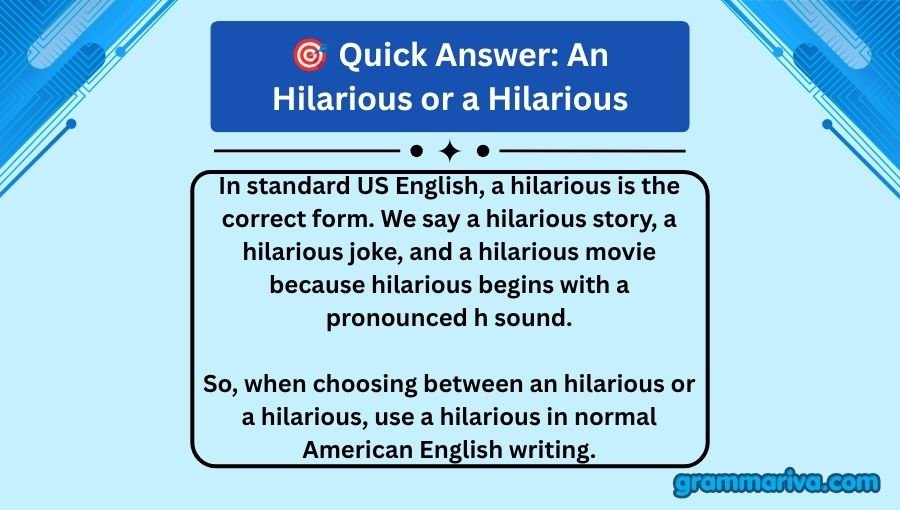
In standard US English, a hilarious is the correct form. We say a hilarious story, a hilarious joke, and a hilarious movie because hilarious begins with a pronounced h sound.
So, when choosing between an hilarious or a hilarious, use a hilarious in normal American English writing.
Correct: She told a hilarious story. ✅
Incorrect in standard US English: She told an hilarious story. ❌
The key is the sound, not simply the first written letter.
🧠 Why Is It a Hilarious Instead of An Hilarious?
The main reason is simple: hilarious starts with a consonant sound. The word begins with the sound we hear in words such as happy, house, and help.
English uses a before consonant sounds and an before vowel sounds.
Compare these:
| Form | Sound at the beginning | Correct article | Example |
|---|---|---|---|
| hilarious | consonant sound | a | a hilarious joke |
| happy | consonant sound | a | a happy child |
| honest | vowel sound | an | an honest person |
| hour | vowel sound | an | an hour |
| hilarious | consonant sound | a | a hilarious story |
This is why the spelling alone can be misleading. You should listen to the opening sound.
The Sound Test
Say the phrase aloud:
a hilarious
The transition feels natural because the h is clearly heard.
Now say:
an hilarious
In standard US English, this sounds unnatural because an is normally followed by a vowel sound.
💡 Test Tip: If the first sound is like h in happy, choose a. If the first sound is a vowel sound, choose an.
✍️ A Hilarious vs An Hilarious at a Glance
The difference between a hilarious and an hilarious comes down to the opening sound of hilarious. Standard US English treats the h as pronounced, so a is the normal choice.
| Form | Type | Meaning | Example | Correct/Incorrect |
|---|---|---|---|---|
| a hilarious | article + adjective | One very funny thing/person | It was a hilarious scene. | ✅ Correct |
| an hilarious | article + adjective | Intended to describe one funny thing/person | It was an hilarious scene. | ❌ Not standard US usage |
| a hilarious joke | article + adjective + noun | One very funny joke | He told a hilarious joke. | ✅ Correct |
| an hilarious joke | article + adjective + noun | Same intended meaning | He told an hilarious joke. | ❌ Not standard US usage |
| hilarious | adjective | Very funny | The video was hilarious. | ✅ Correct |
Notice that hilarious itself does not change. The article changes based on the sound that follows it.
🔍 Is An Hilarious Ever Correct?
For standard US English, a hilarious is the safe and natural choice. An hilarious may appear in older writing or in some varieties of English where the initial h can be weak or silent, but that is not the normal choice for American English.
This matters because grammar can vary by region. A form that appears in a book or on a website is not automatically the best choice for your own writing.
If your goal is clear, modern US English, write:
a hilarious mistake ✅
rather than:
an hilarious mistake ❌
I once edited a short article where the writer had used an hilarious several times. The writer had remembered the rule about an before vowel sounds but had applied it to the letter rather than the sound. Changing every instance to a hilarious fixed the problem immediately.
📚 A Hilarious: Meaning and Correct Use
A hilarious is used when hilarious describes a singular countable noun. The noun usually comes immediately after the adjective.
For example:
She watched a hilarious movie. ✅
Here is the sentence breakdown:
- a = indefinite article
- hilarious = adjective
- movie = singular countable noun
The same pattern works with many nouns:
- a hilarious joke
- a hilarious story
- a hilarious video
- a hilarious moment
- a hilarious mistake
- a hilarious comment
- a hilarious scene
- a hilarious person
A Hilarious Joke
Use a hilarious joke when talking about one joke that is extremely funny.
My brother told a hilarious joke at dinner. ✅
The word joke is singular, so it needs an article. Because hilarious begins with a consonant sound, we use a.
A Hilarious Story
Use a hilarious story when describing one funny story.
She shared a hilarious story from college. ✅
The same rule applies even when the sentence becomes longer.
He wrote a hilarious story about his first day at work. ✅
The extra words do not change the article.
A Hilarious Person
You can also use the phrase to describe someone who is very funny.
My cousin is a hilarious person. ✅
Here, a comes before hilarious because the full noun phrase begins with the consonant sound of h.
Meaning Summary
| Meaning | Word Type | Example Sentence |
|---|---|---|
| Very funny joke | adjective | She told a hilarious joke. |
| Very funny story | adjective | He shared a hilarious story. |
| Very funny event | adjective | It was a hilarious moment. |
| Very funny person | adjective | She is a hilarious person. |
| Very funny mistake | adjective | That was a hilarious mistake. |
❓ Why Do People Confuse A Hilarious and An Hilarious?
People often confuse these forms because they see the letter h and remember that some words beginning with h use an.
That memory is partly true, but it is incomplete. Words such as honest and hour begin with h, yet their h is not pronounced in standard English. That creates phrases such as an honest answer and an hour.
Hilarious works differently.
The h is pronounced, so we say:
a hilarious story ✅
not:
an hilarious story ❌
A Real Writing Memory
A student once wrote, “He gave an hilarious answer” in a school assignment. When I asked him why, he pointed to the h and said, “I thought h words use an.” That was a great teaching moment because the problem was not a lack of effort. He simply needed to learn that sound matters more than spelling.
⚖️ Key Differences Between A Hilarious and An Hilarious
The biggest difference is grammatical standard use. A hilarious follows the normal US English rule because hilarious starts with a consonant sound.
| Feature | A hilarious | An hilarious |
|---|---|---|
| Standard US English | ✅ Yes | ❌ No |
| Begins with pronounced h | Yes | Yes |
| Article before adjective | A | An |
| Natural American usage | Yes | No |
| Example | a hilarious video | an hilarious video |
The meaning does not change. The issue is simply whether the article agrees with the sound that begins the phrase.
📝 Case Study: A Hilarious in Real Workplace Writing
Imagine that a manager sends this email after a team meeting:
“Yesterday’s meeting included a hilarious moment when the presentation froze during the final slide.”
That sentence sounds natural and professional.
Now imagine this version:
“Yesterday’s meeting included an hilarious moment when the presentation froze.”
The second version may be understood, but it does not fit standard US English.
The same rule applies in everyday speech:
“That was a hilarious story.” ✅
It also works in professional content:
“The article includes a hilarious example of a common office mistake.” ✅
The context does not change the grammar rule.
🚫 Grammar Rules Explanation
The indefinite articles a and an are chosen according to the sound that follows them.
Use a before a consonant sound:
- a book
- a teacher
- a funny story
- a hilarious joke
Use an before a vowel sound:
- an apple
- an idea
- an honest person
- an hour
The word hilarious begins with a pronounced h sound in standard US English. That makes it a consonant-sound word for article purposes.
Therefore:
a hilarious joke ✅
is standard US English.
The form:
an hilarious joke ❌
does not follow the normal modern American pattern.
This is the same reason we say a hotel when the h is pronounced, but an hour when the h is not pronounced.
A general rule found in standard grammar references is that a/an depends on pronunciation rather than spelling alone.
Correct vs Incorrect at a Glance
| Sentence | Correct/Incorrect | Why |
|---|---|---|
| She told a hilarious joke. | ✅ Correct | Hilarious begins with a consonant sound. |
| She told an hilarious joke. | ❌ Incorrect in standard US English | An does not normally precede the pronounced h sound. |
| It was a hilarious movie. | ✅ Correct | The initial h is pronounced. |
| He made a hilarious mistake. | ✅ Correct | Hilarious begins with a consonant sound. |
| We watched an hilarious video. | ❌ Incorrect in standard US English | The normal article is a. |
⚠️ Common Mistakes With A Hilarious
The most common mistake is choosing an because the writer sees the first letter and thinks about other h-words.
Other mistakes can happen when people type quickly, trust autocorrect, or have not learned the sound-based rule.
Common Grammar Confusions
| Confusion | Correct Form | Why People Confuse Them |
|---|---|---|
| it’s / its | it’s = it is; its = possession | Apostrophe confusion |
| your / you’re | your = possession; you’re = you are | Similar sound |
| their / there / they’re | Different meanings | Same or similar sounds |
| a / an | Depends on the following sound | Spelling can mislead |
| then / than | Different meanings | Fast typing |
Fast typing can make small grammar errors easy to miss. Autocorrect can also fail to catch them because an hilarious is still understandable to readers.
Specific Wrong Forms
| Wrong Form | What’s Wrong | Correct Form |
|---|---|---|
| an hilarious joke | Wrong article for standard US English | a hilarious joke |
| an hilarious story | The h is pronounced | a hilarious story |
| an hilarious movie | Article does not match the opening sound | a hilarious movie |
| an hilarious moment | Use a before the consonant sound | a hilarious moment |
| an hilarious comment | The initial sound is /h/ | a hilarious comment |
The best fix is not to memorize every example. Learn the sound rule and apply it.
❓ Is A Hilarious Used in Everyday Conversation?
Yes. A hilarious is completely natural in everyday American speech when hilarious describes a singular noun.
Examples include:
That was a hilarious joke. 😂
She told a hilarious story.
We had a hilarious conversation.
It was a hilarious mistake.
You may hear people shorten or change sentences in casual speech, but when the noun needs an indefinite article, a hilarious is the standard choice.
💼 How Should You Use A Hilarious in Professional Writing?
Professional writing follows the same rule. Use a hilarious when the adjective describes a singular countable noun.
For example:
The report includes a hilarious example of a communication error. ✅
The speaker shared a hilarious story during the presentation. ✅
The campaign uses a hilarious video to attract attention. ✅
You should avoid an hilarious in standard US business writing.
The phrase may look small, but correct articles make your writing feel polished.
🎨 How Does A Hilarious Work in Creative Writing?
Creative writing gives you more freedom with tone, but grammar still matters unless you are intentionally showing a character’s unusual speech.
For example:
He remembered a hilarious moment from his childhood.
She turned the mistake into a hilarious story.
The novel opens with a hilarious scene at a crowded restaurant.
If a writer uses an hilarious on purpose to represent a particular voice, that is a stylistic choice. It should not be confused with standard US English grammar.
📱 A Hilarious in Social Media and Texting
Social media posts are often informal, but the basic rule remains the same.
You might write:
Just watched a hilarious video 😂
My friend sent me a hilarious meme 🤣
That was a hilarious fail!
Even in casual posts, a hilarious is the natural American English form.
| Context | Which Term to Use | Example |
|---|---|---|
| Everyday conversation | a hilarious | That was a hilarious story. |
| Professional writing | a hilarious | We included a hilarious example. |
| Creative writing | a hilarious | It became a hilarious scene. |
| Social media/texting | a hilarious | I found a hilarious video. |
❓ Is A Hilarious Always Followed by a Noun?
No. The word hilarious can appear without an article when it is used as a predicate adjective.
For example:
The movie was hilarious. ✅
You do not need a because there is no singular noun directly after hilarious.
Compare:
It was a hilarious movie. ✅
and:
The movie was hilarious. ✅
Both are correct, but they use different sentence structures.
| Sentence Pattern | Example | Correct |
|---|---|---|
| a + hilarious + noun | a hilarious movie | ✅ |
| subject + be + hilarious | The movie was hilarious. | ✅ |
| an + hilarious + noun | an hilarious movie | ❌ in standard US English |
This distinction can help you avoid adding an article when one is not needed.
🔄 How To Remember the Difference
The easiest way to remember this rule is to say the word aloud.
Do not ask only:
“Does hilarious start with H?”
Ask:
“What sound starts hilarious?”
You hear the h.
That means:
a hilarious ✅
A simple memory trick is:
Hear the sound, then choose the article.
If you hear a consonant sound, choose a.
If you hear a vowel sound, choose an.
| Question | Answer |
|---|---|
| Is the h pronounced? | Yes |
| Does hilarious begin with a consonant sound? | Yes |
| Should I use a? | Yes |
| Should I normally use an? | No |
| Best US English form | a hilarious |
❓ What Are Similar Words That Follow the Same Rule?
Many words beginning with h use a when the h is pronounced.
Examples include:
- a happy child
- a helpful teacher
- a healthy meal
- a hilarious joke
- a historic building
- a huge mistake
- a helpful answer
But some words beginning with h use an because the h is not pronounced in standard speech:
- an honest person
- an hour
- an honor
- an heir
This comparison shows why simply looking at the first letter is not enough.
💡 Test Tip: Use the Sound, Not the Letter
When you are unsure whether to use a or an, cover the article and say the next word aloud.
Try:
___ hilarious
You naturally hear the consonant h.
Now try:
___ honest
The h is not pronounced, so the phrase begins with a vowel sound.
This quick test works far beyond hilarious.
| Word | First Sound | Correct Article | Example |
|---|---|---|---|
| hilarious | consonant | a | a hilarious story |
| happy | consonant | a | a happy child |
| honest | vowel | an | an honest answer |
| hour | vowel | an | an hour |
| helpful | consonant | a | a helpful guide |
❓ Does British English Ever Use An Hilarious?
You may occasionally encounter an hilarious in British or older written material, especially where the speaker or writer uses a weaker initial h sound. However, this is not the normal choice for standard modern US English.
Since this article focuses on US English, the recommended form is:
a hilarious ✅
If you are writing for an American audience, this choice will sound natural and clear.
Regional differences can explain why you sometimes see another form, but they do not change the standard recommendation for American writing.
📖 Common Phrases With A Hilarious
There are several natural combinations that use a hilarious.
| Phrase | Meaning |
|---|---|
| a hilarious joke | A very funny joke |
| a hilarious story | A very funny story |
| a hilarious moment | A very funny moment |
| a hilarious mistake | A funny mistake |
| a hilarious video | A very funny video |
| a hilarious conversation | A very funny conversation |
These phrases are useful because they give you ready-made examples.
For instance:
We watched a hilarious video after lunch.
He told a hilarious story about his first job.
That turned into a hilarious conversation.
🧩 Synonyms and Alternatives for Hilarious
Sometimes you can avoid the article question by choosing another adjective. This can be useful when you want a different tone.
| Alternative | Works When | Does Not Work When |
|---|---|---|
| funny | You want a simple, general word | You want very strong humor |
| amusing | You want a softer tone | You want a very casual phrase |
| entertaining | Something keeps people interested | You specifically mean extremely funny |
| comic | You are describing humor or comedy | You need a very natural everyday phrase |
| laugh-out-loud funny | You want a strong casual expression | You need formal or concise writing |
For example:
It was a funny story.
This is correct, but it does not have exactly the same strength as:
It was a hilarious story.
❓ Why Does Getting A Hilarious Right Matter?
Small grammar choices affect how clear and polished your writing feels. A reader may understand an hilarious, but standard US English expects a hilarious.
This matters most when you are writing for school, work, clients, or a public audience.
Clear writing builds trust.
That short idea captures the value of small grammar choices.
| Situation | Why Getting It Right Matters |
|---|---|
| Resume | Shows attention to detail |
| Client email | Makes the message look polished |
| Published content | Supports consistent grammar |
| Social post | Makes casual writing cleaner |
A single article will not usually ruin communication. Still, repeated grammar errors can make a writer appear less careful.
🛠️ A Hilarious in Four Real Writing Situations
The correct form stays the same even when the writing situation changes.
Everyday Conversation
“That was a hilarious story!”
This sounds natural and relaxed.
Workplace Communication
“The presentation included a hilarious example.”
This is appropriate for professional writing.
Creative Content
“The character remembered a hilarious moment from childhood.”
The form remains standard.
Social Media
“I just watched a hilarious video 😂”
Informal writing still follows the same article rule.
| Situation | Example |
|---|---|
| Conversation | That was a hilarious joke. |
| She shared a hilarious example. | |
| Story | It became a hilarious scene. |
| Social post | Found a hilarious video! 😂 |
❓ What Happens If You Remove the Article?
Sometimes you can avoid the issue completely by changing the sentence.
Compare:
It was a hilarious movie. ✅
with:
The movie was hilarious. ✅
Both sentences are correct.
The first uses hilarious before a singular noun, so it needs a.
The second uses hilarious after the verb was as a description of the subject. No article is required.
| Version | Structure | Correct |
|---|---|---|
| a hilarious movie | article + adjective + noun | ✅ |
| the movie was hilarious | noun + linking verb + adjective | ✅ |
| an hilarious movie | wrong article in standard US English | ❌ |
This is a useful option when you are editing a sentence and want a simpler structure.
❓ Can You Say A Hilarious Without a Noun?
Usually, a hilarious by itself is incomplete when hilarious is functioning as an adjective.
For example:
She told a hilarious. ❌
This does not work because the reader expects a noun after the adjective.
Instead, write:
She told a hilarious story. ✅
Or change the structure:
The story was hilarious. ✅
The article a usually needs a singular countable noun to complete the noun phrase.
🧠 Quick Recap Checklist
Use this checklist whenever you are unsure.
| Question | If Yes → Use |
|---|---|
| Is the next sound a consonant sound? | a |
| Is the h in hilarious pronounced? | a |
| Are you writing standard US English? | a hilarious |
| Is hilarious describing a singular noun? | a hilarious + noun |
| Is hilarious used after a linking verb? | Usually no article |
Practice Examples
- She told ___ hilarious story.
Answer: a hilarious story ✅ - We watched ___ hilarious movie.
Answer: a hilarious movie ✅ - That was ___ hilarious mistake.
Answer: a hilarious mistake ✅
The rule is simple once you focus on the sound.
❓ Is It A Hilarious or An Hilarious?
The standard US English choice is a hilarious. The h in hilarious is pronounced, so the word begins with a consonant sound.
Example: She told a hilarious story. ✅
❓ Why Do We Say A Hilarious Story?
We say a hilarious story because the indefinite article depends on sound. Since hilarious starts with a pronounced h, it takes a, not an.
❓ Is An Hilarious Grammatically Correct?
In standard modern US English, an hilarious is not the recommended form. You should write a hilarious.
Some regional or older forms may explain why you encounter an hilarious, but American writers should normally choose a hilarious.
❓ Is It A Hilarious Joke or An Hilarious Joke?
The correct US English form is a hilarious joke. The phrase begins with the pronounced consonant sound in hilarious.
He told a hilarious joke. ✅
❓ Is It A Hilarious Movie or An Hilarious Movie?
Use a hilarious movie in standard US English.
We watched a hilarious movie last night. ✅
The article a agrees with the consonant sound at the beginning of hilarious.
❓ Does the Letter H Always Take A?
No. The letter itself does not decide whether to use a or an. The sound does.
We say:
- a hilarious movie because the h is pronounced.
- an honest person because the h is silent.
- an hour because the h is silent.
- a happy person because the h is pronounced.
❓ Can I Use Hilarious Without A?
Yes. If hilarious comes after a linking verb, you usually do not need an article.
The joke was hilarious. ✅
But when hilarious comes before a singular countable noun, an article is normally needed:
It was a hilarious joke. ✅
❓ Is A Hilarious Better for American English?
Yes. A hilarious is the standard and natural choice in US English.
If you are writing an American article, essay, email, caption, or business document, use a hilarious.
❓ What Is the Easy Rule for A Hilarious vs An Hilarious?
Listen to the first sound. If the first sound is a consonant sound, use a. If it is a vowel sound, use an.
Because hilarious starts with a pronounced h, the answer is:
a hilarious ✅
❓ How Can I Remember A Hilarious?
Remember this short rule:
Hear the sound before choosing the article.
Say hilarious aloud. You hear the h, so choose a.
That gives you:
a hilarious joke ✅
a hilarious story ✅
a hilarious video ✅
❓ Is A Hilarious or An Hilarious More Common in US English?
A hilarious is the normal form in standard US English. It is the form American writers should use in school, work, online content, and everyday communication.
🎯 Final Rule to Remember
A hilarious or an hilarious becomes easy when you stop looking only at the spelling and listen to the first sound. In standard US English, the h in hilarious is pronounced, so a is the correct indefinite article.
Use:
a hilarious joke ✅
a hilarious story ✅
a hilarious movie ✅
a hilarious moment ✅
Avoid:
an hilarious joke ❌
an hilarious story ❌
The same sound-based rule explains why we say a hilarious but an honest. The first word begins with a different sound, even though both words begin with the letter h.
I recommend using the sound test whenever you hesitate. Say the word aloud, listen to its first sound, and then choose a or an. It takes only a second, and it works in far more situations than this one.
Once you remember “sound first, spelling second,” this little grammar problem disappears. 😊 When in doubt, say it aloud and let the sound choose the article.

Hi, I’m Lucas Bennett. I’m a grammar content specialist at Grammariva. I work on articles covering everyday grammar questions, sentence usage, and writing tips that readers can apply with confidence.
[…] the difference. By the end, you should feel confident choosing the right form every time. ✅ An Hilarious or a Hilarious | Any Problem or Any Problems | Bespeckled or […]