Have you ever typed a question and stopped because you were not sure whether to write “when I can” or “when can I”? You are not alone. These two word orders look almost the same, but they do different jobs in English. One is usually used inside a larger sentence. The other is normally used to ask a direct question.
Understanding when i can or when can i becomes much easier once you learn one simple rule: direct questions often place the helping verb before the subject, while embedded questions keep normal statement order. ✨
For example, you can ask, “When can I leave?” But if you place that question inside another sentence, you would usually say, “Do you know when I can leave?” The words are almost identical, but their structure changes because the sentence has changed.
I teach grammar by looking at patterns instead of asking students to memorize long rules. In this guide, I will show you the difference, explain why the word order changes, and give you simple examples you can use in everyday conversation, school, work, emails, and online writing. Its Self or Itself | Unregister vs Deregister | Soo vs So
Quick Answer: When I Can or When Can I? 🎯
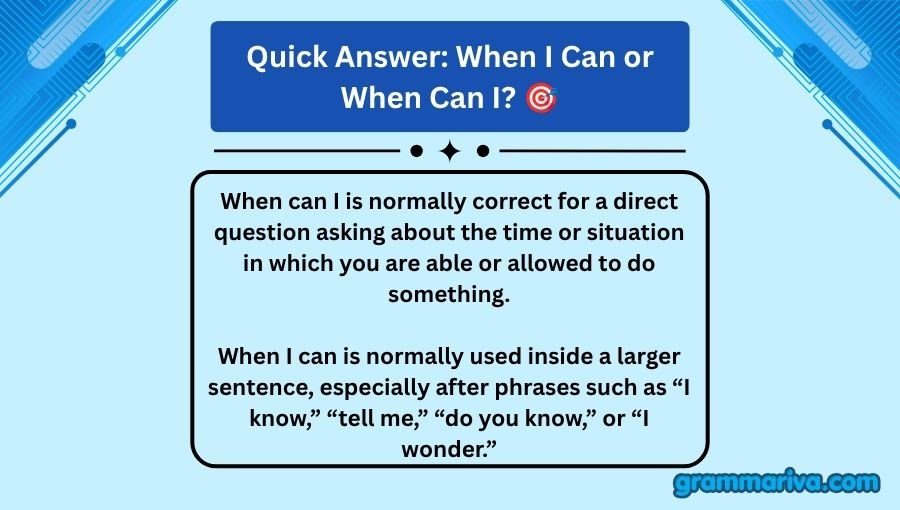
When can I is normally correct for a direct question asking about the time or situation in which you are able or allowed to do something.
When I can is normally used inside a larger sentence, especially after phrases such as “I know,” “tell me,” “do you know,” or “I wonder.”
| Expression | Main Use | Example |
|---|---|---|
| When can I | Direct question | When can I call you? |
| When I can | Part of a larger sentence | Tell me when I can call you. |
| When can I | Asking about possibility or permission | When can I start? |
| When I can | Reporting or discussing a question | I want to know when I can start. |
The key difference is sentence structure, not meaning alone.
Is When I Can or When Can I the Correct Form? 🧭
Both forms can be correct. The right choice depends on whether you are asking a direct question or placing the question inside another sentence.
Use “when can I” when you are directly asking someone something:
When can I visit?
Use “when I can” when the question becomes part of another sentence:
Do you know when I can visit?
This difference is called subject-auxiliary inversion in direct questions. In simple terms, the helping verb moves before the subject in a direct question.
| Form | Type | Meaning | Example | Correct/Incorrect |
|---|---|---|---|---|
| When can I | Direct question | Asking when something is possible | When can I leave? | ✅ Correct |
| When I can | Embedded question | Referring to when something is possible | Tell me when I can leave. | ✅ Correct |
| When I can? | Direct question | Intended as a direct question | When I can leave? | ❌ Usually incorrect |
| When can I leave? | Direct question | Asking about leaving | When can I leave? | ✅ Correct |
| I know when can I leave. | Embedded question | Reporting information | I know when can I leave. | ❌ Incorrect |
| I know when I can leave. | Embedded question | Reporting information | I know when I can leave. | ✅ Correct |
The basic pattern
A direct question often follows this pattern:
Question word + helping verb + subject + main verb
When + can + I + leave?
An embedded question usually follows this pattern:
Question word + subject + helping verb + main verb
when + I + can + leave
That small change explains most examples involving this pair.
When Can I Work as a Direct Question? ❓
When can I is used when you are asking a question directly. The phrase usually comes at the beginning of the sentence.
Examples include:
- When can I call you?
- When can I start?
- When can I submit the form?
- When can I visit?
- When can I expect an answer?
Notice the word order. Can comes before I.
Asking about permission
You can use when can I to ask when you have permission to do something.
When can I enter the room?
Here, the speaker wants to know the earliest or appropriate time for entry.
Asking about possibility
The phrase can also ask when something will be possible.
When can I book an appointment?
The speaker is asking about available timing.
Asking about plans
It can also be used in casual planning.
When can I see you?
The question asks about a suitable time.
| Meaning | Word Type | Example Sentence |
|---|---|---|
| Permission | Modal question | When can I leave the office? |
| Possibility | Modal question | When can I apply? |
| Availability | Modal question | When can I meet you? |
| Expected timing | Modal question | When can I expect the results? |
💡 Test Tip
If you can put a question mark at the end and the sentence is a complete question spoken directly to someone, “when can I” is usually the correct pattern.
When can I start?
That sounds natural.
When I can start?
That does not normally work as a standard direct question.
When I Can Belongs Inside a Larger Sentence 📝
When I can is commonly used when the question is embedded inside another sentence.
An embedded question is a question idea placed inside a larger statement or question.
Compare:
When can I leave?
with:
Do you know when I can leave?
The first sentence asks the question directly. The second sentence asks whether the listener knows the answer.
In the second sentence, I comes before can.
Common structures
You will often see when I can after phrases such as:
- Do you know…
- I wonder…
- Tell me…
- Can you tell me…
- I want to know…
- I need to know…
- Please let me know…
Examples:
Can you tell me when I can apply?
I wonder when I can visit.
Please let me know when I can start.
I need to know when I can submit the report.
| Beginning Phrase | Correct Embedded Form | Example |
|---|---|---|
| Do you know… | when I can | Do you know when I can leave? |
| Tell me… | when I can | Tell me when I can call. |
| I wonder… | when I can | I wonder when I can apply. |
| I need to know… | when I can | I need to know when I can register. |
| Can you tell me… | when I can | Can you tell me when I can begin? |
Why Does the Word Order Change? 🔎
The word order changes because direct questions and embedded questions follow different grammar patterns.
In a direct question, English often moves the helping verb before the subject.
When can I leave?
In an embedded question, the clause usually keeps statement-like word order.
I know when I can leave.
The word can is a modal helping verb. In a direct question, it comes before the subject I.
This gives us a simple contrast:
Direct question:
When + can + I + leave?
Embedded question:
I know + when + I + can + leave.
The meaning stays closely related. The grammatical structure changes.
| Sentence | Question Type | Word Order |
|---|---|---|
| When can I leave? | Direct | can + I |
| Do you know when I can leave? | Embedded | I + can |
| When can I call? | Direct | can + I |
| Tell me when I can call. | Embedded | I + can |
| When can I apply? | Direct | can + I |
| I wonder when I can apply. | Embedded | I + can |
When I Can or When Can I in Everyday English 💬
In everyday conversation, both forms are common because people regularly ask direct questions and then talk about those questions inside longer sentences.
Consider this short conversation:
Person A: When can I pick up my package?
Person B: You can pick it up after three.
Later, Person A might say:
I asked the clerk when I can pick up my package.
The first sentence is a direct question. The second uses an embedded structure.
I once heard a student ask, “Can you tell me when can I come?” The student knew the vocabulary and the meaning was clear. The only problem was the word order. I changed it to “Can you tell me when I can come?” and explained that the second part was no longer a direct question.
That small change made the sentence sound much more natural.
Can You Use When Can I Inside a Larger Sentence? 🤔
Usually, you should not use normal direct-question word order inside an ordinary embedded question.
For example:
Do you know when I can leave? ✅
is standard.
Do you know when can I leave? ❌
is not the standard embedded-question structure.
However, a direct question can appear as a separate sentence inside a conversation or quotation:
I asked myself, “When can I leave?”
Here, when can I leave is still functioning as a direct question. It is presented as a question rather than as an embedded clause.
| Structure | Example | Standard? |
|---|---|---|
| Direct question | When can I leave? | ✅ |
| Embedded question | Do you know when I can leave? | ✅ |
| Statement with embedded question | I know when I can leave. | ✅ |
| Incorrect embedded inversion | I know when can I leave. | ❌ |
| Quoted direct question | She asked, “When can I leave?” | ✅ |
When I Can or When Can I at a Glance 📊
The easiest way to remember the difference is to look at what comes before the phrase.
If you are asking directly, use when can I.
If you are reporting, discussing, or embedding the question, use when I can.
| Sentence | Correct/Incorrect | Why |
|---|---|---|
| When can I call you? | ✅ Correct | It is a direct question. |
| Do you know when I can call you? | ✅ Correct | It is an embedded question. |
| Tell me when can I call you. | ❌ Incorrect | The embedded clause uses the wrong word order. |
| I wonder when I can call you. | ✅ Correct | The question is embedded. |
| When I can call you? | ❌ Usually incorrect | It uses embedded word order as a direct question. |
A simple memory trick
Think:
Direct = CAN I
Inside another sentence = I CAN
So:
When can I go?
but:
Do you know when I can go?
This is one of the fastest ways to remember the rule.
How Do You Know Which Form to Choose? 🧠
Ask yourself one question:
Am I asking the question directly?
If the answer is yes, use when can I.
If the answer is no because the question is part of another sentence, use when I can.
Example 1
When can I order?
You are directly asking someone.
Use when can I.
Example 2
I need to know when I can order.
You are not directly asking “When can I order?” You are stating what information you need.
Use when I can.
Example 3
Can you tell me when I can order?
The entire sentence is a question, but when I can order is an embedded question.
Use when I can.
| Ask Yourself | If Yes | Example |
|---|---|---|
| Am I asking directly? | Use when can I | When can I order? |
| Is it inside another sentence? | Use when I can | Tell me when I can order. |
| Am I quoting a direct question? | Use when can I | He asked, “When can I order?” |
| Am I reporting a question? | Use when I can | He asked when I could order. |
Case Study: A Workplace Email 📧
Imagine that you work at a company and need to ask your manager about taking time off.
A direct question could be:
When can I take my vacation?
That is clear and natural.
Now imagine that you are writing an email:
Could you please let me know when I can take my vacation?
Here, when I can take my vacation is part of a larger sentence.
A more casual workplace message might be:
Do you know when I can submit my vacation request?
Again, the embedded clause uses I can, not can I.
I once edited a short workplace message that said, “Please tell me when can I send the file.” The writer was trying to sound polite, but the grammar became less natural because the direct-question structure was placed inside an embedded question. I changed it to “Please tell me when I can send the file.” The meaning stayed exactly the same.
| Workplace Situation | Best Form | Example |
|---|---|---|
| Asking your manager directly | When can I | When can I take Friday off? |
| Asking politely in an email | When I can | Could you tell me when I can take Friday off? |
| Reporting what you asked | When I can | I asked when I can take Friday off. |
| Quoting your exact question | When can I | I asked, “When can I take Friday off?” |
Grammar Rules Explanation 📚
The rule is based on the difference between direct questions and embedded questions.
In a direct question, a modal such as can usually comes before the subject.
When can I leave?
The pattern is:
Question word + modal + subject + verb
In an embedded question, the clause follows normal statement word order.
I know when I can leave.
The pattern is:
Question word + subject + modal + verb
This is why the following pair differs:
When can I leave?
Do you know when I can leave?
The first is a direct question. The second contains an embedded question.
Standard English grammar references and major dictionaries follow this general distinction between direct and embedded question structures.
Correct vs Incorrect at a Glance
| Sentence | Correct/Incorrect | Why |
|---|---|---|
| When can I start? | ✅ Correct | Direct question structure. |
| Do you know when I can start? | ✅ Correct | Embedded question structure. |
| I wonder when I can start. | ✅ Correct | Embedded question structure. |
| I wonder when can I start. | ❌ Incorrect | The direct-question order is used inside an embedded clause. |
| Tell me when I can start. | ✅ Correct | Normal embedded word order. |
One important point is that the outer sentence can still be a question:
Can you tell me when I can leave?
The word can at the beginning belongs to the main question. The words I can belong to the embedded question.
What Are the Most Common Mistakes? ⚠️
People often make this mistake because the two structures look almost identical.
Three common causes are:
- Fast typing: People write the words in the order that first comes to mind.
- Autocorrect: A phone may change or suggest wording without understanding the whole sentence.
- Lack of knowledge: Learners may know both words but not know when English changes the word order.
Another problem is that some languages use different question structures. A learner may naturally transfer the pattern from their first language into English.
Similar grammar confusions
| Confusion | Correct Form | Common Error |
|---|---|---|
| it’s / its | It’s cold. / Its color is bright. | Mixing the contraction and possessive form |
| your / you’re | Your bag is here. / You’re early. | Using your for you’re |
| their / there | Their car is new. / It is there. | Mixing location and possession |
| then / than | First this, then that. / Taller than me. | Mixing time and comparison |
| who / whom | Who called? | Using whom in every situation |
| can I / I can | When can I go? / Tell me when I can go. | Mixing direct and embedded order |
Specific wrong forms
| Wrong Form | What’s Wrong | Correct Form |
|---|---|---|
| When I can go? | Embedded order used as a direct question | When can I go? |
| Do you know when can I go? | Direct inversion used inside an embedded question | Do you know when I can go? |
| Tell me when can I start. | Wrong order after “tell me” | Tell me when I can start. |
| I wonder when can I apply. | Embedded question needs statement order | I wonder when I can apply. |
| Can you explain when can I leave? | Direct order is incorrectly embedded | Can you explain when I can leave? |
Does This Rule Apply to Other Question Words? 🔤
Yes. The same basic idea appears with other question words such as where, why, how, what, and who.
Compare:
Where can I park?
with:
Do you know where I can park?
The direct question has can I.
The embedded question has I can.
The same pattern appears with why:
Why can I not enter?
I want to know why I cannot enter.
The exact structure can change depending on the verb and meaning, but the main lesson remains useful: direct questions and embedded questions can have different word orders.
| Question Word | Direct Question | Embedded Question |
|---|---|---|
| When | When can I leave? | Tell me when I can leave. |
| Where | Where can I park? | Do you know where I can park? |
| How | How can I apply? | I want to know how I can apply. |
| What | What can I do? | Tell me what I can do. |
| Why | Why can I not enter? | I wonder why I cannot enter. |
Usage in Different Contexts 🌎
The distinction matters in almost every kind of English writing.
Everyday conversation
Direct questions are very common:
When can I see you?
But embedded questions are also common:
Do you know when I can see you?
Professional writing
Polite workplace questions often use embedded structures:
Could you let me know when I can submit the document?
This sounds polite because the sentence is framed as a request for information.
Creative writing
Writers can use both forms depending on the scene:
“When can I leave?” she asked.
or:
She wondered when she could leave.
Social media and texting
Informal messages may be shorter:
When can I come over?
But a longer message might say:
Let me know when I can come over.
| Context | Which Term to Use | Example |
|---|---|---|
| Everyday conversation | When can I for direct questions | When can I call? |
| Professional writing | When I can in embedded questions | Please tell me when I can call. |
| Creative writing | Either, based on structure | He asked when he could return. |
| Social media/texting | Either, based on structure | When can I join? |
Can I Use These Forms With Other Modal Verbs? 💡
Yes. The same idea applies to modal verbs such as could, should, would, and may, although the exact meaning changes.
Compare:
When could I visit?
with:
Do you know when I could visit?
The direct question uses could I. The embedded question uses I could.
Another example:
When should I arrive?
Please tell me when I should arrive.
The same word-order pattern is easy to see.
| Direct Question | Embedded Question |
|---|---|
| When can I leave? | Tell me when I can leave. |
| When could I leave? | Tell me when I could leave. |
| When should I leave? | Tell me when I should leave. |
| When would I leave? | I wonder when I would leave. |
| When may I leave? | Please tell me when I may leave. |
This helps show that the lesson is not only about the word can. It is also about how English builds direct and embedded questions.
Common Phrases With When I Can and When Can I 💬
These phrases appear often in natural English.
| Phrase | Meaning |
|---|---|
| When can I…? | Directly asking about a possible time |
| Do you know when I can…? | Asking someone for information |
| Tell me when I can… | Asking someone to provide the time or condition |
| Let me know when I can… | Asking someone to inform you later |
| I wonder when I can… | Expressing uncertainty |
| I need to know when I can… | Saying that the information is needed |
Examples:
When can I apply?
Let me know when I can apply.
I wonder when I can apply.
Do you know when I can apply?
These sentences all concern timing or possibility. Their structures simply differ.
Synonyms and Alternatives for Asking About Time ⏰
Sometimes you do not need either exact form. You can rewrite the sentence.
For example, instead of:
When can I leave?
you could say:
What time may I leave?
Or:
What time am I allowed to leave?
However, these alternatives can change the tone or meaning slightly.
| Alternative | Works When | Does Not Work When |
|---|---|---|
| What time can I…? | Asking for a specific time | You are asking about a general opportunity |
| When am I allowed to…? | Asking about permission | You are only asking about convenience |
| What time should I…? | Asking about the recommended time | You want to know when something becomes possible |
| When is it possible for me to…? | Formal or detailed writing | Casual conversation may sound too wordy |
| What time works for me to…? | Planning a meeting or activity | Asking about official permission |
The shortest option is often the most natural:
When can I come?
Why Does Getting This Right Matter? 🎯
Grammar affects how clearly your message is understood. A small word-order mistake may not stop someone from understanding you, but it can make your writing sound less natural.
In professional writing, clear question structure helps your emails and requests sound polished.
In schoolwork, correct grammar shows that you understand how English sentence patterns work.
In digital communication, clear grammar prevents readers from stopping to figure out what you mean.
“Clear writing makes the reader’s job easier.”
That simple idea is worth remembering.
| Situation | Why Getting It Right Matters |
|---|---|
| Resume or application | Shows careful language use |
| Client email | Makes requests clear and professional |
| Published content | Improves grammar and readability |
| Social post | Makes short messages easier to understand |
How Can You Remember the Difference? 🧩
I recommend using a two-step test.
Step 1: Look at the sentence
Ask whether you are speaking directly to someone.
When can I start?
If yes, use can I.
Step 2: Look for an opening phrase
If the phrase follows something like:
- Do you know…
- Tell me…
- I wonder…
- I need to know…
- Please let me know…
then you are probably dealing with an embedded question.
Do you know when I can start?
The CAN I / I CAN trick
Memorize this tiny pattern:
Direct: CAN I?
Embedded: I CAN.
Then build the sentence around it.
When can I start?
Do you know when I can start?
This trick works especially well when you are writing quickly.
Quick Recap Checklist ✅
Use this checklist whenever you are unsure.
| Question | If Yes → Use |
|---|---|
| Am I asking directly? | When can I |
| Is the question inside another sentence? | When I can |
| Am I quoting a direct question? | When can I |
| Am I reporting or discussing the question? | When I can |
| Does the sentence begin with “Do you know,” “tell me,” or “I wonder”? | Usually when I can |
Practice examples
1. ___ I submit the form?
Answer: When can I submit the form? ✅
2. Can you tell me ___ submit the form?
Answer: when I can submit the form. ✅
3. I wonder ___ visit.
Answer: when I can visit. ✅
Try saying each pair aloud. Hearing the difference can make the pattern easier to remember.
FAQs About When I Can vs When Can I ❓
Is “when can I” grammatically correct?
Yes. When can I is the standard structure for a direct question asking when you can do something.
When can I leave?
Is “when I can” grammatically correct?
Yes. When I can is correct when it appears as part of a larger sentence.
Please tell me when I can leave.
Should I say “When can I go?” or “When I can go?”
For a direct question, say “When can I go?”
For an embedded question, use “when I can go.”
Do you know when I can go?
Is “Do you know when can I go?” correct?
No, not in standard English. The embedded question should use normal subject-before-modal order:
Do you know when I can go?
Why do we say “when I can” after “tell me”?
Because tell me when I can… contains an embedded question. The embedded clause does not normally use the inverted order of a direct question.
Tell me when I can leave.
Can “when I can” begin a sentence?
Yes, but it normally needs to be part of a larger structure.
For example:
When I can, I will help you.
Here, when I can has a different function. It means roughly “at the times when I am able to.” It is not simply a direct question.
Can I use “when can I” in an email?
Absolutely. Use it when you are asking a direct question:
When can I schedule the meeting?
For a softer request, an embedded form may sound more polite:
Could you let me know when I can schedule the meeting?
Does the same rule apply to “where can I”?
Yes. Compare:
Where can I park?
with:
Do you know where I can park?
The same direct-versus-embedded pattern applies.
Is “when can I” more formal than “when I can”?
Neither form is automatically more formal. The difference is grammatical structure. However, an embedded question can sound more polite when used in a request.
When can I speak with you?
Could you tell me when I can speak with you?
The second version is framed as a polite request.
What is the easiest way to remember the rule?
Remember:
Direct question = CAN I
Embedded question = I CAN
So write:
When can I leave?
but:
Do you know when I can leave?
Conclusion 🌟
When i can or when can i is a simple grammar choice once you understand the difference between direct and embedded questions. For a direct question, use “when can I.” For a question placed inside a larger sentence, use “when I can.”
The easiest memory trick is CAN I for direct questions, I CAN for embedded questions. That one pattern will help you with many similar structures, including “where can I,” “how can I,” and other modal questions.
For example, ask:
When can I start?
But write:
Can you tell me when I can start?
Both sentences communicate the same basic idea. The grammar changes because the sentence structure changes.
I always recommend saying the sentence aloud when you are unsure. Your ear will often catch an awkward word order before your eyes do. 😊 Once you practice a few pairs, this distinction becomes almost automatic.
Keep this rule in mind: direct questions invert; embedded questions normally do not. Master that pattern, and you will have one more useful piece of English grammar firmly under control. 🚀

Hi, I’m Olivia Carter. I’m an English language editor at Grammariva, and I work on making grammar lessons clear, accurate, and easy to follow. I especially enjoy writing about common grammar mistakes and everyday English.
[…] By the end, you should be able to choose the correct phrase without stopping to think twice. 👍 When I Can or When Can I | Its Self or Itself | Unregister vs […]
[…] choose the right form quickly and confidently. 🚀 Mine as Well or Might as Well or Mind as Well | When I Can or When Can I | Its Self or […]