Have you ever typed a sentence and stopped because you were unsure whether mine as well or might as well or mind as well was the right phrase? You are not alone. These three versions look and sound close, especially when you hear them in fast speech. But only one is the standard expression when you mean that something is a sensible or reasonable thing to do.
The correct phrase is might as well. It is used when there is little reason not to do something, or when an action seems like the best choice in a situation. 😊
The other two forms, mine as well and mind as well, are not standard replacements for this expression. They usually appear because of spelling mistakes, sound-based typing, autocorrect, or confusion about the word might.
In this guide, I will explain the difference in plain US English. You will see clear examples, quick tests, common mistakes, tables, real-life situations, and simple memory tricks. By the end, you should be able to choose the correct phrase without stopping to think twice. 👍 When I Can or When Can I | Its Self or Itself | Unregister vs Deregister
🎯 Quick Answer: Mine as Well or Might as Well or Mind as Well
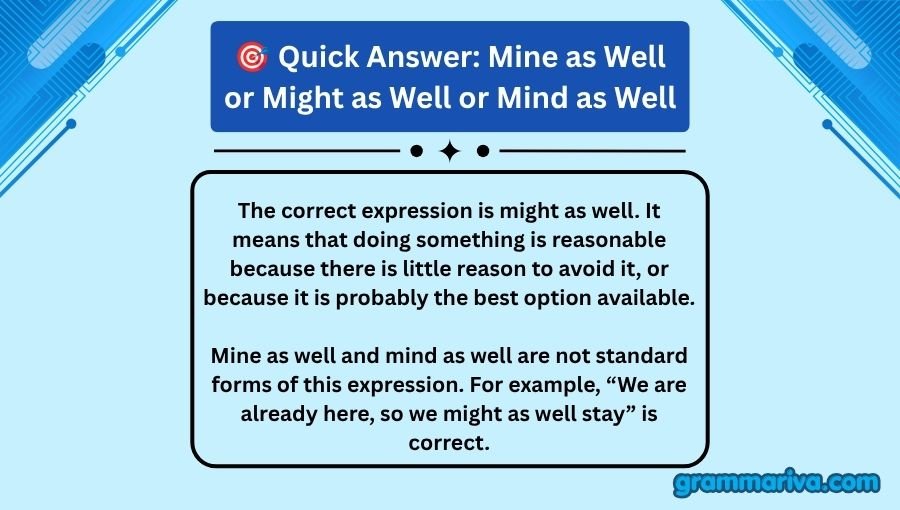
The correct expression is might as well. It means that doing something is reasonable because there is little reason to avoid it, or because it is probably the best option available.
Mine as well and mind as well are not standard forms of this expression. For example, “We are already here, so we might as well stay” is correct.
📚 Related Word Forms and Nearby Words
The confusion becomes easier when you look at the individual words. Might, mine, and mind are different words with different jobs.
| Form | Type | Example |
|---|---|---|
| might | Modal verb | We might leave early. |
| mine | Possessive pronoun | That backpack is mine. |
| mind | Verb or noun | Please mind the door. |
| might as well | Fixed expression | We might as well begin. |
The key point is simple: might as well works as a set phrase. You should not replace might with mine or mind.
❓ What Is the Difference Between Might as Well and the Other Forms?
Might as well is the standard phrase for saying that an action is reasonable or has little downside. Mine as well and mind as well do not normally carry this meaning.
Consider these examples:
| Form | Type | Meaning | Example | Correct/Incorrect |
|---|---|---|---|---|
| might as well | Expression | A reasonable choice | We might as well order pizza. | ✅ Correct |
| mine as well | Incorrect phrase | No standard meaning here | We mine as well order pizza. | ❌ Incorrect |
| mind as well | Incorrect phrase | No standard meaning here | We mind as well order pizza. | ❌ Incorrect |
| might | Modal verb | Possibility | It might rain. | ✅ Correct |
| mine | Possessive pronoun | Belonging to me | The blue car is mine. | ✅ Correct |
| mind | Verb/noun | Pay attention or thoughts | Mind the step. | ✅ Correct |
The last three words are real English words. The problem comes when they are placed into the fixed expression.
Why Might Is the Correct Word
Might is a modal verb. It can express possibility. In the expression might as well, it helps create a meaning close to “there is no good reason not to” or “this seems like the sensible choice.”
For example:
We are already at the store, so we might as well buy the groceries.
The speaker is saying that buying the groceries makes sense because they are already there.
Why Mine Does Not Work
Mine is a possessive pronoun. It tells us that something belongs to the speaker.
That notebook is mine.
Here, mine has a clear possessive job. It cannot normally replace might in might as well.
Why Mind Does Not Work
Mind can be a verb or a noun. As a verb, it can mean to pay attention to, care about, or object to something.
Please mind the gap.
That meaning has nothing to do with the fixed expression might as well.
💡 How Do You Use Might as Well Correctly?
Use might as well when an action seems reasonable because of the situation. It often suggests that another option is not useful, possible, or worth choosing.
Here are common patterns:
Subject + might as well + base verb
We might as well leave now.
You might as well tell her the truth.
I might as well finish the report tonight.
Notice that the verb after might as well stays in its base form.
You say:
✅ We might as well go.
Not:
❌ We might as well going.
And not:
❌ We might as well to go.
Meaning 1: There Is Little Reason Not To
This is one of the most common uses.
The movie starts in ten minutes, so we might as well wait.
The speaker could leave, but waiting makes more sense.
Meaning 2: This Is the Best Choice Available
Sometimes there are no perfect choices.
We missed the earlier train, so we might as well take the next one.
The next train may not be ideal, but it is the sensible option.
Meaning 3: The Action Is Convenient
The phrase can also show that something is easy to do because you are already in the right situation.
I am going to the kitchen, so I might as well make some coffee.
The speaker is already going to the kitchen. Making coffee is convenient.
| Meaning | Word Type | Example Sentence |
|---|---|---|
| Little reason not to | Fixed expression | We might as well stay. |
| Best available choice | Fixed expression | We might as well take a taxi. |
| Convenient action | Fixed expression | I am cooking, so I might as well make extra food. |
🧠 Test Tip
Ask yourself:
“Am I saying that this action is reasonable or that there is little reason not to do it?”
If yes, might as well is probably the phrase you need.
❓ Can Mine as Well Ever Be Correct?
Yes, the words mine and as well can appear in the same sentence, but that does not make mine as well a fixed expression.
For example:
That seat is mine as well.
This can be grammatically possible in a special context where mine has its normal possessive meaning and as well means “also.”
However, this is very different from the common expression might as well.
Compare:
✅ You can take my old laptop. The newer one is mine as well.
Here, mine means “belonging to me,” while as well means “also.”
But:
❌ We are already here, so we mine as well stay.
This is incorrect because mine is being used as though it were might.
| Sentence | Meaning | Correct? |
|---|---|---|
| That jacket is mine. | The jacket belongs to me. | ✅ |
| That jacket is mine as well. | The jacket belongs to me too. | ✅ |
| We might as well stay. | Staying is reasonable. | ✅ |
| We mine as well stay. | Incorrect replacement for might. | ❌ |
So, the words can appear next to each other in unusual sentence structures, but mine as well is not the standard expression people mean when they ask about this grammar choice.
❓ Can Mind as Well Be Correct?
Mind as well is not the standard phrase when you mean “there is little reason not to.”
The word mind is perfectly normal English. It simply has a different role.
Please mind the baby.
I do not mind waiting.
She changed her mind.
None of these sentences uses mind as well as the equivalent of might as well.
A common mistake is:
❌ We mind as well go now.
The correct sentence is:
✅ We might as well go now.
I once caught myself reading a rushed text message where I had written “mind as well.” I knew the correct phrase, but I had typed what the word sounded like in quick speech. That small mistake is exactly why this confusion is so common.
| Wrong Form | Correct Form | Example |
|---|---|---|
| mind as well | might as well | We might as well start. |
| mine as well | might as well | You might as well come with us. |
| mind as well go | might as well go | We might as well go now. |
| mine as well try | might as well try | We might as well try. |
📝 Might as Well: Meaning and Correct Use
Might as well is often used when the speaker accepts a practical choice. It does not always show excitement. Sometimes it sounds neutral or slightly resigned.
For example:
The restaurant is closed, so we might as well eat at home.
The speaker did not necessarily prefer eating at home. It simply makes sense now.
Common Sentence Patterns
| Pattern | Example | Purpose |
|---|---|---|
| We might as well + verb | We might as well leave. | Practical choice |
| I might as well + verb | I might as well call him. | Reasonable action |
| You might as well + verb | You might as well ask. | Suggestion |
| They might as well + verb | They might as well stay. | Practical choice |
| Since + situation, might as well | Since we are here, we might as well look around. | Explains the reason |
Positive and Neutral Uses
We might as well celebrate while everyone is here.
This can sound positive.
We missed the bus, so we might as well walk.
This is more neutral.
The phrase depends on context and tone.
❓ Why Do People Confuse Might, Mine, and Mind?
People often confuse these words because they can sound similar in fast speech. Typing habits make the problem worse.
The most common causes are:
- Fast typing
- Autocorrect
- Voice-to-text errors
- Hearing the phrase instead of seeing it
- Lack of knowledge about the fixed expression
- Trying to spell a phrase from sound alone
I once edited a short workplace message that said, “We mine as well send the file today.” The writer knew exactly what they meant. They simply typed the sound they heard in their head. A quick correction changed mine to might.
This shows why context alone is not enough. You also need to know the standard phrase.
| Confusion | Example | Reason |
|---|---|---|
| it’s / its | It’s raining. / The dog wagged its tail. | Sound and apostrophe confusion |
| your / you’re | Your phone / You’re ready | Similar sound |
| they’re / their / there | They’re here. / Their car / Over there | Similar pronunciation |
| to / too / two | Go to school. / Me too. / Two books | Similar sound |
| might / mine / mind | Might as well go. | Similar-looking or misheard forms |
The lesson is simple: when a phrase is fixed, learn the complete phrase instead of guessing from sound.
⚠️ Common Wrong Spellings and Uses
The specific confusion can appear in several forms. Most are simple typing or word-choice mistakes.
| Wrong Form | What’s Wrong | Correct Form |
|---|---|---|
| mine as well | Mine is not the modal verb needed here. | might as well |
| mind as well | Mind has a different meaning. | might as well |
| might aswell | The phrase is normally written as two words. | might as well |
| might as going | The verb form is wrong after might. | might as well go |
| might to go | Do not use to after might. | might go |
| might as well to leave | Extra to is unnecessary. | might as well leave |
One of the easiest ways to avoid these mistakes is to memorize the complete structure:
might + as + well + base verb
For example:
We might as well start.
I might as well ask.
They might as well wait.
🧩 Grammar Rules Explanation
The standard construction is might as well + base verb.
Might is a modal auxiliary verb. Modal verbs are followed by the base form of another verb. In this expression, as well is part of the phrase that gives the sentence its practical-choice meaning.
For example:
We might as well leave.
The structure is:
- We = subject
- might = modal verb
- as well = expression completing the construction
- leave = base verb
The phrase does not work by swapping might with any similar-looking word.
Mine is a possessive pronoun. Mind can function as a verb or noun. Neither performs the same grammatical job as might in this construction.
Standard English reference works and dictionaries consistently recognize might as well as the normal expression for this meaning.
Correct vs Incorrect at a Glance
| Sentence | Correct/Incorrect | Why |
|---|---|---|
| We might as well leave now. | ✅ Correct | Might as well expresses a reasonable choice. |
| We mine as well leave now. | ❌ Incorrect | Mine is not the correct modal verb. |
| You might as well ask him. | ✅ Correct | The action is presented as reasonable. |
| You mind as well ask him. | ❌ Incorrect | Mind cannot replace might here. |
| Since we are already here, we might as well look around. | ✅ Correct | The situation makes the action practical. |
❓ Is Might as Well the Same as May as Well?
Might as well and may as well can sometimes express a similar idea, but might as well is the more familiar choice in many everyday sentences.
For example:
We might as well leave.
You may also hear:
We may as well leave.
Both can communicate that leaving is a reasonable choice.
However, do not turn this into mine as well or mind as well. The important part is that the modal verb must fit the intended grammar.
| Expression | General Use | Example |
|---|---|---|
| might as well | Practical or reasonable choice | We might as well wait. |
| may as well | Similar practical choice | We may as well wait. |
| mine as well | Not the standard expression | ❌ We mine as well wait. |
| mind as well | Not the standard expression | ❌ We mind as well wait. |
📧 How Is Might as Well Used in Real-Life Conversation?
In everyday speech, might as well is extremely useful because people often make quick practical choices.
Imagine two friends waiting for a delayed bus.
Friend 1: “The bus is already twenty minutes late.”
Friend 2: “We might as well walk.”
The second speaker means that walking now seems like a sensible choice.
Another example:
“The meeting starts in five minutes. We might as well go inside.”
The phrase sounds natural because the speakers are responding to a situation.
Case Study: A Workplace Email
Imagine an employee writing:
“The client has already approved the first version, so we might as well send the final copy today.”
This is clear and professional. The writer is saying that sending the final copy makes sense based on what has already happened.
Now compare:
“The client has already approved the first version, so we mine as well send the final copy today.”
The meaning is still easy to guess, but the grammar is wrong. In a workplace email, that mistake can make the message look rushed.
| Situation | Natural Sentence | Result |
|---|---|---|
| Delayed meeting | We might as well start without him. | Practical decision |
| Shopping | We are here, so we might as well buy it. | Convenient choice |
| Work | We might as well send the report today. | Reasonable action |
| Travel | The next train is soon, so we might as well wait. | Practical decision |
🌎 Might as Well in Different Contexts
The phrase works across many types of communication. The main difference is tone.
| Context | Which Term to Use | Example |
|---|---|---|
| Everyday conversation | might as well | We might as well get pizza. |
| Professional writing | might as well | We might as well review the file again. |
| Creative writing | might as well | I might as well take the long road. |
| Social media/texting | might as well | Might as well post it 😂 |
Everyday Conversation
This is where you are most likely to hear the phrase.
“We are already downtown, so we might as well grab lunch.”
Professional Writing
It can work in professional writing, but use it when the tone fits.
“Since the draft is complete, we might as well review the final section today.”
Creative Writing
Writers may use the phrase to show a character making a decision.
“The storm had already started. She might as well keep walking.”
Social Media and Texting
Casual communication often uses shorter versions.
“Might as well send it 😂”
The subject may be left out because the context makes it obvious.
❓ Does Might as Well Always Mean You Want to Do Something?
No. Might as well does not always mean strong desire. It often means that an action is practical under the circumstances.
For example:
I missed my train, so I might as well get some coffee.
The speaker may not have planned to get coffee. The delay simply creates a reason to do it.
This is one reason the phrase is useful. It can show acceptance of a situation.
| Situation | What the Phrase Suggests |
|---|---|
| No better option | This is reasonable now. |
| Convenient opportunity | I can do this while I am here. |
| Changed plans | This is the next sensible choice. |
| Minor decision | There is little reason not to do it. |
💬 Common Phrases With Might as Well
There are several natural sentence patterns built around the phrase.
| Phrase | Meaning |
|---|---|
| might as well go | Going is reasonable |
| might as well stay | Staying is reasonable |
| might as well try | Trying has little downside |
| might as well ask | Asking is worth doing |
| might as well wait | Waiting is practical |
| might as well do it | The action seems reasonable |
These are not separate idioms. They are common combinations using the same basic structure.
❓ What Are Good Alternatives to Might as Well?
You can replace might as well in some situations with phrases such as “may as well,” “there is no reason not to,” or “it makes sense to.” The best choice depends on tone.
| Alternative | Works When | Does Not Work When |
|---|---|---|
| may as well | You want a similar practical meaning | You need a very different meaning |
| it makes sense to | You want clear, direct wording | You want a casual conversational tone |
| there is no reason not to | You want to explain the logic | You need a short casual phrase |
| why not | You want a casual suggestion | You need a formal explanation |
| we could | You want to present an option | You mean there is little reason not to |
For example:
We might as well leave.
Could become:
It makes sense to leave.
Or:
Why not leave?
The meanings are close, but the tone changes.
❓ Why Does Getting This Phrase Right Matter?
Correct word choice makes your writing easier to trust. A small mistake may not change the meaning, but it can distract the reader.
This matters most in professional communication, published writing, schoolwork, and content creation.
A useful rule I tell writers is:
Clear words make clear ideas easier to understand.
You do not need complicated grammar to sound professional. You need the right words in the right places.
| Situation | Why Getting It Right Matters |
|---|---|
| Resume | Shows careful writing |
| Client email | Builds confidence and clarity |
| Published content | Keeps the writing polished |
| Social post | Prevents avoidable spelling errors |
A reader may understand “We mine as well go.” But they will still notice the mistake.
🧠 How To Remember the Difference
The easiest memory trick is to connect might with possibility.
Think:
might = maybe
Then remember:
might as well = this is probably a reasonable thing to do
For example:
It might rain.
This uses might to show possibility.
We might as well leave.
This uses might as well to show a practical choice.
Do not connect the phrase to mine or mind. Those words belong to different grammar patterns.
A Simple Memory Rule
If you mean “we should probably do it because there is little reason not to,” choose “might as well.”
Try these:
We are already dressed, so we might as well go.
The store closes soon, so we might as well hurry.
You are already calling her, so you might as well ask.
❓ How Can You Tell Which Form Is Correct?
Look at the word after the phrase and ask what meaning you want.
If you mean a practical choice, use might as well.
If you mean ownership, mine may be correct.
If you mean paying attention or caring, mind may be correct.
| Meaning You Want | Correct Word | Example |
|---|---|---|
| Practical choice | might | We might as well leave. |
| Ownership | mine | The phone is mine. |
| Pay attention | mind | Mind the step. |
| Care or object | mind | I do not mind waiting. |
This test works because it checks meaning instead of spelling.
⚠️ When Autocorrect and Fast Typing Cause Problems
Modern typing can create strange mistakes. A phone may suggest a familiar word even when it is wrong for the sentence.
Voice-to-text can also turn might into mine or mind. Fast typing creates the same problem.
If you frequently write this phrase, train yourself to scan for it before publishing.
My Three-Second Editing Check
When I proofread, I use a simple process:
- Find the phrase.
- Ask what it means.
- Check that the word is might.
- Check that the next verb is in its base form.
For example:
❌ We might as well going home.
Becomes:
✅ We might as well go home.
This takes only a few seconds.
❓ Can You Say “Might as Well” in Formal Writing?
Yes. Might as well is grammatically correct in standard English and can appear in professional writing. Still, the tone should fit the situation.
For highly formal writing, “it would be reasonable to” may sometimes sound more precise.
Compare:
We might as well review the proposal again.
With:
It would be reasonable to review the proposal again.
Both are grammatical. The second is more formal.
| Writing Style | Best Choice |
|---|---|
| Casual text | might as well |
| Friendly email | might as well |
| Normal workplace writing | might as well |
| Formal report | It may be reasonable to… |
| Academic argument | It would be reasonable to… |
The phrase itself is not wrong or unprofessional. Context determines whether it is the best style choice.
📝 Practice Examples: Test Yourself
Before checking the answers, choose the word that completes each sentence.
- We are already at the beach, so we ___ as well stay.
- That red umbrella is ___.
- Please ___ the wet floor.
- The movie starts soon, so we ___ as well go inside.
- I do not ___ waiting for ten minutes.
Answers
| No. | Answer | Why |
|---|---|---|
| 1 | might | Practical choice |
| 2 | mine | Shows ownership |
| 3 | mind | Means pay attention to |
| 4 | might | Practical choice |
| 5 | mind | Means object to/care about |
The biggest clue is always the meaning.
❓ Is “Might as Well” Better Than “Mine as Well”?
Yes, when you mean that an action is reasonable or that there is little reason not to do it, might as well is the correct standard choice.
For example:
✅ We might as well order now.
Not:
❌ We mine as well order now.
The incorrect version may be understandable because the reader can guess what you meant. Still, it should be corrected in polished English.
❓ Is “Mind as Well” Ever a Replacement for “Might as Well”?
No. Mind as well is not the standard replacement for might as well.
Mind remains a separate word with its own meanings.
I do not mind helping.
Mind the stairs.
She changed her mind.
When you mean “we should probably do this,” use:
We might as well do it.
This distinction is especially useful for writers who rely on speech-to-text or type quickly.
❓ What Is the Fastest Way To Fix the Mistake?
Replace mine as well or mind as well with might as well when the sentence expresses a practical choice.
Use this quick test:
Does the sentence mean “there is little reason not to”?
If yes:
might as well
If the sentence means “belongs to me,” use mine.
If it means “pay attention,” “care,” or “object,” use mind.
That three-part test solves most cases immediately.
✅ Quick Recap Checklist
| Question | If Yes → Use |
|---|---|
| Do you mean a practical or reasonable choice? | might as well |
| Do you mean something belongs to you? | mine |
| Do you mean pay attention or care? | mind |
| Are you suggesting there is little reason not to act? | might as well |
| Are you writing “mine as well” because it sounds right? | Check it carefully |
Practice Examples
We are already here, so we might as well stay. ✅
That blue notebook is mine. ✅
Please mind the step. ✅
Remember the meanings, not just the spelling.
❓ What Does “Might as Well” Mean?
Might as well means that something is a reasonable choice because there is little reason not to do it, or because it is the best option available.
Example:
“We missed the bus, so we might as well walk.”
The speaker is accepting walking as the practical choice.
❓ Is “Mine as Well” Grammatically Correct?
Not as a replacement for might as well. Mine is normally a possessive pronoun, as in “That book is mine.”
The words mine and as well can appear together in a sentence for separate reasons, but mine as well is not the standard fixed phrase meaning “we should probably.”
❓ Is “Mind as Well” Correct English?
Not when you mean might as well. Mind has its own meanings, such as “pay attention to” or “care about.”
Correct:
We might as well leave.
Incorrect:
We mind as well leave.
❓ Should You Say “Might as Well Go” or “Might as Well Going”?
Say might as well go. A modal verb such as might is followed by the base form of the verb.
Correct:
We might as well go.
Incorrect:
We might as well going.
❓ Can “Might as Well” Be Used in a Question?
Yes. It can appear in questions, especially when someone is suggesting a practical choice.
For example:
“Should we wait here?”
“Might as well, since the bus is coming soon.”
It can also appear in a question-like suggestion:
“Why not? We might as well try.”
❓ What Is Another Way To Say “Might as Well”?
Depending on the context, you can say may as well, it makes sense to, why not, or there is no reason not to.
For example:
We might as well leave.
can become:
It makes sense to leave.
The exact replacement depends on the tone and meaning you want.
❓ Why Do People Type “Mine as Well”?
People often type mine as well because might can sound like mine in fast speech. Autocorrect, voice-to-text, and fast typing can also cause the error.
The writer usually knows the intended meaning. The problem is choosing the wrong spelling for the sound.
❓ Why Do People Write “Mind as Well”?
Mind as well often comes from hearing the phrase incorrectly or typing quickly. The word mind is familiar, so the brain may choose it automatically.
But the standard phrase for a practical choice is might as well.
❓ Which Is Correct: Might as Well, Mine as Well, or Mind as Well?
For the meaning “there is little reason not to,” the correct choice is might as well.
✅ We might as well start now.
❌ We mine as well start now.
❌ We mind as well start now.
The other two words are real English words, but they do not replace might in this expression.
❓ Can “May as Well” Also Be Correct?
Yes. May as well can express a similar practical idea.
We may as well leave now.
However, when you are choosing among mine as well, might as well, and mind as well, the standard answer is might as well.
🏁 Conclusion
When you see mine as well or might as well or mind as well, remember that might as well is the standard phrase when you mean that something is a sensible or practical choice. It can suggest that there is little reason not to act, or that one option is the best choice left.
Mine and mind are not interchangeable with might. Mine usually shows ownership, while mind can mean to pay attention, care, or object. They have their own jobs in English.
I recommend memorizing the complete phrase instead of trying to spell it from sound. That small habit can prevent mistakes caused by fast typing, autocorrect, or speech-to-text. 😊
So, if you are already at the store, you might as well buy the item. If you are already writing the sentence, you might as well choose the correct form.
When the meaning is “there is little reason not to,” remember: might as well. ✅

Hi, I’m Ethan Brooks. I’m an English grammar writer at Grammariva, where I work on clear explanations, practical examples, and useful writing tips. I enjoy making difficult grammar topics easier to understand.


[…] and how to use the word naturally in everyday and professional writing. 😊 To Fast or Too Fast | Mine as Well or Might as Well or Mind as Wel | When I Can or When Can […]