Impatient vs inpatient can be confusing because these two words look almost the same. They differ by only one letter, but their meanings are completely different. One describes a person’s feelings or behavior. The other is a medical term for someone receiving care in a hospital or other health facility.
If you have ever written, “The patient was inpatient because he could not wait,” you may have mixed up two words that sound closely related but do very different jobs. Don’t worry. This is an easy mistake to fix. I teach word-choice rules by focusing on meaning first, and this pair is a great example of why that works.
In this guide, I’ll explain impatient vs inpatient with simple definitions, clear examples, comparison charts, memory tricks, common mistakes, and real-life situations. You’ll see how impatient works in everyday English and how inpatient works in medical writing. By the end, the difference should feel natural. ✨ Emasculate or Demasculate | He Is Risen or He Has Risen | Envolved or Involved
Quick Answer: Impatient vs Inpatient 🎯
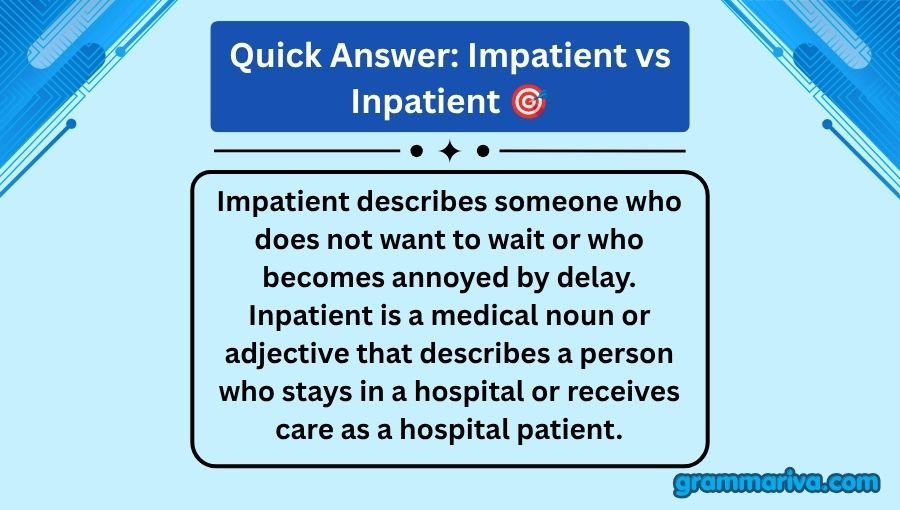
Impatient describes someone who does not want to wait or who becomes annoyed by delay. Inpatient is a medical noun or adjective that describes a person who stays in a hospital or receives care as a hospital patient.
| Word | Meaning | Example |
|---|---|---|
| Impatient | Unable or unwilling to wait calmly | Maria became impatient after waiting an hour. |
| Inpatient | A person receiving care while staying in a medical facility | The inpatient was moved to another room. |
A quick way to remember it is simple: impatient = waiting problem; inpatient = medical care.
Is Impatient the Same as Inpatient? 🤔
No. Impatient and inpatient are not interchangeable. Impatient is mainly an adjective about a person’s attitude, while inpatient is a medical term connected with hospital care.
Consider these two sentences:
- ✅ The customer became impatient while waiting for help.
- ❌ The customer became inpatient while waiting for help.
The first sentence works because the customer is annoyed about waiting. The second changes the meaning to a medical term and does not fit the situation.
Now look at a medical example:
- ✅ The hospital admitted the patient as an inpatient.
- ❌ The hospital admitted the patient as an impatient.
Here, inpatient identifies the person’s medical status. Impatient would describe an attitude instead.
| Feature | Impatient | Inpatient |
|---|---|---|
| Main use | General English | Medical English |
| Word type | Adjective | Noun and adjective |
| Main idea | Not willing to wait | Receiving care while staying at a facility |
| Related idea | Frustration | Hospital treatment |
| Example | He is impatient. | He is an inpatient. |
Impatient vs Inpatient at a Glance 📌
The fastest way to understand impatient vs inpatient is to focus on the letters after the first part of the word.
Impatient contains im-, while inpatient contains in-. More importantly, their meanings tell you which word you need.
| Word | Think About | Typical Question |
|---|---|---|
| Impatient | Waiting and frustration | “Does this person dislike waiting?” |
| Inpatient | Hospital care | “Is this person staying for medical treatment?” |
A simple example
Imagine two people.
John has been waiting 45 minutes for his food. He keeps checking his watch.
- ✅ John is impatient.
- ❌ John is inpatient.
Sarah is staying in a hospital overnight for treatment.
- ❌ Sarah is impatient.
- ✅ Sarah is an inpatient.
The words may look similar, but the context makes the correct choice clear.
What Does Impatient Mean? 😤
Impatient means unwilling to wait calmly or easily annoyed by delays. It can also describe someone who wants something to happen quickly.
The word is usually an adjective.
Example 1: Waiting
The children became impatient while waiting for the bus.
Here, impatient describes the children’s feelings. They do not want to keep waiting.
Example 2: Wanting quick results
He is impatient to see the final results.
The person wants the results soon.
Example 3: Annoyance
She sounded impatient during the phone call.
The word describes her tone and attitude.
| Meaning | Word Type | Example Sentence |
|---|---|---|
| Not willing to wait | Adjective | The passengers were impatient. |
| Easily annoyed by delay | Adjective | He became impatient with the slow service. |
| Wanting something quickly | Adjective | She was impatient to start the project. |
Test Tip 💡
Ask yourself:
“Is this sentence about waiting, delay, frustration, or wanting something quickly?”
If yes, impatient is probably the word you need.
What Does Inpatient Mean? 🏥
Inpatient refers to a person who stays in a hospital or another medical facility while receiving treatment. It can also work as an adjective to describe care or services provided to such patients.
As a noun
The inpatient was taken to the testing area.
Here, inpatient means a person receiving medical care while staying at the facility.
As an adjective
The doctor reviewed the inpatient treatment plan.
Here, inpatient describes the type of treatment.
The key idea is staying for medical care.
| Use | Meaning | Example |
|---|---|---|
| Noun | A patient staying for medical treatment | The inpatient spoke with the nurse. |
| Adjective | Related to care for patients who stay at a facility | The hospital offers inpatient services. |
| Medical setting | Care requiring a stay | He needs inpatient treatment. |
Why Do People Confuse Impatient and Inpatient? 🔍
People confuse these words because they have similar spellings and share the word patient. However, the extra letters at the beginning change the meaning.
I once reviewed a short workplace email where someone wrote, “The manager is inpatient with the slow response.” The writer meant that the manager was tired of waiting. The correct word was impatient. The medical meaning of inpatient made the sentence sound completely wrong.
This kind of mistake often happens when people type quickly. They remember the general shape of the word but do not stop to check its meaning.
| Cause of Confusion | What Happens |
|---|---|
| Similar spelling | The words look almost identical. |
| Shared word part | Both contain “patient.” |
| Fast typing | A writer may choose the wrong form automatically. |
| Autocorrect | Software may not understand the intended meaning. |
| Weak context check | The writer may not ask what the sentence actually means. |
The best solution is not to memorize the spelling alone. Memorize the meaning.
How Is Impatient Used in Everyday English? 💬
Impatient is common in everyday speech and writing. It can describe people, attitudes, reactions, behavior, or even a strong desire for something to happen.
Here are some common patterns.
Impatient with someone or something
The teacher was impatient with the noisy class.
This means the teacher was annoyed by the students’ behavior.
Impatient for something
The fans were impatient for the concert to begin.
They wanted the concert to start quickly.
Impatient to do something
I was impatient to open my birthday gifts.
The speaker strongly wanted to open them.
| Pattern | Example | Meaning |
|---|---|---|
| impatient with | She was impatient with the delay. | Annoyed by something |
| impatient for | They were impatient for news. | Eager for something |
| impatient to | He was impatient to leave. | Eager to do something |
How Is Inpatient Used in Medical Writing? 🩺
Inpatient is mostly used in health care settings. It describes people who stay in a facility for treatment, as well as services designed for those patients.
You may see it in hospital documents, medical forms, health insurance information, and professional communication.
Examples include:
- inpatient care
- inpatient treatment
- inpatient services
- inpatient unit
- inpatient admission
- inpatient facility
| Medical Phrase | Meaning |
|---|---|
| Inpatient care | Medical care provided to patients who stay at the facility |
| Inpatient treatment | Treatment given during such a stay |
| Inpatient unit | A hospital area for admitted patients |
| Inpatient admission | The process of admitting someone for a stay |
| Inpatient services | Services intended for admitted patients |
This is where impatient vs inpatient becomes especially important. A spelling mistake in casual conversation may simply sound funny. In medical writing, it can create real confusion.
Can Impatient and Inpatient Be Used as Nouns? 📝
Inpatient can be used as a noun. Impatient normally cannot be used as a noun in standard modern English.
For example:
- ✅ The inpatient was resting after the procedure.
- ❌ The impatient was resting after the procedure.
The second sentence does not work because impatient normally describes a person rather than naming that person as a noun.
Compare:
The impatient customer left the store.
Here, impatient is an adjective. The noun is customer.
The inpatient left the hospital after treatment.
Here, inpatient itself functions as a noun.
| Word | Noun Use | Adjective Use |
|---|---|---|
| Impatient | Generally no | Yes |
| Inpatient | Yes | Yes |
What Is the Grammar Rule Behind Impatient and Inpatient? 📚
The main grammar rule is based on meaning and word function.
Impatient is an adjective. It describes a person who does not want to wait or who becomes annoyed by delay.
Inpatient can be a noun or an adjective. It refers to medical patients who stay in a facility for treatment or to services connected with that type of care.
Standard English reference sources and dictionaries treat these as separate words with separate meanings. The fact that both contain patient does not make them interchangeable.
Correct vs Incorrect at a Glance
| Sentence | Correct/Incorrect | Why |
|---|---|---|
| She became impatient during the delay. | ✅ Correct | The sentence describes frustration with waiting. |
| She became inpatient during the delay. | ❌ Incorrect | Inpatient has a medical meaning. |
| The hospital admitted him as an inpatient. | ✅ Correct | He is staying for medical care. |
| The hospital admitted him as an impatient. | ❌ Incorrect | Impatient is not the medical noun. |
| The impatient customer asked for help. | ✅ Correct | Impatient describes the customer’s attitude. |
Sentence breakdown
The patient became impatient.
- The patient = noun
- became = linking verb
- impatient = adjective describing the patient
The patient became an inpatient.
- The patient = noun
- became = linking verb
- an inpatient = noun phrase identifying the patient’s medical status
The difference is small in spelling but large in grammar and meaning.
Impatient vs Inpatient in Different Contexts 🌎
The right word depends heavily on the situation. In everyday conversation, impatient is much more common. In health care settings, inpatient is the natural choice when discussing admitted patients.
| Context | Which Term to Use | Example |
|---|---|---|
| Everyday conversation | Impatient | I am getting impatient. |
| Professional writing | Depends on meaning | The client became impatient. |
| Medical writing | Inpatient for hospital care | The inpatient unit was full. |
| Creative writing | Depends on meaning | The impatient traveler checked the clock. |
| Social media/texting | Impatient | I’m too impatient to wait! |
Everyday conversation
I’m getting impatient.
This means the speaker is tired of waiting.
Professional writing
The customer became impatient after several delays.
This is suitable for a business report.
Creative writing
The impatient traveler stared at the empty road.
The word creates a mood.
Social media
Too impatient to wait for the weekend 😂
Here, the word describes the person’s eagerness.
Common Phrases With Impatient and Inpatient 🗣️
These words appear in different types of phrases. Impatient often appears with words connected to waiting, while inpatient appears with medical terms.
| Phrase | Meaning |
|---|---|
| Impatient with the delay | Annoyed about waiting |
| Impatient for results | Eager to receive results |
| Impatient to leave | Eager to leave |
| Inpatient care | Care for admitted patients |
| Inpatient treatment | Treatment during a medical stay |
| Inpatient services | Medical services for admitted patients |
These phrase patterns can help you choose the correct word without stopping to think about spelling.
What Are the Most Common Mistakes With These Words? ⚠️
The most common mistake is using inpatient when the writer means impatient.
For example:
- ❌ I am inpatient because the bus is late.
- ✅ I am impatient because the bus is late.
Another mistake is treating impatient as the noun for a person receiving hospital care.
- ❌ The impatient was moved to another room.
- ✅ The inpatient was moved to another room.
I once caught myself typing “inpatient” in a sentence about a delayed delivery. I had been writing quickly and saw the familiar letters patient. I reread the sentence and noticed that nothing about the situation was medical. That quick meaning check fixed the error immediately.
Similar Word Confusions
| Confusing Pair | Correct Difference |
|---|---|
| it’s / its | it’s = it is; its = possession |
| your / you’re | your = possession; you’re = you are |
| there / their / they’re | Place, possession, and they are |
| affect / effect | Usually verb vs. noun, depending on use |
| then / than | Time/order vs. comparison |
| accept / except | Receive/agree vs. exclude |
Specific Wrong Forms and Corrections
| Wrong Form | What’s Wrong | Correct Form |
|---|---|---|
| inpatient when meaning frustrated | Wrong meaning | impatient |
| impatient when meaning hospital patient | Wrong meaning | inpatient |
| an impatient | Incorrect noun use in this meaning | an inpatient |
| inpatient customer | Usually wrong if the meaning is frustrated | impatient customer |
| impatient care | Wrong medical term | inpatient care |
How Can You Remember the Difference? 🧠
Use a simple memory trick:
Impatient = “I don’t want to wait.”
The word impatient is about a person’s reaction to waiting, delay, or slow progress.
Inpatient = “I am in for medical care.”
The word inpatient connects to someone who is staying in a medical facility for treatment.
| Memory Clue | Word | Meaning |
|---|---|---|
| “I don’t want to wait.” | Impatient | Frustrated or eager |
| “I am in for care.” | Inpatient | Hospital patient |
| Waiting problem | Impatient | Personal feeling |
| Medical stay | Inpatient | Medical status |
Quick memory test
Ask:
Is someone annoyed because they are waiting?
Use impatient.
Is someone staying at a hospital or medical facility for treatment?
Use inpatient.
That two-question test works in most situations.
A Real-Life Case Study: One Letter, Two Very Different Messages 📝
Imagine a hospital employee sending this email:
“Mr. Davis is inpatient because he has been waiting for his test results.”
The writer probably means that Mr. Davis is frustrated about waiting. In that case, the sentence should say:
“Mr. Davis is impatient because he has been waiting for his test results.”
Now imagine a different email:
“Mr. Davis is an inpatient and will remain in the hospital overnight.”
Here, inpatient is correct because the sentence is about his medical status.
The context changes everything.
| Original Idea | Correct Word | Better Sentence |
|---|---|---|
| Frustrated about waiting | Impatient | Mr. Davis is impatient about the delay. |
| Staying for treatment | Inpatient | Mr. Davis is an inpatient. |
| Wants quick results | Impatient | Mr. Davis is impatient for the results. |
| Receiving hospital care | Inpatient | Mr. Davis needs inpatient care. |
This is why I recommend reading the entire sentence before choosing between the two forms.
Why Does Getting Impatient vs Inpatient Right Matter? ✍️
Using the correct word improves clarity. It also helps your writing sound professional.
Imagine reading a medical report that says:
“The inpatient patient became inpatient during the delay.”
The repeated use makes the meaning unclear.
A clearer version would be:
“The inpatient became impatient during the delay.”
Now the two meanings are clear. The person is a hospital patient, and that person is also frustrated by waiting.
A small spelling difference can carry a large meaning.
Clear words make simple messages easier to understand.
| Situation | Why Getting It Right Matters |
|---|---|
| Resume | Shows careful word choice |
| Client email | Prevents confusion |
| Medical document | Keeps important meanings clear |
| Social post | Makes the message sound natural |
Can One Person Be Both Impatient and an Inpatient? 🏥
Yes. A person can be both an inpatient and impatient at the same time.
For example:
The inpatient became impatient while waiting for the doctor.
This sentence is completely correct.
The person is an inpatient because they are staying in a medical facility. The person is impatient because they are tired of waiting.
This is one of the best examples for learning the difference.
| Description | Correct Word |
|---|---|
| The person is staying in the hospital | Inpatient |
| The person dislikes waiting | Impatient |
| Both facts are true | Both words can be used |
So the words are not opposites. They describe different parts of the same situation.
What Are Some Alternatives to Impatient? 🔄
Depending on the sentence, you can sometimes replace impatient with another word. The best alternative depends on the exact feeling.
| Alternative | Works When | Does Not Work When |
|---|---|---|
| Restless | Someone cannot relax or sit still | The issue is specifically medical status |
| Eager | Someone strongly wants something | You want to stress annoyance |
| Frustrated | A delay causes annoyance | The person is simply excited |
| Hasty | Someone acts too quickly | The person is only waiting |
| Anxious | Someone feels worried or eager | You mean hospital admission |
For example:
She was impatient for the results.
Could become:
She was eager for the results.
But:
She was admitted as an inpatient.
Cannot become:
She was admitted as an eager.
The medical meaning is specific.
Why Autocorrect Does Not Always Save You 📱
Autocorrect can fix spelling, but it may not understand meaning. Both impatient and inpatient are valid English words. A spell checker may accept either one.
That means you must check the context yourself.
| Problem | Example | Best Fix |
|---|---|---|
| Fast typing | inpatient instead of impatient | Read the sentence again |
| Autocorrect | Software accepts the wrong word | Check meaning |
| Similar spelling | Words look nearly identical | Focus on context |
| Lack of knowledge | Writer does not know the difference | Learn the two core meanings |
A good editor does not only check spelling. A good editor checks meaning.
What Are the Key Differences Between Impatient and Inpatient? 🔑
The core difference can be reduced to one sentence:
Impatient describes a person’s attitude toward waiting, while inpatient describes a person’s medical status.
| Difference | Impatient | Inpatient |
|---|---|---|
| Meaning | Not willing to wait calmly | Staying for medical treatment |
| Common field | Everyday English | Health care |
| Part of speech | Adjective | Noun or adjective |
| Can describe emotion? | Yes | No |
| Can name a hospital patient? | No | Yes |
| Example | She is impatient. | She is an inpatient. |
Quick Recap Checklist ✅
Use this checklist whenever you are unsure.
| Question | If Yes → Use |
|---|---|
| Is the person tired of waiting? | Impatient |
| Is the person annoyed by a delay? | Impatient |
| Does the person want something quickly? | Impatient |
| Is the person staying in a hospital for treatment? | Inpatient |
| Are you talking about hospital care? | Inpatient |
| Are you naming an admitted medical patient? | Inpatient |
Practice Examples
- The child was ___ because the game had not started.
Answer: impatient - The doctor spoke with the ___ after the admission.
Answer: inpatient - The customer became ___ after waiting 30 minutes.
Answer: impatient
If the sentence involves waiting or frustration, think impatient. If it involves medical admission or hospital care, think inpatient.
FAQs About Impatient vs Inpatient ❓
What is the difference between impatient and inpatient?
Impatient means unwilling or unable to wait calmly. Inpatient refers to a person receiving medical care while staying in a hospital or similar facility.
Is inpatient a medical word?
Yes. Inpatient is mainly used in health care. It can describe a patient who stays at a medical facility for treatment or the care and services provided to such patients.
Is impatient an adjective?
Yes. Impatient is an adjective. It describes someone who dislikes waiting, becomes annoyed by delays, or strongly wants something to happen soon.
Can inpatient be a noun?
Yes. Inpatient can be a noun when it means a person who has been admitted for medical care and stays at the facility.
Can a person be both impatient and inpatient?
Yes. A person can be an inpatient at a hospital and also be impatient because they are tired of waiting.
For example:
The inpatient became impatient while waiting for the doctor.
How do you remember impatient vs inpatient?
Think impatient = “I don’t want to wait.” Think inpatient = “I am in for medical care.” The first describes an attitude. The second describes a medical status.
Should I write “impatient patient”?
Yes, if both meanings are intended. For example:
The impatient patient asked when the doctor would arrive.
Here, impatient describes the patient’s attitude.
Is “inpatient care” correct?
Yes. Inpatient care is the standard phrase for medical care provided to patients who stay at a health care facility.
Is “inpatient” the opposite of “outpatient”?
In medical language, inpatient and outpatient describe different types of care. An inpatient stays at the facility for treatment, while an outpatient generally receives care without staying there.
Is “I am inpatient because I am waiting” correct?
No. If you mean that you are frustrated or unwilling to wait, say:
I am impatient because I am waiting.
Inpatient should be used for the medical meaning.
Conclusion 🌟
Impatient vs inpatient is much easier to remember once you connect each word to its meaning. Impatient describes someone who does not want to wait, feels annoyed by delays, or wants something to happen quickly. Inpatient refers to a person who stays in a hospital or medical facility for treatment, and it can also describe related medical care.
When you are unsure, ask yourself one simple question: Is this sentence about waiting or medical care? Waiting, frustration, or eagerness points to impatient. Hospital admission or treatment points to inpatient.
I find that meaning-based checks work better than trying to memorize spelling alone. Once you see the context, the right word usually becomes obvious. ✨
Remember the shortcut: impatient means “I don’t want to wait,” while inpatient means “I am in for medical care.” Keep that line in mind, and you will rarely confuse these two words again.
One letter can change the meaning, so always choose the word that matches the situation. 🚀

Hi, I’m Ethan Brooks. I’m an English grammar writer at Grammariva, where I work on clear explanations, practical examples, and useful writing tips. I enjoy making difficult grammar topics easier to understand.



[…] and common mistakes. By the end, you should be able to choose the right phrase with confidence. ✨ Impatient vs Inpatient | Emasculate or Demasculate | He Is Risen or He Has […]