Have you ever typed a sentence and stopped because you were not sure whether to say “I didn’t do nothing or I didn’t do anything”? You are not alone. This pair causes confusion because both sentences can sound natural in casual speech, especially in some dialects and informal settings. However, standard American English treats them differently.
The key issue is negative words. The words didn’t, nothing, and anything can all affect the meaning of a sentence. When they appear together, the sentence can become confusing very quickly.
As an English teacher and editor, I see this mistake often in informal writing. The good news is that the rule is simple once you understand how English handles negative words. 😊
In this guide, I will explain the difference between the two forms, show which one to use in standard English, and give you clear examples for school, work, texting, conversation, and social media. Propose or Purpose | Reevaluation or Re-Evaluation | In the Street or On the Street
Quick Answer: I Didn’t Do Nothing or I Didn’t Do Anything?🎯
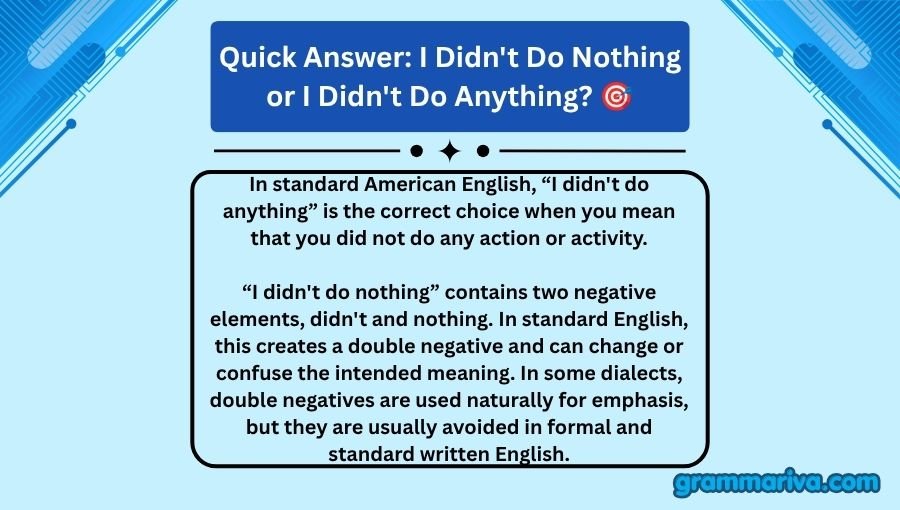
In standard American English, “I didn’t do anything” is the correct choice when you mean that you did not do any action or activity.
“I didn’t do nothing” contains two negative elements, didn’t and nothing. In standard English, this creates a double negative and can change or confuse the intended meaning. In some dialects, double negatives are used naturally for emphasis, but they are usually avoided in formal and standard written English.
Correct: I didn’t do anything. ✅
Nonstandard in formal English: I didn’t do nothing. ❌
So, when you want a safe choice for school, work, essays, professional messages, and standard American English, use “I didn’t do anything.”
Is “I Didn’t Do Anything” Grammatically Correct? 📝
Yes. “I didn’t do anything” is grammatically correct in standard American English. The word didn’t already makes the verb phrase negative, so anything is the appropriate indefinite pronoun.
Consider the sentence:
I didn’t do anything.
Here is the structure:
- I = subject
- didn’t = negative form of did
- do = base form of the verb
- anything = indefinite pronoun referring to any possible action or thing
The important point is that didn’t already carries the negative meaning.
Why “Anything” Works After “Didn’t”
In standard English, negative statements commonly use any, anything, anyone, or anywhere.
Examples:
- I didn’t see anything.
- She didn’t tell anyone.
- We didn’t go anywhere.
- He didn’t buy anything.
The pattern is easy to spot.
Negative verb + any-word = standard negative structure.
A student once wrote, “I didn’t see nothing at the store” in a school assignment. When I asked what the student wanted to say, the answer was simply, “I didn’t see anything.” The meaning was clear once we removed the second negative.
A Simple Test Tip 💡
When you have didn’t in the sentence, check the word that follows it.
If you are talking about zero things, use anything, not nothing, in standard English.
I didn’t do anything. ✅
I didn’t do nothing. ❌
This same pattern works with many other sentences.
She didn’t buy anything. ✅
She didn’t buy nothing. ❌
We didn’t hear anything. ✅
We didn’t hear nothing. ❌
Is “I Didn’t Do Nothing” Always Wrong? ⚠️
No. The answer depends on the type of English and the context.
In standard formal American English, “I didn’t do nothing” is generally treated as a double negative and is not the preferred form. However, double negatives occur in several English dialects and speech communities. In those settings, the form can have a natural grammatical role within that dialect.
This distinction matters.
A sentence can be common in everyday speech and still be inappropriate for a formal essay or professional document. Language changes across communities, and speakers may follow different grammar patterns depending on their dialect.
For example, a character in a novel might say:
“I didn’t do nothing!”
A writer may use that form intentionally to represent a character’s natural speech. That does not mean the same sentence is the best choice for a school paper.
Standard English vs. Dialect
| Situation | Preferred Form | Example |
|---|---|---|
| School essay | Standard English | I didn’t do anything. |
| Business email | Standard English | I didn’t do anything. |
| Formal report | Standard English | I didn’t do anything. |
| Casual conversation | Depends on dialect | I didn’t do anything. |
| Fictional dialogue | Depends on character | “I didn’t do nothing!” |
| Formal exam | Standard English | I didn’t do anything. |
The safest rule is simple: use “I didn’t do anything” when you need standard American English.
What Is the Difference Between “Nothing” and “Anything”? 🔎
The main difference is how these words work with positive and negative structures.
Nothing is itself a negative word. Anything usually appears in negative sentences, questions, and conditional sentences.
Compare these:
I did nothing. ✅
I didn’t do anything. ✅
These two sentences can express almost the same basic idea.
The first uses nothing as the negative word.
The second uses didn’t as the negative word and anything as the matching indefinite pronoun.
The problem appears when you combine both negative forms:
I didn’t do nothing. ❌
That sentence contains two negative elements.
Compare the Structures
| Form | Negative Words | Standard English? | Meaning |
|---|---|---|---|
| I did nothing. | 1 | Yes | I did not do anything. |
| I didn’t do anything. | 1 | Yes | I did not do anything. |
| I didn’t do nothing. | 2 | Usually no | Can sound like a double negative. |
| I did anything. | 0 | Yes, depending on context | I performed an action involving any possible thing. |
Both “I did nothing” and “I didn’t do anything” are standard ways to express the idea that no action happened.
I Didn’t Do Nothing or I Didn’t Do Anything: The Core Rule 📚
The easiest rule is this:
Do not normally use two negative words together when writing standard American English.
If you use didn’t, choose anything.
If you use nothing, remove didn’t.
That gives you two correct patterns:
I didn’t + verb + anything. ✅
I + verb + nothing. ✅
For example:
I didn’t eat anything. ✅
I ate nothing. ✅
But:
I didn’t eat nothing. ❌
The same pattern works with other negative forms.
| Negative Verb | Standard Form | Alternative Standard Form |
|---|---|---|
| didn’t see | I didn’t see anything. | I saw nothing. |
| didn’t hear | I didn’t hear anything. | I heard nothing. |
| didn’t buy | I didn’t buy anything. | I bought nothing. |
| didn’t say | I didn’t say anything. | I said nothing. |
| didn’t find | I didn’t find anything. | I found nothing. |
This is one of the most useful patterns to remember.
Why Do People Confuse “I Didn’t Do Nothing” and “I Didn’t Do Anything”? 🤔
People often confuse these forms because natural speech is not always the same as formal writing.
When people speak quickly, they may choose familiar phrases without stopping to analyze every word. Dialect also plays a major role. Some English varieties use multiple negative words as part of their normal grammar.
Another reason is that nothing seems to match the idea of zero. If you want to say that you did zero things, it feels logical to say:
I didn’t do nothing.
But standard English uses a different structure:
I didn’t do anything.
The meaning is still about zero actions. The grammar simply distributes the negative meaning differently.
I once caught myself typing a similar double negative in a quick message. I reread the sentence and realized that I had already used didn’t. Changing nothing to anything fixed it immediately.
The “One Negative” Trick
Try this mental check:
Did I already use a negative word?
If yes, use an any-word.
For example:
- didn’t + anything
- can’t + anyone
- won’t + ever
- don’t + anywhere
This quick check can prevent many common errors.
Can You Say “I Did Nothing” Instead? ✅
Yes. “I did nothing” is grammatically correct in standard English.
It uses nothing as the negative word, so you do not need didn’t.
Compare:
I didn’t do anything. ✅
I did nothing. ✅
Both can mean that you performed no action.
There can be a small difference in tone. “I did nothing” can sound shorter or stronger. “I didn’t do anything” often sounds more conversational.
Meaning and Word Type
| Meaning | Word Type | Example Sentence |
|---|---|---|
| Zero things or actions | Negative pronoun | I did nothing. |
| No action occurred | Negative verb structure | I didn’t do anything. |
| No person | Negative pronoun | I saw nobody. |
| No place | Negative adverb/pronoun | I went nowhere. |
The choice depends on the sentence structure.
How Does “Didn’t” Affect the Verb “Do”? ✏️
The word didn’t is the contraction of did not. When it is used as a past-tense auxiliary, the main verb stays in its base form.
That is why we say:
I didn’t do anything. ✅
Not:
I didn’t did anything. ❌
The past tense is already carried by did. The main verb does not need another past-tense form.
This rule is worth remembering because it appears in many everyday sentences.
| Incorrect | Correct | Reason |
|---|---|---|
| I didn’t did anything. | I didn’t do anything. | Did already marks the past. |
| She didn’t went there. | She didn’t go there. | Use the base verb after didn’t. |
| He didn’t saw it. | He didn’t see it. | Use the base verb after didn’t. |
| We didn’t ate lunch. | We didn’t eat lunch. | Use the base verb after didn’t. |
So there are actually two grammar points in the sentence:
- Use didn’t + base verb.
- Use anything, rather than nothing, in the standard negative structure.
Case Study: A Simple Workplace Conversation 💼
Imagine a manager asks an employee about a missing file.
Manager: “Did you change the report?”
Employee: “No. I didn’t do anything to it.”
That answer is clear and professional.
Now imagine the employee says:
“I didn’t do nothing to it.”
A listener may understand the intended meaning from context. However, in standard professional English, the sentence sounds nonstandard because didn’t and nothing are both negative.
A better response would be:
“I didn’t do anything to it.”
Or:
“I did nothing to it.”
The first sounds more natural in many everyday conversations. The second is shorter and can sound more direct.
Practical Workplace Examples
| Situation | Best Sentence | Why |
|---|---|---|
| Denying an action | I didn’t do anything. | Clear negative structure |
| Denying a specific change | I didn’t change anything. | Natural and direct |
| Saying no action occurred | I did nothing. | Uses one negative |
| Formal explanation | I did not make any changes. | Professional tone |
Clear grammar can make a short workplace response sound much more confident.
Grammar Rules Explanation: Why One Form Is Preferred 📖
Standard American English normally avoids negative concord, often called a double negative when two negative elements occur in a way that creates a nonstandard negative structure.
In a sentence such as:
I didn’t do anything.
The negative meaning comes from didn’t, while anything is the appropriate indefinite pronoun for this negative environment.
In:
I didn’t do nothing.
Both didn’t and nothing are negative. In standard English, that combination is generally not used to express a simple negative statement.
The key idea is not that nothing is a bad word. It is perfectly correct when used in the right structure.
I did nothing. ✅
Likewise, anything is not limited to negative sentences. It can appear in questions and conditional statements too.
Did you do anything? ✅
If you need anything, call me. ✅
Most major English reference works and style guides recognize the distinction between standard negative structures and dialectal uses of multiple negatives.
Correct vs. Incorrect at a Glance
| Sentence | Correct/Incorrect | Why |
|---|---|---|
| I didn’t do anything. | ✅ Correct | One negative structure |
| I did nothing. | ✅ Correct | Nothing supplies the negative |
| I didn’t do nothing. | ❌ Nonstandard | Uses two negative elements |
| I didn’t do something. | ⚠️ Context-dependent | Something changes the meaning |
| I did not do anything. | ✅ Correct | Formal version of the same structure |
The important point is that “I didn’t do anything” and “I did nothing” are both standard.
What Does “I Didn’t Do Anything” Mean? 💡
“I didn’t do anything” means that you did not perform any action or activity.
The sentence can be used in many situations.
For example:
I didn’t do anything after work.
This means the speaker did not take part in any activity after work.
Another example:
I didn’t do anything to the computer.
This means the speaker did not make a change to the computer.
The phrase can also be used defensively:
“Why is the file different?”
“I didn’t do anything to it.”
Here, the speaker denies making a change.
Examples in Different Situations
- I didn’t do anything yesterday.
- I didn’t do anything wrong.
- I didn’t do anything with the file.
- I didn’t do anything after dinner.
- I didn’t do anything to cause the problem.
The exact meaning comes from the context.
What Does “I Did Nothing” Mean? 🧠
“I did nothing” means that the speaker performed no action.
It is a standard and concise sentence.
For example:
I did nothing during the break.
This means the speaker took no action during the break.
It can also emphasize inactivity:
Everyone was busy, but I did nothing.
The sentence is grammatically correct because nothing supplies the negative meaning.
A useful comparison is:
I didn’t do anything. ✅
I did nothing. ✅
These are both good choices.
How Can You Remember the Difference? 🎯
Use the negative pair rule.
Think of these words as partners:
- didn’t → anything
- did → nothing
The pattern is not absolute in every possible sentence, but it is an excellent rule for this specific comparison.
Easy Memory Chart
| If You Use… | Then Use… | Example |
|---|---|---|
| didn’t | anything | I didn’t do anything. |
| did | nothing | I did nothing. |
| didn’t | anyone | I didn’t see anyone. |
| did | nobody | I saw nobody. |
| didn’t | anywhere | I didn’t go anywhere. |
| did | nowhere | I went nowhere. |
When you see didn’t, look for an any- word.
That simple habit can make this grammar point much easier.
Common Mistakes With Negative Sentences ⚠️
These mistakes happen for several reasons.
Fast Typing
When people type quickly, they often write the first phrase that comes to mind. They may not notice that two negative words have appeared.
Autocorrect
Autocorrect can also affect word choice. It may suggest familiar words without checking the full grammar of the sentence.
Lack of Grammar Knowledge
Some learners have never been taught how negative words work together. If they know that nothing means zero, they may naturally place it after didn’t.
Dialect and Everyday Speech
Some speakers grow up hearing double negatives in their local or cultural speech. That pattern can feel completely natural.
None of these reasons means the speaker is careless. It simply means the rules of spoken and written English can differ.
Similar Grammar Confusions
| Confusion | Correct Form | Basic Difference |
|---|---|---|
| it’s / its | It’s raining. / The dog hurt its paw. | It’s = it is; its shows possession |
| your / you’re | Your book / You’re ready | Your shows possession; you’re = you are |
| they’re / their / there | They’re here. / Their car / Over there | Different meanings |
| then / than | Then we left. / Taller than me | Time vs. comparison |
| affect / effect | It affected me. / The effect was clear. | Different grammatical roles |
| didn’t do nothing / didn’t do anything | I didn’t do anything. | Avoid double negative in standard English |
Specific Wrong Forms to Avoid
| Wrong Form or Use | What’s Wrong | Correct Form |
|---|---|---|
| I didn’t do nothing. | Double negative in standard English | I didn’t do anything. |
| I didn’t did anything. | Wrong verb form after didn’t | I didn’t do anything. |
| I didn’t done anything. | Past participle used incorrectly | I didn’t do anything. |
| I did not do nothing. | Still contains two negatives | I did not do anything. |
| I didn’t do anythings. | Anything is normally singular | I didn’t do anything. |
| I didn’t do not anything. | Incorrect placement of negatives | I didn’t do anything. |
I once edited a short customer message that contained three different negative mistakes in two sentences. The writer was typing quickly and had never learned the didn’t + anything pattern. Once the pattern was explained, the correction took only a few seconds.
Is “I Didn’t Do Something” the Same Meaning? 🔍
No. “I didn’t do something” does not always mean exactly the same thing as “I didn’t do anything.”
This is a subtle but useful difference.
Anything can mean any possible thing in a negative sentence.
I didn’t do anything.
This normally means no action happened.
Something refers to a particular or expected thing.
I didn’t do something you asked me to do.
Here, the speaker may be talking about one specific task.
Compare:
I didn’t eat anything.
I ate no food.
versus:
I didn’t eat something on the table.
I did not eat a particular item.
The context matters.
Usage in Different Contexts 🌎
The safest choice is still “I didn’t do anything” for standard English. However, the level of formality can affect which alternative sounds best.
| Context | Which Term to Use | Example |
|---|---|---|
| Everyday conversation | I didn’t do anything | I didn’t do anything last night. |
| Professional writing | I didn’t do anything | I didn’t do anything to the document. |
| Creative writing | Depends on character and voice | “I didn’t do nothing!” |
| Social media/texting | Usually I didn’t do anything | I didn’t do anything lol. |
Everyday Conversation
In ordinary conversation, “I didn’t do anything” is very natural.
“What did you do today?”
“Honestly, I didn’t do anything.”
Professional Writing
Use standard grammar in emails, reports, applications, and workplace documents.
I didn’t make any changes to the file.
This is clear and professional.
Creative Writing
A writer may intentionally use a double negative to show a character’s speech pattern.
“I didn’t do nothing,” Jake said.
The writer is not necessarily making a grammar mistake. The form can be part of characterization.
Social Media and Texting
Informal messages allow more flexibility, but standard grammar is still useful when clarity matters.
I didn’t do anything 😂
is clear and easy to understand.
Common Alternatives to “I Didn’t Do Anything” 🔄
Sometimes you can replace the phrase with another expression without changing the basic idea.
| Alternative | Works When | Does Not Work When |
|---|---|---|
| I did nothing. | You want a short, direct statement | You need a more conversational tone |
| I did not do anything. | You want a formal tone | You want very casual speech |
| I made no changes. | You are talking about a document or object | You mean general activity |
| I took no action. | You are discussing a decision or response | You mean leisure or daily activity |
| I wasn’t involved. | You mean you had no role in something | You actually performed an unrelated action |
The best alternative depends on what you mean.
For example:
I didn’t do anything to the report.
can become:
I made no changes to the report.
But you cannot always replace it with “I made no changes” if you are talking about an entire day’s activities.
Why Does Getting This Difference Right Matter? ✨
Grammar helps readers understand your meaning without stopping to guess.
The phrase “I didn’t do anything” is especially useful because it is clear, natural, and accepted in standard English.
Clarity in Communication
A clear sentence reduces confusion.
I didn’t do anything.
has one obvious negative structure.
Professionalism
Formal writing benefits from standard grammar. A clean sentence can make an email, report, or application sound more polished.
Digital Communication
Text messages are informal, but clear grammar still helps when the topic is serious.
A simple sentence is often better than a sentence that makes the reader pause.
“I didn’t do anything to the account.”
is clearer than:
“I didn’t do nothing to the account.”
Why It Matters in Real Situations
| Situation | Why Getting It Right Matters |
|---|---|
| Resume | Shows control of standard English |
| Client email | Builds clarity and trust |
| Published content | Helps readers understand the message |
| Social post | Makes the intended meaning easier to read |
A useful rule I give students is:
When one negative is enough, let one negative do the work.
That makes the sentence easier to understand.
Common Phrases With “Anything” 🗣️
The word anything appears in many common negative and question structures.
| Phrase | Meaning |
|---|---|
| I didn’t see anything. | I saw nothing. |
| I don’t know anything about it. | I have no knowledge of it. |
| I can’t find anything. | I cannot find any item or answer. |
| Did you hear anything? | Did you hear something or any information? |
| I won’t say anything. | I will say nothing. |
| If you need anything, call me. | Call me if you need any help or item. |
These patterns show why anything is so useful after negative verbs.
How the Meaning Changes With “Nothing” 🔄
The word nothing can also appear in several standard structures.
| Phrase | Meaning |
|---|---|
| I did nothing. | I took no action. |
| Nothing happened. | No event occurred. |
| There is nothing here. | No thing is here. |
| Nothing is wrong. | There is no problem. |
| I know nothing about it. | I have no knowledge of it. |
Notice that these sentences do not need didn’t to create the negative meaning.
That is why this sentence works:
I did nothing. ✅
But this standard-English sentence does not normally work:
I didn’t do nothing. ❌
What About Double Negatives in English? ⚠️
A double negative occurs when two negative elements appear in the same clause.
In formal and standard American English, double negatives are generally avoided when the intended meaning is simply negative.
For example:
I don’t know anything. ✅
I know nothing. ✅
I don’t know nothing. ❌
However, language is more complex than a simple “right or wrong” label. Some dialects use negative concord, where multiple negative words work together to express one negative meaning. That usage is systematic within those varieties.
For learners of standard American English, though, the safest approach is to follow the standard pattern.
When Can “I Didn’t Do Nothing” Appear in Writing? ✍️
The phrase can appear in writing when the writer is representing natural speech or a particular dialect.
For example, a novelist might write:
“I didn’t do nothing,” Maria said.
The purpose could be to show how the character speaks.
That is different from writing:
I didn’t do nothing in my formal report.
In the second case, there is no clear reason to use the nonstandard structure.
A Useful Writing Rule
Use standard grammar in your own formal voice. Use nonstandard grammar only when you have a clear reason, such as dialogue, characterization, or accurate representation of a dialect.
This keeps your writing clear without treating dialect differences as simple mistakes.
Quick Recap Checklist ✅
Use this checklist whenever you are unsure.
| Question | If Yes → Use |
|---|---|
| Did you already use didn’t? | Use anything |
| Do you want a simple standard negative? | Use I didn’t do anything |
| Do you want to use nothing? | Remove didn’t: I did nothing |
| Are you writing formally? | Use standard English |
| Are you writing realistic dialogue? | Consider the character’s dialect and voice |
Practice Examples
1. I didn’t do ______ after school.
Answer: anything ✅
2. I ______ nothing during the meeting.
Answer: did ✅
3. I didn’t do ______ to change the file.
Answer: anything ✅
Try saying each answer aloud. The correct structure will soon feel natural.
FAQs About I Didn’t Do Nothing vs I Didn’t Do Anything ❓
Is “I didn’t do anything” grammatically correct?
Yes. “I didn’t do anything” is grammatically correct in standard American English. The negative word didn’t works with anything to express that no action was performed.
Is “I didn’t do nothing” grammatically correct?
In standard American English, it is generally considered a nonstandard double negative when the intended meaning is simply “I did not do anything.” Some dialects use this structure naturally, especially in speech and informal dialogue.
Which is correct: “I didn’t do nothing” or “I didn’t do anything”?
For standard American English, use “I didn’t do anything.” It is the safer choice for school, work, formal writing, and most edited content.
Can I say “I did nothing” instead of “I didn’t do anything”?
Yes. “I did nothing” is grammatically correct. It expresses the same basic idea by using nothing as the negative word instead of using didn’t.
Why is “I didn’t do nothing” called a double negative?
It contains two negative elements: didn’t and nothing. Standard English normally does not combine them to express one simple negative statement.
Is “I did nothing” stronger than “I didn’t do anything”?
Sometimes it can sound more direct or firm, but the basic meaning is very similar. The difference is often one of style and emphasis rather than basic meaning.
Can “I didn’t do nothing” be correct in a song or novel?
It can be appropriate when the writer is intentionally representing a character’s speech or a particular dialect. In that setting, the grammar may be part of the character’s voice.
Should I use “I didn’t do anything” in a formal email?
Yes. “I didn’t do anything” is a clear and standard choice for a formal email. You can also use “I did not do anything” if you want a slightly more formal tone.
What is the easiest way to remember the rule?
Remember this pair:
I didn’t do anything.
I did nothing.
If you use didn’t, use anything. If you use nothing, you do not need didn’t.
Is “I didn’t do something” correct?
It can be correct, but its meaning depends on context. Something usually points to a particular thing or expected action. It does not normally mean exactly the same thing as anything in a negative sentence.
Conclusion: I Didn’t Do Nothing or I Didn’t Do Anything? 🎉
I didn’t do nothing or I didn’t do anything is a common grammar question, but the basic rule is easy to remember. In standard American English, use “I didn’t do anything” when you want to say that you performed no action. You can also say “I did nothing”, which is another fully standard option.
The key is to avoid using two negative elements together when you are writing standard English. Didn’t already creates the negative meaning, so anything fits naturally after it.
Think of the rule as a simple pair: didn’t + anything or did + nothing. Once you learn that pattern, many similar sentences become easier.
I recommend using the standard form in school assignments, professional emails, articles, applications, and other edited writing. In creative dialogue, however, a different form may be intentional when it reflects a character’s speech.
Keep this simple rule in mind: One negative is enough to make your meaning clear. 😊
Master that pattern, and you’ll never need to pause over this grammar choice again. 🚀

Hi, I’m Lucas Bennett. I’m a grammar content specialist at Grammariva. I work on articles covering everyday grammar questions, sentence usage, and writing tips that readers can apply with confidence.



[…] covers common mistakes, and shows how to use these forms in everyday and professional English. ✨ I Didn’t Do Nothing or I Didn’t Do Anything | Propose or Purpose | Reevaluation or […]
[…] tips, and answers to questions people often ask. 💡 Passerbyers or Passersby or Passerby | I Didn’t Do Nothing or I Didn’t Do Anything | Propose or […]